Traditional SEO told you whether you ranked on page one. GEO tells you whether an AI recommends you at all. That is a different problem, and it needs different tools.
As ChatGPT, Perplexity, Google AI Mode, Gemini, and Claude now synthesize answers rather than list links, brands that do not appear in those AI-generated responses are effectively invisible to a growing slice of searchers. Generative Engine Optimization (GEO) is the discipline of fixing that. The tools in this post go beyond passive tracking and actively help you close the gap.
If you are already using an AI search monitoring tool to see where you stand, this post is the logical next step: the platforms that help you do something about it. (For pure monitoring, see our roundup of best AI search monitoring tools and our guide to AI search visibility gap analysis tools.)
Short answer: For most teams, Peec AI (actions-focused, $89/mo) or AthenaHQ (deepest optimization guidance, $270/mo) offer the best monitoring-to-action pipeline. Agencies wanting one platform for both SEO and GEO should look at Search Atlas. All three do more than track – they tell you what to fix.
What GEO optimization actually means
GEO optimization is distinct from simply monitoring your AI visibility score. Monitoring answers: “Am I showing up?” Optimization answers: “What do I change so I show up more, in a better position, with the right framing?”
Based on publicly available research and platform documentation, the levers GEO tools pull on fall into three buckets:
- Content gaps – topics, entities, and source types that AI models cite when answering queries in your niche, but that your site does not cover (or does not cover with enough authority).
- Citation source gaps – earned media, forum presence, and third-party references that AI models use as signals. If your brand only appears on your own domain, models hedge their recommendations.
- Structural and on-page signals – schema markup, entity clarity, answer-formatted writing, and internal linking patterns that make content easier for LLMs to parse and quote.
The best GEO tools diagnose all three and give you a prioritized action list. The weaker ones hand you a dashboard full of numbers and leave the diagnosis to you.
How we evaluated these tools
Based on publicly available information including official documentation, G2 and OMR reviews, independent write-ups, and platform changelog announcements, we assessed each tool on:
- Optimization depth – does the tool recommend specific actions, or just display metrics?
- AI engine coverage – how many of ChatGPT, Perplexity, Gemini, Claude, Google AI Mode, Copilot, Grok are tracked?
- Prompt/query volume – how many prompts can you monitor at each price point?
- Ease of turning insight into action – is there an integrated content workflow, or do you export CSVs?
- Pricing transparency and value – is what you need available at a reasonable tier, or does everything useful sit behind enterprise walls?
The 7 best AI visibility tools for GEO optimization
1. AthenaHQ – Best for teams that want specific optimization tasks, not just data
| Detail | Info |
|---|---|
| Starting price | $270/mo (annual billing) |
| AI engines covered | ChatGPT, Gemini, Claude, Perplexity, Copilot, Google AI Overviews |
| Founded by | Former Google Search and DeepMind engineers, Y Combinator-backed |
| Best for | Mid-market and enterprise marketing teams |
| Free trial | Yes (limited) |
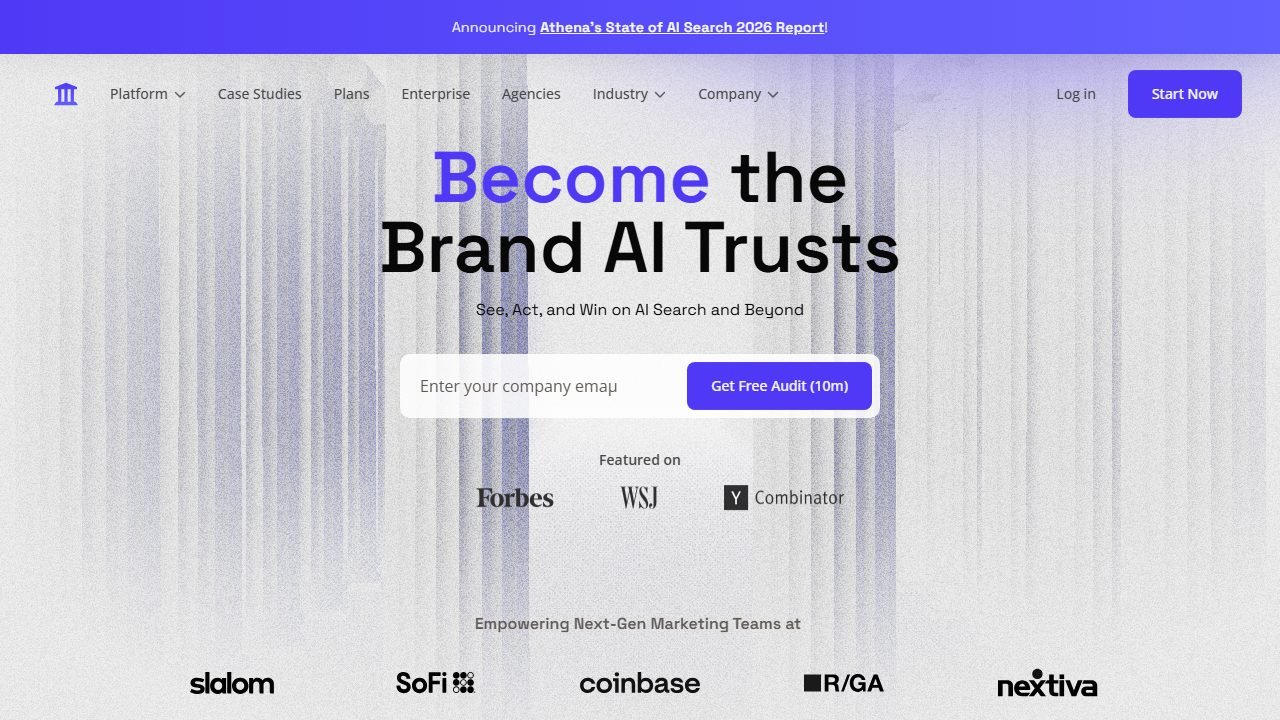
AthenaHQ is one of the few GEO platforms built from the ground up around the optimization workflow rather than the monitoring workflow. Its Action Center translates raw AI visibility data into a prioritized queue of specific tasks: update this page to address a knowledge gap, get a mention on this type of editorial source, fix this entity ambiguity. The platform describes its core job as “action on AI search,” and based on public documentation, that framing is reflected in the product structure rather than just the marketing copy.
The Ask Athena AI copilot lets marketing teams ask natural-language questions like “Why is my competitor outranking me on ChatGPT for [query]?” and receive data-backed answers drawn from the account’s real-time GEO data. The Content feature identifies specific gaps preventing brand citation and suggests both on-page and off-page remediation steps, including content drafts that maintain brand voice.
Pricing lands at $270/mo on annual billing for the Lite plan (3,500 credits/month), $545/mo for Growth, and $2,000+/mo for Enterprise. That puts it above Peec AI and Visiblie at the entry level, but reviewers consistently note the optimization guidance depth justifies the premium over pure monitoring tools.
Pros:
- The most action-oriented workflow of any tool in this roundup – specific tasks, not just scores
- Ask Athena copilot bridges the gap between data and decision-making
- 60+ country and language support on Enterprise plans
- Founded by credible AI/search engineering talent (ex-Google, DeepMind, YC)
Cons:
- Entry price of $270/mo (annual) is steep for solo practitioners or small agencies
- Credit-based system can make it harder to budget for variable workloads
- Some reviewers note the platform is still maturing relative to its ambition
2. Peec AI – Best for turning AI visibility data into a prioritized GEO roadmap
| Detail | Info |
|---|---|
| Starting price | $89/mo (Starter) |
| AI engines covered | ChatGPT, Perplexity, Google AI Overviews + add-ons for Gemini, Claude, DeepSeek, Grok, Llama |
| Funding | $29.1M total ($21M Series A, Singular VC) |
| Best for | Marketing teams and agencies wanting monitoring + action pipeline |
| Unlimited seats | Yes (all paid plans) |
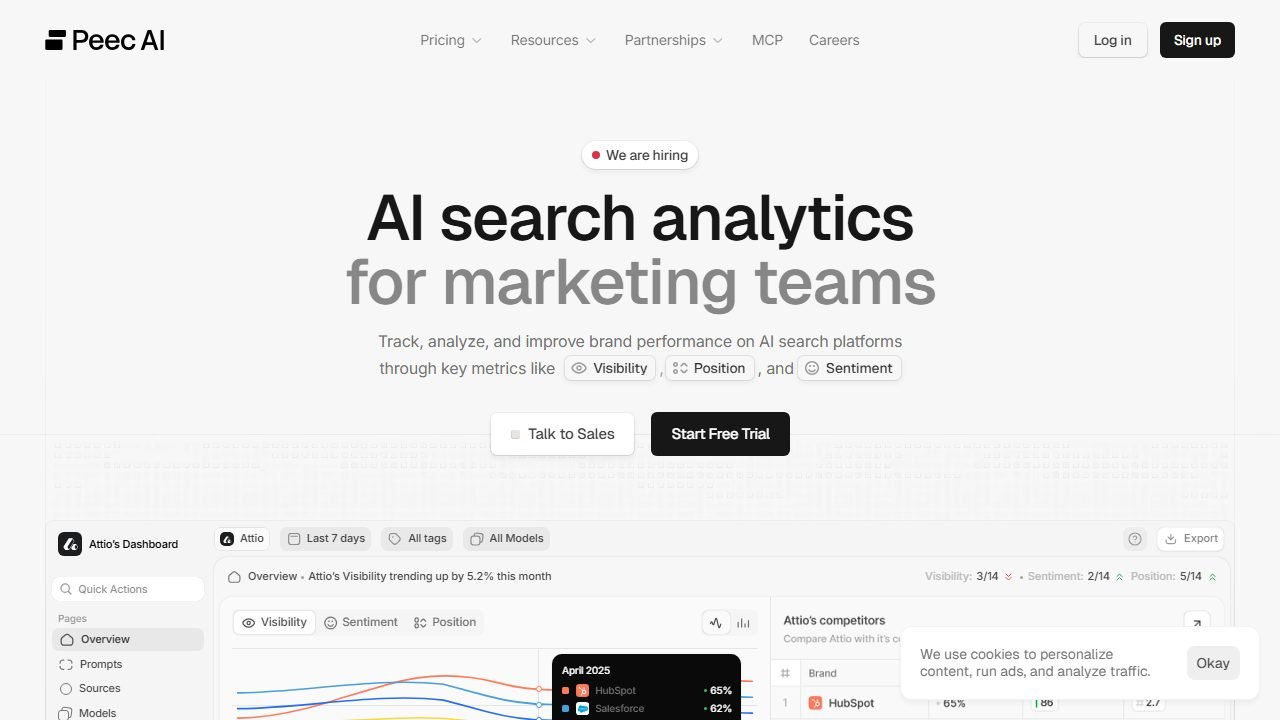
Peec AI started as a focused monitoring tool and has progressively added the optimization layer its users were asking for. The standout feature is Actions: a beta module that clusters your AI visibility gaps into Owned Media opportunities (blog posts, comparison pages, how-to guides, product pages that need updating or creating) and Earned Media gaps (editorial coverage, forum presence, reference site citations). Each action gets a Relative Opportunity Score – Low, Medium, or High – based on how frequently AI models cite that source type and how large your gap is versus competitors.
The platform tracks three core metrics at the prompt level: Visibility (how often your brand appears), Position (where in the response you appear), and Sentiment (tone assessment). Daily automated tracking covers up to 300+ prompts. The $89/mo Starter tier gets you ChatGPT, Perplexity, and Google AI Overviews; other engines are available as paid add-ons, which can push the real monthly cost higher than the headline price for teams needing broad coverage.
Peec AI serves brands including Axel Springer, Chanel, ElevenLabs, and TUI, and was adding roughly 300 customers per month as of early 2026 following its $21M Series A led by European VC firm Singular.
Pros:
- Actions feature provides a concrete, scored GEO roadmap rather than raw data
- Unlimited seats on all paid plans – strong value for agencies
- Prompt-level granularity with visibility, position, and sentiment in one view
- Well-funded with a fast development cadence
Cons:
- Actions feature is still in beta – less mature than AthenaHQ’s equivalents
- Add-on pricing for extra AI engines can inflate actual costs
- Prompt quotas per plan may constrain larger sites on the Starter tier
3. Profound – Best enterprise platform for AI visibility with compliance requirements
| Detail | Info |
|---|---|
| Starting price | $99/mo (Starter, ChatGPT only) / $399/mo (Growth) |
| AI engines covered | 10+ including ChatGPT, Claude, Perplexity, Google AI Mode, Gemini, Copilot, DeepSeek, Grok, Meta AI |
| Funding | $35M Series B (Sequoia Capital) |
| Best for | Enterprise brands with compliance requirements |
| Compliance | SOC 2 Type II, HIPAA |
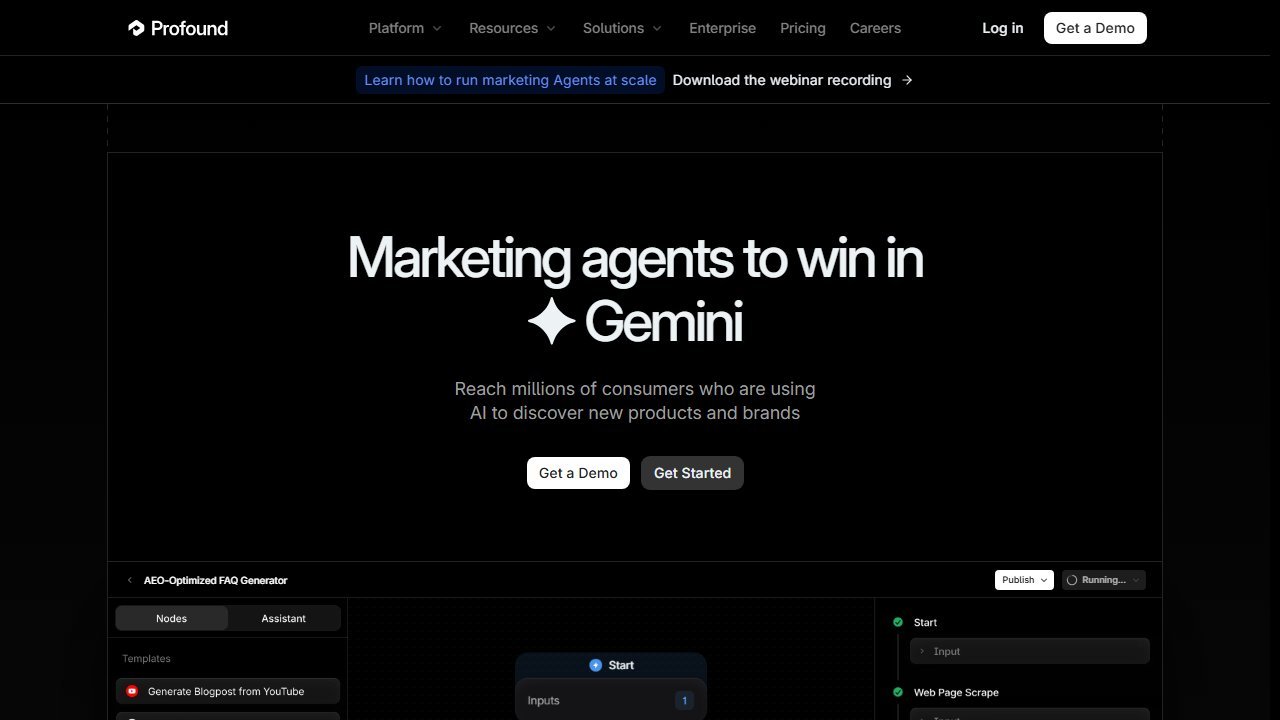
Profound is the enterprise benchmark in the GEO tools category, backed by $35M from Sequoia Capital and built around a three-dimensional data approach that distinguishes it from simpler trackers. The platform combines AI results data, 400M+ real user prompts through its Conversation Explorer, and AI crawler analytics – giving enterprise teams not just visibility metrics but genuine insight into how real users are querying AI systems in their category.
Beyond monitoring, Profound offers one-click AI content creation and real-time optimization recommendations built directly into the results view. The enterprise tier includes a dedicated strategist, customizable dashboards, and white-label reporting. SOC 2 Type II and HIPAA compliance make it one of the few GEO platforms that regulated industries (healthcare, financial services) can deploy without procurement friction.
The pricing structure deserves honest scrutiny. The $99/mo Starter plan covers ChatGPT only with 50 prompts – reviewers broadly describe it as a funnel into the $399/mo Growth plan, which adds more platforms but still caps content agents. Full platform access sits behind custom enterprise pricing, typically $2,000-5,000+/mo according to independent estimates. One analysis found Profound runs 48% more expensive than the category average. That premium is justified for enterprise compliance use cases but hard to defend for teams that just need a capable mid-market optimization tool.
Pros:
- Widest AI engine coverage (10+) of any tool reviewed here
- Conversation Explorer with 400M+ real user prompts is a genuine research asset
- SOC 2 Type II and HIPAA compliance opens regulated industry use cases
- Dedicated strategist support on enterprise plans
Cons:
- $99/mo entry tier is deliberately limited – $399/mo is the real functional starting price
- 48% more expensive than the category average according to independent analysis
- Full optimization features (content agents, custom reporting) require enterprise pricing
4. Search Atlas (with OTTO SEO) – Best all-in-one for teams doing both SEO and GEO
| Detail | Info |
|---|---|
| Starting price | $99/mo (Starter) |
| AI engines covered | ChatGPT, Gemini, Claude, Perplexity, Copilot, Grok, SearchGPT |
| LLM Visibility tool | QUEST (cross-platform visibility scores, citation share, competitor comparison) |
| Best for | SEO agencies and in-house teams wanting one platform for everything |
| White-label | Available on Growth and Pro plans |
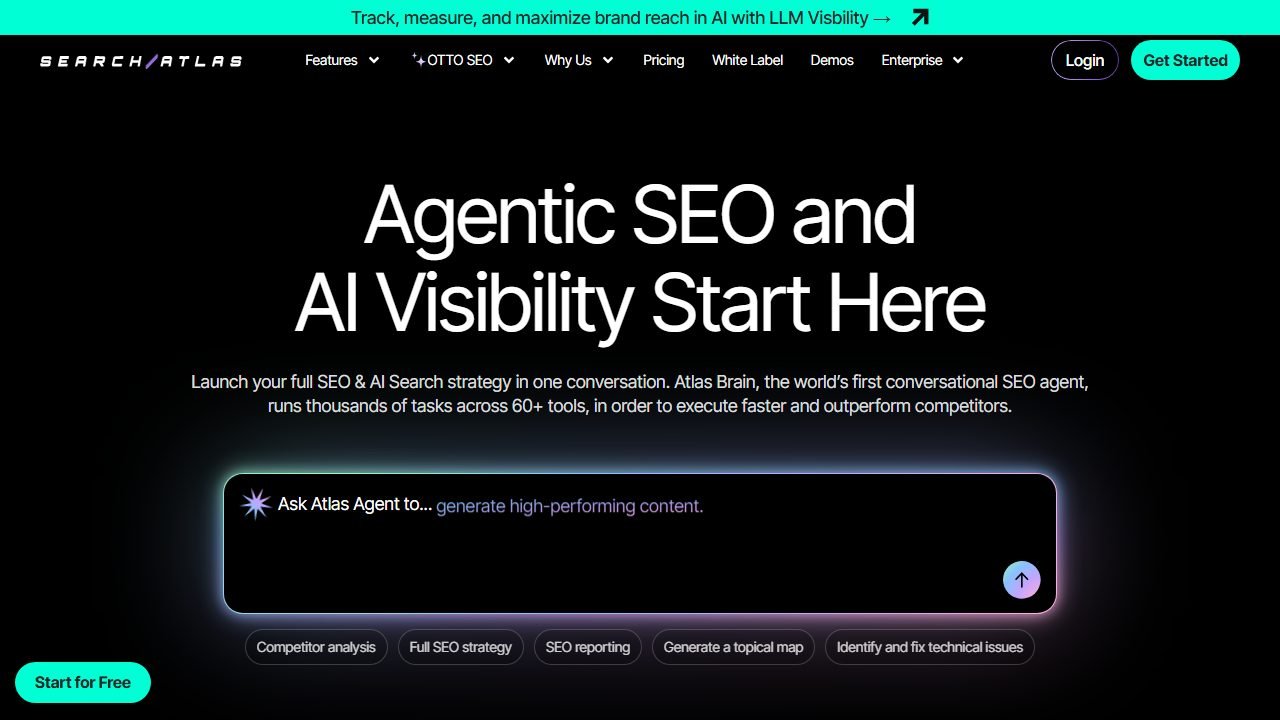
Search Atlas occupies a different position from the pure-play GEO tools above: it is a comprehensive SEO platform that has built a genuinely capable LLM visibility layer, rather than a GEO-first tool that bolted on some keyword tracking. For teams who need both traditional search and AI visibility in a single workflow, that matters.
The QUEST tool monitors how content appears across large language model platforms with cross-platform visibility scores, query-level performance including position, sentiment, and citation share, competitor comparison across all tracked LLMs, and topic clustering showing which content themes drive AI citations. OTTO SEO, the AI automation layer, can then act on those insights by automating on-page optimizations, technical SEO fixes, content creation, and digital PR outreach – the platform claims up to 99% of manual SEO tasks can be automated through OTTO.
Pricing is transparent: Starter at $99/mo, Growth at $199/mo, Pro at $399/mo, with 20% discounts on annual billing. Recent updates doubled OTTO project quotas on Growth and Pro plans while reducing Cloud Stack pricing. The white-label option on Growth+ makes this a strong agency platform.
Pros:
- Combines traditional SEO and LLM visibility tracking – no tool-switching needed
- OTTO SEO can act on GEO insights automatically, not just report them
- Tracks more LLMs than most competitors at equivalent price points
- Transparent, competitive pricing with white-label for agencies
Cons:
- GEO features are one module within a larger platform – less depth than Profound or AthenaHQ for pure GEO use cases
- OTTO automation requires setup time to configure properly
- Some reviewers note the breadth can make the tool feel complex for teams with a narrow GEO focus
5. Rankscale – Best for agencies needing validated methodology and deep AI engine breadth
| Detail | Info |
|---|---|
| Starting price | From $20/mo |
| AI engines covered | 17+ including ChatGPT, Perplexity, Gemini, DeepSeek and emerging engines |
| Google Looker Studio | Native connector (Pro plan) |
| REST API | Available (April 2026) |
| Best for | Agencies and data-driven teams wanting an externally validated approach |
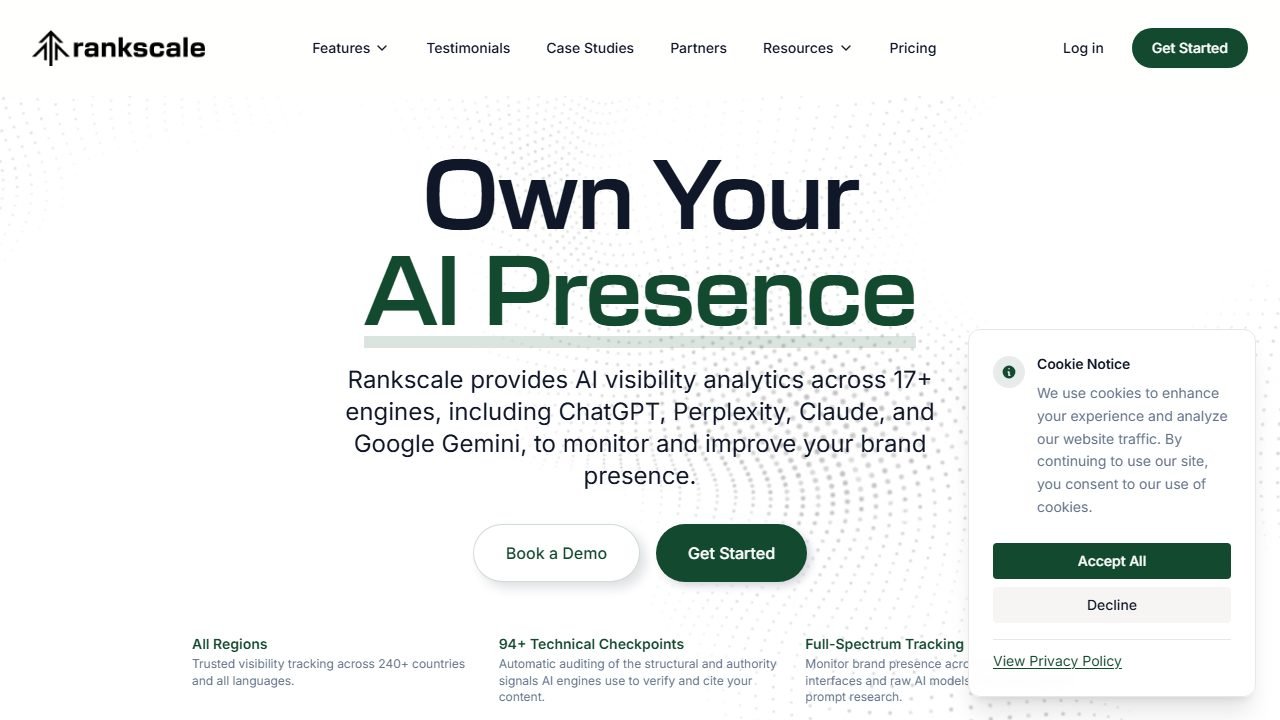
Rankscale has carved out a distinctive position in the GEO tools market on two grounds: the lowest entry price for meaningful AI engine coverage, and an exclusively licensed Prompt Decoding methodology that has been independently validated against a Harvard/OpenAI NBER Working Paper. That external validation is not just a marketing claim – it means the prompt volume estimates Rankscale provides have been scrutinized by academic researchers, which matters when you are trying to argue for budget based on AI visibility data.
The platform covers 17+ AI engines from its base tier at $20/mo, with no add-on fees for extra engines. Integrations with Google Looker Studio on the Pro plan ($99/mo) and a REST API released in April 2026 allow agencies to build automated client reports combining AI visibility with other analytics sources. Q1 2026 additions included Page Audit V2 (200+ checks), ChatGPT Shopping Analysis, and shared credits for the Agency plan. OMR Reviews gives Rankscale a 9.9/10 customer support score – the highest in its category according to that platform.
The trade-off is that Rankscale’s optimization layer is less developed than AthenaHQ’s or Peec AI’s Actions feature. It excels at measurement and diagnosis; translating those diagnoses into a content action plan still requires more manual effort from the user.
Pros:
- Lowest price for 17+ AI engine coverage – no per-engine add-on fees
- Prompt Decoding methodology independently validated vs. Harvard/OpenAI research
- Looker Studio native connector and REST API for agency reporting workflows
- Highest-rated customer support in the category (OMR, 9.9/10)
Cons:
- Optimization guidance is less prescriptive than AthenaHQ or Peec AI
- Page Audit features are newer and still maturing
- Less name recognition than Profound or Otterly for client pitches
6. Otterly.ai – Best for teams that want a GEO audit alongside ongoing monitoring
| Detail | Info |
|---|---|
| Starting price | $29/mo (Lite, 15 prompts) |
| AI engines covered | ChatGPT, Google AI Overviews, Google AI Mode + additional platforms |
| GEO Audit | Brand SWOT + Digital PR, On-Page, UGC evaluation |
| Best for | Small teams and agencies wanting affordable monitoring with built-in GEO audits |
| Recognition | G2, OMR, and Gartner recognized |
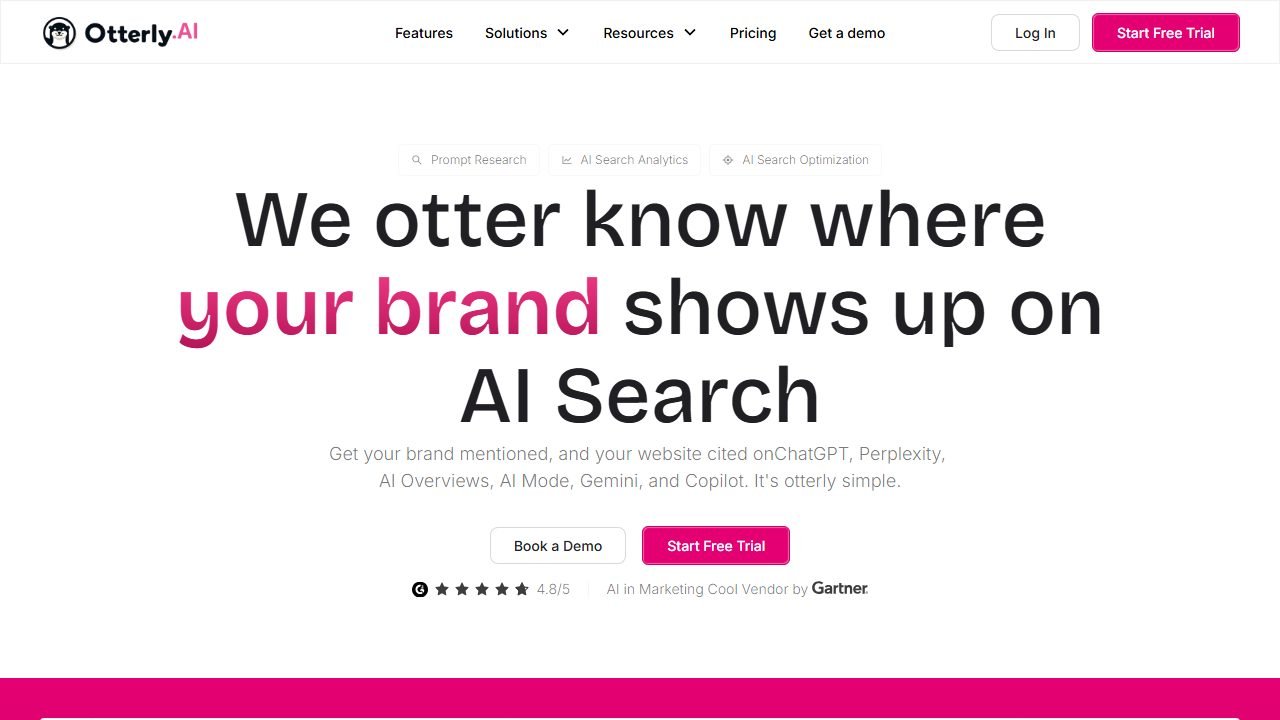
Otterly.ai is the most accessible entry point in this roundup for small teams and solo SEOs who need GEO capabilities without a four-figure monthly commitment. The $29/mo Lite plan is genuinely functional for brands with a focused prompt set. The Standard plan at $189/mo expands to 100 prompts, and the Premium at $489/mo covers 400 prompts.
The GEO Audit feature is what gives Otterly its optimization angle. Beyond standard prompt monitoring, the audit runs a brand SWOT analysis and evaluates three specific GEO tactic pillars: Digital PR (earned citation coverage), On-Page content (how well your pages are structured for AI citation), and UGC performance (forum and community mentions that AI models use as social proof signals). Prompt research is assisted by the platform, helping users identify relevant prompts from keywords, brand names, or URLs rather than having to construct prompt sets from scratch.
Citation tracking shows which URLs AI engines cite in response to monitored prompts, with weekly position change monitoring. Founded in Austria in 2024, Otterly reached $770K revenue with a seven-person team by 2025 and has since accumulated recognition from G2, OMR, and Gartner.
Pros:
- Most affordable entry price ($29/mo) with real GEO audit capability
- Three-pillar GEO audit (Digital PR, On-Page, UGC) gives structured optimization framework
- Prompt research assistance reduces setup friction for new users
- G2, OMR, and Gartner recognition adds third-party credibility
Cons:
- Lite plan’s 15-prompt limit is very restrictive for all but the smallest sites
- Less AI engine breadth than Rankscale or Profound at equivalent price points
- Audit depth is lighter than AthenaHQ’s action recommendations
7. Visiblie – Best for teams wanting transparent European pricing with solid coverage
| Detail | Info |
|---|---|
| Starting price | €79/mo (Starter) / €129/mo (Growth) |
| AI engines covered | ChatGPT, Perplexity, Claude, Google AI (all plans) + Grok, Mistral on Custom |
| Prompts per week | 50 (Starter), 100 (Growth), 150 (Scale) |
| Best for | European teams, agencies wanting white-label GEO reporting |
| Managed services | Yes (GEO Roadmap and Managed GEO Services available) |
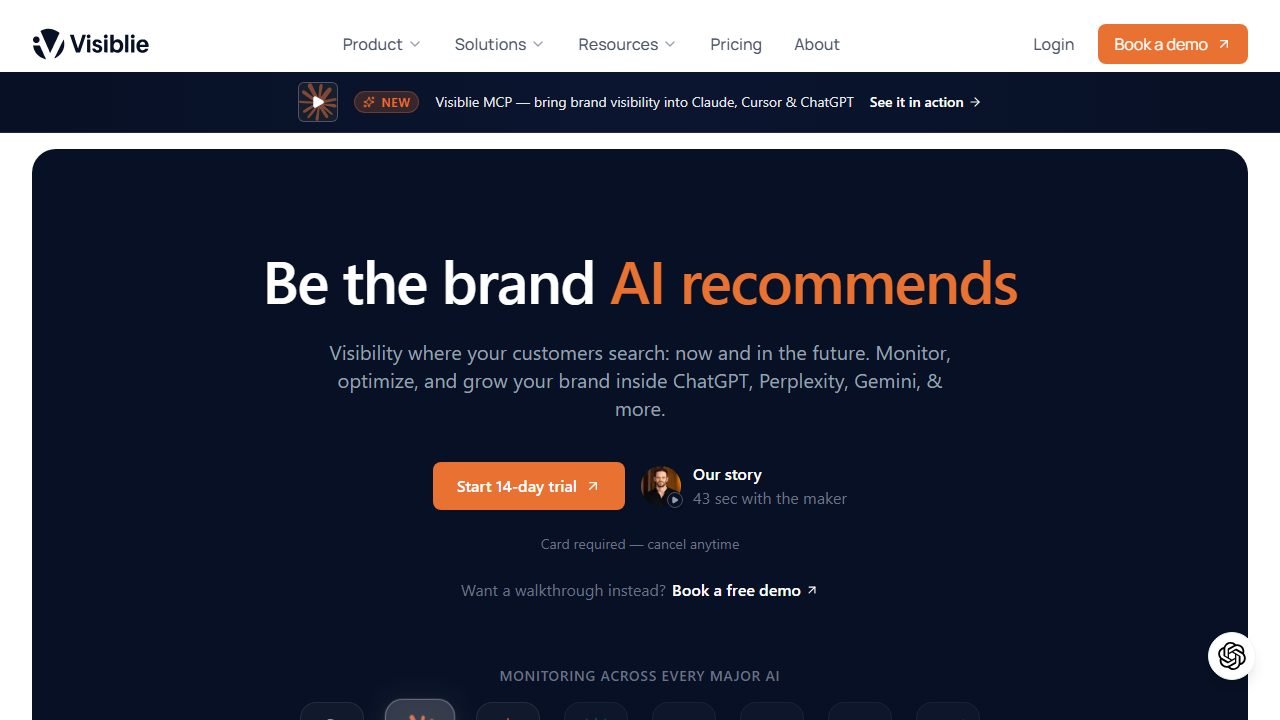
Visiblie distinguishes itself with transparent Euro-denominated pricing, a clear per-week prompt model, and a Managed GEO Services tier that sits above the self-serve software. For European brands or agencies with EU clients, the pricing clarity and GDPR-native design reduce procurement friction.
The platform tracks brand visibility, domain ranking, link citation analysis, and provides GEO URL audits across eight AI models from a single dashboard. All paid plans (Starter through Scale) include ChatGPT, Perplexity, Claude, and Google AI as standard engines. The Growth plan at €129/mo (or €103/mo on annual billing) is the most popular tier and adds five seats, making it workable for small agency teams.
Visiblie’s optimization services layer is a genuine differentiator: the Tailored GEO Roadmap (€499 one-time, delivered in 72 hours) provides a custom optimization plan for brands that want expert guidance rather than DIY diagnostics. The Managed GEO Services option covers content strategy, semantic SEO, and hands-on AI visibility optimization. That services tier is not common among software-first GEO tools and fills a gap for teams without in-house GEO expertise.
Pros:
- Transparent pricing with no hidden add-on fees on core engine coverage
- Managed GEO Services option for teams wanting done-for-you optimization
- One-time GEO Roadmap delivery at reasonable cost (€499)
- Scale plan includes unlimited seats – good for larger agency teams
Cons:
- Weekly rather than daily prompt tracking on lower tiers limits real-time response
- Grok and Mistral only on Custom tier
- Smaller brand recognition than Profound or Peec AI may complicate client pitches in some markets
GEO tools compared side by side
| Tool | Starting Price | AI Engines | Optimization Focus | Best For |
|---|---|---|---|---|
| AthenaHQ | $270/mo (annual) | 6 (ChatGPT, Gemini, Claude, Perplexity, Copilot, AIO) | Action Center + AI copilot, content drafting | Mid-market teams wanting prescribed tasks |
| Peec AI | $89/mo | 3 base + add-ons | Actions feature with Opportunity Scores | Agencies wanting monitoring + GEO roadmap |
| Profound | $399/mo (functional) | 10+ | Content agents, real-time optimization | Enterprise with compliance needs |
| Search Atlas | $99/mo | 7 (incl. Grok, SearchGPT) | OTTO automation + QUEST LLM visibility | SEO agencies adding GEO |
| Rankscale | $20/mo | 17+ | Page Audit V2, validated methodology | Data-driven teams and agencies |
| Otterly.ai | $29/mo | 3+ platforms | GEO Audit (Digital PR, On-Page, UGC) | Small teams, entry-level GEO audits |
| Visiblie | €79/mo | 4 standard + Custom | GEO Roadmap + Managed Services | European teams, done-for-you option |
How to choose the right GEO optimization tool
The right tool depends less on the tool and more on what kind of GEO work you are actually set up to do.
If you need a prescribed action list more than raw data – start with AthenaHQ or Peec AI. Both are built around turning visibility gaps into a to-do list. AthenaHQ is more mature for this workflow; Peec AI is cheaper and adds unlimited seats.
If you are an SEO agency adding GEO to your service stack – Search Atlas is the practical choice. You avoid a separate tool subscription, the QUEST module surfaces LLM citation data alongside your existing rank and backlink reporting, and OTTO can automate parts of the GEO optimization work itself.
If you have enterprise compliance requirements – Profound is the only tool in this roundup with SOC 2 Type II and HIPAA certification. For healthcare, fintech, or any regulated industry, that is not negotiable.
If you are starting out and budget is tight – Otterly.ai at $29/mo (or Rankscale from $20/mo) gives you a functional starting point. Otterly’s GEO Audit gives early clients something structured to act on. Rankscale’s breadth across 17+ engines at that price point is remarkable.
If you want a done-for-you element – Visiblie’s Managed GEO Services tier is the clearest option. Profound also offers dedicated strategists on Enterprise. Most other tools in this category are self-serve only.
One honest note: none of these tools can directly change how AI models rank your brand. What they can do is surface where the gaps are, and give you a structured path to close them through content, citations, and on-page improvements. The optimization still happens through the work you put in. The tool determines how efficiently you can find and prioritize that work.
For related context on tracking your baseline before you start optimizing, see our guide to best AI search monitoring tools and our AI search visibility gap analysis tools roundup.
Not sure if GEO monitoring belongs in your stack? Read our explainer on why teams are adding AI search monitoring tools and what you lose without them.

Written by
FazFaz is the founder of AIToolsBakery. Every tool on this site is personally tested with real-world writing tasks before a single word gets published. No sponsored rankings, no recycled press releases.
Read more about how we test →