Equity-free money is a good reason for a founder to look at grants, and a long application is a good reason to look at AI. Most pages ranking for this topic are written by the companies selling the tools, and they tend to rank themselves first. What they rarely say is that the funder’s rules should shape your choice of tool, because some funders limit how much of an application AI may write, and some say a success fee cannot come out of the grant.
This guide starts there. It covers the programmes a startup is most likely to apply to, what each funder says about AI and fees, and then eight tools, with what they cover, what they cost and how far to trust their win rates. Search interest in this exact topic is small, and most founders will need one tool at most, so we say where a free tier or an official site is enough.
How we put this together. We have not used these tools ourselves; this is a research-based comparison. Every price and feature below comes from the vendor’s own website, and every programme rule comes from the funder or a government source, read on 2 November 2026 and linked. We created no accounts and started no trials, so we cannot tell you how good any tool’s drafts are. Win rates and funding totals are the vendors’ own claims. Prices are as the sites showed them to us, in the currency shown. None of these companies paid to appear on this page. This is a tool comparison, not legal or tax advice, so check fee arrangements and eligibility with the funder or your adviser.
If you are a nonprofit rather than a company, this is the wrong page. See our guides to the best AI grant writing tools and AI grant tools for nonprofit development teams, which cover foundation funders and donor-style pipelines.
Start with the programme, not the tool
A grant tool is only as useful as its coverage of the programme you can actually win. Check three things before you compare software: is the programme open, are you eligible, and what do its rules say about AI and paid help.
US SBIR and STTR: back, with new limits
Several sources reported that SBIR and STTR authority had lapsed, and it did. A Congressional Research Service Insight dated 13 July 2026 says the Small Business Innovation and Economic Security Act was signed on 13 April 2026 and reauthorised both programmes through 30 September 2031, “ending a six-month lapse in authority”. That is the status as of 2 November 2026, and the source is CRS rather than sbir.gov: the sbir.gov home, about, FAQ and policy pages we read do not state the reauthorisation, and the policy directive posted there is still the May 2023 one.
What sbir.gov does show is activity. Its funding opportunities page listed 306 open topics on 2 November 2026, with 23 tagged funding year 2027. The first topics listed there opened on 28 October and close on 25 November 2026. The page warns that its listings “are not necessarily the latest and most up-to-date”, so read the agency’s own solicitation before you plan around a date.
The law also changed the rules a tool cannot see for you. Per CRS, from fiscal year 2027 each agency’s programme director must set a maximum number of Phase I and Phase II proposals a small business can submit, by solicitation, topic or year. Agencies must also screen for foreign security risk and reject proposals in defined cases. So a tool that makes it cheap to apply to many topics now runs into a cap, and foreign investors or ties can matter more than your prose.
Money and eligibility vary by agency. The sbir.gov home page gives general ranges of $50,000 to $275,000 for Phase I and $750,000 to $1.8 million for Phase II, and says the government takes 0% equity or IP. NSF offers up to $305,000 for Phase I and up to $1,250,000 for Phase II, says its funds do not cover “intellectual property, marketing and business development costs”, and says companies majority owned by venture capital operating companies, hedge funds or private equity firms are not eligible. If you have raised a large round, check that line first.
NSF also limits attempts. Its Project Pitch page allows two pitches per company a year and three in total for the same project, and a response typically takes one to two months. Each pitch section is capped by characters, up to 3,500. A pitch that small does not need a drafting subscription, so write it before you pay for one.
What US funders say about AI
NIH’s notice of 17 July 2025 is the strictest we read. It says “NIH will not consider applications that are either substantially developed by AI, or contain sections substantially developed by AI, to be original ideas of applicants.” If AI is detected after an award, NIH may refer the matter to the Office of Research Integrity and take enforcement action, including “disallowing costs” and “possible termination”. It also says AI tools “may be appropriate to assist in application preparation for limited aspects”, and it caps each Principal Investigator at six applications a calendar year. The only activity codes excepted are T codes and R13 conference grants, and the notice names no SBIR exemption.
NSF is softer. Its notice of 14 December 2023 says proposers “are encouraged to indicate in the project description the extent to which, if any, generative AI technology was used”, and that they remain responsible for accuracy and authenticity. We did not find an equivalent rule for Department of War topics on the pages we read, so check each solicitation.
EU: EIC Accelerator
The EIC Accelerator offers a grant below €2.5 million and equity investment of up to €10 million to startups and SMEs in EU member states and countries associated with Horizon Europe. UK applicants can apply only for the grant-only scheme. It takes one application at a time, with a 12-page short proposal, a pitch deck and a video, then a full proposal and a jury interview. Short proposals can go in at any time and are batched monthly.
The interview matters for tool choice. The EIC Board points out that applicants must present and defend the project in person, and its review of consultants calls the claim that you must have a consultant “manifestly untrue”. Free help exists through National Contact Points, and the EIC says it offers free business coaching after Step 1. We found no EIC page on AI drafting in what we read, so ask your National Contact Point.
UK: Innovate UK
Two things to know. First, UKRI’s generative AI policy covers UKRI funding opportunities, and Innovate UK is one of its councils. It says applicants “must not use generative AI tools to generate an entire application, or sections of an application, without human involvement”, expects you to be transparent about substantive use, and warns that confidentiality of what you enter into AI tools is not guaranteed. Using AI for translation, better English or cutting word count does not need declaring. It also bars AI use during interviews.
Second, check that the programme exists. Kreston Reeves reported in March 2025 that Innovate UK paused Smart Grants that January. We found no new Smart round on 2 November 2026, and the Innovate UK Business Connect opportunities list we read showed other competitions, such as Growth Cohorts and sector challenges. A tool’s Smart Grant case studies therefore describe past rounds.
Success fees: who pays, and from what
Most software here charges a subscription. Granter adds a percentage, and consultants often charge one too, so it is worth knowing how funders see that.
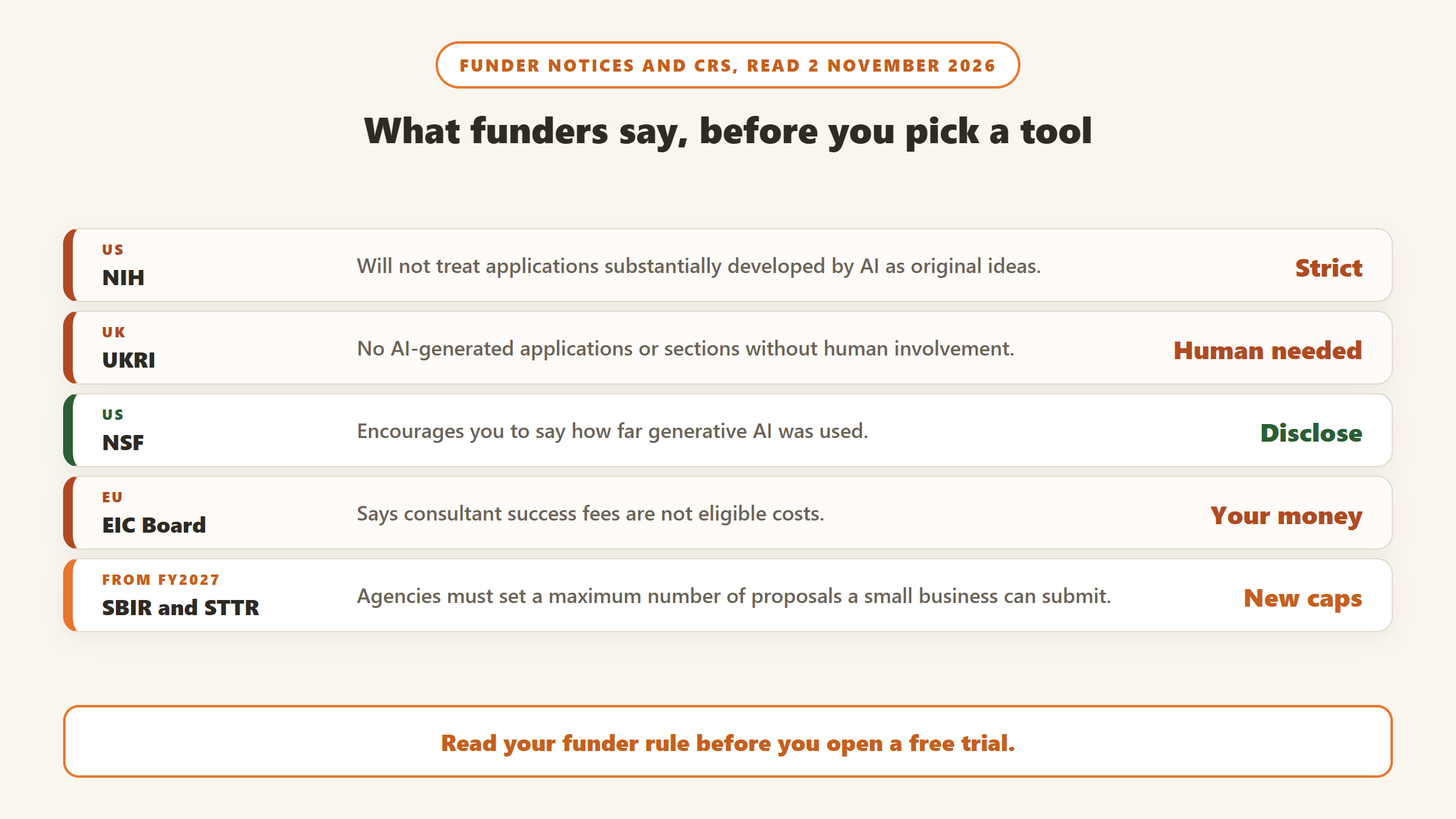
The EIC Board is direct: “Beware that consultant’s success fees are not eligible costs for the EC. So, you have to find another source of money to cover the costs of the consultant.” It adds that if you decide not to sign the grant, you may still owe the fee, and that some contracts trigger payment at the invitation to negotiate rather than at a signed agreement. It suggests asking for at least three offers, asking for the consultant’s success rate, and checking compliance with its voluntary Code of Conduct.
In the US, some SBIR awards are contracts: sbir.gov defines a funding agreement as a contract, grant or cooperative agreement. For covered federal contracts, the Covenant Against Contingent Fees has the contractor warrant that nobody was retained to obtain the contract for a contingent fee, “except a bona fide employee or agency”. If breached, the government may annul the contract or recover the fee. The FAR subpart defines a contingent fee as one that depends on success in securing a government contract, and it has exceptions. We found nothing on sbir.gov’s FAQ or policy pages addressing success fees for SBIR grants. So we are not telling you a given arrangement is banned. Ask the agency or a lawyer before you sign anything that pays on winning.
A flat subscription avoids most of this, though you still pay it from your own funds. NSF, for one, lists what its awards can pay for, so do not assume a tool bill can go in the budget.
The tools compared
| Tool | Programmes it says it covers | What the AI does | Entry price (2 Nov 2026) | Pricing model |
|---|---|---|---|---|
| Official sites (benchmark) | sbir.gov, NSF, EIC, Innovate UK Business Connect | No AI | Free | None |
| Granted AI | DOD, NIH, NSF, DOE and USDA SBIR topics, plus other federal, state, foundation and international | Reads the solicitation, coaches, drafts, AI review board | Free tier with 1 draft a month; Basic $29 a month | Subscription, Pro $89 a month or $680 a year |
| Grantable | Grants.gov including SBIR and STTR, plus state, corporate and foundation via web research | Finds funders, makes checklists, drafts in your voice | Free with 5 chat messages a day; Starter $50 a month | Subscription by capacity, Pro $150 a month |
| OpenGrants | 8,000+ US federal, state and private grants and contracts | Match scoring, application builder | $9 a month, 7-day trial with card | Subscription |
| TurboInnovate (was TurboSBIR) | NIH, NSF, DOE, DOD, NASA and others, plus market reports | Proposal generator, market and competitor reports | “Try for free”; no public price found | Not published |
| Grantify | UK SMEs, US SBIR, EIC Accelerator | AI writing assistant plus human funding experts | Matching and first call free; no public price | Quoted before you commit |
| Granter | Regional, national and EU; case studies lean Portuguese | Matches, drafts, scores against criteria, tracks post-award | One-week free trial; Professional €1,500 plus 5% success fee | Fee plus success fee |
| GrantBite | 10,000+ funding programmes, EU heavy | Search, eligibility check, writer listed in plans | Starter $89 a month or $69 billed annually | Subscription with AI credits |
| Joltoo (free spot, not yet tested) | 6,500+ grants from 800+ funders, deep tech, US and Europe among them | Eligibility ranking, drafting, review against criteria | Free tier; Pro $69 a month billed annually | Subscription |
We ordered these by how clearly each serves a startup’s first grant application: visible price first, then stated programme coverage, then how much you must rely on a sales conversation. It is not a ranking of draft quality, because we have not assessed any drafts.
Granted AI: a dedicated SBIR page with a visible price
Granted AI has a dedicated SBIR page that names DOD, NIH, NSF, DOE and USDA topics. You upload the solicitation, and it says it builds “a section-by-section drafting plan” for that agency. It also offers commercialization coaching, tracks evaluation criteria and flags gaps, and has a Granted Review Board of AI reviewers that score your draft. It claims 3 to 5 days on average to a complete Phase I draft and 85% less writing time; those are its figures, with no method shown.
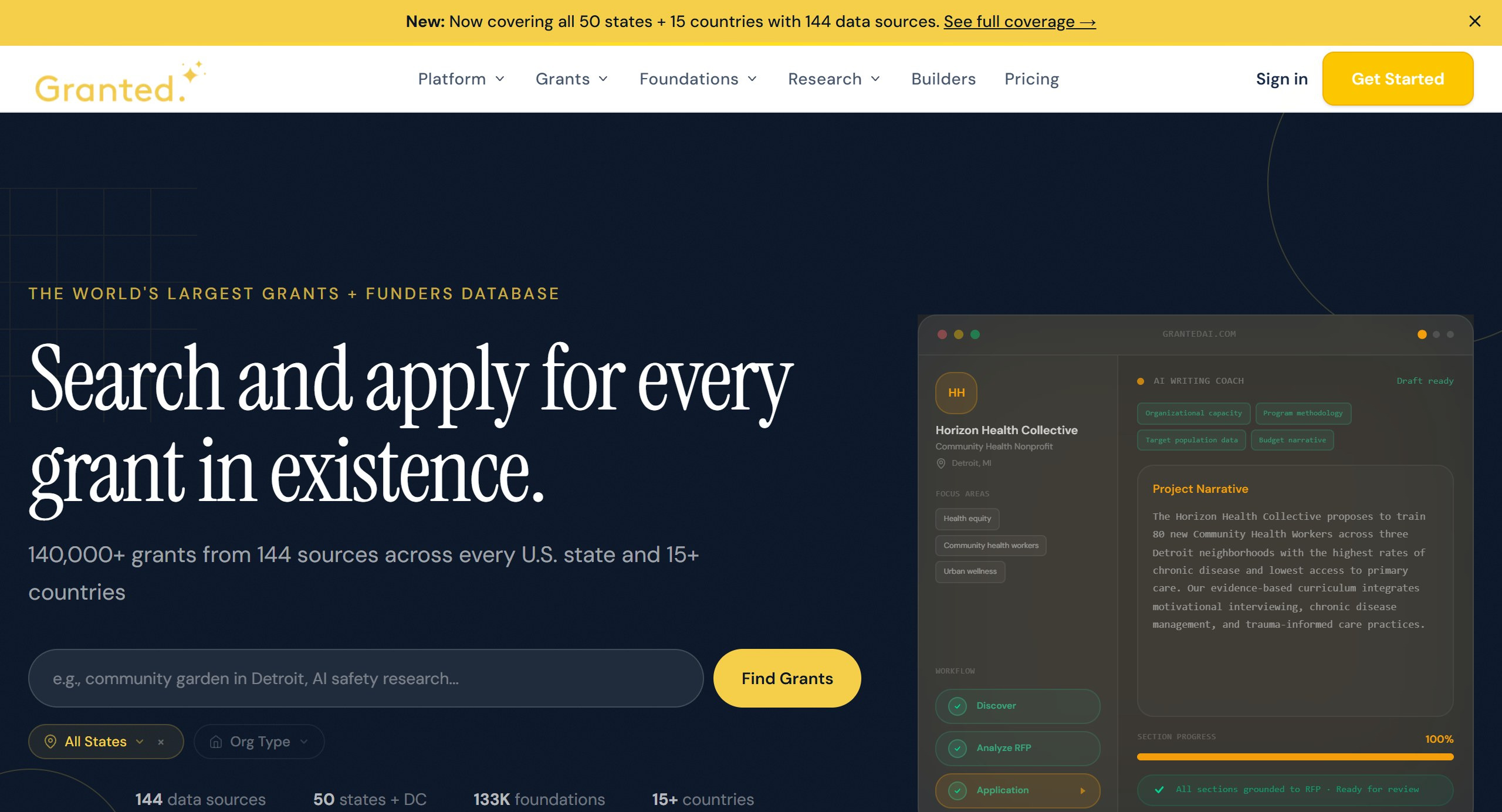
On the pricing page, the free tier allows 1 draft a month and 3 searches. Basic costs $29 a month with 3 drafts. Professional costs $89 a month or $680 billed annually, which the page shows as $57 a month, with unlimited drafts. The page says the product “is built for nonprofits, researchers, and small teams”, so startups are one audience among several.
Read the guarantee closely. The banner says win a grant in 12 months or get a full refund. The conditions are Professional only, annual or after 12 consecutive paid months, at least 3 proposals submitted using Granted, and a request within 30 days of the end of the year. Three SBIR proposals in a year is a real commitment, and from fiscal year 2027 agencies must cap submissions. Its privacy policy says uploaded solicitations and coaching answers go to OpenAI, whose API agreement it says prohibits training on them.
Choose it if you are writing a US SBIR proposal and want the AI to work from the actual solicitation. Be careful if your target is NIH: its “submission-ready” language sits awkwardly with a rule against applications substantially developed by AI.
Grantable: nonprofit roots with a business page
Grantable sells itself first to nonprofits, and our Grantable review covers that use. It also has a page for businesses and startups that says its database syncs Grants.gov, SBIR and STTR solicitations included, and that its AI researches state, corporate and foundation programmes on the web. It turns solicitation rules into a checklist and drafts from your company profile and past proposals. The same page states “20% average SBIR Phase I success rate” as a general market figure, with no source shown.
The pricing page sells capacity rather than features: Free has 5 chat messages a day, Starter is $50 a month with 50 messages a day, and Pro is $150 a month with 200, with no per-seat fees. Funder discovery is free.
Its trust page is unusually plain. It says content is never used to train AI models, and that its most recent SOC 2 Type II examination covered 9 April to 9 July 2025, adding “we do not claim an active certification” while it selects a new audit firm. If your application contains sensitive technical detail, that is the kind of disclosure to look for at every vendor.
Choose it if you want one workspace for federal, state and corporate grants with reusable company material. Skip it if you need EU or UK programmes as the core: its business page describes US programmes.
OpenGrants: low-cost US search
OpenGrants searches “8,000+ open grants and contracts from federal, state and private funders”. Its pricing page lists Pro at $9 a month, or $8 billed annually, with AI match scoring, unlimited alerts, pipeline tracking, an application builder and a connector for Claude and ChatGPT. Developer costs $299 a month for API and white-label use. The 7-day trial needs a card and charges when it ends. Many sample searches on its home page are public-sector or nonprofit, such as rural broadband and youth mental health, with “small business R&D” among them.
It says little about what its application builder drafts, so we would not buy it as a writer. As a cheap way to build a shortlist of US opportunities, its price is the lowest paid plan we found here.
Choose it if you want US discovery and alerts for a few dollars a month. Skip it if you want agency-specific proposal help or non-US coverage, which the page does not describe.
TurboInnovate: SBIR tools folded into a research platform
TurboSBIR now says it “has been integrated into the broader TurboInnovate platform”. The old page describes AI workflows and templates for finding and applying to SBIR, STTR and contract opportunities at NIH, NSF, DOE, DOD and NASA, and says it has helped “thousands of companies win millions of dollars in the last 6 years”, which is the vendor’s claim.
TurboInnovate aims wider, with market sizing, technical state of the art, funding proposal and contract bid reports, and partner matching. A customer quoted on its page uses it to write SBIR commercialization reports, the section Granted AI calls the hardest. Its page says “We will not use your files for training”. We found no public price, only “Try for free”.
Choose it if your gap is the market and commercialization section. Skip it if you need a price before you talk to anyone.
Grantify: software plus human reviewers
Grantify is a consultancy with a platform. Its AI assistant drafts answers from your inputs and what it calls an anonymised database of successful applications, and its experts run two rounds of review, with a free resubmission if you are unsuccessful. It lists UK SMEs, US SBIR and the EIC Accelerator as services. Its NSF page says registration, matching and a first call are free, and that “we’ll set out exactly what’s included and what it costs before you commit”. We found no public price and no statement on whether it takes a success fee, so ask.
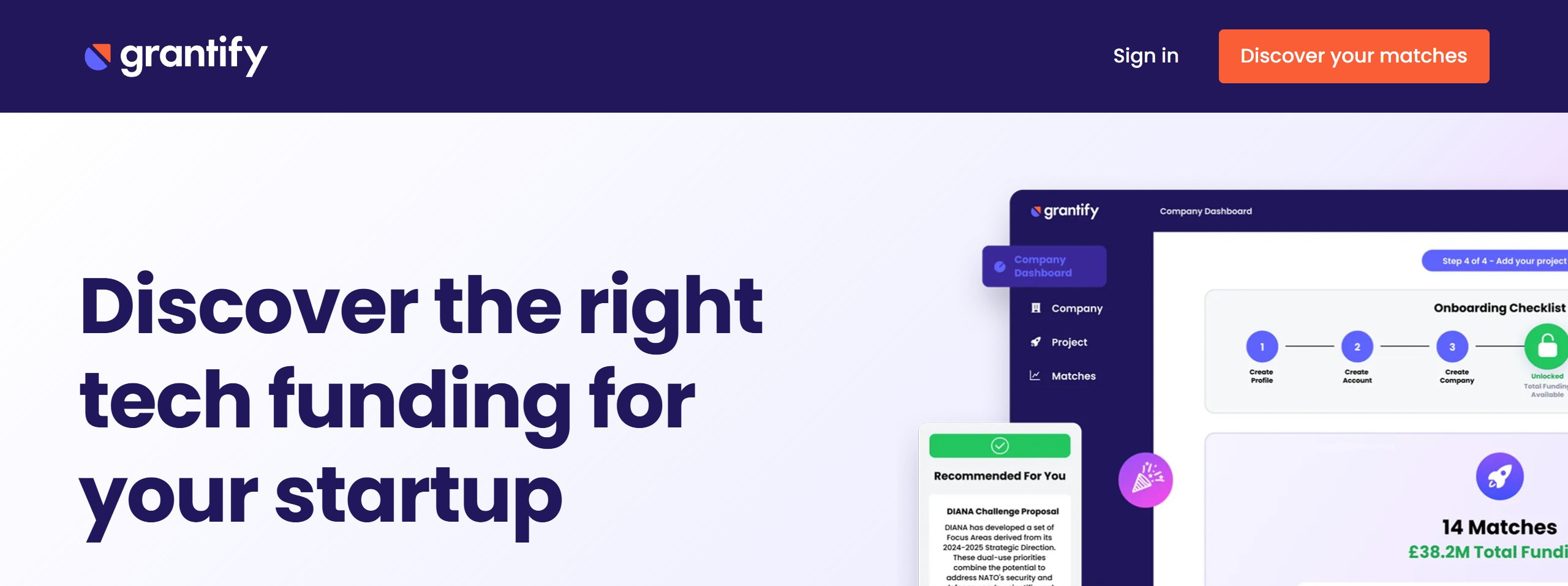
Grantify is a clear example of why you should open the numbers. The success stats page headlines “SBIR Phase I 2023 success rate 66%”. Further down the same page, the detail reads: “In 2023, we secured funding for 2 out of 3 Phase 1 applications.” Two of three is a real result and a very small sample. The same page cites 75 to 80% for its best EIC Stage 1 funding round, where “best” is doing the work, and pitch success of 15 out of 20 in one month.
The headline totals also differ by page: over £200M on the home page, £185M on the stats page, and £135M in a pop-up, some of which may simply be older. Much of its case study list is Innovate UK Smart Grants, the programme reported as paused. A pop-up still says “72% of recent Smart Grant winners used Grantify”.
Choose it if you want a human to review the application and you can get a clear written quote. Skip it if you want a self-serve price.
Granter: a European agent with a success fee
Granter calls itself “Your AI Grant Consultant”. It says its agent matches you to grants, checks eligibility, drafts the full application, scores it against the call’s criteria, and tracks milestones and reports after approval. Its pricing page lists matching “across regional, national & EU”, and its case studies include Super Bock, Fidelidade and the Portuguese Navy, so its evidence leans towards Portugal and larger organisations.
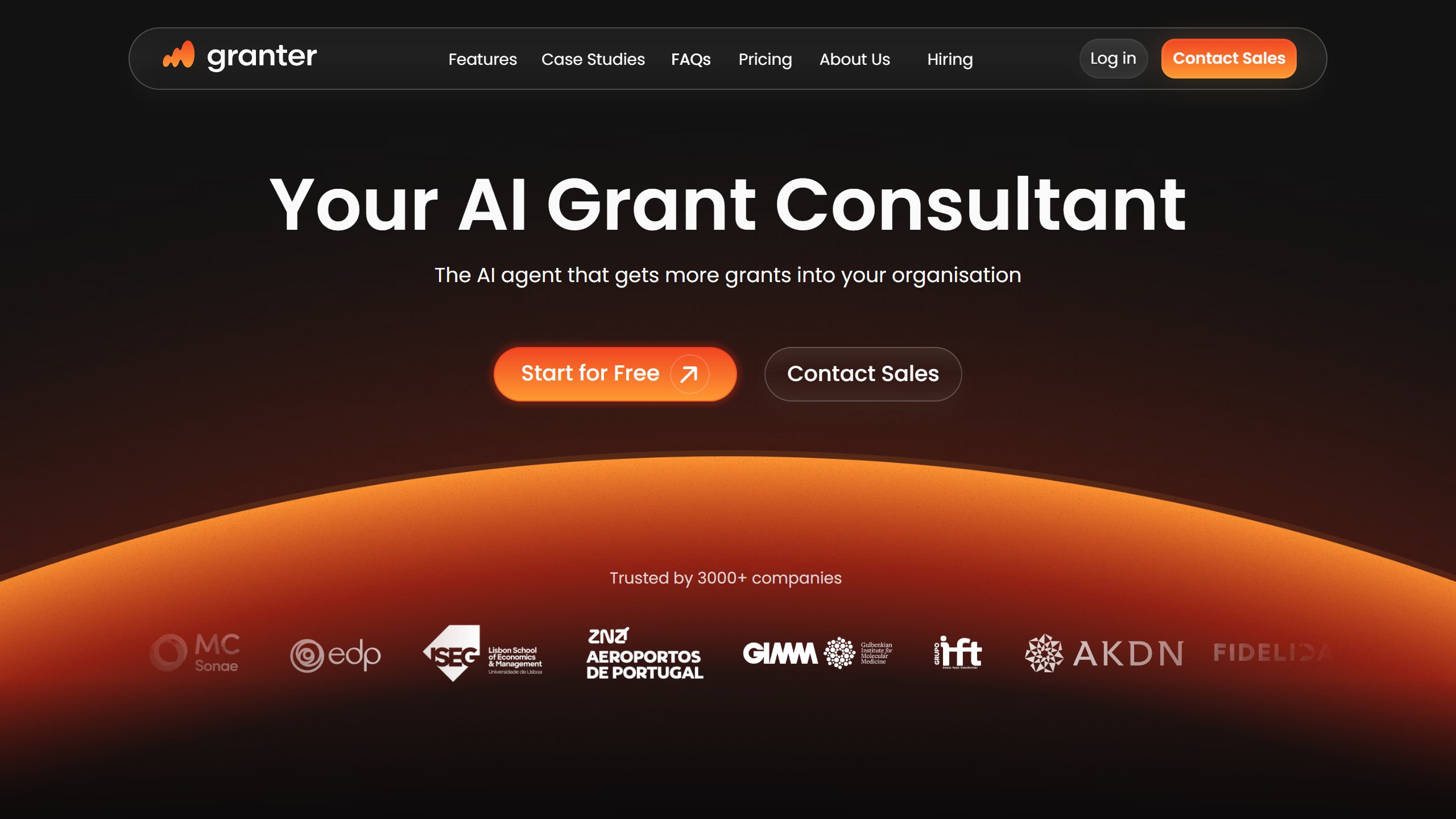
Pricing is the clearest difference here. There is a one-week free trial. Professional shows “1500€ + 5% success fee” with 5 projects and 3 applications, hands-on submission help and post-approval management, and Enterprise is custom. The page does not say how often the €1,500 is charged or what the 5% is calculated on, so get that in writing. On an EIC grant, remember the Board’s warning: a consultant’s success fee is not an eligible cost.
The headline figures are “2x Higher approval rates” and “75% Less time”, with no method shown, and “€50.3M In grants submitted through Granter”. Submitted is not the same as won. “Writes applications ready for submission” also needs reading against the UKRI and NIH positions above.
Choose it if you are a European company applying to national or EU calls and want post-award tracking. Skip it if a percentage fee on top of €1,500 does not fit a first small grant.
GrantBite: EU-leaning database with AI credits
GrantBite offers a funding database, AI search, a grant tracker and a document vault, with EU innovation, climate, R&D and SME programmes prominent. Its pricing page showed Starter at $89 a month or $69 billed annually, with 1 user, 2 projects and 600 credits; Professional at $229 or $179, with 2,000 credits; and Scale at $899 or $719, with 6,000 credits. Extra credits on the higher plans cost $32.90 per 1,000, and premium AI models use two to three times the credits. The page also has a EUR option, and prices exclude VAT.
Credits are the catch to model, because a long application will use more than a short search, and the page does not say how many credits a proposal takes. There is also a conflict to check: the pricing table lists the AI Grant Writer in plans, while the home page marked it “Coming soon” on the day we read it.
Choose it if you want a European database and tracker. Skip it if you are buying it for drafting before confirming the writer is live on your plan.
Joltoo: deep tech grants and investors (free spot, not yet tested)
We agreed to list Joltoo at no charge, we have not tested it, and this description comes from its own site. It targets deep tech companies with “6,500+ non-dilutive grants” and “4,300+ funds from pre-seed to Series D+”, and its programmes directory lists NIH SBIR and NSF SBIR alongside its EIC and Innovate UK grant listings. Its application builder drafts section by section from your company profile, reviews against a programme’s rubric and exports to DOCX or PDF.
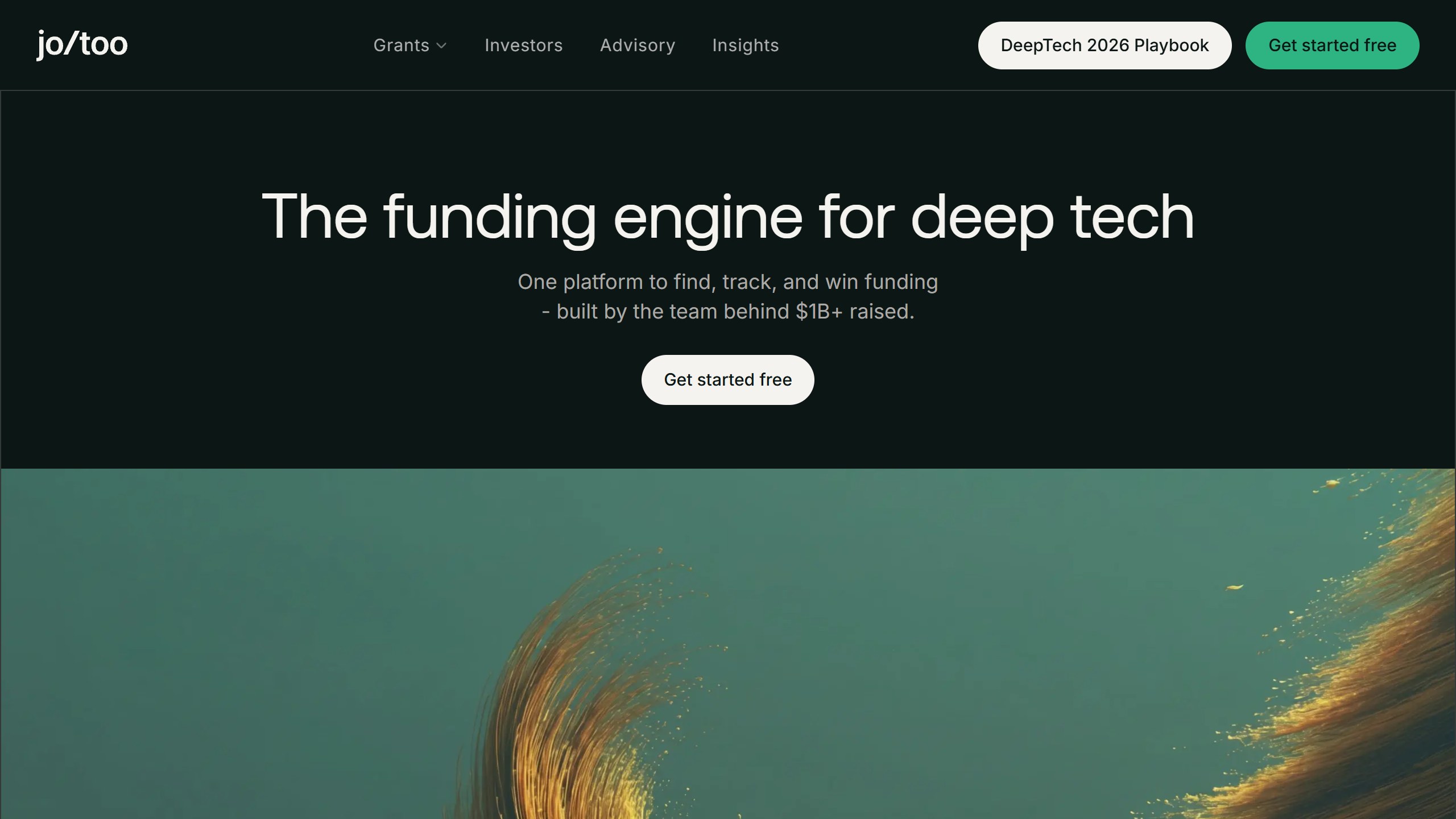
The pricing page has a free tier with up to 20 grants a day, 5 saved applications and AI writing and review for 5 grants. Pro costs $69 a month billed annually ($828 a year), and Scale is quote-only. Its terms say AI limits reset monthly and do not roll over, and that outputs “may be incomplete, outdated, or wrong”. Its refund policy says fees already paid are not normally refundable, and its privacy policy says it does not use private workspace content to train AI models. The claim of being “built by the team behind $1B+ raised” is its own.
Consider it if you are a deep tech company raising grants and venture money together. Skip it if you are not in deep tech.
What we left out, and why
Instrumentl is built for nonprofits by its own description, and its plans started at $299 a month paid annually, so it belongs on our nonprofit pages. Candor is a Y Combinator company that described AI search and drafting for federal funding, but its site returned “Deployment Paused” on 2 November 2026 and we could not read its pricing or current product; that does not mean it has closed, so check it again later. A similarly named personal finance app at candor.money is unrelated to grants. General chatbots can help with language, but UKRI warns that confidentiality is not guaranteed, so check the terms of the plan you use before pasting unpublished technical detail.
How to choose an AI grant tool
Name one programme before you sign up
If you cannot name the programme and confirm you are eligible, you do not need a writer yet. Use sbir.gov topics, the NSF suitability questions, the EIC page or the Innovate UK Business Connect list. All are free. Your first check is ownership for NSF, location for the EIC, and whether the round is actually open for Innovate UK.
Match coverage to geography
For US federal work, look at Granted AI, Grantable, OpenGrants or TurboInnovate. For the UK or EIC with human help, look at Grantify. For EU and national calls in Europe, look at Granter or GrantBite. For deep tech across regions, Joltoo says it covers both grants and investors. Search for your exact programme in a free tier before paying, because database sizes tell you nothing about whether your call is in there.
Decide how much the AI should write
Keep the ideas, technical plan and claims your own, and use AI for checklists, structure, gap checks and language. That approach fits every funder rule above, from NIH’s “limited aspects” to UKRI’s human involvement. Our AI grant writing workflow is written for nonprofit teams, but its review steps carry over. Check every citation, because NIH warns specifically about fabricated citations.
Work out the real cost
A subscription for one proposal cycle is small against a Phase I award. A percentage is different. On a €200,000 award, a 5% fee would be €10,000, plus the €1,500, if the 5% applies to the full award, which is what you need to confirm with the vendor. Model credits too, if a plan uses them, and check whether annual billing locks you in past your application date.
Ask about your data
Your application may hold unpublished technical detail. Grantable, Joltoo and TurboInnovate each state they do not train on your content, and Granted AI points to its OpenAI agreement. Ask any vendor who processes your files, whether they train on them, and what audit they hold now, not last year.
Use the free human help
National Contact Points and EIC coaching are free in Europe, and NSF says its reviewers give detailed feedback to reviewed proposals and its programme staff offer virtual coaching. That can do more for a first application than another subscription.
Sources
- US programmes: CRS Insight on the SBIR and STTR reauthorisation, sbir.gov, sbir.gov funding opportunities, sbir.gov FAQ, NSF SBIR programme, NSF Project Pitch, NSF critical information.
- AI rules: NIH notice on fairness and originality, NSF notice on generative AI, UKRI generative AI policy.
- Fees: EIC Board observations (news), EIC Board review of consultants (PDF), EIC Code of Conduct, FAR Covenant Against Contingent Fees, FAR subpart on contingent fees.
- EU and UK programmes: EIC Accelerator, Innovate UK Business Connect opportunities, Kreston Reeves on Smart Grants.
- Vendors: Granted AI pricing, Granted AI SBIR page, Grantable pricing, Grantable for businesses, Grantable trust, OpenGrants pricing, TurboInnovate, TurboSBIR, Grantify stats, Grantify NSF page, Granter pricing, GrantBite pricing, Joltoo pricing, Joltoo terms.
- Left out: Instrumentl pricing, Candor on Y Combinator.
- All pages read 2 November 2026.

Written by
FazFaz is the founder of AIToolsBakery. Some tools here are tested hands on. Others are assessed from vendor documentation and pricing verified on the live page, and every review says which one it is. Sponsors can buy a position in a guide. They cannot buy the score, the criticism, or silence about a better option.
How we test and how we make money →