AI in grant writing is genuinely useful in 2026, and it is also genuinely easy to mess up. The grant writers I have talked to who are getting real value from AI follow a specific workflow that respects what AI does well (structure, first drafts, polish) and stops it from doing what AI does badly (claiming inflated outcomes, generating language that triggers funder skepticism, missing the unwritten subtext of an RFP).
This guide is the working version of that workflow. Tools to use, prompts that produce useful drafts, where to stop AI and bring in the human writer, and the bright lines that keep your organization out of trouble with funders who increasingly require AI-use disclosure.
I have reviewed every major AI grant-writing tool for AIToolsBakery and tracked the workflow practices of working grant writers at $500K to $20M nonprofits. The workflow below is the consolidated honest version.
Faz says: The grant writers who are succeeding with AI are not the ones who use it for everything. They are the ones who use it for the right things. AI is genuinely good at structure, first drafts, and editorial polish. It is genuinely bad at funder relationships, organizational truth-telling, and reading the unwritten subtext of an RFP. The workflow that works respects this division of labor.
Saru says: This guide is research-based, sourced from working grant writers at $500K-$20M nonprofits, AI tool documentation current to May 2026, and field observation of submission processes across multiple funder types (foundations, government, corporate). AI capabilities and funder disclosure requirements both evolve quarterly. Verify against current funder guidance before applying.
What AI grant writing does well
Five tasks where AI in 2026 genuinely shortens grant-writing time without sacrificing quality:
Structural drafting from RFP. Given the RFP and your program data, AI produces a structurally-correct first draft that matches the funder’s requested format and word counts. Saves 3-5 hours per proposal vs. starting from scratch.
Translation between technical and funder language. Program-design language often does not match how funders talk about outcomes. AI translates between the two reliably. Saves 1-2 hours per proposal of “what does this mean in plain English” work.
Logic model and theory-of-change drafting. AI produces usable first-pass logic models and theory-of-change frameworks given your program description. The output requires editing but starts from a solid structure.
Editorial polish on human-written drafts. Given a working draft, AI catches awkward phrasing, suggests stronger verbs, and tightens prose. Better than most volunteer editors at this specific task.
Cross-checking proposal against RFP requirements. Paste your draft proposal and the RFP. Ask AI which RFP requirements are addressed and which are missing. Catches structural omissions before submission.
What AI grant writing does badly
Five tasks where AI in 2026 will hurt your proposal if you trust it:
Knowing the funder’s unwritten preferences. Every program officer has unspoken priorities, language preferences, and “tells” that distinguish a top-tier proposal from a competent one. AI cannot read these. Your grant writer who has worked with this funder for five years can.
Reading RFP subtext. RFPs often signal what the funder really cares about in ways the rubric does not capture. The phrasing around “demonstrated commitment to community-led approaches” means different things from different funders. AI takes the language literally; experienced writers read between the lines.
Citing impact numbers. AI will happily generate plausible-sounding impact statistics that are entirely fabricated. If you do not catch this, the funder will, and the relationship is over. Every number in your proposal must trace to a real source.
Generating outcome language without overpromise. AI defaults toward strong, confident outcome claims. Grant writers know the careful art of describing outcomes ambitiously enough to be compelling but conservatively enough to be achievable. AI overshoots almost every time.
Adapting tone to specific funder. Different funders prefer different writing styles. AI produces a generic competent prose style that does not match any specific funder’s preferences. Human revision is required to adapt.
The honest workflow, step by step
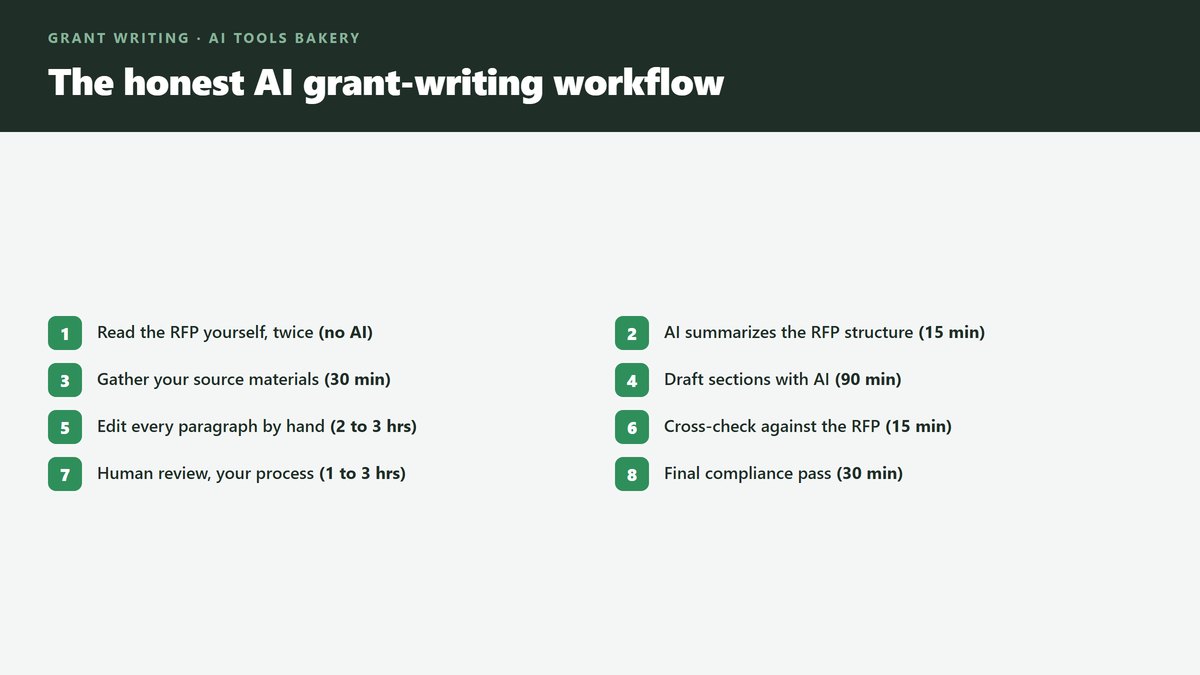
Step 1: Read the RFP yourself, twice (no AI)
Do not feed the RFP to AI yet. Read it yourself. Twice. Take notes on:
- What is the funder actually trying to accomplish with this program?
- What is the unwritten priority that distinguishes this RFP from the funder’s general giving?
- What is the application format, word counts, attachments required?
- What is the submission deadline and the realistic timeline backward from there?
- Is this funder you have worked with before? What do you know about their preferences?
This is the strategic step. AI cannot do it. Twenty minutes well spent prevents three hours of misdirected drafting later.
Step 2: Have AI summarize the RFP structure (15 minutes)
Now use AI for what it does well: structural extraction. Paste the full RFP into Claude or ChatGPT with this prompt:
Below is a grant RFP. Extract: 1. All required sections with word counts 2. All required attachments and what each contains 3. Evaluation criteria with relative weight if provided 4. Specific yes/no compliance requirements (eligibility, geography, budget caps) 5. The submission process and deadline Format as a checklist I can work from.
The output is a clean working checklist that you cross-reference against your strategic notes from Step 1.
Step 3: Gather your source materials (30 minutes)
Pull together:
- Your standard program description (current version, dated)
- Your most recent annual report or impact report
- Your logic model or theory of change if you have one
- 3-5 success stories with specific names/numbers (anonymized as needed)
- Your most recent budget for the relevant program
- 2-3 past proposals to similar funders for tone reference
You will paste these into AI in the next step. Having them ready as a single document saves time and produces better drafts.
Step 4: Generate first drafts section by section (90 minutes)
Take each required section from the checklist. For each, prompt AI like this:
You are drafting the [SECTION NAME] section of a grant proposal to [FUNDER NAME] for our [PROGRAM NAME]. Context about our organization: [paste relevant sections of your source materials] Context about this specific program: [paste program description] Funder’s stated priorities for this RFP: [paste from Step 2 checklist] Required word count: [X words] Required content: [bullet list from RFP] Write a first draft that: stays within the word count; addresses each required content element; uses concrete program details from the source materials; cites specific outcomes from the success stories where appropriate; adopts a professional grant-writing tone (clear, evidence-based, not promotional). Do not invent numbers, dates, or facts not provided in the source materials. If you need a number we have not provided, mark it as [VERIFY: description of what is needed].
The output is a first draft you can edit. The [VERIFY: …] markers tell you where you need to substitute real data before submission. Do not let any [VERIFY: …] tag reach the funder.
Step 5: Edit every paragraph by hand (120-180 minutes)
This is the step that distinguishes proposals that work from proposals that read as AI-generated. Do not skip it.
For each paragraph:
- Read it aloud (you will catch awkward phrasing this way)
- Verify every factual claim against your source materials
- Replace any generic language with specific program details
- Adjust tone toward your organization’s voice and the funder’s preferences
- Remove any superlatives that overpromise outcomes
- Strengthen weak verbs and tighten prose
A well-edited AI first draft is indistinguishable from a fully human-written draft. A poorly-edited AI first draft is detectable from the first paragraph and will hurt your relationship with the funder.
Step 6: Cross-check against RFP requirements (15 minutes)
Use AI again, this time for compliance review:
Below is my draft proposal. Below is the RFP. Tell me: 1. Which RFP requirements does the draft address fully? 2. Which requirements does the draft address partially? 3. Which requirements does the draft miss entirely? 4. Are there any factual claims in the draft that look suspicious or require verification?
Address every gap before moving to human review.
Step 7: Human review by your standard process (60-180 minutes)
Run the proposal through your normal review chain: ED, program staff, board member, external reviewer. This step does not change with AI assistance. The goal is catching organizational truth issues, strategic positioning, and tone calibration that AI cannot catch.
Step 8: Final compliance pass (30 minutes)
Final review for:
- Word counts within limits for every section
- All attachments present and named correctly
- All [VERIFY: …] tags resolved with real data
- All required forms completed
- AI use disclosure included if required by funder
Submit.
Total time vs. human-only baseline
For a typical 10-page foundation proposal:
- Fully human-written: 12 to 20 hours of grant writer time
- AI-assisted with this workflow: 5 to 8 hours of grant writer time
- Quality difference: at or slightly above human-only baseline when human review is disciplined
The savings are real. They do not come from skipping the human review. They come from compressing the first-draft generation phase from 6-10 hours to 90 minutes.
The tools
The specialized AI grant-writing tools versus the general-purpose AI assistants:
Specialized tools (Grantable, Granted AI): Built for the workflow above. Ingest your organization’s documents, learn your voice, integrate with your CRM, produce drafts in your house style. Worth the cost for organizations submitting 8+ proposals per year. Pricing typically $79-$200/month.
General-purpose AI assistants (Claude, ChatGPT): Capable of producing competent drafts with good prompting. Free or low-cost ($0-$20/month). The right choice for organizations submitting fewer than 8 proposals per year, or for grant writers who prefer maximum prompt control.
The honest read: for most small-to-mid nonprofits, Claude or ChatGPT with the workflow above is sufficient. Move to specialized tools when proposal volume justifies the cost and when the integration value (CRM sync, document library, team workflow) starts mattering. See our Best AI Grant Writing Tools for the deeper category review.
The bright lines
Three rules that keep your organization out of trouble:
Never submit an AI-generated proposal without human review. The funder will detect AI-only language. The relationship will not recover. Always edit.
Never let AI invent facts. Every number, name, date, and outcome claim must trace to real organizational data. AI will happily generate plausible-sounding falsities. Catch them in the editing step.
Always disclose AI use where required. A growing number of funders (Hewlett, MacArthur, and many federal grant programs as of 2026) require disclosure of AI assistance in proposal preparation. Not disclosing when required is grounds for disqualification and worse, for relationship damage with the funder. Check each RFP for a disclosure requirement and comply.
Two prompt templates you can copy and adapt
The workflow is only as good as the prompts you use. Two templates that I have observed working grant writers use successfully. Adapt the bracketed sections for your organization and your specific RFP.
Template 1: First-draft section generator
“You are an experienced nonprofit grant writer drafting the [SECTION NAME, e.g., Program Description] section of a grant proposal to [FUNDER NAME, e.g., the Robert Wood Johnson Foundation] for our [PROGRAM NAME, e.g., Healthy Communities Initiative].”
“Context about our organization: [paste 2-3 paragraphs from your boilerplate organizational description].”
“Context about this program: [paste your program description, including the population served, geographic scope, program design, and key partners].”
“Funder stated priorities for this RFP: [paste the relevant paragraph from the funder RFP about priorities or evaluation criteria].”
“Required word count: [X words]. Required content elements: [list the bullet points from the RFP that this section must address].”
“Write a first draft that stays within the word count, addresses each required content element, uses concrete program details from the source materials, cites specific outcomes from past program success stories where appropriate, adopts a professional grant-writing tone that matches the funder editorial style (clear, evidence-based, not promotional).”
“Do not invent numbers, dates, or facts not provided in the source materials. If you need a number we have not provided, mark it as [VERIFY: description of what is needed] so the human reviewer can verify before submission.”
Template 2: Compliance cross-check
“You are a meticulous grant-proposal reviewer. Below is the draft proposal we plan to submit. Below the draft is the original RFP.”
“[PASTE FULL DRAFT PROPOSAL] [PASTE FULL RFP]”
“Tell me: (1) Which RFP requirements does the draft address fully, (2) Which RFP requirements does the draft address partially, with specific gaps, (3) Which RFP requirements does the draft miss entirely, (4) Are there any factual claims in the draft that look suspicious or require verification, (5) Are there any tone or framing choices in the draft that seem inconsistent with the funder stated priorities or editorial style?”
“Provide your assessment as a structured checklist, not prose. Be specific about which paragraph or section needs each fix.”
Use this as the last step before human review. Output is a clean checklist of fixes to apply before submission.
Funder-specific quirks to watch
Different funder types have different unwritten preferences that AI cannot fully detect. Quick honest read on the major categories.
Family foundations are highly relational; the strongest proposals reflect the relationship between your ED and the family principal. AI-drafted content reads as generic to family foundations even when technically competent. Use AI for first drafts then heavily personalize the cover letter and executive summary with relational context only your team has.
Community foundations weight community connection and local impact heavily. The proposal should sound like it understands the specific community, not like a generic application that could go to any funder. AI tends to produce community-generic content; humanize aggressively.
Federal grants are the opposite: they reward precise compliance with the RFP structure, specific evidence-based outcome claims, and adherence to the federal grants management framework. AI is more useful for federal grants than for foundation grants because the work is more structural and less relational. But the disclosure requirement is also stronger; most federal grant programs in 2026 require disclosure of AI assistance in proposal preparation.
Corporate foundations vary widely. Some are essentially family foundations operated through a corporate vehicle; others are highly structured. Read the corporate foundation annual giving report before drafting to gauge which type you are dealing with.
Sample disclosure language for AI-assisted grant proposals
A growing number of funders in 2026 require disclosure when AI was used in proposal preparation. Sample language to adapt for your specific submissions.
Short form (for funders that simply require acknowledgment): “This proposal was drafted with AI assistance for initial structural drafting and editorial polish. All factual claims, outcome data, and program-specific content were verified, sourced, and finalized by [Organization Name] staff. The final proposal was reviewed and approved by [Executive Director Name].”
Longer form (for funders requiring more detail): “We use AI tools (specifically [Tool Name, e.g., Claude]) as part of our grant-writing workflow. AI is used for: (1) first-draft generation of structured content from our internal program materials, (2) cross-checking proposals against RFP requirements, (3) editorial polish on draft text. AI is not used for: (4) inventing or generating program data, (5) producing final donor or funder communications without human review, (6) any content that touches confidential information. Every factual claim in this proposal is verified against [Organization Name] records. The full proposal was reviewed and approved by [Executive Director Name] before submission.”
What we still cannot honestly assess
The workflow above is the consolidated practice I have observed across working grant writers at $500K-$20M nonprofits. Your specific results depend on your existing grant-writing process, your team’s discipline, and the funders you write to. Some funder types (large federal grants, complex collaborative proposals) require additional workflow elements not covered here. Run the workflow on one proposal before adopting it for your full grant calendar.
Where to go from here
The practical next steps:
- Pick your next grant proposal
- Set aside 30 minutes for Step 1 (RFP reading) before doing anything else
- Pick your tool (Claude or ChatGPT for most, Grantable/Granted AI if volume justifies)
- Run the workflow on one proposal
- Track time spent vs. your usual baseline
- Iterate
For broader context on nonprofit AI tooling:
- Best AI Grant Writing Tools for Nonprofits, the category review
- Best AI Tools for Nonprofits, the broader picture
- Best AI Tools for Small Nonprofits Under $500K, the stack for tight budgets
- Donor Data Privacy in AI Fundraising, the ethics layer
AI grant writing in 2026 is real. The savings are real. The risk of misuse is also real. The grant writers who succeed in 2026 are the ones who treat AI as a multiplier on their existing skill, not as a replacement for it. Used that way, AI is a meaningful operational improvement to nonprofit fundraising. Used badly, it is a fast way to damage funder relationships that took years to build.
Workflow documentation by Faz at AIToolsBakery. Independent guide, no payment received from any tool mentioned. Verified against working grant writers’ practices as of May 2026.

Written by
FazFaz is the founder of AIToolsBakery. Some tools here are tested hands on. Others are assessed from vendor documentation and pricing verified on the live page, and every review says which one it is. Sponsors can buy a position in a guide. They cannot buy the score, the criticism, or silence about a better option.
How we test and how we make money →