For healthcare compliance training in 2026, Relias and HealthStream lead for hospitals and health systems, MedTrainer wins for multi-site outpatient groups, Compliancy Group is best for guided HIPAA at small practices, and KnowBe4 covers security-awareness gaps. Match the platform to your setting, accreditation load, and workforce size.
Healthcare compliance training is one of the hardest training problems in any industry. A single hospital has to keep clinicians, nurses, front-desk staff, billers, and contractors current on HIPAA privacy and security, OSHA bloodborne pathogens, CMS conditions of participation, fraud waste and abuse rules, infection control, and whatever The Joint Commission surveyor asks about next. Miss a deadline and you are not just failing an internal metric, you are exposing the organization to fines, failed surveys, and real patient risk.
AI changes the economics of that work. Instead of assigning the same annual module to everyone and hoping it sticks, modern platforms personalize learning paths by role, auto-generate and refresh courses when a regulation changes, predict which staff are about to fall out of compliance, and adapt security-awareness simulations to each person’s risk profile. The result is less manual course building, faster audit prep, and training that actually reflects the 40% of knowledge that degrades within 90 days of a traditional course. Below are the eight platforms we rate highest, each matched to a specific healthcare setting.
Comparison table
| Tool | Best for | AI angle | Pricing model |
|—|—|—|—|
| Relias | Enterprise healthcare and post-acute | Personalized pathways, competency analytics | Quote-based, per learner |
| HealthStream | Large hospitals and health systems | jane AI competency-based learning | Quote-based, per learner |
| MedTrainer | Multi-site outpatient and ambulatory | AI compliance operations plus LMS | Quote-based, per location/seat |
| symplr Learning | Enterprise GRC plus learning | AI-assisted tracking and reporting | Quote-based, enterprise |
| Compliancy Group | Small and mid practices | Guided HIPAA with coaching | Quote-based, per organization |
| KnowBe4 | HIPAA security awareness | AI phishing simulation and risk scoring | Per-seat, quote-based |
| Litmos | AI course authoring for custom content | AI content authoring, auto-refresh | Quote-based, per learner |
| Vocaliv | AI-adaptive microlearning | Behavior-based training suggestions | Quote-based |
For the wider picture beyond compliance, see our best AI tools for corporate training pillar, and if you are standing up a program from scratch, our guide on how to build an AI training program.
Relias
Relias is the default enterprise choice for healthcare and human-services training, serving more than 13,000 organizations and 4.5 million caregivers across acute care, post-acute, long-term care, behavioral health, and community health. Its library runs to 1,500-plus accredited healthcare-specific courses covering clinical skills, regulatory compliance, and professional development, which is deeper than almost anyone else in the space.
What makes it a compliance workhorse is the tracking layer. Relias automates compliance monitoring across federal, state, and accreditation requirements, handles license management, and builds audit-ready documentation so a survey does not turn into a fire drill. Personalized learning paths and competency assessments let you assign exactly what a role needs rather than blanket-assigning every course.
Who it is for: mid-size to large healthcare and post-acute organizations that need breadth, accreditation coverage, and mature reporting. Standout feature: the accredited course catalog paired with automated multi-jurisdiction compliance tracking. Honest limitation: some reviewers note the AI feature set is thinner than newer entrants and that integrating with outside systems can be clunky, so validate your interoperability needs in the demo. Pricing is quote-based per learner with no public rates and no free trial.
HealthStream
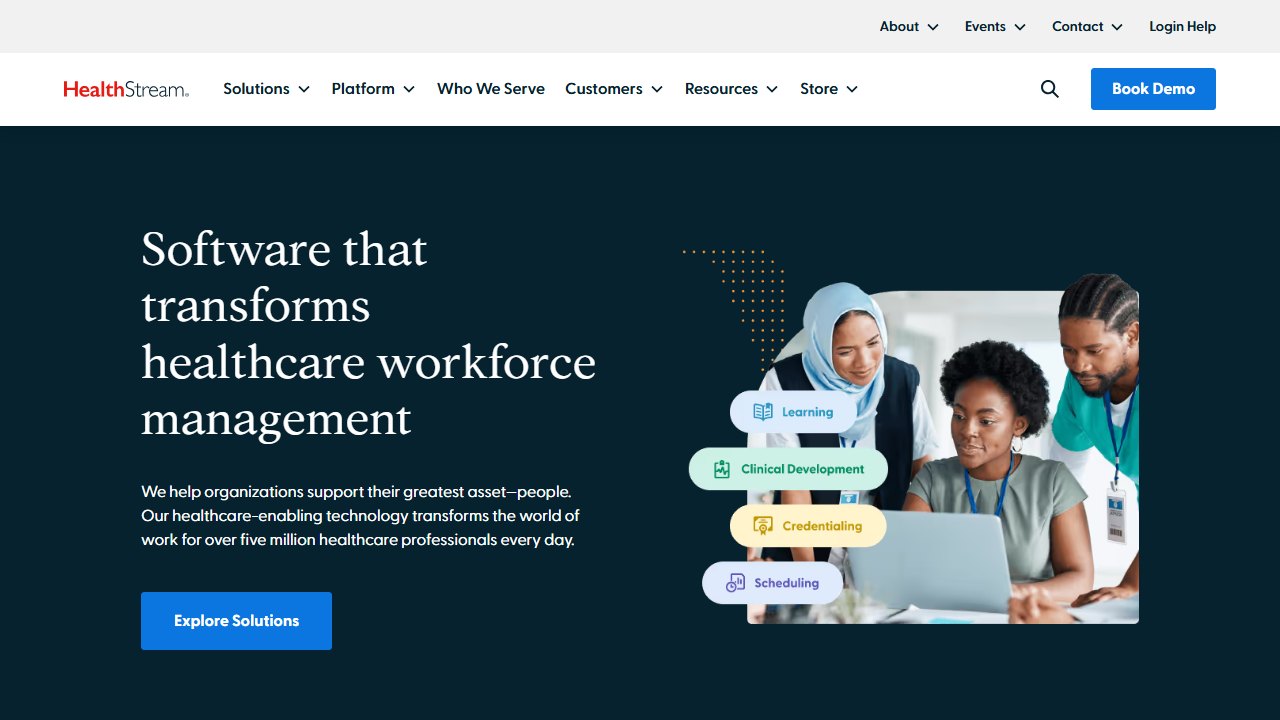
HealthStream is built for the largest hospitals and health systems, where credentialing, competency, and workforce development all have to sit alongside compliance. Its compliance courseware is designed by regulatory experts to meet CMS, OSHA, HHS, and HIPAA requirements across seven healthcare settings, and its ComplyQ and SafetyQ solutions package that into managed regulatory training.
The AI differentiator is jane, a clinically focused engine that builds personalized, competency-based learning pathways for healthcare professionals rather than treating everyone as an identical learner. For a 10,000-employee system, that personalization is the difference between meaningful competency and check-the-box completion. HealthStream also ties training to credentialing and workforce management, so compliance status lives next to the rest of the employee record.
Who it is for: enterprise hospitals and health systems that want compliance inside a broader clinical workforce platform. Standout feature: jane AI competency pathways plus deep credentialing integration. Honest limitation: it is a heavy enterprise deployment, so it is overkill and hard to justify for a small clinic or single practice. Pricing is quote-based per learner, negotiated at the system level.
MedTrainer
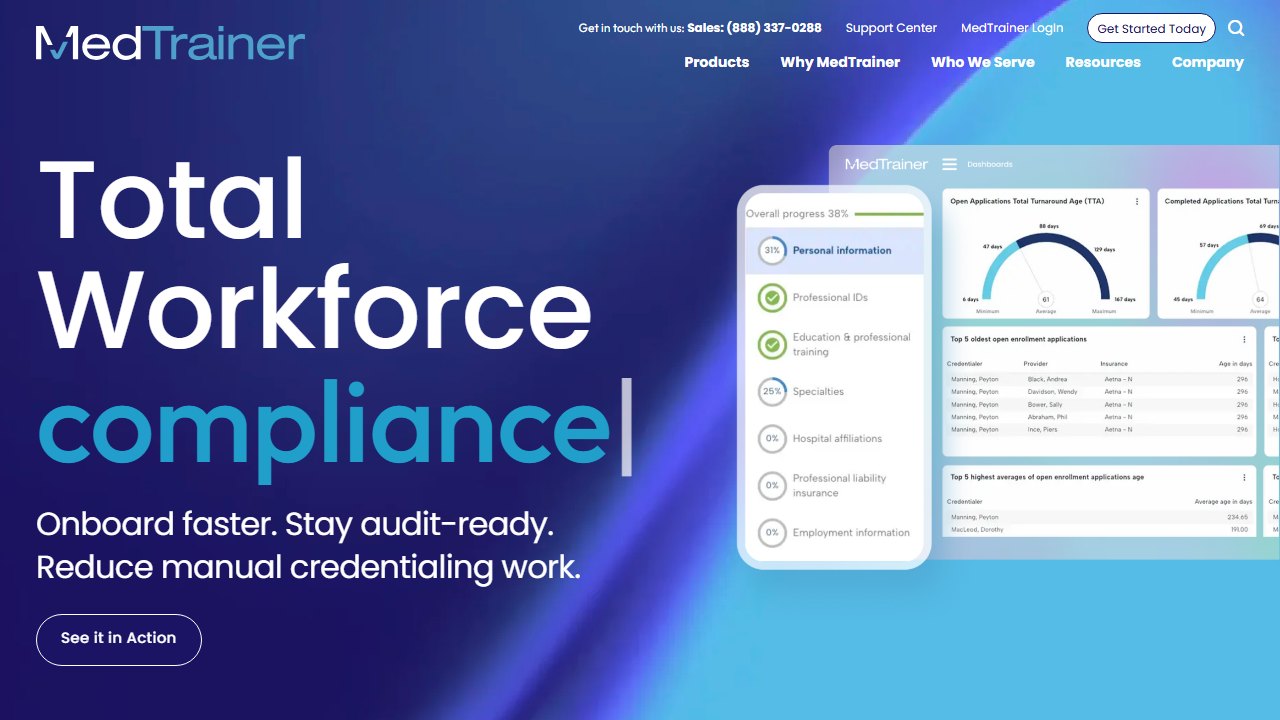
MedTrainer is the strongest all-in-one for multi-site outpatient and ambulatory groups. It pairs a healthcare-specific LMS with the operational side of compliance, including credentialing, document and policy management, incident reporting, and safety plans, so a growing group of clinics can run compliance from one system instead of stitching together five.
MedTrainer leans into AI for compliance operations, using it to streamline course assignment, surface gaps, and speed up the administrative grind of keeping dozens of locations survey-ready. That operational focus is why it tends to win against pure course libraries for organizations whose real pain is coordination across sites, not a shortage of content.
Who it is for: multi-location outpatient, dental, and ambulatory groups that need compliance operations and training in one platform. Standout feature: combined LMS, credentialing, and policy management tuned for multi-site coordination. Honest limitation: the clinical course depth is not as vast as Relias or symplr, so content-heavy hospital systems may find the library lighter than they want. Pricing is quote-based, generally structured around locations and seats. This pairs well with a structured rollout, which we cover in how to build an AI training program.
symplr Learning
symplr Learning sits inside symplr’s broader healthcare operations and governance, risk, and compliance platform, which is exactly its appeal for large enterprises that already think in GRC terms. The learning catalog is enormous, with more than 8,500 clinical and non-clinical eLearning courses and over 3,000 CE credits, so it covers both mandatory compliance and ongoing professional development.
On tracking, symplr aligns automated reporting to The Joint Commission, OSHA, CMS, Magnet, and other key standards, and manages licenses, certifications, and mandatory training in one place. Because it connects to the wider symplr compliance and workforce suite, training completion feeds the same governance view an executive uses to gauge organizational risk.
Who it is for: enterprise health systems that want learning wired into a real GRC and workforce operations platform. Standout feature: 8,500-plus course catalog with accreditation-aligned automated tracking. Honest limitation: like most enterprise suites, you are buying into an ecosystem, so it is heavier and pricier than a standalone LMS if training is all you need. Pricing is quote-based at the enterprise level.
Compliancy Group
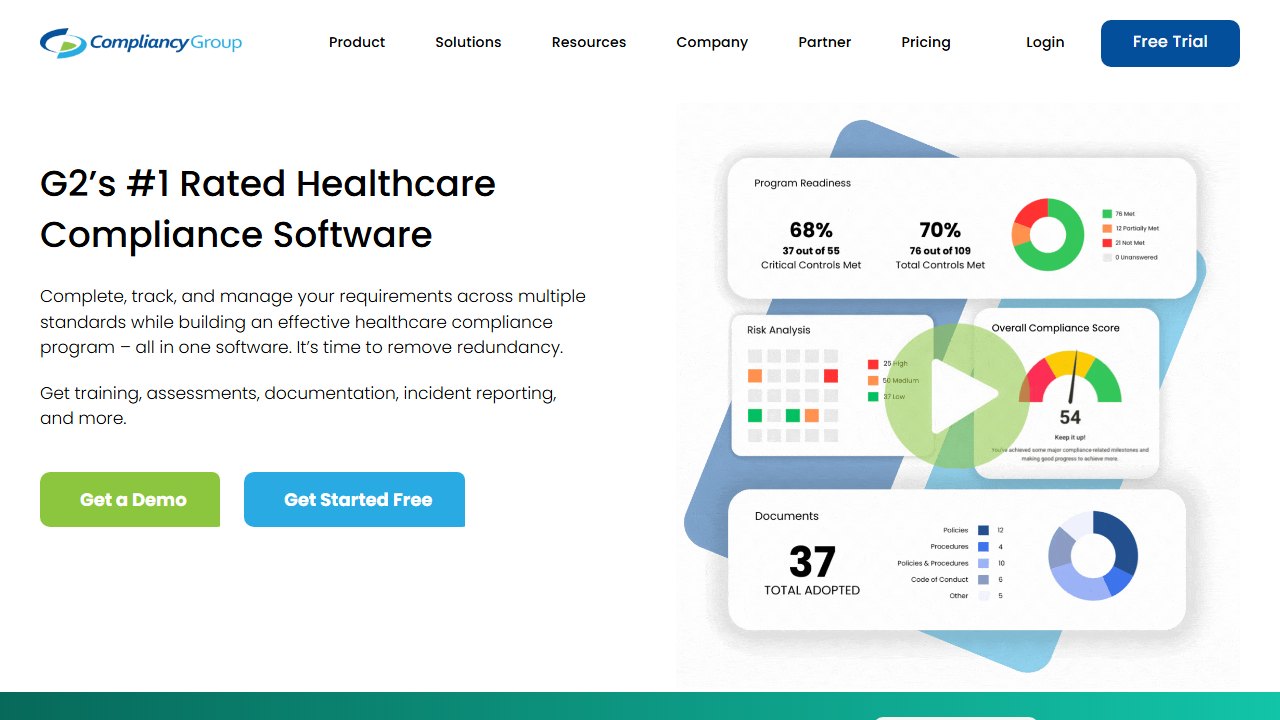
Compliancy Group takes a different shape from the big LMS players. Rather than a giant course catalog, it delivers complete HIPAA program management: training modules alongside policy templates, risk assessments, and ongoing support from dedicated compliance coaches. For a small or mid-size practice without a full-time compliance officer, that guided, human-backed model is the point.
The platform walks a practice through building and maintaining an entire HIPAA program, then produces the documentation and trust signals needed to prove it. That makes it less about volume of clinical content and more about doing HIPAA correctly end to end, with a coach making sure nothing gets missed.
Who it is for: small and mid-size medical, dental, and specialty practices that want guided HIPAA compliance rather than an enterprise LMS. Standout feature: coach-supported HIPAA program management with policies, risk assessments, and training bundled together. Honest limitation: it is HIPAA-centric, so organizations needing broad clinical, OSHA, and accreditation course libraries will still want a dedicated LMS alongside it. Pricing is quote-based per organization.
KnowBe4
KnowBe4 is not a clinical LMS, and that is precisely why it belongs here. Healthcare compliance has a security-awareness dimension that most course libraries barely touch, and the numbers are stark. In KnowBe4’s 2026 benchmarking, healthcare and pharmaceuticals ranked the most phishing-prone industry for the second straight year, with a baseline phishing-prone percentage of 42.7% that climbs to 54% in systems above 10,000 employees.
KnowBe4 addresses the HIPAA Security Rule’s workforce training requirement with continuous simulated phishing and adaptive, AI-driven awareness training that targets each employee’s risk profile. That matters more every year: the company’s own analysis found 83% of phishing emails were AI-generated, which makes generic annual training insufficient. Organizations that train continuously see phishing susceptibility drop roughly 40% within 90 days and up to 87% after a year.
Who it is for: any healthcare organization that needs to satisfy the security-awareness side of HIPAA and defend against AI-powered phishing. Standout feature: adaptive phishing simulation with role and risk-based targeting. Honest limitation: it does not cover clinical, OSHA, or accreditation content, so it complements rather than replaces a healthcare LMS. Pricing is per-seat and quote-based by tier.
Litmos
Litmos earns its spot for organizations that need to build and maintain custom compliance content, not just assign off-the-shelf modules. Its HIPAA-compliant healthcare LMS ships ready-to-use training for HIPAA, OSHA, PHI and PII protection, and breach protocols, and a partnership with American Medical Compliance adds more than 450 courses spanning OSHA, HIPAA, fraud waste and abuse, infection control, and sexual harassment.
The AI story here is authoring. Litmos includes an AI Content Authoring Tool that produces mobile-responsive SCORM courses without design expertise, and uses AI to build and refresh clinical and compliance content faster, so a module can be updated quickly after a regulatory change. For a compliance team that constantly tailors training to its own policies, that speed is the differentiator.
Who it is for: healthcare organizations and L&D teams that want to author and continuously update their own compliance courses. Standout feature: AI content authoring plus a large ready-made healthcare compliance catalog. Honest limitation: Litmos is a general LMS with a strong healthcare layer rather than a purpose-built clinical compliance system, so credentialing and accreditation tracking are lighter than Relias or symplr. Pricing is quote-based per learner. For more on building content well, see our best AI instructional design tools.
Vocaliv
Vocaliv is the newest name on this list and the most AI-native in its pitch. It combines healthcare regulatory knowledge with adaptive learning that proactively suggests relevant training based on user behavior and emerging risks, aiming for training that is personalized, engaging, and measurably effective rather than a static annual assignment.
The emerging pattern it represents matters: platforms are shifting from periodic courses to ongoing micro-assessments that keep knowledge fresh between formal cycles, directly targeting the roughly 40% knowledge degradation that hits within 90 days of traditional training. For teams that have watched completion rates stay high while actual retention quietly falls, that continuous-reinforcement model is the draw.
Who it is for: organizations that want an AI-first, adaptive microlearning approach to compliance and are comfortable adopting a younger platform. Standout feature: behavior-based training recommendations with continuous micro-assessments. Honest limitation: as a newer entrant it has a smaller track record and less independent review volume than the established LMS vendors, so validate its content depth and certifications against your specific accreditation needs before committing. Pricing is quote-based.
Measuring training, honestly
Training is the discipline most prone to measuring the wrong thing well. Four levels of rigour are available and most organisations stop at the first.
Reaction is easy and nearly worthless
Satisfaction scores at the end of a session tell you whether people enjoyed it, which correlates weakly with whether they can now do anything differently. Collect it if you like, and do not report it as evidence the training worked.
Completion is an activity metric
Completion percentage measures compliance with an instruction. It is genuinely necessary for regulated training, where the record is the point, and it is not evidence of capability anywhere else. Report it as what it is.
Behaviour change is where the real evidence starts
Pick one observable behaviour and measure it before and after: the proportion of discovery calls that reach a defined qualification step, the share of tickets resolved without escalation, the number of safety observations logged. It needs a baseline from before the training, which is why this gets skipped, and it is the first level that would survive a hostile question.
Business outcome, with the caveat stated out loud
Attributing revenue or incident rates to a training programme inside one year is genuinely hard, because everything else moved too. If you report an outcome, report what else changed in the same period. The most credible thing a training team can do is claim the behaviour change it can evidence and be openly cautious about the outcome it cannot.
Take the baseline in the week before launch
Whatever you choose, capture it before anything is switched on, from a source the project did not touch. It takes an hour and it is unrecoverable afterwards, which is the single reason most training investments can never be evaluated.
Rolling this out so people actually use it
The failure mode in corporate training software is not a bad product, it is a deployment that reaches week six with impressive licence numbers and no behaviour change.
Pick one team and one behaviour, not one platform
The instinct is to roll out to everyone because the licence covers it. The better move is one team, one measurable behaviour, and a fixed period. A discovery call structure, an objection, a specific product pitch. Narrow scope means you can tell whether it worked, and a result from one team persuades the rest far more effectively than a mandate.
Managers have to use it before reps do
Roleplay and coaching platforms live or die on whether managers review the output. If a rep completes a scenario and nobody ever mentions it, completion becomes a compliance task within a fortnight. Before launch, agree which existing meeting will use the output, ideally the one-to-one that already happens, and make somebody responsible for opening it there.
Mandatory completion produces completion, not skill
If the only metric is completion percentage, you will get a high completion percentage and learn nothing. Pair it with something qualitative from the start: a manager rating on a rubric, a before-and-after recording, or a call outcome. Otherwise the dashboard will look excellent while the sales floor is unchanged.
Plan for the second wave, which is where it usually dies
The first cohort is volunteers and enthusiasts and it always goes well. The second is everyone else, and their experience decides whether best ai becomes part of how the team works. Budget real time for the second wave, expect more resistance, and do not read the first cohort’s enthusiasm as evidence the rollout is done.
Name the owner and the stop condition
One person whose job includes this, with the hours to do it, and a written statement of what twelve months would have to look like for you not to renew. Both are unglamorous and both are the difference between a platform that survives a budget review and one that quietly does not.
How to choose
Start from your setting, not the feature list. Large hospitals and health systems get the most from HealthStream or Relias, where accredited depth, competency pathways, and credentialing integration justify the enterprise weight. Post-acute, behavioral health, and human-services organizations lean Relias for its catalog. Multi-site outpatient, ambulatory, and dental groups usually land on MedTrainer because their real pain is coordinating compliance operations across locations.
Small practices should look at Compliancy Group for guided HIPAA with a coach rather than an oversized LMS. Enterprises that already run governance and risk centrally will want symplr Learning inside that GRC stack. Teams that constantly author their own policy-specific content should shortlist Litmos, and anyone chasing an AI-first adaptive model can trial Vocaliv.
Whatever clinical LMS you pick, treat security awareness as a separate, non-optional layer. Healthcare is the most phishing-prone industry, so pairing your compliance LMS with KnowBe4 closes a gap that course completion alone will not. And before any platform touches protected health information, get the Business Associate Agreement and current security documentation in writing.
If your compliance program also involves patient-facing communication or difficult conversations, our roundup of AI roleplay tools for corporate training and our best AI onboarding tools guide are worth a look for the practice side of readiness.

Written by
FazFaz is the founder of AIToolsBakery. Some tools here are tested hands on. Others are assessed from vendor documentation and pricing verified on the live page, and every review says which one it is. Sponsors can buy a position in a guide. They cannot buy the score, the criticism, or silence about a better option.
How we test and how we make money →