Phishing stopped being a typo ridden email a while ago. In 2026 the attack an employee actually faces is a cloned voice on a phone call, a deepfake video of a manager on a quick sync, or a flawless AI written message that lands in Slack instead of the inbox. The static “watch this 20 minute video once a year” model was already weak. Against AI generated social engineering it is close to useless.
That is why the security awareness market has quietly turned into an AI arms race. The platforms worth paying for now personalize every simulation to the individual, ramp difficulty as people improve, auto assign remedial micro training the moment someone clicks, and increasingly rehearse voice and video deepfakes, not just email. Below are the eight platforms doing this best, ordered by merit for a typical mid market or enterprise buyer. This guide is part of our broader look at the best AI corporate training tools, and it pairs closely with our AI compliance training platforms roundup since most teams buy both.
| Platform | Standout AI strength | Best for | Pricing model |
|---|---|---|---|
| KnowBe4 | AIDA agents automate assignment, campaigns, and deepfake content | Enterprises needing depth plus compliance breadth | Per seat, quote based |
| Hoxhunt | Adaptive, gamified phishing personalized per employee | Global teams chasing measured behavior change | Per seat, quote based |
| Adaptive Security | Voice and video deepfake simulation | Firms targeted by executive impersonation | Per seat, quote based |
| Huntress Managed SAT | Managed content from live threat telemetry | Lean IT teams and MSPs | Per active user, quote based |
| NINJIO | Narrative episodes plus susceptibility profiling | Culture and engagement focused programs | Per seat, quote based |
| Proofpoint SAT | Training tied to threats hitting your own users | Existing Proofpoint email security customers | Per seat, quote based |
| Cofense | Reporting and triage calibrated to live phishing | Teams that prioritize real threat reporting | Per seat, quote based |
| Phished | Automated behavioral training with a human risk score | Teams wanting hands off automation | Per seat, quote based |
KnowBe4
KnowBe4 is the largest security awareness platform by content volume, with well over a thousand modules, phishing templates in 35 plus languages, and the deepest compliance library on this list. What moves it into the AI era is AIDA, its suite of AI Defense Agents. The Automated Training Agent analyzes a user’s learning history, job role, risk score, and behavior to auto assign the most relevant content, and the AIDA Orchestration agent independently creates, schedules, and manages phishing tests and training at the individual user level so security teams stop running campaigns by hand.
There is a Deepfake Training Content Agent that generates custom deepfake experiences, which matters as executive impersonation spreads. KnowBe4 says risk scores drop roughly 4x faster with AIDA Orchestration than with traditional manual programs, with about twice as many users actively trained.
Who it is for: enterprises that want one platform to cover phishing simulation, broad awareness content, and regulatory training across a large, multilingual workforce.
Honest limitation: the breadth is also the friction. The console is sprawling, and smaller teams often use a fraction of what they pay for. The best AIDA automation sits on higher tiers, so confirm which agents your plan includes before you sign.
Pricing model: per seat and quote based, tiered by feature depth, with the full AIDA agent suite on the advanced tiers.
Hoxhunt
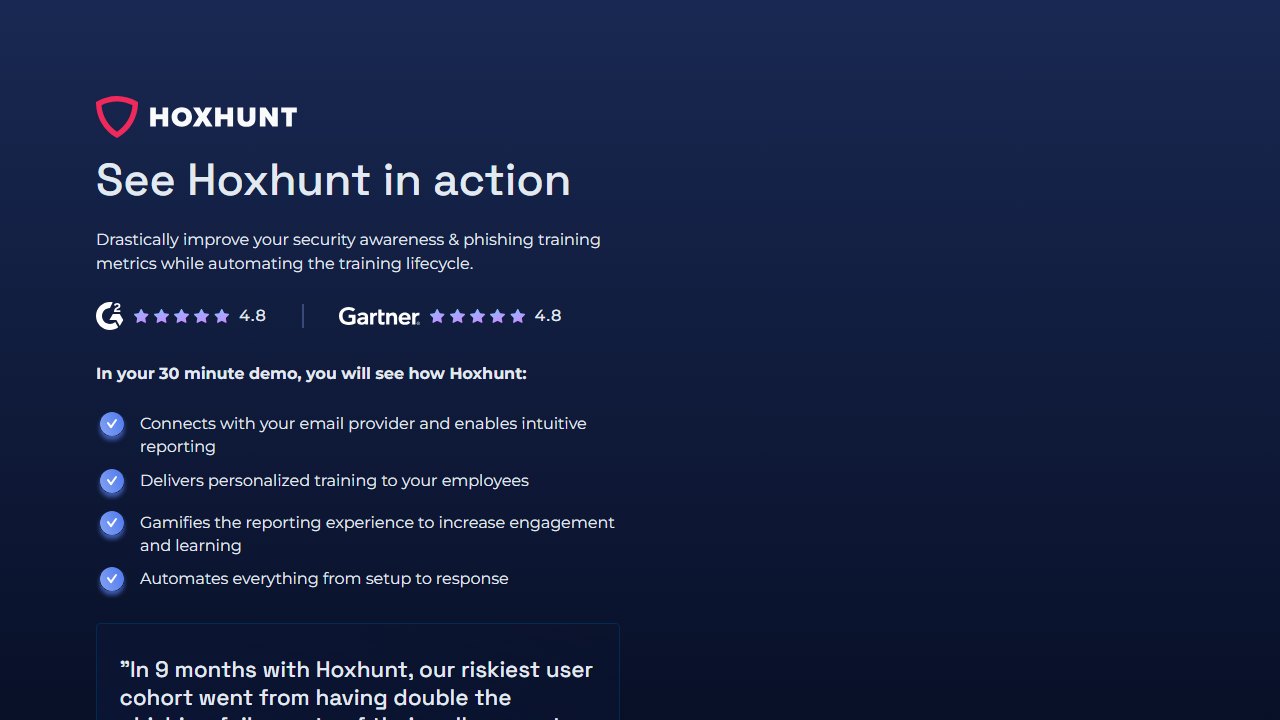
Hoxhunt built its reputation on one idea: training should change behavior, not just get watched. It uses AI and behavioral science to deliver personalized, gamified micro training, with simulations tailored to each employee by department, location, and skill. The adaptive model raises difficulty over time as a person improves, and it delivers across email, Slack, and Teams rather than the inbox alone.
The numbers are the selling point. Across Hoxhunt’s 2026 dataset, real threat detection climbed from 13 percent to 71 percent over the training curve, the kind of behavior change a static template library simply cannot show. Employees are rewarded for reporting real suspicious mail, which turns the workforce into a live sensor network, and simulations are localized into 30 plus languages.
Who it is for: global organizations that care about measured outcomes and engagement, and that are tired of tick the box modules everyone resents.
Honest limitation: the gamified, drip style program is a long game, not a one week compliance sprint. It shines when leadership commits to running it continuously, and it can feel light if you also need a heavy formal compliance course catalog.
Pricing model: per seat and quote based, scaled to headcount.
Adaptive Security
Adaptive Security is the platform built specifically for the threats the others bolt on later: deepfake audio, video, voice, and text based social engineering. It can simulate a voice call from an internal team member using just a few seconds of audio, and create a video avatar of a colleague from a couple of minutes of footage, so employees rehearse the exact impersonation attack that is now hitting finance and executive teams.
It is also a credible, well backed company rather than a novelty. Founded in 2024 in New York, it raised a $43M round led by a16z and the OpenAI Startup Fund, later extended, and closed an $81M Series B led by Bain Capital Ventures in December 2025, bringing total funding to roughly $146.5M. The platform combines multichannel simulation across email, voice, SMS, and deepfake video with OSINT driven personalization.
Who it is for: organizations that are genuine impersonation targets, especially in finance, tech, and anywhere wire fraud or executive spoofing is a real risk.
Honest limitation: it is newer and narrower than the incumbents. If you need a giant compliance course library or decades of established content, pair it with a broader platform rather than expecting it to be your only tool.
Pricing model: per seat and quote based.
Huntress Managed SAT
Huntress Managed SAT is designed to cut human risk without the overhead of a traditional awareness program. The pitch is “managed,” meaning content and campaigns are largely run for you, and the training is continuously updated from real Huntress threat telemetry, so it reflects how attacks are actually evolving rather than what a content team wrote last year. It ships dedicated modules on AI generated phishing, deepfake awareness, and voice cloning.
Because Huntress already sits in the managed detection and response world, the SAT product benefits from a threat intelligence pipeline most standalone awareness vendors do not have. For a small team, the appeal is obvious: less to configure, fewer campaigns to babysit, and content that stays current on its own.
Who it is for: lean IT and security teams, and MSPs that need to roll awareness training out across many client tenants without a dedicated program manager.
Honest limitation: the managed approach trades control for convenience. If you want to hand build elaborate custom campaigns or need a very specific compliance course catalog, a more configurable platform gives you more knobs.
Pricing model: per active user and quote based.
NINJIO
NINJIO takes a different bet than the automation heavy platforms: it tries to change how employees react under pressure using story. Its short, Hollywood style episodes dramatize real breaches, and the platform layers in emotional susceptibility profiling, phishing simulation, and phish reporting into a continuous learning system aimed at reducing human risk over time rather than satisfying an audit.
The susceptibility profiling is the interesting AI angle. Rather than treating everyone the same, NINJIO builds a profile of what each person is prone to fall for and steers content accordingly. For organizations where the real problem is engagement, where people tune out generic training, the narrative format tends to earn attention that a slide deck never will.
Who it is for: culture first programs that want memorable, high engagement content and care about the human, emotional side of susceptibility.
Honest limitation: the episodic model is lighter on deep formal course catalogs and granular compliance mapping than KnowBe4. It is a behavior and awareness engine first, not a compliance LMS.
Pricing model: per seat and quote based.
Proofpoint Security Awareness
Proofpoint Security Awareness earns its place mostly through integration. Because Proofpoint sees a huge volume of the email threats actually hitting your users, its training can constantly refresh based on the campaigns your organization is really facing, and its ThreatSim engine automates phishing simulations against that live picture. The content mix covers phishing recognition, ransomware, and insider threat, with videos, quizzes, and gamified challenges.
The strategic value is closing the loop between what your email security gateway blocks and what your people get trained on. If a specific lure is targeting your finance team this month, the training can reflect that rather than staying generic.
Who it is for: organizations already running Proofpoint email security that want awareness training wired into the same threat data and console.
Honest limitation: the value proposition is weaker if you are not already a Proofpoint customer. As a standalone purchase it competes with more specialized behavior change platforms, and the AI personalization is less aggressive than Hoxhunt or KnowBe4’s agent model.
Pricing model: per seat and quote based, often bundled with the broader Proofpoint stack.
Cofense
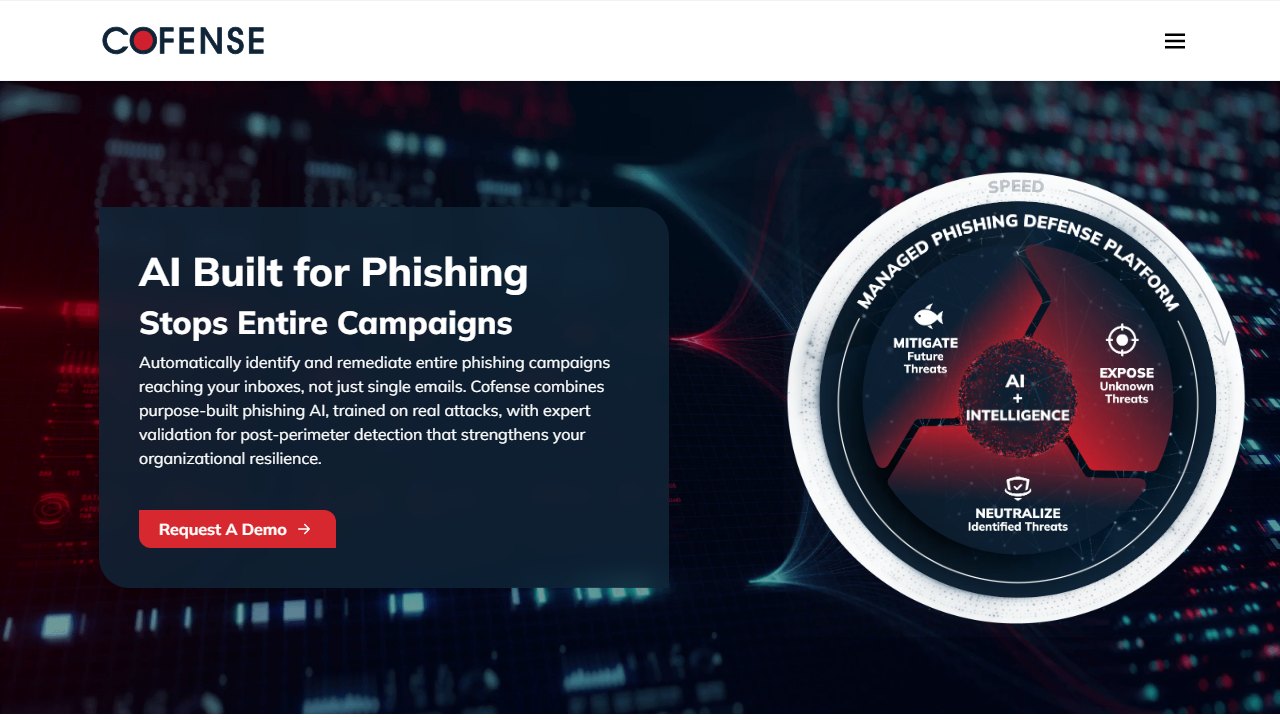
Cofense comes at the problem from the reporting side. Its heritage is PhishMe simulation and a reporting and triage workflow calibrated against live global phishing activity, so the emphasis is less on flashy content and more on turning employees into reliable reporters and then triaging what they flag. That crowdsourced reporting network is genuinely differentiated: real employee reports feed intelligence that improves detection.
For a security operations team, this framing is attractive because it treats awareness as a detection layer, not just an education requirement. The people who report the odd email become an early warning system, and Cofense’s tooling is built to make that signal useful rather than noise.
Who it is for: teams that prioritize real world phishing reporting and want awareness tightly connected to their SOC and incident response.
Honest limitation: the broader awareness content experience is less gamified and story driven than NINJIO or Hoxhunt, so if engagement is your weak point you may need to work harder on adoption.
Pricing model: per seat and quote based.
Phished
Phished leans hardest into hands off automation. It runs automated behavioral training built around a human risk score for each employee, generating simulations and follow up micro training with minimal manual campaign management. The idea is that an admin sets the program up and the platform decides who gets what, when, based on each person’s demonstrated risk. It also pairs the training with checks aimed at reducing the broader attack surface, positioning itself as behavior change plus practical safeguards.
Who it is for: smaller and mid sized teams that want a modern, largely automated program and a single risk number to report to leadership, without a dedicated awareness manager.
Honest limitation: it is less known in North America than the incumbents and has a smaller content and compliance library, so heavily regulated enterprises should verify framework coverage before committing.
Pricing model: per seat and quote based.
Authoring tools and the per author licence model
Course authoring is priced per author per year, not per learner, which makes it one of the easier budgets to calculate and one of the more expensive to get wrong. Here is where best ai sits, read 4 September 2026.
iSpring publishes the clearest per author rates
iSpring publishes iSpring Suite at $970 USD per author per year, iSpring Suite AI at $1,290 and iSpring Cloud AI at $720. Because the meter is authors rather than learners, the arithmetic is simple: two instructional designers on Suite AI is $2,580 a year regardless of whether you train fifty people or five thousand. That is the friendliest structure in this category for an organisation with a large workforce and a small L&D team.
Articulate is currently showing a limited-time offer, not a standard price
This one needs care. Articulate‘s canonical pricing URL redirected us to a special offer page on 4 September 2026, showing $1,198 USD per user per year against a struck-through $1,749, described as 31% off and a limited time offer, with an FAQ headed “Who is eligible for this special pricing offer?”. So the published figure is promotional. Ask what the price is outside the offer and what it renews at, because a 31% discount in year one against an undiscounted year two is a materially different deal from a $1,198 rate card.
The add-ons are priced separately and are not small
Articulate publishes Localization starting at $5,000 a year and Reach Pro starting at $3,600 for 1,200 active learners a year. Localization is the one that surprises people: if you train a multilingual workforce, translation management can cost more than the authoring seats. Price the combination you would actually deploy rather than the headline seat.
Per author is only cheap if authoring is centralised
The model rewards a small team of dedicated designers and punishes a federated approach where every department wants to build its own content. Decide which you are before buying. If fifteen people across the business each need to publish occasionally, a per author licence is the wrong shape and you should be looking at a tool priced differently, or accepting a bottleneck by design.
How to choose
Start with the threat you are actually most exposed to. If your executives and finance staff are impersonation targets, weight deepfake and voice simulation heavily and look hard at Adaptive Security and KnowBe4’s deepfake agent. If your problem is that nobody engages with training, the story led NINJIO or the gamified Hoxhunt model will move the needle further than another content library.
Then decide how much program you want to run. A lean team or MSP is usually better served by a managed model like Huntress than by the most configurable enterprise console, because unused configurability is just cost. And remember that phishing simulation and formal compliance training are two different jobs. Most mature programs pair an engagement engine here with a deeper compliance catalog, which is exactly why we cover them separately. If you are building the whole program from scratch, our guide on how to build an AI training program walks through sequencing, and for the wider skilling picture see our AI onboarding tools roundup for getting new hires secure from day one.
Finally, insist on measurement. The platforms worth their price can show behavior change over time, not just completion rates. Ask every vendor to prove, with their own data, that click rates fall and reporting rises across the training curve. That single question separates the real AI platforms from the video libraries wearing an AI badge.

Written by
FazFaz is the founder of AIToolsBakery. Some tools here are tested hands on. Others are assessed from vendor documentation and pricing verified on the live page, and every review says which one it is. Sponsors can buy a position in a guide. They cannot buy the score, the criticism, or silence about a better option.
How we test and how we make money →