Search for an AI singing app and you mostly find tools that generate an AI singer, not ones that help you sing better. Search for an AI vocal coach and the top results include lists written by vocal coach apps that rank themselves first. Neither helps much if you just want to know which app will actually improve your voice.
The bigger issue is a split in the category itself. The apps that build their whole product around AI, with chat coaches, voice profiles and written critiques, are almost all new and tiny: every one we found had fewer than 40 US App Store ratings. The apps millions of people actually use, such as Simply Sing, Smule and Yousician, say little or nothing about AI. This guide sets the two side by side and quotes what each vendor actually claims.
How we put this together. We have not used these apps ourselves; this is a research-based comparison. Every price, rating and feature below comes from the vendor’s own website or its US App Store and Google Play listing, read on 9 October 2026, and we link to each source. App Store prices are US in-app purchase prices in US dollars. Nothing here is a test result, and user numbers quoted from vendors are their own figures.
What “AI vocal coach” means in practice
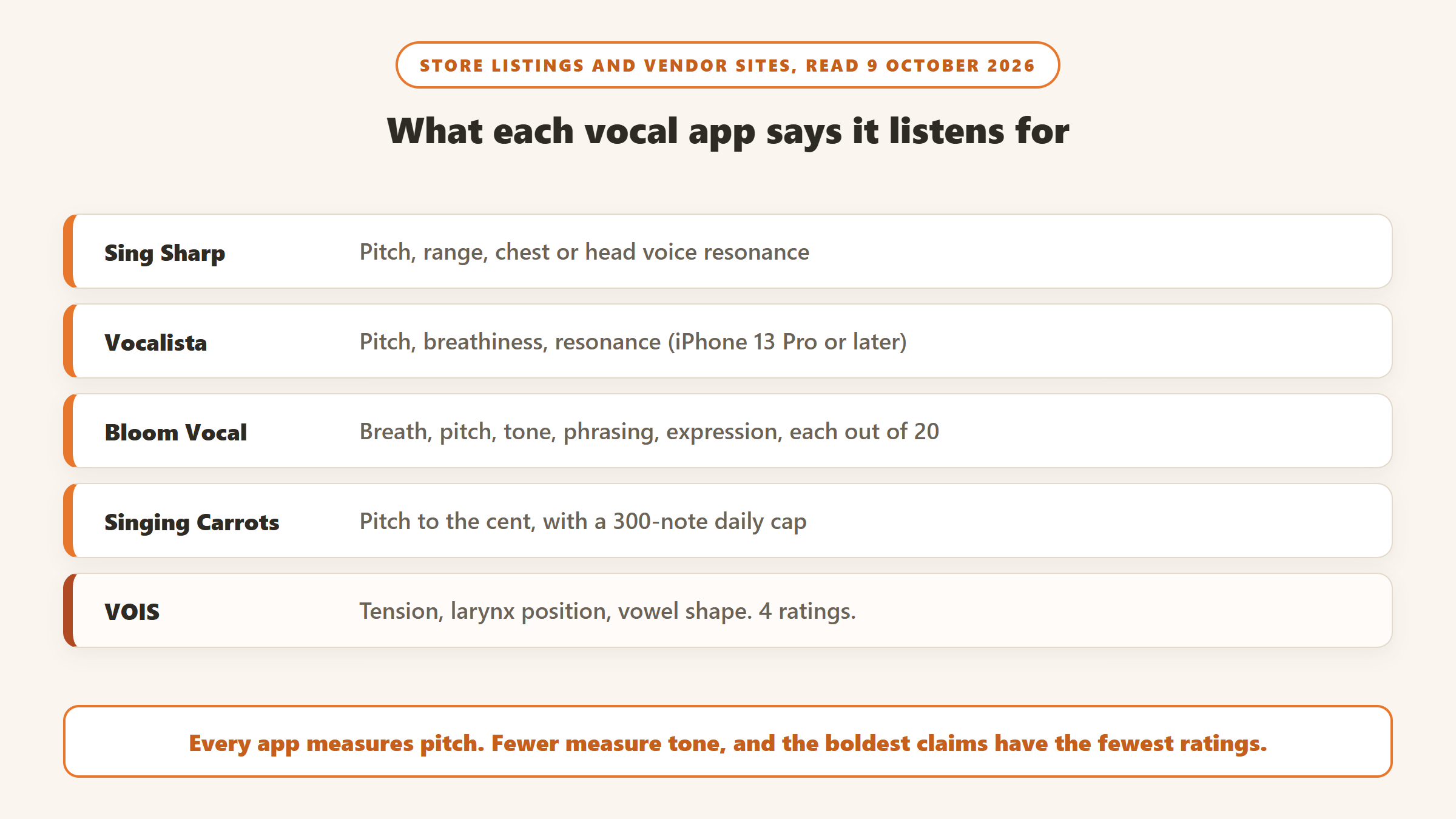
Every singing app measures pitch. That part is standard audio analysis, and it is what turns a line green when you hit the note. The AI label means something more than that, and the apps here sit at three levels.
Pitch detection with smart exercises
The app hears whether you are sharp or flat, tests your range, and keeps exercises inside it. Sing Sharp and Vocalista work this way, and both say AI powers their analysis. Simply Sing and Yousician do something similar without calling it AI.
Feedback on tone, not just pitch
A step up is analysis of how you sound: breathiness, resonance, chest versus head voice, phrasing. Vocalista’s iPhone app scores breathiness and resonance, and Bloom Vocal gives a five-part critique of a recording with timestamps.
A coach you can talk to
The newest apps add a chat coach that remembers your voice, sets a daily plan and answers questions. Singing Carrots and Singing Coach AI do this. They are the closest thing to a teacher in an app, and also the least proven.
AI vocal coach apps compared
| App | What the AI does | Price (US) | Free option | Platforms | US App Store ratings |
|---|---|---|---|---|---|
| Sing Sharp | AI audio analysis, range test, adaptive exercises | $19.99/mo, $39.99/3 mo or $99.99/yr | Free download with ads | iPhone, Android | 4.3 (13,650) |
| Simply Sing | Finds your voice type, adjusts songs, feedback (not called AI) | Premium from $4.99 to $89.99 | Free download | iPhone, Android | 4.7 (450,058) |
| Singing Carrots | Chat coach, daily plan, real-time pitch | From $119.99/yr (vendor blog); prices behind login | Range and pitch tests | Web, iPhone, Android (members) | 4.0 (7) |
| Vocalista | Pitch, breathiness and resonance feedback (iPhone) | Vocalista+ from $7.99 to $79.99 | Free download | iPhone, Android | 4.6 (3,217) |
| Bloom Vocal | Five-part critique of a recording | Credits from $5.99 (web) or $7.99 (App Store) | First analysis free | Web, iPhone, Android | No ratings yet |
| Singing Coach AI | Chat coach, voice profile, song reviews | $9.99, $39.99 or $99.99 a month | 3 song reviews a month | iPhone, Android | 3.9 (31) |
| Yousician | Real-time pitch feedback in a course (not called AI) | $19.99/mo or $119.99/yr | Free tier | iPhone, Android | 4.6 (138,649, whole app) |
| Smule | Karaoke with pitch guidance, optional AI tools | VIP from $5.99 | Free with limits | iPhone, Android | 4.5 (181,650) |
| VOIS | Claims tension, larynx and vowel analysis | $14.99 to $19.99/mo | Not stated | iPhone | 3.8 (4) |
Prices and ratings read on 9 October 2026. Apple’s in-app purchase lists mix current, introductory and older prices, so we give ranges where the labels are unclear. Check the price in the app before you subscribe.
How we chose and ordered these
Every app had to listen to your singing and respond to it, with exercises, feedback or coaching. Pure karaoke with no feedback, voice changers and AI singer generators were left out. We ordered them by how well the vendor explains what its analysis does, weighted by public evidence (ratings volume, installs, recent updates), then price. We left out apps we could not find in US stores and apps not updated in over a year. None of these vendors paid for placement on this page.
1. Sing Sharp: the most established AI vocal trainer
Sing Sharp has been on the App Store since 2013, with a 4.3 average from 13,650 US ratings and 4.3 from 87,317 reviews on Google Play, where it has over a million installs. Its listing says it “listens while you sing, powered by advanced AI audio analysis.” It tests your vocal range, shows your pitch as you sing, visualises resonance so you can see whether you are in chest or head voice, and generates exercises that keep “every vocal exercise inside your safe range.”
That last point matters more than it sounds. The most common way to hurt your voice with an app is to push into notes you cannot yet reach, and an app that adapts exercises to your measured range guards against that.
Membership in the US App Store was $19.99 for a month, $39.99 for three months or $99.99 for a year, with a $2.99 purchase to remove ads.
Choose it if you want structured vocal exercises with AI analysis and a long track record. Skip it if you mainly want to sing songs rather than exercises.
2. Simply Sing: the biggest audience, singing real songs
Simply Sing, from the makers of Simply Piano, has a 4.7 average from 450,058 US ratings and more than 10 million Android installs, far more than any dedicated vocal coach. In its own words, “the app finds your voice type, adjusts songs to you, and gives feedback to help you sing them better.”
Neither store description calls that AI, so treat it as a well-proven feedback app rather than an AI coach. It is built around singing songs you know, which keeps many people practising longer than scales do. Premium in-app purchases ranged from $4.99 to $89.99 in the US App Store, a mix of monthly, yearly and offer prices.
Choose it if you want to enjoy singing songs and get better along the way. Skip it if you want technique work on breath and tone.
3. Singing Carrots: the most complete AI coach, with little track record
Singing Carrots offers the fullest AI coaching we found. Its App Store listing invites you to “have a real conversation with your AI vocal coach”, which “listens to you sing, gives you feedback as you go, sets your daily plan, and adapts to your voice and your pace.” Its sample feedback is precise, such as a note sung 15 cents flat, and it caps daily practice at 300 notes to protect your voice. Its Google Play listing says your singing is analysed on your device and that the coach’s written replies are generated by AI.
The caveats are important. Singing Carrots began as a website, which it says works in any modern browser, and its iPhone app only launched in June 2026, with 7 US ratings averaging 4.0 on 9 October. Its Android app requires an existing Pro account and showed almost no downloads. Prices are behind a login; its own blog says plans start from $119.99 a year. A free account includes a range test, a pitch accuracy test and introductory coaching.
Singing Carrots also publishes several “best AI vocal coach” lists that rank itself first, and it reports large user numbers and progress results from its own data. We cannot verify those figures.
Choose it if you want an AI coach that plans your practice and you are happy to start in a browser. Skip it if you want a mature mobile app with clear pricing.
4. Vocalista: tone feedback, if you have a recent iPhone
Vocalista is an exercise app with a 4.6 average from 3,217 US ratings and frequent updates. Its iPhone listing promises “AI-powered feedback” with “insights on your pitch, breathiness, and resonance after each exercise”, which goes beyond pitch into how your voice sounds.
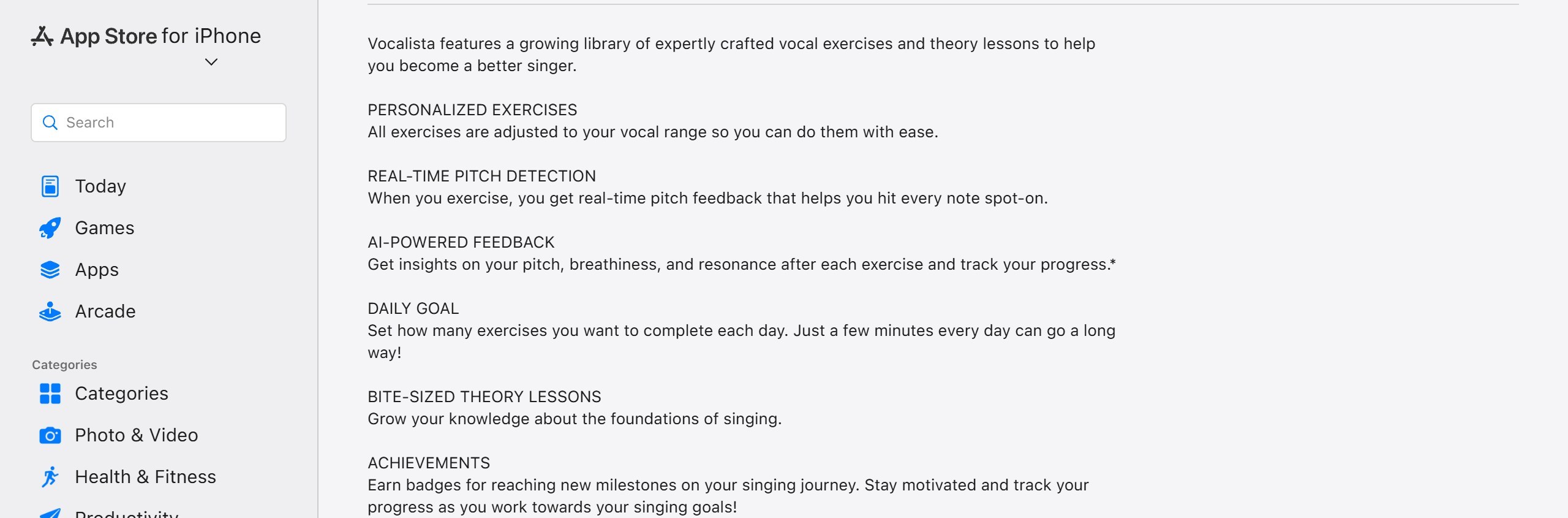
Two catches. Breathiness and resonance detection need an iPhone 13 Pro or any iPhone 14 or later, according to the listing’s own footnote. And its Google Play listing describes pitch detection and range-adjusted exercises but no AI feedback section, so on Android you may get less. Vocalista+ ranged from $7.99 to $79.99 in the US App Store.
Choose it if you have a recent iPhone and want feedback on tone, not just pitch. Skip it if you are on Android or an older phone.
5. Bloom Vocal: a detailed critique of each recording
Bloom Vocal, from a Korean studio, calls itself “an AI vocal coach that remembers your voice.” Instead of live exercises, you record yourself and it scores five areas, “breath support, pitch accuracy, tone and register, rhythm and phrasing, and expression, each scored out of 20”, with feedback tied to timestamps in the recording. It then gives you one prioritised fix a week with exercises.
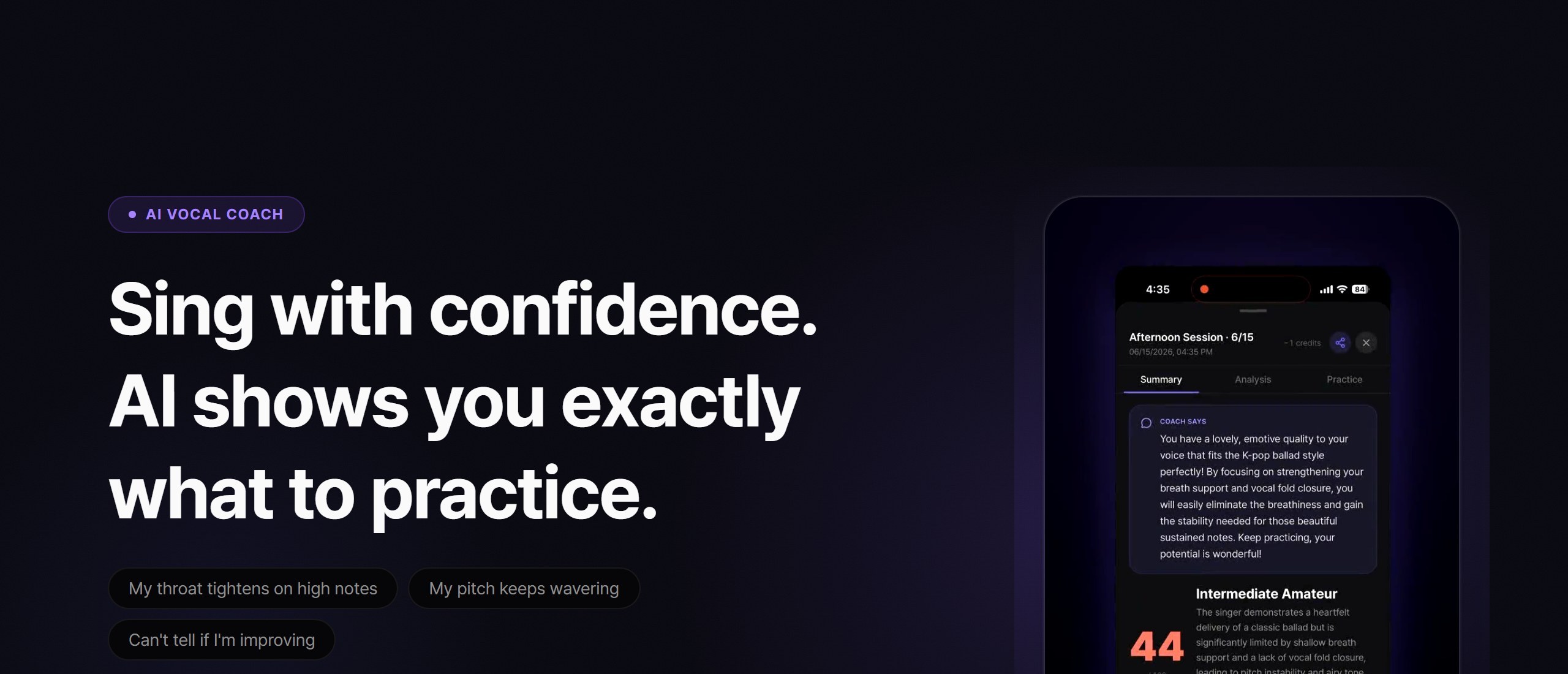
It charges by the minute. On its website the first analysis is free, and credit packs were $5.99, $14.99 and $29.99, with one credit covering one minute and credits that never expire. In the iPhone app the same packs cost $7.99, $19.99 and $39.99, about a third more, and the app also offers a $12.99 monthly subscription that the website does not mention. Buy credits on the web if you can. The iPhone app launched in August 2026 and had no ratings yet; on Android it had over 1,000 installs.
Choose it if you want a detailed written review of a song you have recorded. Skip it if you want daily guided exercises.
6. Singing Coach AI: chat coaching with a wide price ladder
Singing Coach AI lets you “chat with an AI coach that knows your voice”, builds what it calls a vocal profile from your recordings, reviews songs and suggests songs for your range. Its latest version added five coach personalities and live feedback as you sing.
Its price ladder is the widest here: free with three song reviews a month, then $9.99, $39.99 or $99.99 a month, with yearly plans in the US App Store up to $719.99. Its website claims more than 31,000 singers, against 31 ratings averaging 3.9 on the US App Store and over 10,000 installs on Google Play.
Choose it if you want a chat coach and the free tier covers what you need. Skip it if you are considering the top tiers; $99.99 a month is close to the cost of real lessons.
7. Yousician: singing inside a full music course
Yousician teaches singing alongside guitar, bass and piano, with “real-time feedback that listens as you play.” Its 4.6 average from 138,649 US ratings covers the whole app, not singing alone, and it makes no AI claim for its voice lessons. One instrument was $19.99 a month or $119.99 a year in the US App Store.
Choose it if you also play an instrument and want one subscription. Skip it if singing is your main focus.
8. Smule: a place to practise, not a coach
Smule is a karaoke and duet app with a 4.5 average from 181,650 US ratings and more than 100 million Android installs. It offers pitch guidance, key changes and “optional AI powered tools to refine tone and range”, but those are effects and practice aids rather than coaching. VIP was $5.99 to $12.99 in the US App Store, plus a $7.99 weekly pass.
Choose it if you want to sing often, with others, for fun. Skip it if you want to be taught.
9. VOIS: the deepest claims, the smallest footprint
VOIS: AI Vocal Coach makes the most technical claims in the category, including excess tension detection, larynx position analysis and vowel shape analysis. Those would be impressive if they hold up, but the app had a 3.8 average from just 4 US ratings on 9 October, and we found no matching Android app. An Android app with the same name is an unrelated voice changer. Monthly plans were $14.99 to $19.99, with a $4.99 weekly option.
Choose it if you want to experiment with technique analysis on iPhone. Skip it if you want evidence that it works.
Can ChatGPT give you singing lessons?
Partly. A general chatbot can explain breathing, warm-ups and technique, and suggest a practice routine. What it cannot do in a normal text chat is hear you, so it cannot tell you that you were 15 cents flat on a high note or that your tone got breathy. Even in voice mode, it is not built to measure pitch. The dedicated apps above exist because they listen and measure; a chatbot is best used alongside one for explanations.
What we left out, and why
Vocal Image often appears in AI vocal coach lists, but it is now a speaking coach. Vanido, VoCo and Singeo still appear in 2026 roundups, but we could not find them in US app store searches on 9 October. Erol Singer’s Studio is well rated but had not been updated since January 2025 and makes no AI claim. Swiftscales is a scale player without analysis.
What AI vocal coaches cannot do yet
Apps are very good at pitch and range, and getting better at tone. They cannot see your posture, your jaw or your shoulders, and they cannot feel tension in the way a teacher listening in the room often can. A voice is also easier to strain than a guitar string, which is why the better apps keep you inside your measured range and cap your daily practice.
Used well, these apps make daily practice structured and give you honest pitch feedback. If you feel hoarseness or pain, stop and see a teacher or a voice specialist; no app here claims to diagnose vocal problems.
Which AI vocal coach app should you pick?
If you are new to singing
Sing Sharp for range-safe exercises, or Simply Sing if you would rather learn through songs.
If you want an AI coach that plans your practice
Singing Carrots, starting with its free tests in a browser.
If you want feedback on your tone
Vocalista on a recent iPhone for exercises, or Bloom Vocal for a detailed review of a recorded song.
If you also play an instrument
Yousician, which covers singing and several instruments in one plan.
Learning an instrument too? Our guides to AI guitar apps and AI piano apps ask the same question about what each app actually hears.
Sources
- Sing Sharp: website, US App Store listing and Google Play listing. Simply Sing: US App Store listing and Google Play listing.
- Singing Carrots: AI singing coach page, US App Store listing and Google Play listing.
- Vocalista: website, US App Store listing and Google Play listing. Bloom Vocal: website, US App Store listing and Google Play listing.
- Singing Coach AI: website, US App Store listing and Google Play listing.
- US App Store listings for Yousician, Smule, VOIS and Erol Singer’s Studio. All read 9 October 2026.

Written by
FazFaz is the founder of AIToolsBakery. Some tools here are tested hands on. Others are assessed from vendor documentation and pricing verified on the live page, and every review says which one it is. Sponsors can buy a position in a guide. They cannot buy the score, the criticism, or silence about a better option.
How we test and how we make money →