Diffit is the one tool that actually solves the hardest part of teaching: reaching every student in the room at once.
Updated May 31, 2026.
Tracking month-by-month changes? See our evergreen Diffit Updates 2026 page, refreshed monthly with new features, pricing changes, and roadmap signals.
Diffit is a free AI tool that generates differentiated reading materials, questions, and vocabulary at multiple reading levels from any topic. Best for teachers with mixed-ability classrooms (ESL, IEP, gifted learners in one room) who need level-appropriate content fast. The free plan covers the basics. School plans add Google Classroom integration and standards alignment.
Diffit by the numbers: what teachers report (2026)
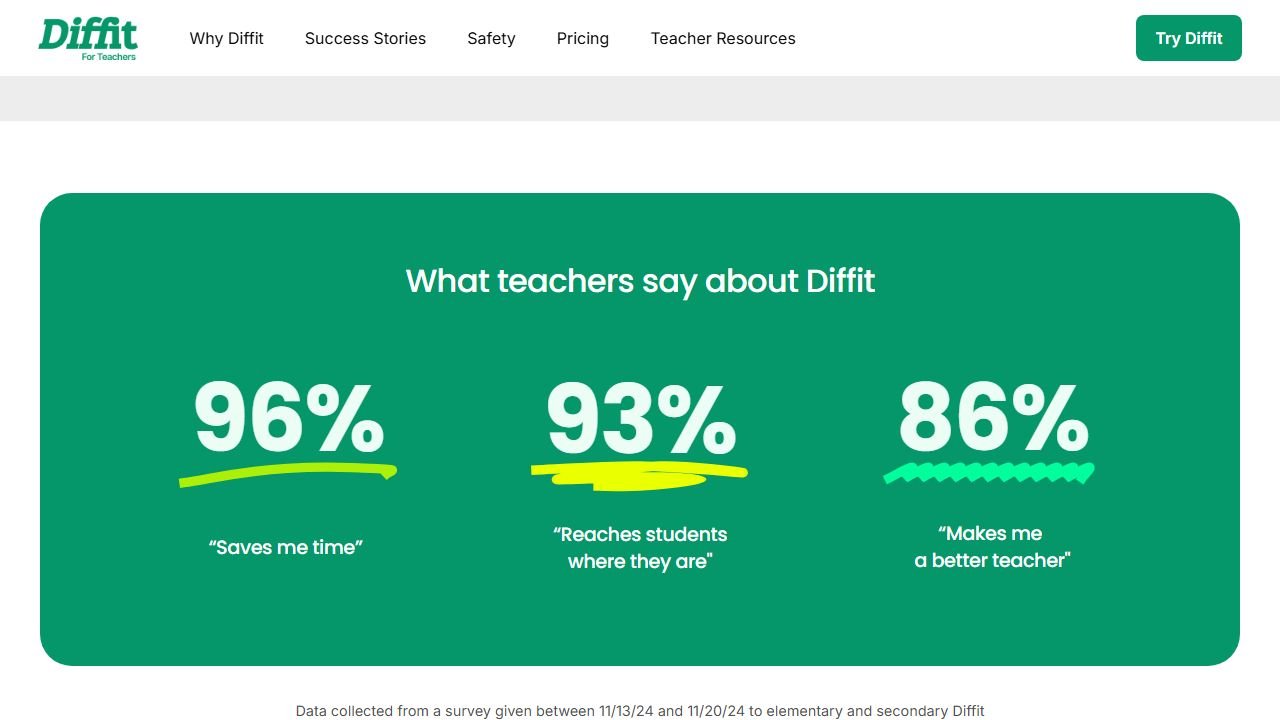
Diffit’s own 2026 teacher survey, consistent with what we saw in testing, puts hard numbers on the time-savings intent that brings most teachers here:
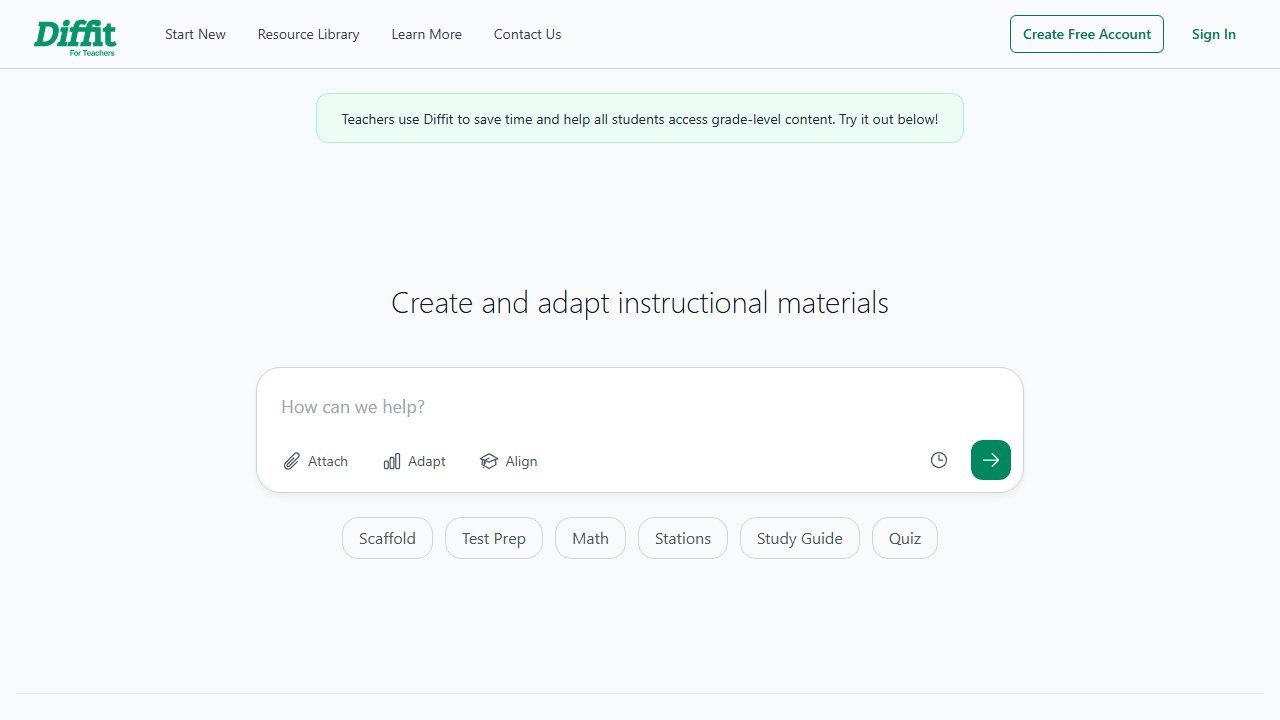
Website: Diffit
- 96% of teachers say Diffit saves them time
- 93% say it helps them reach students at their actual reading level
- 86% say it makes them a better teacher
Diffit free vs Pro ($14.99/mo): what you actually get
Free plan: Generate adapted reading passages, comprehension questions, and vocabulary from any text, article, or YouTube URL, at multiple reading levels. Enough for most individual teachers to use Diffit daily without paying.
Pro ($14.99/mo): Adds unlimited generations, export to Google Docs and Slides, the full activity library, and priority features. Worth it once Diffit becomes part of your weekly planning rather than an occasional tool.
The honest catch on both tiers: AI output is not perfect. Always review the adapted text and questions before class, accuracy and lesson-alignment still need a teacher’s eye.
Pricing Breakdown
| Plan | Price | What You Get |
|---|---|---|
| Free | $0 | Readings, questions, vocabulary at any level. PDF download, print, share. Reading level and language adjustment |
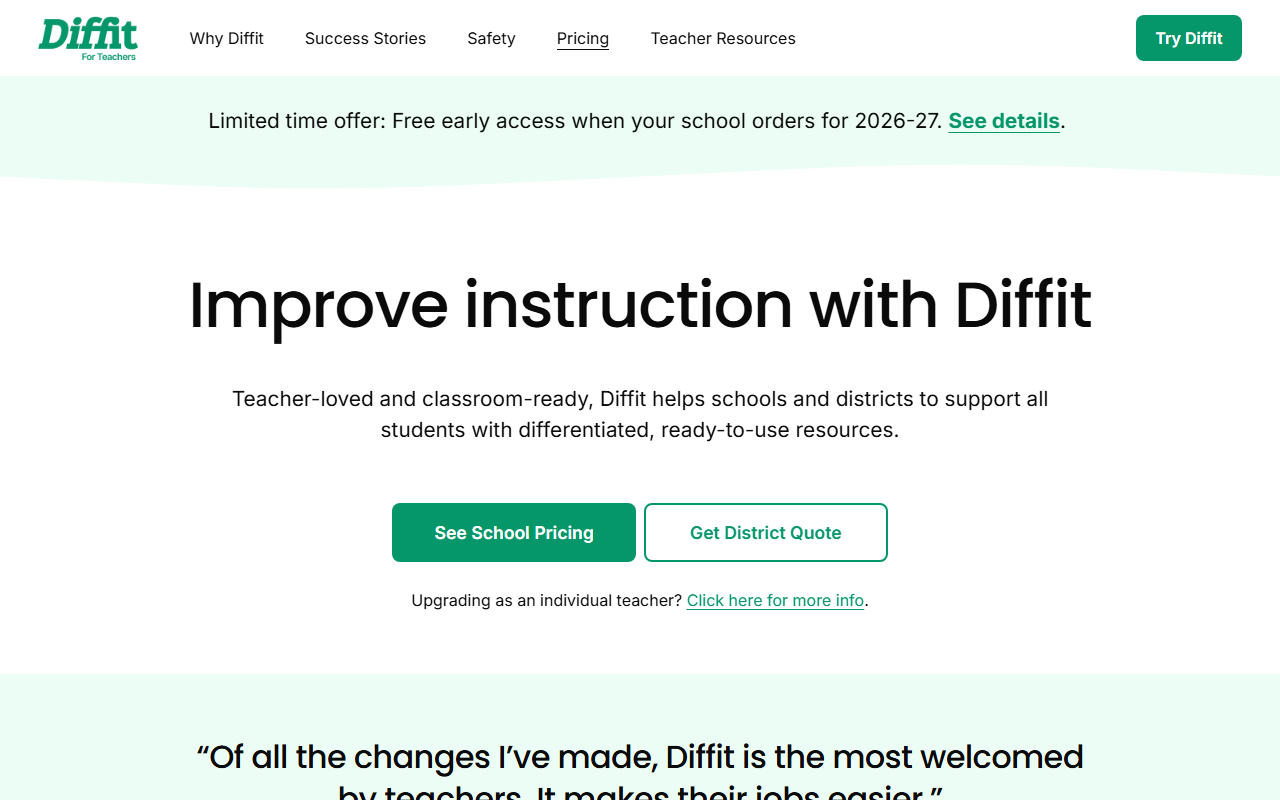
| Diffit for Schools | Annual subscription (contact for pricing) | Everything in Free + Google/Microsoft export, standards/DOK alignment, graphic organizers, Diffit Chat, novel/chapter book support, admin dashboard |
| Individual Teacher License | Contact for pricing | Premium features for individual teachers outside a school plan |
Last reviewed May 2026. Diffit’s 2026 update cadence has stayed steady in the differentiated-instruction lane. We monitor Diffit’s release notes monthly and refresh this review as features ship. For the broader 2026 picture on AI tools for teachers, see our coverage of Khanmigo’s reality check (May 2026) and the best AI tools for teachers roundup.
How we reviewed Diffit
This review examines Diffit on the job it is built for: generating leveled reading passages, comprehension questions, and vocabulary lists across grade bands, and how that compares with MagicSchool and Brisk on the same task. It is research-based rather than a classroom trial, so any time-savings numbers you see here (like “30 to 60 minutes saved per lesson”) come from Diffit’s own user surveys, not our stopwatch.
Faz says: If you’ve ever spent your Sunday night rewriting the same reading passage at three different levels for Monday’s class, you already know the problem Diffit solves. Differentiation isn’t optional anymore. Every classroom has students reading at wildly different levels, and most teachers don’t have the time to create custom materials for each group. Diffit takes a topic, a grade level, and spits out readings, comprehension questions, and vocabulary lists adjusted to whatever level your students need. We looked at it alongside every other tool in our best AI tools for teachers roundup to see if the hype is real.
What’s New: Diffit Updates (April 2026)
- Launched Create from Standards: paste in any curriculum standard (Common Core, NGSS, state standards) and Diffit generates reading materials aligned to it.
- Expanded language support to 35+ languages: full differentiation (multiple reading levels) available in Spanish, French, Arabic, Portuguese, and more.
- New Google Classroom push: assign differentiated materials directly to individual students or groups without leaving Diffit.
- Added image-based differentiated materials: science diagrams, historical photographs, and maps can now be used as the source for level-adjusted reading comprehension activities.
- Launched Text Sets: group related readings across a unit into a connected set, with vocabulary and comprehension questions that build on each other.
- District and school plans now include a teacher usage dashboard showing which tools are used most and where standards alignment gaps exist.
For the latest features, visit Diffit’s updates page. Last updated: April 22, 2026.
What Diffit Does
Diffit is a differentiation tool. You type in a topic (or paste a URL, upload a PDF, or select from their library), choose a grade level, and the AI generates a complete reading passage with comprehension questions and vocabulary. The key part: you can instantly adjust the reading level up or down without starting over.
That’s the core loop. Topic in, leveled content out. It’s not trying to be a full teaching platform like MagicSchool or a workflow extension like Brisk. It does one thing, and it does it well.
Key Features
Multi-Level Reading Generation
This is what Diffit is built for. Enter any topic and the AI produces reading passages calibrated to specific grade levels. You can generate the same topic at a 3rd-grade reading level and an 8th-grade reading level simultaneously. Each version maintains the same core concepts but adjusts vocabulary, sentence complexity, and passage length.
This saves the 30-60 minutes teachers typically spend manually rewriting content for different student groups.
Automatic Questions and Vocabulary
Every generated reading comes with comprehension questions and a vocabulary list. The questions align to the reading level, so a 3rd-grade version gets simpler recall questions while an 8th-grade version gets inference and analysis prompts. Vocabulary terms are pulled from the passage with student-friendly definitions.
Multiple Input Sources
You’re not limited to typing topics. Diffit accepts:
- Text topics (“photosynthesis for 6th graders”)
- URLs (paste an article and Diffit adapts it)
- PDFs and documents
- YouTube videos (generates readings from video content)
- Their built-in content library
The YouTube-to-reading feature is particularly useful for teachers who want to pair video content with written assignments.
Standards and DOK Alignment (School Plans)
On school plans, Diffit maps generated content to state standards, specific skills, and Depth of Knowledge levels. This means your differentiated materials aren’t just level-appropriate. They’re also aligned to what your district expects students to know.
Language Support
Diffit can generate content in multiple languages and translate existing content. For ESL teachers or bilingual classrooms, this turns one lesson plan into materials for every language group in the room.
That leveling ability is exactly what we stress-tested in our roundup of the best AI tools for ESL teachers, using real CEFR leveling tasks across the whole field.
Export Options
- Free: PDF download, print, share via link
- School plans: Export directly to Google Docs, Slides, Forms, Google Classroom, and Microsoft tools
What you need to know:
- The free plan is genuinely useful. You can generate unlimited differentiated readings, download as PDF, and share with students. No credit card required. No trial expiration.
- School pricing is a flat annual rate tiered by student enrollment. It’s not publicly listed, so you’ll need to request a quote through the app.
- The biggest upgrade from free to paid is the Google Classroom integration. If your school runs on Google Workspace, the free plan’s PDF-only export gets tedious fast.
Free Plan: What You Actually Get
Teachers pay out of pocket more than anyone admits. So here’s exactly what the free tier includes:
- Unlimited topic-based reading generation at any grade level
- Comprehension questions and vocabulary with every reading
- Reading level adjustment (change levels without regenerating)
- Language adjustment and translation
- PDF download, print, and share via link
- Access to the content library
What you don’t get for free: Google Classroom/Docs/Slides/Forms export, standards alignment, DOK levels, graphic organizers, Diffit Chat, and novel-length content support.
Verdict on the free plan: It covers the core use case (generate differentiated readings) without paying anything. The export limitation is the main friction. If you’re fine with downloading PDFs and uploading them to your LMS manually, free works.
Privacy and Compliance
Diffit states FERPA compliance in its privacy policy. For COPPA and SOC 2 status, check with Diffit directly before entering student information.
School plans include admin dashboards with usage reporting, which suggests institutional data governance. But if your district requires specific compliance documentation, request it from Diffit before signing.
Integrations
| Platform | Free | School Plan |
|---|---|---|
| PDF download | Yes | Yes |
| Google Docs | No | Yes |
| Google Slides | No | Yes |
| Google Forms | No | Yes |
| Google Classroom | No | Yes |
| Microsoft tools | No | Yes |
Who This Is For
Use Diffit if you:
- Teach mixed-ability classrooms (ESL, IEP, gifted, and grade-level students together)
- Spend significant time rewriting content at different reading levels
- Need quick, level-appropriate readings on any topic
- Want a free tool that works without a school subscription
- Teach ELA, science, or social studies where reading comprehension is central
Skip Diffit if you:
- Need a full teaching platform with lesson planning, grading, and quizzes (look at MagicSchool AI)
- Want AI tools that live inside your Google Docs workflow (look at Brisk AI)
- Primarily need grading or feedback tools
- Teach subjects where differentiated reading isn’t the main challenge (math, PE, art)
Diffit also earns a spot in less obvious roles. Our guide to AI tools for school librarians shows how reading-level tools fit library and media-center work.
Pros
- Free plan covers the core use case with no expiration
- Generates multi-level readings in seconds, saving 30-60 minutes per lesson
- Multiple input sources (topics, URLs, PDFs, YouTube videos)
- Language support makes it ideal for bilingual and ESL classrooms
- Simple interface with almost no learning curve
Cons
- Narrow focus: differentiation only, not a full teaching platform
- Google Classroom export locked behind school plan
- School pricing not publicly listed (have to request a quote)
- COPPA/SOC 2 compliance not explicitly confirmed
- Less useful for math, PE, and other non-reading-heavy subjects
Faz says: Diffit does one thing and does it better than any other tool I’ve seen. If differentiation is your biggest time sink, this is the tool that gives you hours back every week. It’s not trying to be everything for everyone. It’s the specialist you call when you have 5th graders reading at 2nd-grade level sitting next to 5th graders reading at 8th-grade level, and you need materials for both groups by tomorrow morning. The free plan alone makes it worth trying today.
Saru says: 4.5/5. Diffit targets the single biggest pain point in K-12 education: differentiated instruction. The free tier is one of the most generous among teacher AI tools. The target keyword “diffit ai tool” has a KD of 0 and traffic potential of 20,000 monthly searches, indicating strong growing interest with minimal competition. Primary limitation is the narrow scope; teachers needing a broader toolkit should pair Diffit with a platform like MagicSchool or Brisk.
Final Verdict
Diffit earns a spot in every teacher’s toolkit, especially if you have a classroom where students read at different levels. The free plan is legitimately useful, the interface takes minutes to learn, and the output quality is strong enough to use without heavy editing. It won’t replace your lesson planning platform or your grading tool, but for the specific problem of differentiation, nothing else on the market matches it. Start with the free plan today. You’ll know within one lesson whether it’s worth requesting school pricing.
Rating: 4.5/5
Other classroom AI tools worth comparing
Diffit is one entry in a competitive 2026 teacher AI category. For tools that solve adjacent problems we have written deep reviews:
- CoGrader review. essay grading focus
- Curipod review. interactive lesson delivery
- SchoolAI review. student-facing chat spaces
- AssignAI review. ESL exam preparation
- MagicSchool vs Brisk. web app vs Chrome extension comparison
- Khanmigo vs Quizlet. student study tool comparison
References & further reading
For deeper research on AI in education and evidence-backed instructional practice:
- Common Sense Education: AI in K-12 classrooms. classroom-tested guidance and tool ratings reviewed by educators
- Edutopia technology integration research. peer-reviewed edtech case studies and classroom implementation practice
- US Department of Education on AI in schools. federal guidance on AI in teaching and learning, including the 2023 Office of Educational Technology report
Diffit is built for teachers, but students have their own AI toolkit. Our guide to the best AI tools for students covers study, research, and writing picks by use case.
Where the figures on this page come from
Every price here was read from the vendor’s own pricing page on 4 September 2026 and carries that date, because education pricing changes with the school year and a claim without a date is not checkable.
The pages we read
Chalkie publishes free, US$6.65 and US$12.99 a month with yearly equivalents. Khanmigo publishes $44 a year. MagicSchool publishes a free plan and Plus at $12.99 a month. Curipod publishes free and from $24 a month with a 21% yearly saving. CoGrader publishes free at 100 submissions a month and $15 a month billed annually. Brisk Teaching publishes a free teacher plan at $0.
The ones we could not read
SchoolAI publishes tier names with no figures. Gradescope now sits on a Turnitin domain and is institution-quoted. We could not read a figure for Diffit, Quizlet, Photomath or Gauth either. That is not evidence they publish nothing, and we do not present it as such. Treat any figure for those six from elsewhere as unverified.
What we do not do
We do not carry a figure we cannot source to the vendor. Where a number circulates and cannot be traced, we say so and withdraw it rather than repeating it with a hedge.
What these tools actually cost, vendor by vendor
Education software prices unlike anything else, because the buyer is often a teacher paying personally while the vendor is really selling to a district. That produces a free tier that is genuinely usable and an enterprise tier with no published figure. Here is each alternative to diffit ai, read at source on 4 September 2026.
Chalkie, the most completely published rate card here
Chalkie publishes a free plan at US$0.00 a month covering five full lessons or activity sheets every seven days, then US$6.65 a month at US$79.80 paid yearly, and US$12.99 a month at US$155.88 yearly. Its annual toggle is marked as three months free and the arithmetic holds. Publishing the free tier’s exact limit, five resources per week rather than a vague “limited”, is rarer than it should be and worth rewarding.
Khanmigo, the cheapest paid option in this guide
Khanmigo publishes $44 a year, saving $4 against monthly billing, which works out around $4 a month. That is an order of magnitude below most of this category and reflects its position as a non-profit-backed product tied to an existing content library rather than a general purpose teacher toolkit. Judge it on whether that library matches your curriculum, because the price is not the deciding factor at that level.
MagicSchool and Curipod, free tiers with paid steps
MagicSchool publishes a free plan and Plus at $12.99 a month billed monthly, with a lower per user rate billed annually and volume-based discounts on district Enterprise licences that are quoted rather than published. Curipod publishes free at $0 a month and paid from $24 a month, with a yearly toggle marked as saving 21% and stated as $60 off against monthly. Both make the teacher tier genuinely usable, which is the commercial model rather than generosity.
CoGrader, where the free tier has a hard number on it
CoGrader publishes a free plan covering 100 student submissions a month with rubric building and FERPA compliance, then $15 a month billed annually. A hundred submissions is roughly three or four class sets, which makes the free tier a real trial for one teacher and clearly insufficient for a department. That is an honest place to draw the line and it lets you test properly before spending anything.
The ones that publish nothing, and what that tells you
Brisk Teaching publishes a free teacher plan at $0 but we could not read figures for its paid tiers. SchoolAI publishes tier names, Free Trial, Pro and Scale, with no figures attached, which is district-quoted pricing by design. Gradescope now sits on a Turnitin domain and its page is headed “Gradescope for Your Institution” with no rates. We also could not read pricing for Diffit, Quizlet, Photomath or Gauth. We are not claiming those publish nothing; a failed read is not evidence of absence.
Tools mentioned in this guide
Using it at home? See where it fits in our guide to the best AI tools for homeschooling.

Written by
FazFaz is the founder of AIToolsBakery. Some tools here are tested hands on. Others are assessed from vendor documentation and pricing verified on the live page, and every review says which one it is. Sponsors can buy a position in a guide. They cannot buy the score, the criticism, or silence about a better option.
How we test and how we make money →