Practice management software is the operational backbone of a law firm. It is where matters, time entries, billing, documents, client intake, and trust accounting all live, and where a disorganized firm becomes an organized one. When it works, an attorney opens one system in the morning and sees every deadline, every unbilled hour, and every client message in one place. When it does not, the firm leaks billable time, misses trust-accounting rules, and loses clients to slow follow-up. The category is mature, but the products vary widely in who they serve and how deep they go.
The differentiator in 2026 is real AI plus fit. Almost every vendor now advertises an “AI assistant,” but there is a wide gap between a genuine tool that drafts correspondence, summarizes a matter, and clears admin work, and a checkbox that summarizes an email and calls it innovation. Just as important is how well each platform matches your firm: a solo practitioner, a document-heavy estate shop, and a personal-injury litigation team have very different needs. Below, the tools are ranked with firm-size fit and AI substance weighted first, with honest notes on cost and where each one falls short.
Top pick: Clio is the best legal practice management software overall in 2026, with Clio Duo AI, the largest integration ecosystem, and vLex-powered research behind it. MyCase is the best choice for solo and small firms on a budget, and Filevine is the best for litigation and personal injury work.
Faz says: The real decision here is built-in-everything versus best-of-breed integrations. All-in-one platforms like CARET Legal and CosmoLex fold accounting straight into practice management, so you never touch QuickBooks. Others, led by Clio, keep the core lean and lean on a huge integration marketplace so you bolt on exactly the tools you want. Neither is wrong; it depends on whether you would rather have one login or one best tool per job. And ignore the AI marketing. Ask the vendor to show you the assistant drafting a real document or summarizing a real matter live, not on a slide. If it cannot, the “AI” is a checkbox, not an assistant.
Saru says: This ranking draws on each vendor’s official product and pricing pages, published AI feature documentation, and aggregated user feedback, current to 2026. Pricing in this category changes often and usually depends on billing frequency (annual is cheaper than monthly) and firm size, so treat every figure here as a starting point as of 2026 and confirm the current per-user price with the vendor before you buy.
How We Ranked These
Practice management software earns its place by running the firm reliably, staying compliant, and saving real time, not by having the longest feature list. We weighted six things:
1. Firm-size fit. A solo attorney and a 200-lawyer firm need different tools. We placed each product by the firm size where it is genuinely the best answer, not where it technically works.
2. AI features. Real drafting, summarizing, and admin automation count. Marketing labels do not. We noted where the AI is a genuine assistant and where it is early or thin.
3. Billing and trust accounting. Time capture, invoicing, payments, and IOLTA-safe trust accounting are the money functions. Getting them right is non-negotiable for a law firm.
4. Integrations. Whether you go all-in-one or best-of-breed, the platform has to connect to the tools you already depend on, from document management to payments to research.
5. Ease of use. Software the whole firm actually adopts beats a powerful system that only the tech-savvy partner opens. Adoption is where value is won or lost.
6. Price. We flag the model and starting price as of 2026, with the caveat that pricing shifts and depends on billing frequency and firm size.
Comparison Table
| Tool | Best for | Starting price (as of 2026) | AI assistant |
|---|---|---|---|
| Clio | Firms of every size, best overall | Around $49 to $149/user/mo | Clio Duo, plus vLex research |
| MyCase | Solo and small firms | Around $39 to $89/user/mo | MyCase IQ |
| Smokeball | Document-heavy small firms | Quote-based tiers | Yes, drafting features |
| Filevine | Litigation and personal injury | Quote-based | Yes, AI add-ons |
| PracticePanther | Ease of use and value | Around $49/user/mo | Growing |
| CARET Legal | All-in-one with accounting | Around $79/user/mo | Yes |
| Rocket Matter | Billing and legal accounting | Around $49/user/mo | Growing |
| CosmoLex | Built-in trust and accounting | Around $89/user/mo | Growing |
Prices vary by billing frequency and firm size and change over time. Confirm current pricing with each vendor.
1. Clio: Best Overall
Clio is the market leader, and it earns the top spot for firms of nearly every size. Its strength is breadth: a mature core for matters, time, billing, and trust accounting, wrapped in the largest integration ecosystem in legal tech, so you can connect almost anything you already use. On the AI side, Clio Duo acts as an in-app assistant for drafting, summarizing, and surfacing insights across your matters, and in 2025 Clio completed its roughly $1 billion acquisition of vLex, bringing the Vincent AI legal research engine into the platform. That combination, practice management plus real legal research AI, is a genuine advantage.
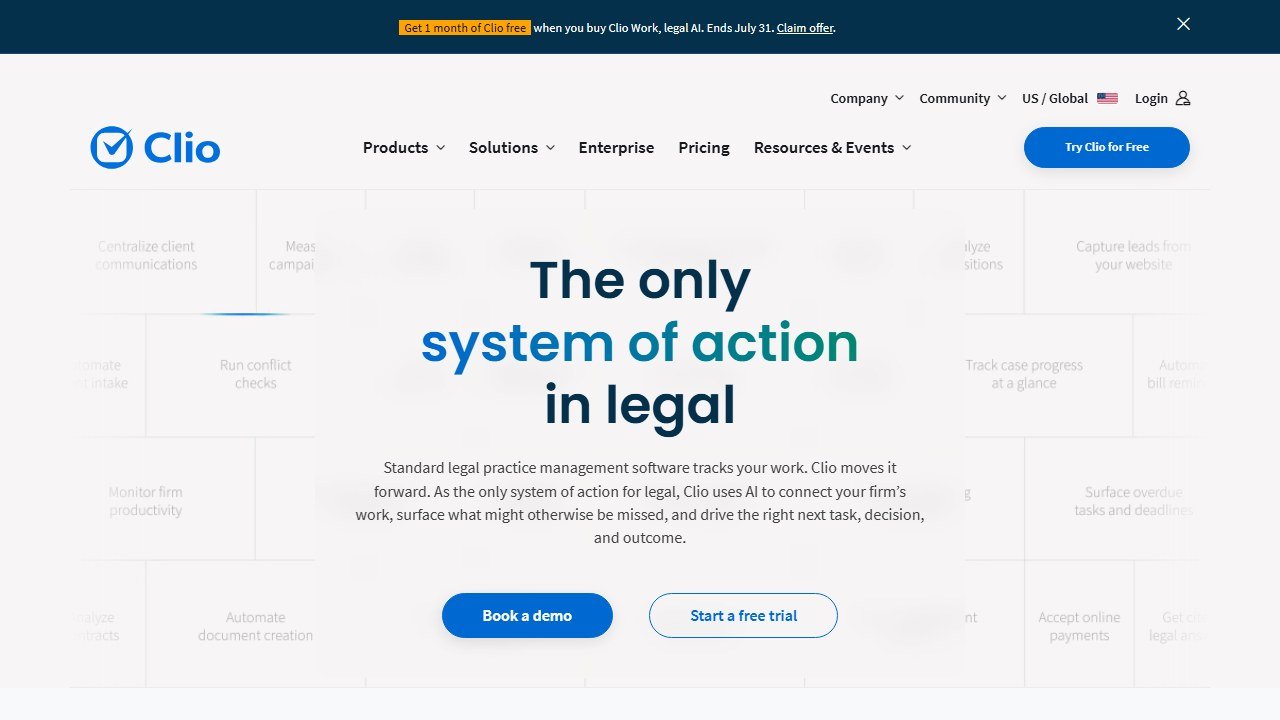
Pricing runs in tiers from EasyStart up to Complete, roughly $49 to $149 per user per month as of 2026, with the AI and advanced automation concentrated on the higher plans. That is not the cheapest option in the category, and the most useful features sit on the upper tiers. But for a firm that wants one platform that scales from solo to large, with the deepest integrations and the most serious AI investment behind it, Clio is the safest and strongest pick. See our full Clio review for the detailed look.
Best for: firms of any size that want the deepest ecosystem, strong AI, and room to scale.
Watch out for: the best AI and automation features live on the pricier tiers.
Clio’s tiers hide a few costs that only show up on the invoice, from Duo add-on pricing to annual versus monthly gaps. Our full Clio pricing breakdown runs the real numbers tier by tier.
2. MyCase: Best for Solo and Small Firms
MyCase is the go-to for solo practitioners and small firms that want a clean, complete tool without enterprise complexity or cost. It covers case management, calendaring, billing, client intake, and a well-regarded client portal, and it builds in payments natively as part of the AffiniPay and LawPay family, so getting paid is a first-class function rather than a bolt-on. Its AI, MyCase IQ, handles writing and document assistance and is one of the more accessibly priced AI offerings in the category.
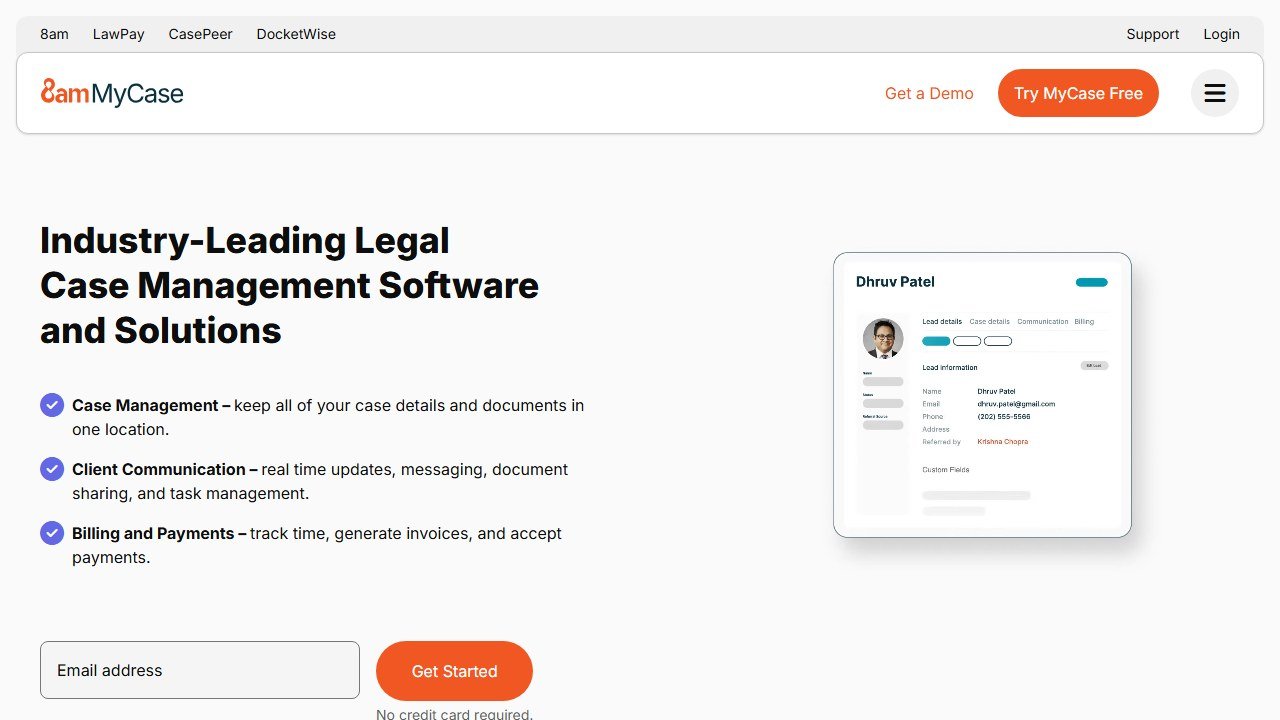
Pricing lands around $39 to $89 per user per month depending on tier and billing frequency as of 2026, which is friendly for a small firm watching every subscription. MyCase is less sprawling than Clio and has a smaller integration marketplace, but for a solo or small firm that values simplicity, built-in payments, and affordable AI over maximum extensibility, it is the better everyday fit. We compare the two head to head in Clio vs MyCase.
Best for: solo and small firms that want an affordable, easy all-in-one with built-in payments.
Watch out for: a smaller integration ecosystem than Clio’s.
3. Smokeball: Best for Document-Heavy Small Firms
Smokeball is built for small firms that live in documents: estate planning, family law, real estate, and similar practices that generate a high volume of forms and correspondence. Its standout is automatic time capture, which passively records the time you spend in every matter and application so billable hours stop slipping through the cracks, paired with deep Microsoft Word document automation that turns your templates into fast, consistent drafts. Its AI features extend that drafting and summarizing work.
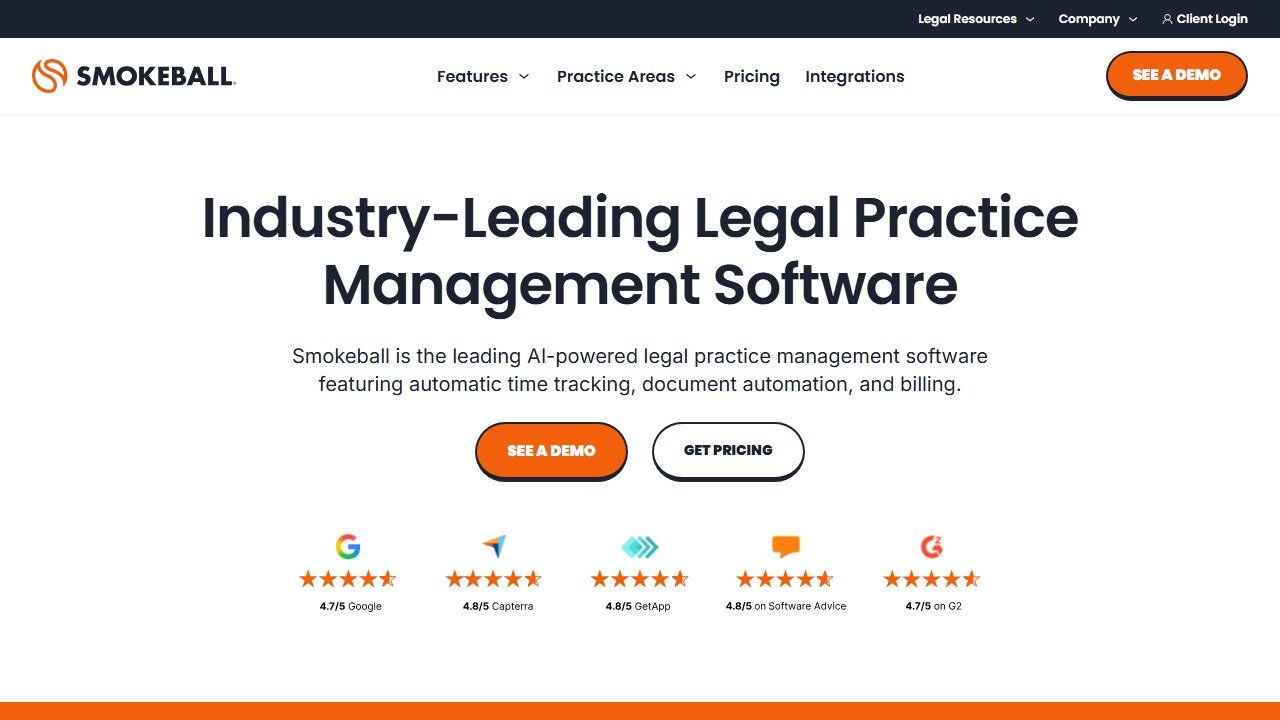
The honest limitation is scope and pricing transparency: Smokeball is priced by quote across its tiers, and its document-first design is a better fit for paperwork-heavy practices than for, say, a litigation shop that lives in case timelines. For the firms it targets, though, the automatic time capture alone can pay for the software by recovering hours that would otherwise go unbilled.
Best for: document-heavy small firms that want automatic time capture and Word automation.
Watch out for: quote-based pricing and a narrower fit outside paperwork-heavy practices.
4. Filevine: Best for Litigation and Personal Injury
Filevine is the pick for litigation-heavy and personal-injury firms, and it is built differently from the rest. Rather than a fixed matter template, it works more like a flexible case and project management platform, which suits the long, complex, milestone-driven workflows of PI, mass tort, and litigation. Firms handling large caseloads use it to track every case’s status, deadlines, and documents in a way generic practice management tools struggle to match, and it layers AI add-ons on top for drafting and analysis.
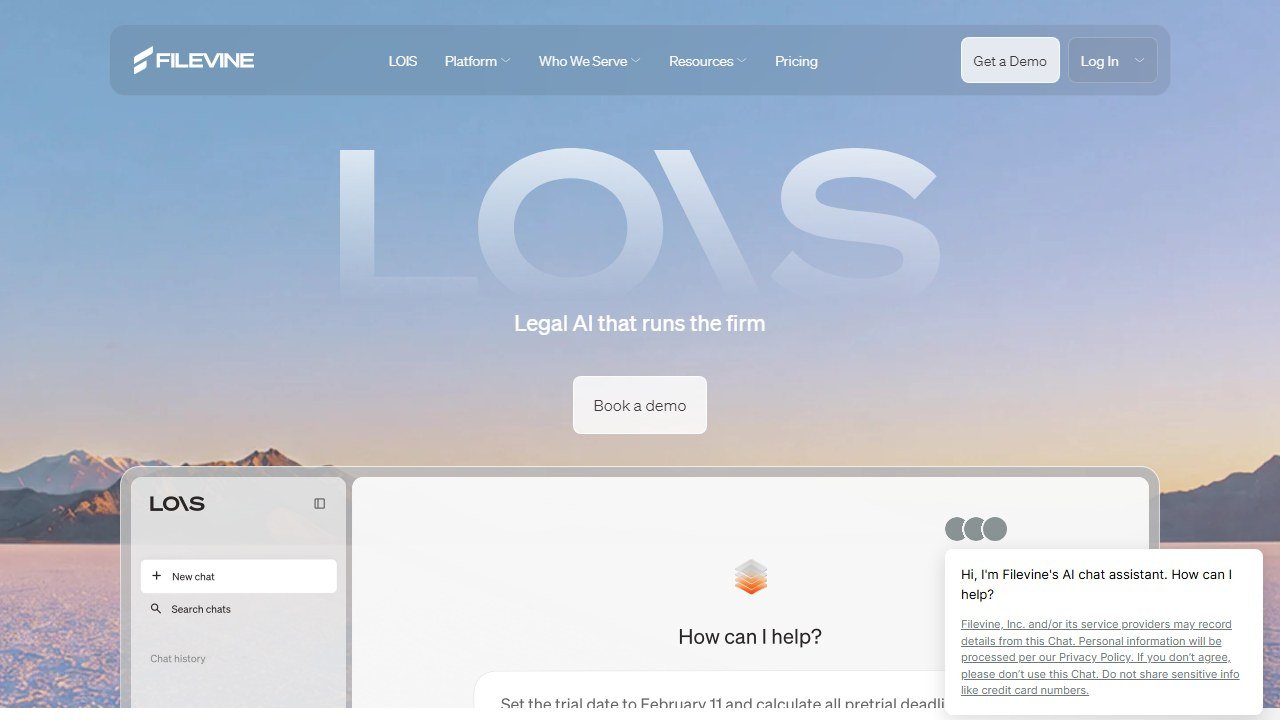
The trade-off is that Filevine’s power and flexibility come with more setup and a steeper learning curve than a plug-and-play tool like MyCase, and pricing is quote-based rather than published. For a small general practice it is more than needed. But for a PI or litigation firm that treats case management as its core operational engine, Filevine’s depth is exactly the point.
Best for: litigation, personal injury, and mass-tort firms with complex, high-volume caseloads.
Watch out for: more setup and a steeper learning curve, with quote-based pricing.
5. PracticePanther: Best for Ease of Use and Value
PracticePanther wins on simplicity and price. It delivers the core practice management a small firm needs, matters, time, billing, calendaring, and payments, in an interface that is genuinely easy to learn, with strong workflow automation that handles routine follow-ups and reminders without fuss. Built-in payments make invoicing and collection straightforward, and firms tend to get up and running fast.
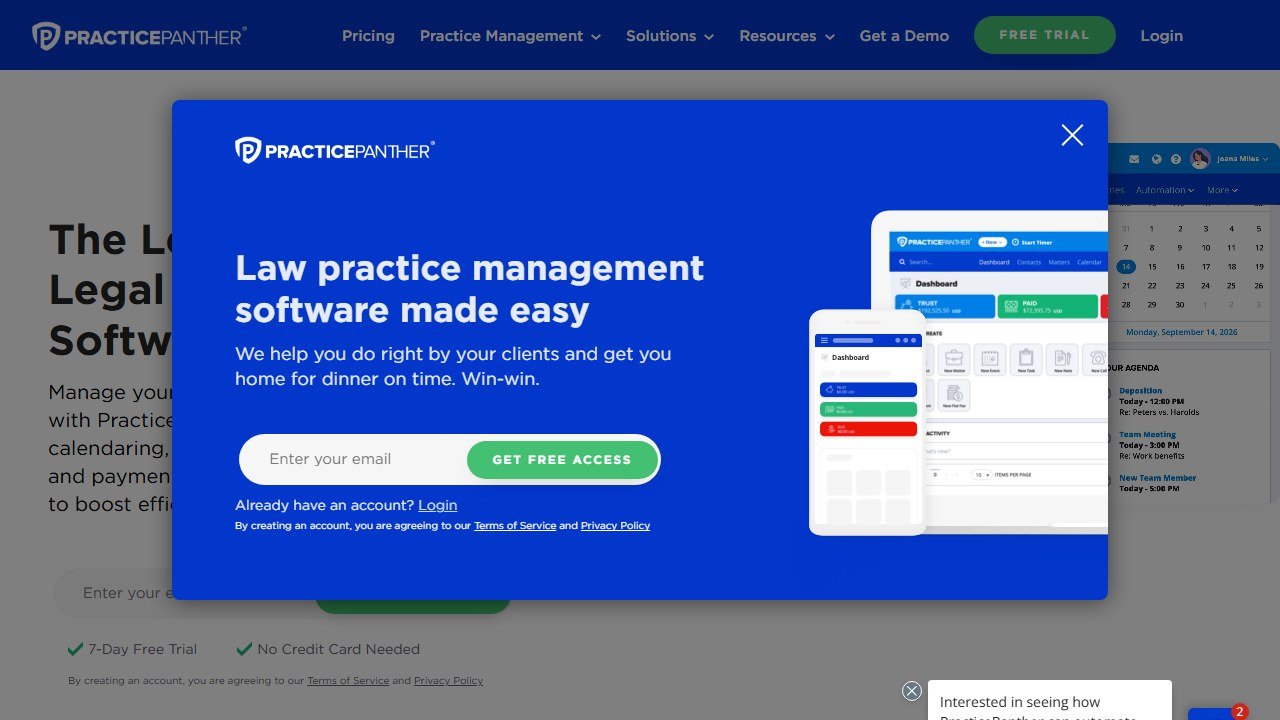
Pricing sits around $49 per user per month as of 2026, keeping it affordable for small teams. It is lighter on the deep specialization of a Filevine or the vast ecosystem of a Clio, and its AI story is still developing rather than a headline strength. But for a small firm whose priority is a tool everyone will actually use, at a reasonable price, PracticePanther is a strong value choice.
Best for: small firms that prize ease of use, fast adoption, and value.
Watch out for: a developing AI story and less depth than the specialists.
6. CARET Legal: Best All-in-One With Built-in Accounting
CARET Legal, formerly Zola Suite, is the pick when you want practice management and accounting in one system rather than syncing to QuickBooks. It pairs full-featured matter, document, billing, and email management with native business and trust accounting, so your general ledger, trust ledgers, and financials live inside the same platform your matters do. For a firm that wants one source of truth for both operations and books, that is a real convenience and a compliance benefit.
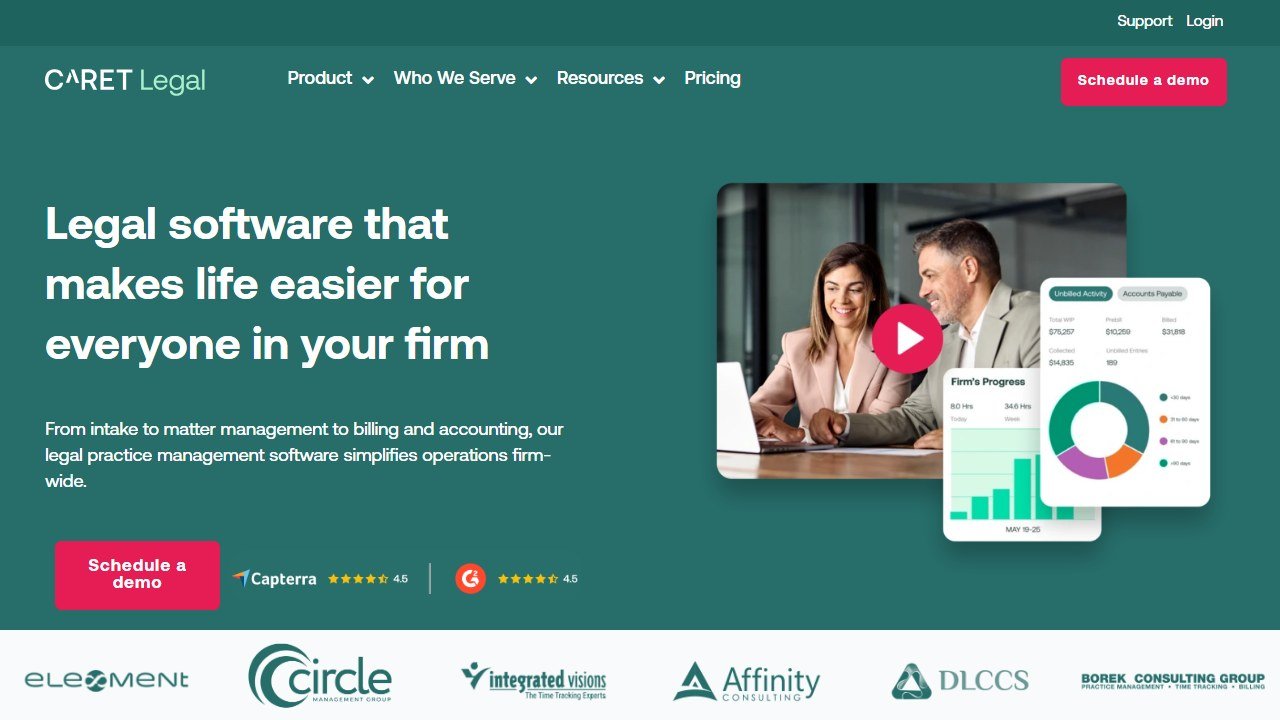
The all-in-one design means you are committing to CARET’s accounting rather than a best-of-breed setup, which suits firms that want fewer moving parts more than firms with an established accounting stack. Pricing starts around $79 per user per month as of 2026. For a mid-size firm that values a single integrated system over maximum flexibility, CARET Legal is a strong all-in-one contender.
Best for: firms that want native, built-in accounting inside their practice management tool.
Watch out for: you are tied to CARET’s accounting rather than a best-of-breed choice.
7. Rocket Matter: Best for Billing and Legal Accounting Workflows
Rocket Matter is the choice for firms that put getting paid first. It covers the full practice management basics, but its reputation and depth are strongest in time tracking, billing, and legal accounting, with batch billing, flexible invoicing, and reporting built to keep cash flow healthy and collections tight. For a firm where the pain point is billing friction and slow payments, that focus is the draw.
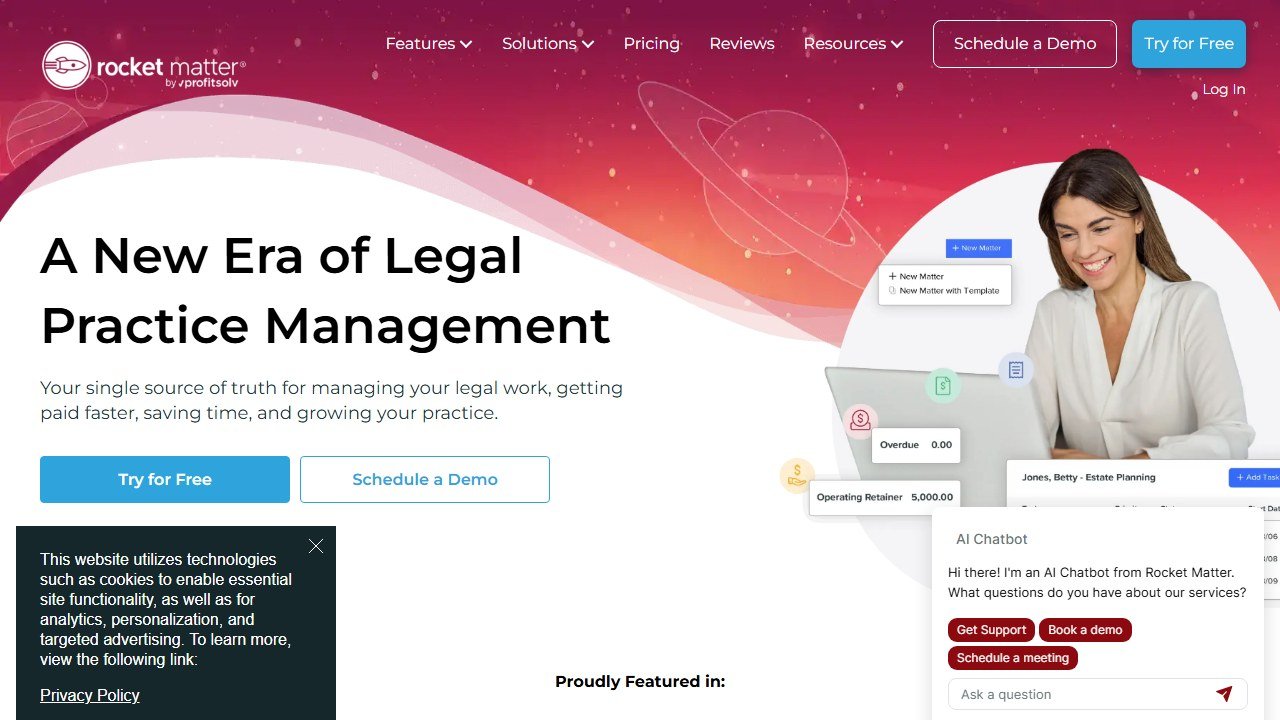
Rocket Matter is a capable general platform beyond billing, but it is not the most cutting-edge on AI, and firms with heavy document-automation or specialized-litigation needs may find more purpose-built options elsewhere. Pricing lands around $49 per user per month as of 2026. For a firm that wants a solid all-round tool with a genuine billing and accounting backbone, it is a reliable pick.
Best for: firms that want strong billing, invoicing, and legal accounting workflows.
Watch out for: a less advanced AI story than the category leaders.
8. CosmoLex: Best for Built-in Trust and Business Accounting
CosmoLex is the answer for firms that want trust and business accounting handled inside the practice management system, with no separate QuickBooks required. It builds full legal accounting, including IOLTA-compliant trust accounting, directly into the platform alongside matter management, time, billing, and documents. For a small or solo firm anxious about trust-accounting compliance, having the three-way reconciliation and trust ledgers native to the tool removes a real source of risk and a second subscription.
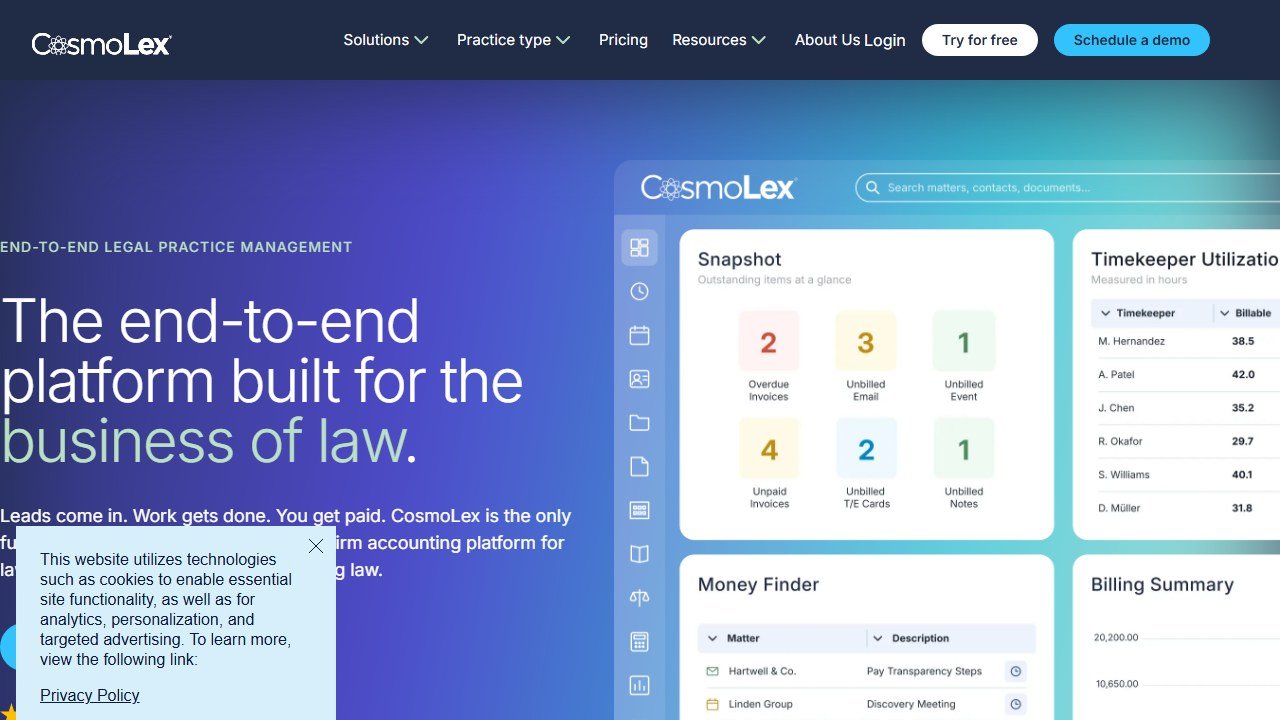
Like CARET Legal, the trade-off is that you are adopting CosmoLex’s accounting rather than integrating your own, which is a feature for firms that want simplicity and a drawback for those wedded to an outside accountant’s stack. Pricing starts around $89 per user per month as of 2026. For a firm whose top priority is compliant, built-in trust accounting without a separate accounting product, CosmoLex is the specialist to shortlist.
Best for: firms that want native, IOLTA-safe trust and business accounting with no QuickBooks.
Watch out for: committing to CosmoLex’s accounting instead of a best-of-breed integration.
How to Choose
Start with firm size and practice area, because they eliminate most of the field fast. A solo or small general practice is best served by MyCase or PracticePanther for affordable, easy all-in-one management. A document-heavy small firm should look hard at Smokeball for its automatic time capture and Word automation. A personal-injury or litigation team should shortlist Filevine for its flexible, milestone-driven case management. And a firm that wants the deepest ecosystem and the most serious AI, at any size, should start with Clio.
Then decide whether you need built-in accounting. If you want one system for both matters and books, CARET Legal and CosmoLex fold native business and trust accounting in, so you skip QuickBooks entirely. If you would rather keep best-of-breed tools, Clio’s huge integration marketplace lets you connect the exact accounting, document, and payment tools you prefer. Weigh the integrations you already depend on, and how mature you need the AI to be: today Clio and MyCase have the clearest genuine-assistant stories, while several others are still developing theirs. Whatever your shortlist, demo the AI live and test the trust accounting against your rules before you commit.
For the wider set of AI tools that plug into these platforms, see our best AI tools for lawyers pillar.
And if you have already ruled out the category leader, our dedicated guide to the best Clio alternatives compares every credible replacement through that exact lens.
Verdict
Clio is the best legal practice management software in 2026, because it combines a mature core, the largest integration ecosystem in legal tech, and the most serious AI investment in the category, with Clio Duo and the vLex research engine behind it. It scales cleanly from solo to large firm, which is why it is the safest strong pick for most practices.
The alternatives fit specific cases: MyCase for affordable, easy solo and small-firm management, Filevine for litigation and personal injury, Smokeball for document-heavy shops, PracticePanther for value, and CARET Legal and CosmoLex for firms that want built-in accounting with no separate QuickBooks. Match the tool to your firm size and practice area, demo the AI on real work, and test the trust accounting before you commit. For the wider stack, see our best AI tools for lawyers pillar and our full Clio review.

Written by
FazFaz is the founder of AIToolsBakery. Some tools here are tested hands on. Others are assessed from vendor documentation and pricing verified on the live page, and every review says which one it is. Sponsors can buy a position in a guide. They cannot buy the score, the criticism, or silence about a better option.
How we test and how we make money →