It is a Tuesday in spring, your phone has fourteen quote requests on it, and each one means a drive across town with a measuring wheel before you can even name a price. Meanwhile the operator two zip codes over sent the homeowner a number ten minutes after she filled out his website form, and he got the job. That gap, speed-to-quote, is where most of the new AI tooling for lawn care actually earns its keep. The rest of it is scheduling, routing, invoicing, and chasing the people who have not paid you.
We are AI Tools Bakery, and we sell none of the software below. That matters here, because when you search “lawn care business software” the results are almost entirely the vendors’ own landing pages and affiliate roundups that earn a commission on every signup. We are neither. We make money from no lawn-care SaaS company, so we can say plainly when a tool is overkill for a solo operator or when a “free” tier is really a funnel.
This is a working buyer’s guide organized around the jobs you actually need done, not a leaderboard. A two-truck operation and a forty-crew commercial maintenance company need almost opposite things, and the comparison table near the end maps each tool to the job it is genuinely good at.
The 30-second answer: Solo and small crews want Jobber or Yardbook for quoting, scheduling, and invoicing in one place. To send instant online quotes, add DeepLawn or SatQuote. Big commercial books want SiteRecon for measurement and Aspire or Service Autopilot for operations. Confirm all pricing on the vendor page.
Quick answer: Build the stack by job: SiteRecon or DeepLawn to measure properties from aerial imagery, SatQuote for instant quoting, plus a routing and invoicing tool to schedule crews and get paid. Confirm you can export your customer and job data before committing to any platform.
Job 1: Measure the property from aerial imagery
The first AI win in this trade is measuring a lawn without driving to it. These tools pull high-resolution aerial and satellite imagery, often layered with “leaf-off” winter shots to see through tree canopy, and an AI segments the turf, driveway, beds, and building footprint into square footage you can price against.
SiteRecon
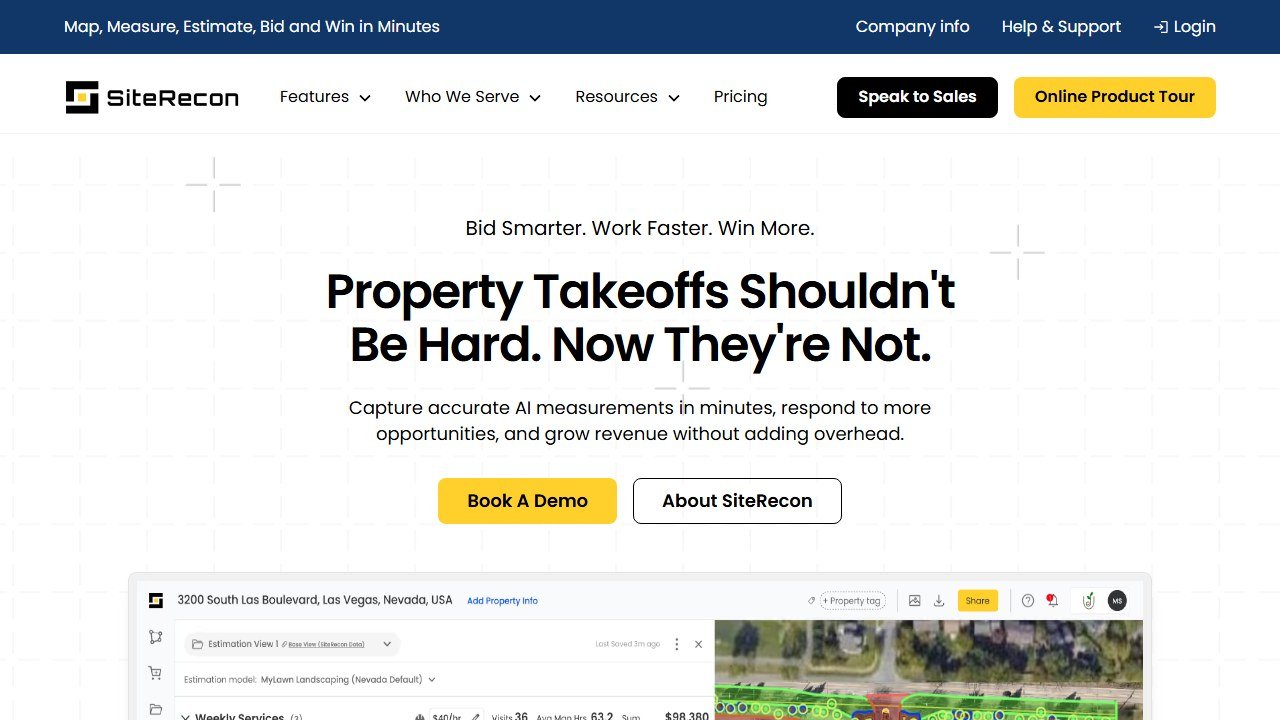
SiteRecon is the heavyweight for measurement at scale. It produces automated takeoffs for properties, including larger commercial sites, and layers in site documentation, leaf-off imagery, and ground-level street views to sharpen accuracy. The pitch is reducing admin hours and standardizing estimates across multiple service lines: maintenance, snow, enhancements. It is the strongest pick for a company moving into commercial work or expanding territory. Visit SiteRecon for current plans.
The honest limit: this is built for volume and commercial complexity, and the pricing reflects that. A solo operator doing residential mowing will pay for capability they will rarely touch. If you mostly want measurement plus quoting head to head, our SiteRecon vs DeepLawn breakdown is the closer look.
DeepLawn
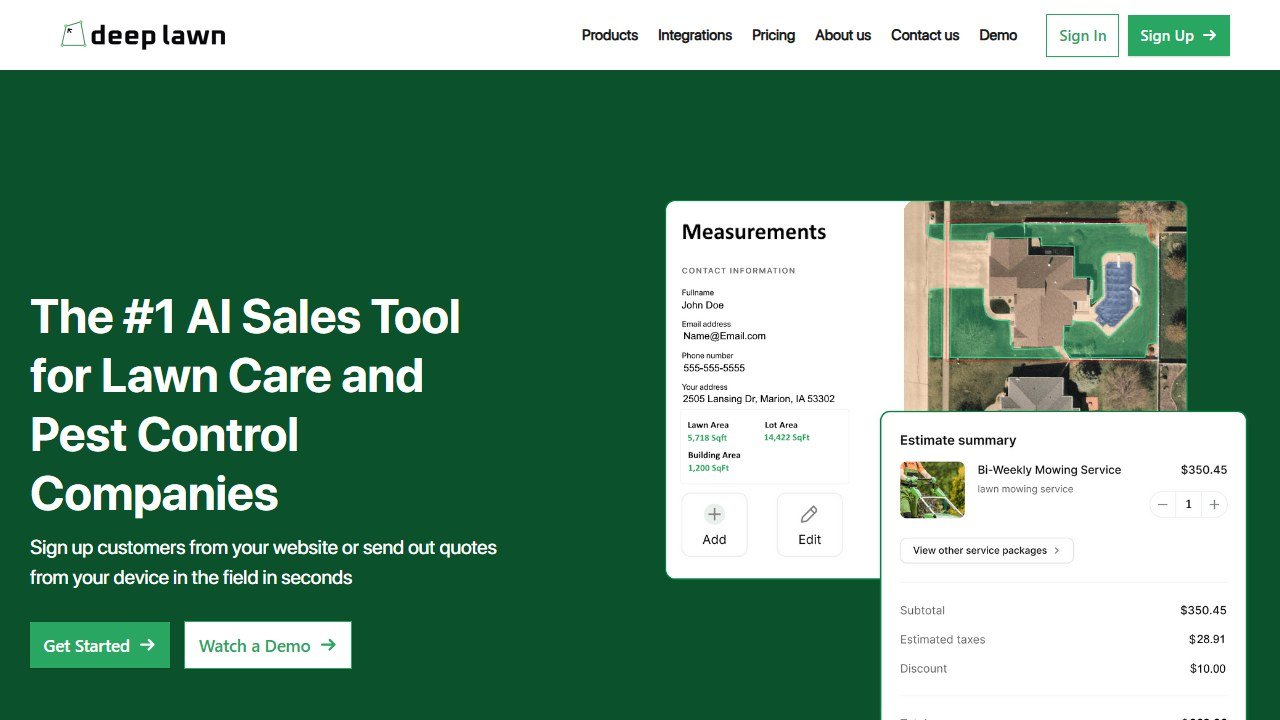
DeepLawn focuses on residential lawn care and pest control. Its AI measures lawn, driveway, sidewalk, and building from recent aerial imagery plus a winter leaf-off pass, usually in well under a minute, and it wires that measurement straight into pricing tables. The standout is the website widget: a homeowner types an address, and your site returns a real quote, sometimes with checkout. Pricing is tiered by plan and by the volume of address searches, starting on the lower end and climbing for high-volume plans. Confirm current tiers at DeepLawn.
The honest limit: it is tuned for clean residential lots. Heavily wooded properties or irregular commercial parcels can still need a human to correct the auto-measurement before you trust the number.
SatQuote
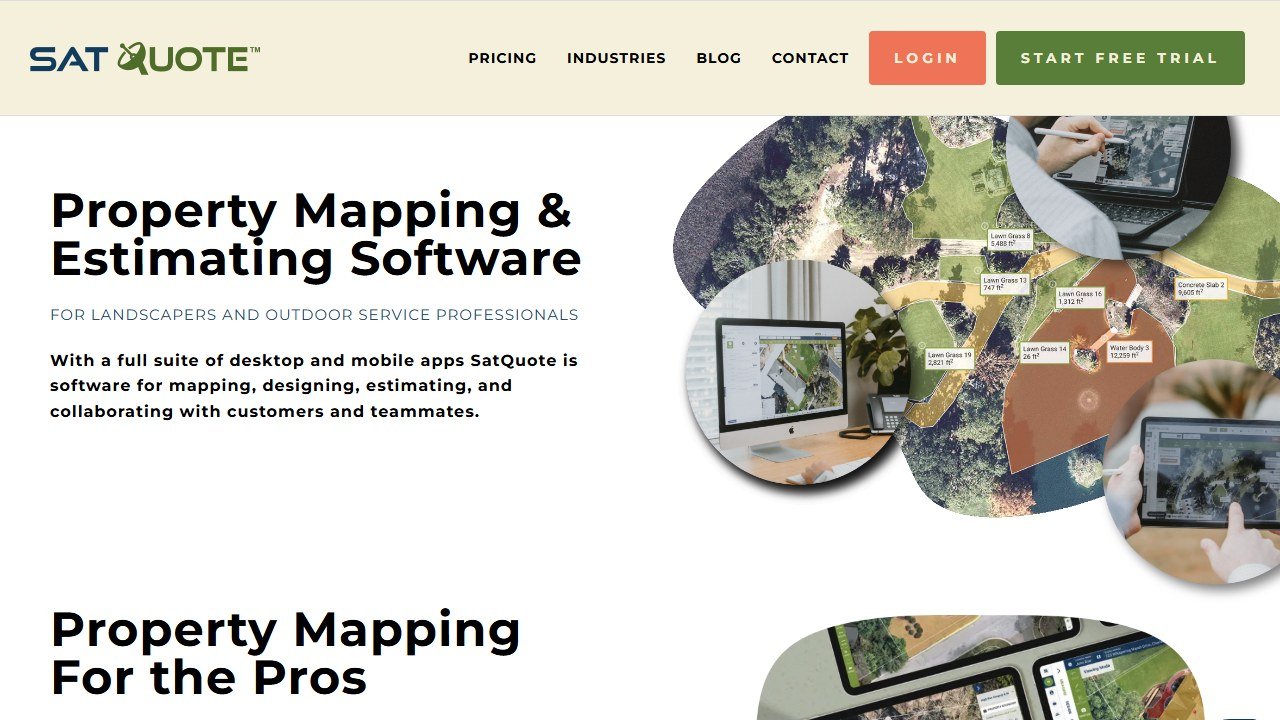
SatQuote blends aerial imagery with a measurement-and-design layer and is broader than pure lawn care, covering snow, irrigation, pest, and hardscape. You measure square footage, linear feet, and area, then build map-based quotes you can share with the customer. Annual pricing sits in a modest band relative to the enterprise tools. See SatQuote for the current plan structure.
The honest limit: the breadth is also the catch. If all you do is mow residential lawns, a focused tool like DeepLawn will feel faster than SatQuote’s more general toolkit.
Job 2: Generate an instant quote
Measurement is half the job. The money move is turning square footage into a price the customer sees fast, ideally before a competitor replies. DeepLawn and SatQuote both do this natively, which is why they straddle the measure-and-quote line. DeepLawn’s e-commerce widget is the clearest example: measurement, pricing rules, and online checkout in one flow, so a lead can become a paying customer without you touching the phone.
If you already run scheduling software, check whether it does quoting too before you buy a second tool. Jobber and Yardbook both generate estimates from inside their CRM, so a small operator may not need a separate measurement product at all in year one. The tradeoff: those built-in estimates rely on you entering the lawn size, so you lose the aerial-measurement speed unless you pair them with one of the Job 1 tools.
A practical rule we like: the value of instant quoting scales with your lead volume. If you get a handful of inquiries a week, a tidy estimate inside Jobber is plenty. If you are buying ads and fielding dozens of form fills, the DeepLawn-style instant widget pays for itself by catching leads while they are still warm.
One more thing the vendor pages gloss over: an instant quote is only as good as the pricing rules you feed it. The AI measures the lawn accurately, but the dollar figure comes from a table you build, so a sloppy setup will confidently quote unprofitable prices at scale. Spend the first week tuning your per-square-foot rates against jobs you have actually completed, then let the automation run. The tools that let you set minimum job sizes and tiered rates by service are worth more than the ones that just multiply area by a single number.
Job 3: Schedule and route crews
Once the work is sold, the daily grind is putting the right crew at the right address in a sane order. This is where the all-in-one platforms live.
Jobber
Jobber is the popular generalist: clean drag-and-drop scheduling, quoting, invoicing, and a mobile app that holds up on spotty rural signal. Its design priority is fast adoption, and most teams are running within days. Pricing scales by plan tier with an added cost per extra user, and there is a free trial. It is our default recommendation for a small-to-mid lawn business that wants one tool for most of the workflow. Start at Jobber.
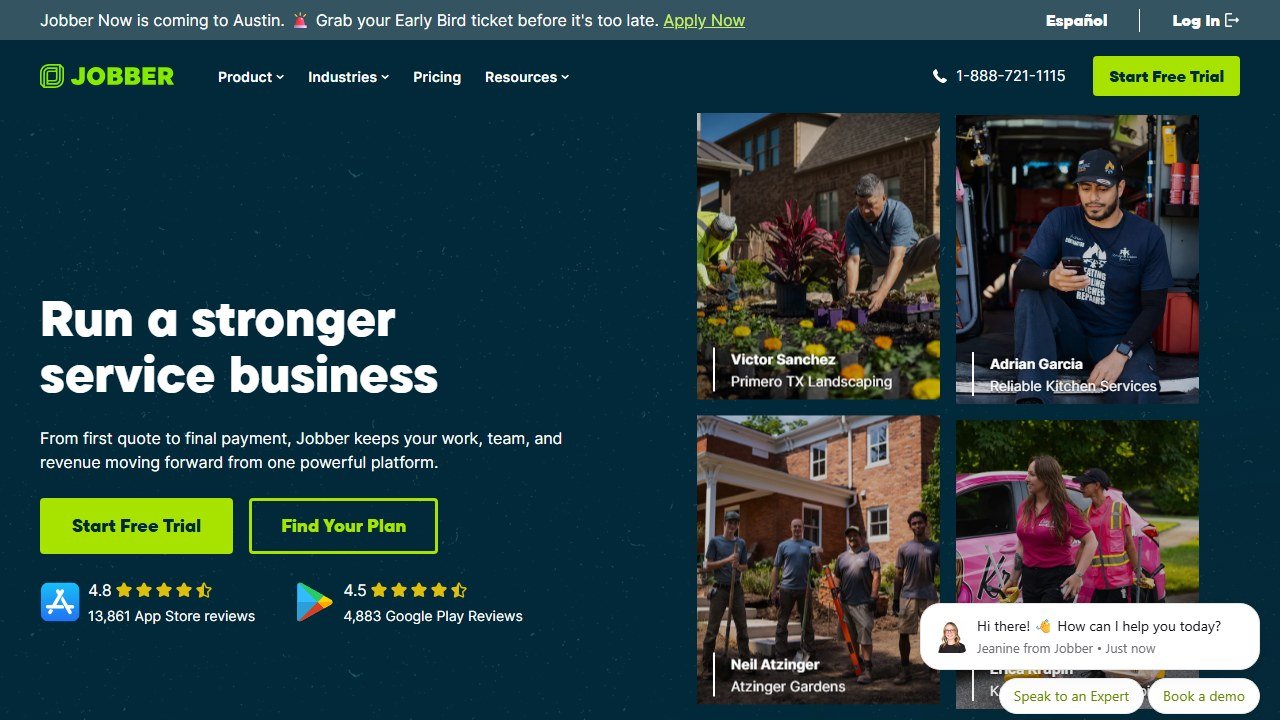
The honest limit: Jobber serves every trade, not just lawn care, so the deepest recurring-service automations belong to the lawn-specific platforms below.
Service Autopilot

Service Autopilot is the recurring-job automation specialist, built by and for lawn and landscape operators. Its strength is large recurring books: smart campaigns triggered by customer behavior, layered reminder sequences, and automated follow-up on aging receivables. Pricing is not always public and tends to scale with business size; expect a real onboarding effort. See Service Autopilot.
The honest limit: the power comes with a learning curve. Small operators routinely report it is more system than they need, and the setup time is real.
Aspire
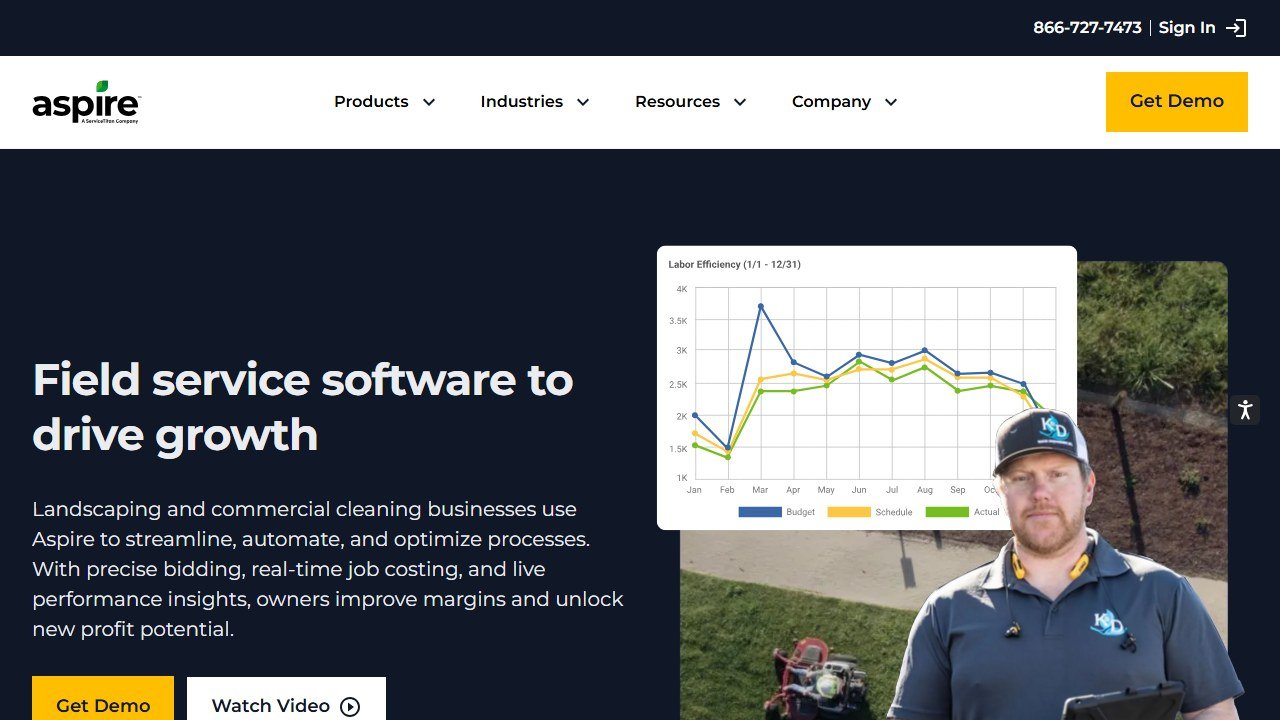
Aspire is the enterprise end of the market, aimed at larger landscaping companies that need end-to-end job costing, scheduling, estimating, CRM, and invoicing with live profitability data. Pricing is based on annual revenue, and there is no free plan. If you are running many crews and care about job-level margin, this is the operations backbone. See Aspire.
The honest limit: it is genuinely not for small operators. The cost and implementation make sense only above a certain revenue line, and below it you are buying complexity you cannot use.
Job 4: Invoice and get paid
Quoting and scheduling mean little if cash stalls in accounts receivable. The all-in-one platforms all invoice, but two are worth calling out for small operators on a budget.
Yardbook
Yardbook is genuinely free for the core workflow: CRM, estimates, invoices, scheduling, expense tracking, and equipment logs. Premium add-ons cover geo-tracking, bulk email and text, automated payment reminders, and auto-scheduling. For a brand-new operator with no software budget, it is the most capable free starting point we have seen. See Yardbook.
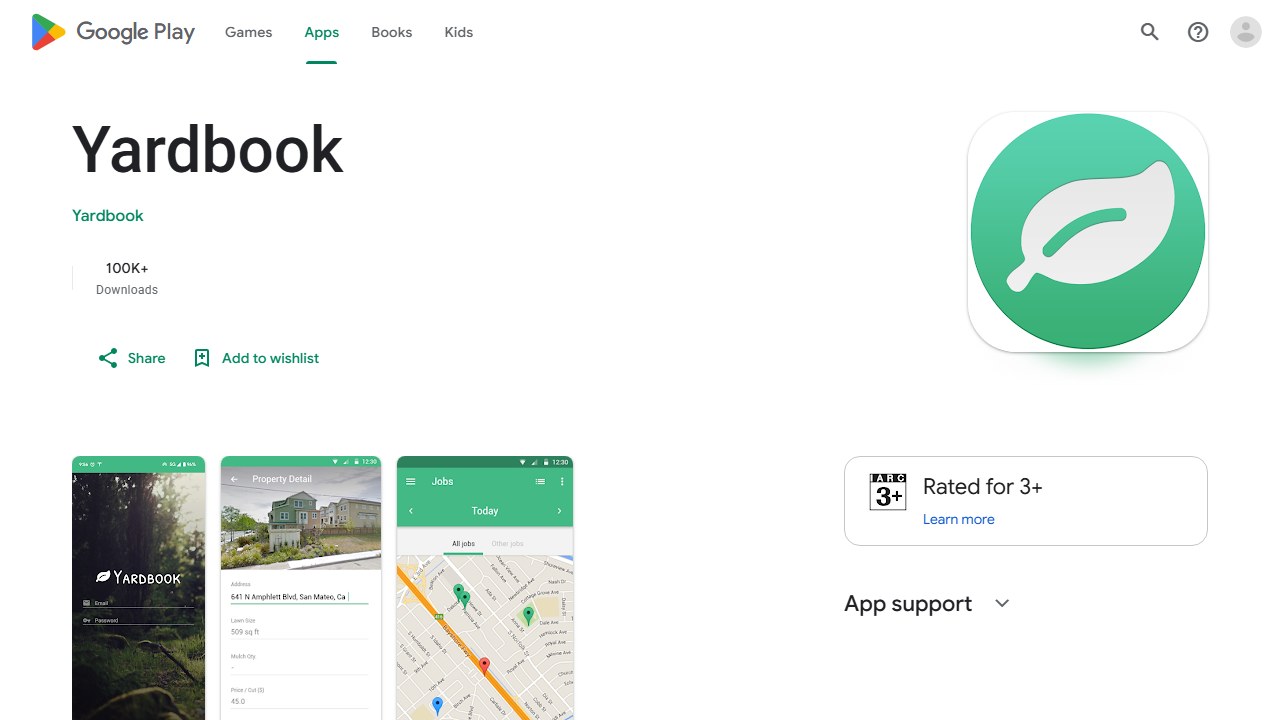
The honest limit: free has a cost in polish and support. The interface feels dated next to Jobber, and the upsell to premium features arrives once you grow.
LawnPro
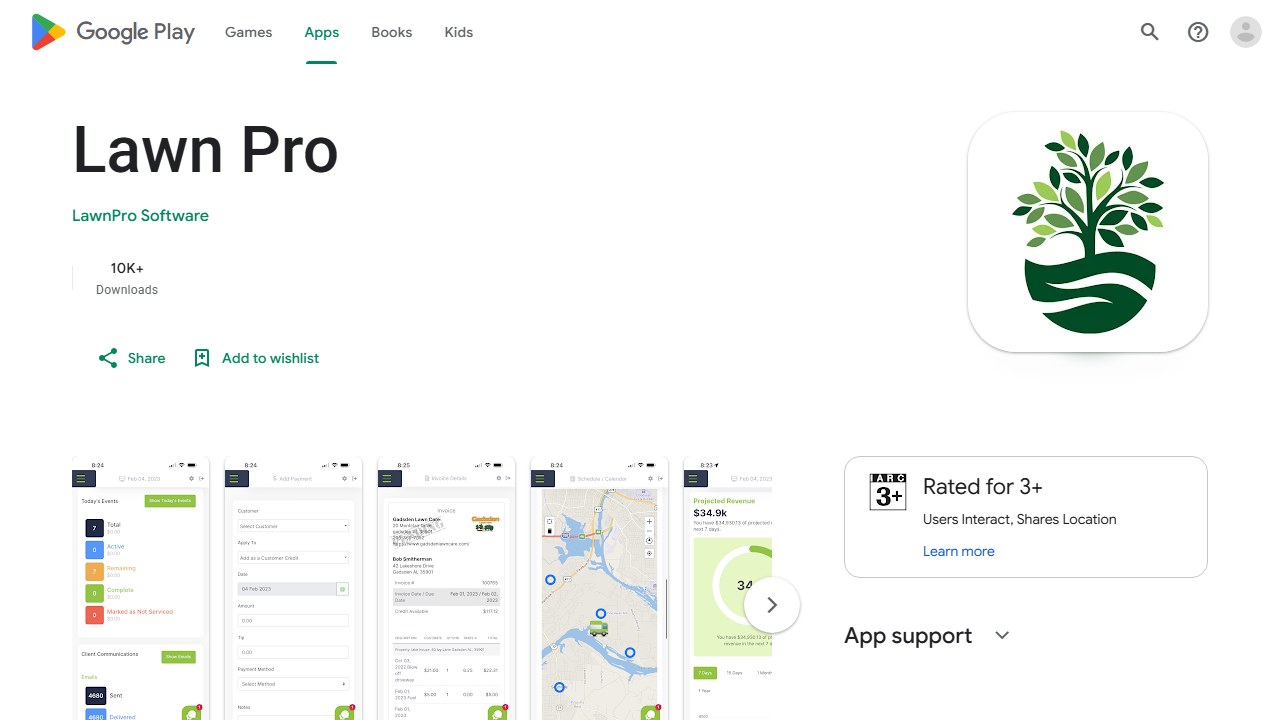
LawnPro covers scheduling, crew routing, visit tracking, invoicing, and payment collection, and it syncs with QuickBooks Online so customers, invoices, and payments stay aligned. A free starter plan caps you at a modest customer count with email invoicing, a client portal, and online payments; paid plans start low. See LawnPro. The QuickBooks sync is the standout if you already keep your books there.
The honest limit: it is built for small and mid operators. A large commercial book will outgrow its reporting and want Aspire or Service Autopilot.
Job 5: Market and retain customers
The cheapest new job is the customer you already have. Service Autopilot leans hardest into this with behavior-triggered campaigns and automated follow-up, which is a real reason a larger residential book might pick it over Jobber. Jobber and Yardbook handle the basics: review requests, reminder emails, and re-quote prompts at season’s end. None of this is exotic AI, but the automation that nudges last year’s clients before spring is often worth more than any measurement gadget.
If your business also touches irrigation, smart watering hardware is becoming a service add-on worth understanding. Our guides to the best smart sprinkler controllers and the Rachio 3 vs Rain Bird comparison cover what to recommend and install.
How these lawn care tools compare
One table, the jobs that matter, mapped to the tool that does each best. Pricing is qualitative and changes often, so confirm every figure on the vendor page before you commit.
| Tool | Job it does | Best for | Pricing model |
|---|---|---|---|
| SiteRecon | Aerial measurement and takeoffs | Commercial and multi-service operators | Subscription, scales with volume |
| DeepLawn | Measure plus instant online quote | Residential lawn and pest, ad-driven leads | Tiered by plan and search volume |
| SatQuote | Measure, design, map-based quotes | Multi-service operators wanting one quoting tool | Annual, mid-range band |
| Jobber | Quote, schedule, invoice in one app | Small to mid crews wanting simplicity | Plan tiers plus per-extra-user fee |
| Service Autopilot | Recurring-job and marketing automation | Large recurring residential books | Scales with business size, often quoted |
| Aspire | End-to-end ops and job costing | Large commercial landscaping companies | Based on annual revenue, no free tier |
| Yardbook | Free CRM, estimates, invoicing | Brand-new and budget-first operators | Free core, paid premium add-ons |
| LawnPro | Scheduling, invoicing, QuickBooks sync | Small to mid operators on QuickBooks | Free starter cap, low-cost paid plans |
A lean way to start
You do not need all of this on day one. Build up as the workload forces it.
- Solo operator, just starting. Begin with Yardbook free for CRM, estimates, and invoicing, or Jobber if you want a cleaner app and can spend a little. Measure lawns by hand at first, or eyeball from public aerial maps. Do not buy enterprise software yet.
- Solo or two-person crew chasing online leads. Add DeepLawn or SatQuote so your website returns instant quotes. This is the single upgrade that wins jobs from slower competitors, and it pays back fastest when you are running ads.
- Growing residential book, 3 to 8 crews. Move to Jobber as your core, or Service Autopilot if recurring-service automation and marketing campaigns are your bottleneck. Keep the instant-quote widget feeding it.
- Commercial or multi-service, many crews. Pair SiteRecon for measurement with Aspire or Service Autopilot for operations and job costing. At this scale the integration and reporting matter more than per-seat price.
What these tools still cannot do
The AI here is real but narrow. Aerial measurement is genuinely fast, yet it still misreads heavy tree cover, freshly built lots the imagery has not caught up to, and oddly shaped commercial parcels, so the square footage that prints in seconds still wants a human glance before you quote a contract on it. The imagery refreshes on a cycle, not in real time, which means a new fence or pool may not show.
None of these tools cut grass, train a crew, or fix a relationship with a customer who feels ignored. The “AI routing” is helpful sorting, not magic, and it rarely re-optimizes live when a job runs long. Instant quoting wins leads but can also race you to the bottom on price if you let the software set numbers you have not sanity-checked against your real costs.
There is also a data point worth naming: these platforms hold your customer list, addresses, and payment history. That is your business asset sitting in someone else’s cloud. Before you commit, confirm you can export your customer and job data cleanly if you ever leave, and read how each vendor handles the property imagery and address data it collects. The honest close: software speeds up a well-run lawn business and exposes a badly run one faster. It is a force multiplier, not a substitute for knowing your numbers. For the wider set of design and property tools beyond operations, our best AI landscaping tools pillar is the map.
For a closer look, see our Neighborbrite review.

Written by
FazFaz is the founder of AIToolsBakery. Some tools here are tested hands on. Others are assessed from vendor documentation and pricing verified on the live page, and every review says which one it is. Sponsors can buy a position in a guide. They cannot buy the score, the criticism, or silence about a better option.
How we test and how we make money →Frequently Asked Questions