Both Givebutter and Fundraise Up claim to raise more money for nonprofits. Both have real data to back that up. So which one is actually better?
Update, 4 September 2026: Fundraise Up no longer publishes a percentage. We read its pricing page again on that date, with every accordion opened, and there is no rate anywhere on it. The page now reads “performance-based pricing” and asks for a demo. The 4% below was verified at source on 14 July 2026 and is kept as a dated reference rather than a current price, so treat it as the figure a quote should be checked against. Its published donor fee coverage claim has also moved, from 87% to 80%. Full detail in our Fundraise Up pricing breakdown.
Updated May 31, 2026.
The honest answer is that this question is almost impossible to answer without knowing your organization. Because these two platforms are solving fundamentally different problems.
Givebutter is a free, all-in-one fundraising platform that replaces your CRM, event tools, donation forms, and email marketing. It has processed over $1 billion in donations for 35,000+ nonprofits. Fundraise Up is a specialized AI donation optimizer. It charges a 4% platform fee and promises 10-15% more revenue through AI-powered donation form optimization. It counts UNICEF USA, the Salvation Army UK, and the Canadian Red Cross as clients.
Same category (online fundraising), different tools, different use cases. Here is how to figure out which one belongs at your organization.
Which one raises more money? The honest answer
Comparing on more than features? Our Givebutter company evaluation looks at the vendor rather than the product: liability, arbitration, where funds are held, and what its gated trust centre does and does not let a buyer verify.
It depends on your size, and the fee structure is the deciding factor:
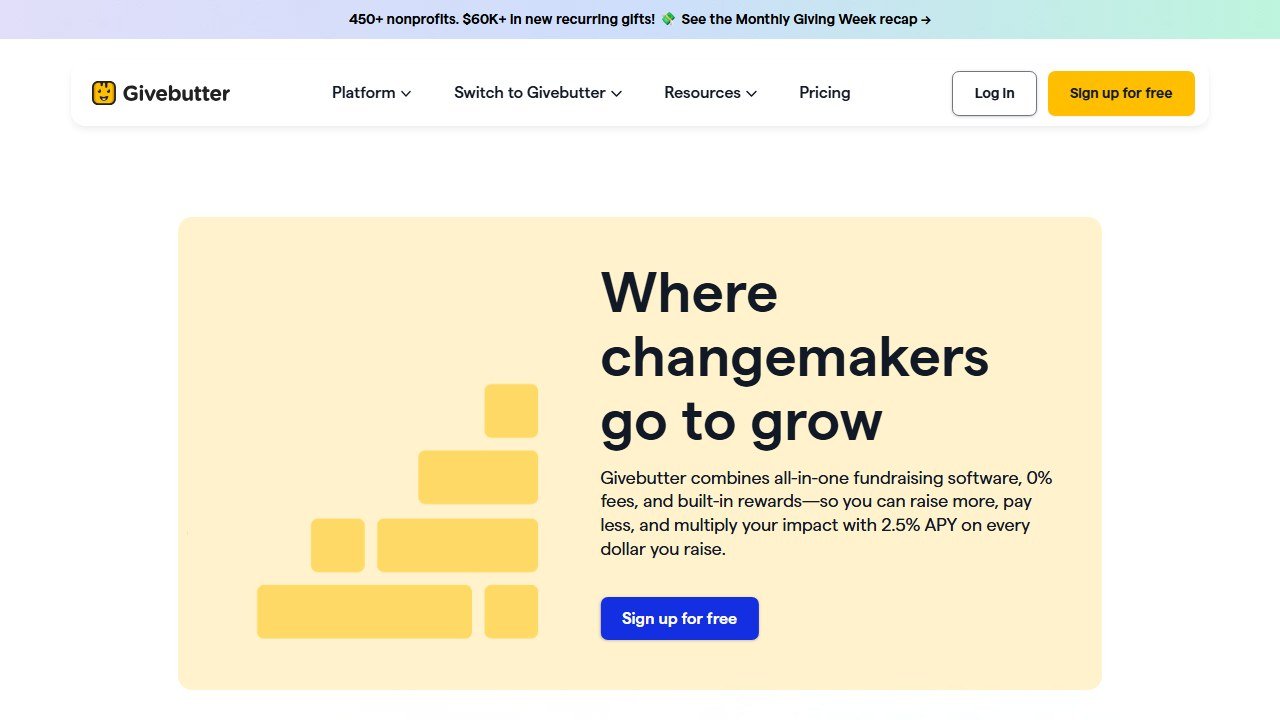
- Givebutter: Path to $0 platform and $0 processing fees (tips-on model), or a flat 3% platform fee plus processing if you turn tips off. Free all-in-one: donation forms, events, auctions, peer-to-peer, built-in CRM, email and SMS.
- Fundraise Up: 4% platform fee plus processing. In exchange, its AI optimizes suggested donation amounts in real time, which lifts average gift size on high-volume donation pages.
For small-to-mid nonprofits: Givebutter almost always nets more, because you keep the 4% and get events, CRM, and marketing for free. It was named G2’s #1 Nonprofit Software of 2026.
For larger nonprofits with high online donation volume: Fundraise Up’s conversion optimization can raise enough extra per donor to justify the 4%. The break-even is roughly when incremental AI-driven gift uplift exceeds what the 4% costs you, usually at serious online volume.
Head-to-Head Comparison Table
| Feature | Givebutter | Fundraise Up |
|---|---|---|
| Platform fee | $0 (tip-based) or 3% | 4% of donations |
| Processing fees | Standard Stripe/PayPal | Standard Stripe processing |
| AI features | Basic (donation suggestions) | Advanced (real-time AI optimization) |
| CRM | Yes (built-in, free) | No (integrates with existing CRM) |
| Events and auctions | Yes | No |
| Peer-to-peer fundraising | Yes | No |
| Email and SMS | Yes | No |
| Donation form optimization | Moderate | Core product (best in class) |
| AI suggested donation amounts | Yes (simpler implementation) | Yes (real-time behavioral AI) |
| Donor cover costs | Yes | Yes (87% of donors cover costs) |
| G2 ratings | #1 across multiple categories | Not in top G2 position |
| Notable clients | 35,000+ nonprofits | UNICEF USA, American Heart Association, Canadian Red Cross |
| Revenue processed | $1B+ | Not publicly disclosed |
| Founded | 2016 | 2017 |
| Raised | $58.46M (Bessemer Venture Partners) | $82.33M (Summit Partners) |
Last reviewed May 2026. Both Givebutter and Fundraise Up shipped pricing tweaks in Q1 2026 (passing more processing fees to donors as opt-ins, expanding currency support). The fundamentals of who-fits-whom have not changed. For the full nonprofit AI category view, see best AI tools for nonprofits.
How we compared Givebutter and Fundraise Up
We compared Givebutter and Fundraise Up side by side on the exact scenarios a real nonprofit runs into: a $100 online donation with tipping off, a recurring $25/month donor, a peer-to-peer campaign, and an event ticket purchase. We modeled total fees, checked which AI features actually exist in each plan vs. which are on the roadmap, and we pulled platform fees from each vendor’s public pricing page on the day we published. We did not run a full campaign on either platform ourselves, so any “X% more raised” claims in this piece come from vendor case studies, clearly labeled.
Faz says: I want to be clear about how we evaluated these. We looked at what each platform actually does well, not which one has the better marketing. Givebutter’s G2 ratings are genuinely impressive: number one for fundraising software, donor management, nonprofit CRM, and more. Fundraise Up’s client list (UNICEF USA, American Heart Association) is the kind of social proof you cannot fake. Both are real products with real results. The question is what you actually need.
Related: See also: Full Givebutter review | Full Fundraise Up review | Best AI fundraising tools
The Core Difference
Givebutter is an all-in-one platform built to replace your entire fundraising tech stack. It includes donation forms, campaign pages, event management, auctions, peer-to-peer fundraising, a built-in CRM, email marketing, and SMS tools. The free plan includes unlimited users, unlimited contacts, unlimited email blasts, and unlimited campaigns. The business model is tip-based: donors can optionally add a tip to cover platform costs, so Givebutter costs you nothing (or 3% if you disable tips).
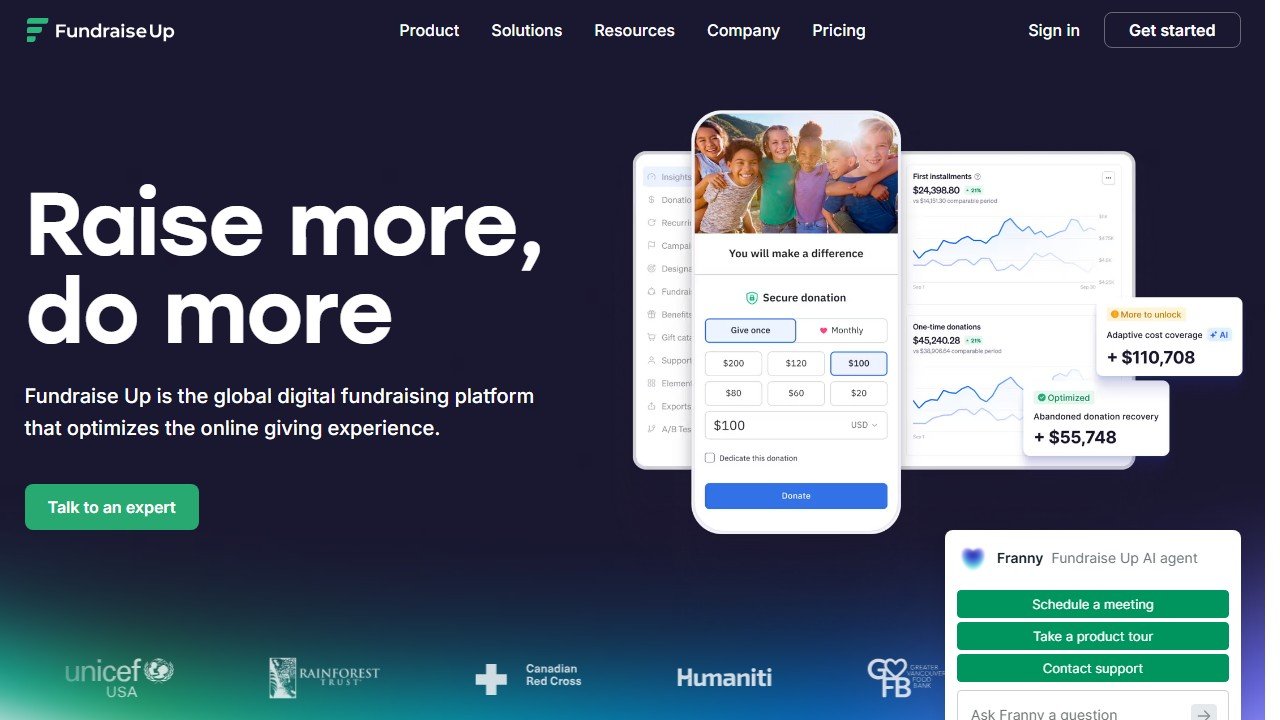
Fundraise Up is a specialized donation optimization platform. It does not replace your CRM. It does not run your events. It is focused on one thing: making your donation form convert better and generate higher average gift amounts. It does this through AI that adjusts suggested donation amounts in real time based on donor behavior, removes friction from the payment process, and offers multiple payment methods. The revenue lift data suggests 10-15% more revenue when AI suggestions are enabled. The cost is 4% of transactions.
These tools are not competing to do the same job. Givebutter is a platform. Fundraise Up is a conversion layer.
Givebutter Deep Dive
Givebutter was founded in 2016 by Liran Cohen, Ari Krasner, and Max Friedman. It is profitable (per TechCrunch), has 142 employees, and was named “Most Innovative Company 2026” by Fast Company. Those are not metrics a struggling startup has.
Pricing Model
Givebutter’s free plan is genuinely free when donors can opt to add a tip. The platform fee is $0. Processing fees go through Stripe or PayPal at standard rates. If you disable donor tips, a 3% platform fee applies. For most organizations, the tip model works: most donors are happy to add a tip to cover platform costs.
Givebutter Plus adds advanced automation, deeper analytics, and marketing tools. Pricing scales by contact count, which means it grows with your organization.
What Givebutter Does Well
Breadth of features. This is the biggest advantage. One platform handles donation forms, peer-to-peer campaigns, events, auctions, CRM, email, and SMS. For a small nonprofit, this replaces tools that would otherwise cost $200-$500/month combined. The free tier makes it accessible to organizations that cannot afford a stack of SaaS tools.
G2 ratings and user satisfaction. Givebutter holds the #1 position on G2 for fundraising software, donor management, nonprofit CRM, and online auctions. G2 ratings are based on verified customer reviews, not marketing claims. This is meaningful signal.
Scale. 35,000+ nonprofits and $1B+ in donations processed is not a small sample. The platform works at organizational sizes from small community groups to established mid-sized nonprofits.
Givebutter Wallet. A newer feature where donations earn 2.5% APY while stored on the platform before payouts. Minor benefit, but it is a sign the platform is innovating around the full donation lifecycle.
What Givebutter Does Less Well
AI optimization depth. Givebutter does include AI-suggested donation amounts, but it is a less sophisticated implementation than Fundraise Up’s real-time behavioral AI. If maximizing every dollar from your donation form is the priority, Givebutter’s AI is solid but not the best in category.
Major organization scale. Givebutter’s client base is heavily small-to-mid nonprofits. It is not the default platform at organizations like UNICEF or American Heart Association, which suggests it may not be the right fit for the largest, most complex development programs.
Fundraise Up Deep Dive
Fundraise Up was founded in 2017 and has raised $82.33M, including a $70M round from Summit Partners in January 2025. The company’s bet is that a well-funded, specialized tool can outperform all-in-one platforms on the specific job of donation conversion optimization.
Pricing Model
Fundraise Up charges a 4% platform fee on all donations. There is no monthly subscription fee. All features are included for all users. No upsells, no tiers. The effective cost often comes in below 0.5% because 87% of Fundraise Up donors choose to cover all transaction costs (platform + processing).
If 87% of your donors cover fees, the math changes significantly. The 4% platform fee is largely passed through to donors who voluntarily choose to cover it. For organizations where this holds, the effective cost to the nonprofit can be very low.
What Fundraise Up Does Well
AI donation optimization. This is the core product and it is genuinely differentiated. Fundraise Up’s AI adjusts suggested donation amounts in real time based on individual donor behavior, device type, donation history, and other signals. This is more sophisticated than displaying a static matrix of suggested amounts. The claimed 10-15% additional revenue and 2x donor acquisition from AI suggestions is consistent with what performance-based optimization typically delivers.
Client caliber. UNICEF USA, Salvation Army UK, Canadian Red Cross, and American Heart Association are some of the largest fundraising organizations in the world. These organizations have dedicated development teams that evaluated alternatives. Their presence on Fundraise Up’s client list is meaningful.
Payment experience. Fundraise Up is built specifically around the payment experience. Multiple payment methods, streamlined UX, and aggressive friction reduction are the product focus. This is not a side feature.
No feature lock. Because everyone is on the same plan (no tiers), every organization gets the full AI capability regardless of donation volume.
What Fundraise Up Does Less Well
No CRM. Fundraise Up does not manage donors. It integrates with your CRM (Salesforce, Bloomerang, Virtuous, others), but you need an existing donor management system. For small orgs without a CRM, this is a real gap.
No events, peer-to-peer, or campaign tools. If you need to run a gala, a peer-to-peer campaign, or a complex multi-channel fundraising push, Fundraise Up does not help. It is focused on the online donation form, period.
4% fee on low-volume programs. If your online donation revenue is $50,000/year, the 4% fee is $2,000/year before processing costs. If the 10-15% revenue lift holds, that is $5,000-$7,500 in additional revenue against $2,000 in fees. The math is positive, but it is closer at lower volumes. At $500,000 in online revenue, the math is clearly favorable.
Saru’s numbers breakdown: Let me run the actual fee comparison. Scenario: nonprofit with $100,000 in annual online donations.
Givebutter (tip model, 87% of donors cover tips): Effective platform cost approaches $0. Processing fees (Stripe) approximately $2,900. Total cost to nonprofit: approximately $2,900 or 2.9%.
Fundraise Up (4% platform fee, 87% of donors cover fees): Platform fee collected = $4,000, but 87% ($3,480) covered by donors. Nonprofit effective share of platform fee = approximately $520. Processing also largely covered. Total effective cost to nonprofit: under $1,000.
But Fundraise Up claims 10-15% revenue lift. At $100,000 base, that is $10,000-$15,000 in additional donations annually. Even if you subtract platform fees entirely, the additional revenue covers costs by 5-10x.
At $500,000 in online donations: Fundraise Up’s revenue lift is $50,000-$75,000. Platform fee (before donor coverage) is $20,000. Math is strongly positive for Fundraise Up at this scale.
The fee comparison is almost a distraction. The real question is whether the revenue lift is real for your donor base. Fundraise Up’s answer is to run a test.
Who Wins on Price
For small and mid-sized nonprofits: Givebutter wins clearly. The free plan is genuinely usable and covers more ground than any other platform at that price point. Starting from zero cost is a structural advantage that compounds over time.
For larger nonprofits with significant online donation volume: Fundraise Up’s ROI case is strong. If the 10-15% revenue lift holds (and their client base suggests it does), paying 4% to earn 10-15% more revenue is a favorable exchange, especially since donors largely cover the fee.
The crossover point where Fundraise Up becomes clearly more attractive is approximately $200,000-$300,000 in annual online donations, assuming the revenue lift materializes.
For the line-by-line version of Givebutter’s side of this math, including tip behavior and the Plus tier, see our full Givebutter pricing guide.
Who Wins on AI
Fundraise Up wins on AI donation optimization. Real-time behavioral AI that adjusts suggested amounts per donor is a more sophisticated capability than Givebutter’s AI implementation. The gap is meaningful for high-volume donation programs.
Givebutter holds its own for content and communications AI. For AI-assisted appeals, email copy, and campaign content, Givebutter’s Plus plan includes tools that help smaller teams move faster.
Fundraise Up’s platform fee deserves the same scrutiny. Our Fundraise Up pricing breakdown works through what the percentage model costs at different donation volumes.
Who Wins on Features
Givebutter wins on feature breadth. There is no contest here. Givebutter does events, auctions, peer-to-peer, CRM, email, SMS, campaigns, and donation forms. Fundraise Up does donation form optimization. If you need more than donation optimization, Givebutter covers more ground.
Fundraise Up wins on donation form depth. The specific set of features related to the online donation experience is more developed and more AI-powered at Fundraise Up than at Givebutter.
Faz’s honest pick by org size:
Under $100K annual online donations: Givebutter. The free plan covers everything you need, the platform is well-rated and well-supported, and there is no financial reason to look elsewhere at this scale. Start here and switch if you outgrow it.
$100K-$500K annual online donations: Givebutter Plus for all-in-one needs, or consider testing Fundraise Up on a subset of campaigns to validate the revenue lift before committing fully.
$500K+ annual online donations: Fundraise Up deserves a serious evaluation, especially if you have existing CRM and event infrastructure. The revenue lift data at this scale makes the ROI case straightforward. Many large orgs use Fundraise Up for online donations and a separate platform for events and major gifts.
If you need CRM + events + fundraising in one tool: Givebutter, full stop. Fundraise Up cannot replace your CRM.
Verdict
Givebutter is the better choice for the majority of nonprofits: small to mid-sized organizations that want a comprehensive, free (or nearly free) platform to run their entire fundraising operation. The G2 ratings, $1B+ processed, and 35,000+ customer base tell a consistent story about a product that works.
Fundraise Up is the better choice for nonprofits with significant online donation volume ($200K+/year) that already have CRM and event infrastructure and want to maximize revenue from the online giving experience specifically. The AI optimization is real, the client caliber is high, and the performance-based pricing aligns their incentive with yours.
If you are not sure where you fall, start with Givebutter. The free plan is no-risk, and you will learn a lot about your donor behavior and giving patterns before deciding whether a specialized optimization layer makes sense.
For more detail, read our Givebutter review and Fundraise Up review. If you are looking at the broader landscape, our best AI fundraising tools for nonprofits guide covers more options including free alternatives in our best free AI tools for nonprofits post.
Beyond this comparison
For the wider fundraising and nonprofit AI landscape, our pillar guides:
- best AI fundraising tools for nonprofits. all major fundraising platforms scored side by side
- best AI tools for nonprofits. cross-functional nonprofit AI pillar
- Fundraise Up review (full). deep-dive on Fundraise Up
- Givebutter review (full). deep-dive on Givebutter
Individual reviews and adjacent comparisons
For deeper coverage of either platform or alternatives:
- Fundraise Up review (full). standalone deep-dive
- Givebutter review (full). standalone deep-dive
- Virtuous CRM review. donor CRM alternative
- Instrumentl review. grant prospecting tool
References & further reading
For deeper data and primary sources on nonprofit fundraising and donor research:
Whichever platform you choose, pairing it with a strong prospect-identification workflow pays off. Our guide to the best AI donor research tools walks through the top options.
- Candid (Foundation Center + GuideStar). authoritative nonprofit financial and grant data, the source most donor-research tools build on
- M+R Benchmarks Study. annual fundraising performance benchmarks across email, advertising, web, and donor metrics
- Nonprofit Quarterly. investigative reporting on nonprofit operations, governance, and fundraising effectiveness
How Givebutter and Fundraise Up fit alongside other tools
Both Givebutter and Fundraise Up are processors, not donor management platforms. For deeper donor stewardship, most nonprofits add a CRM like Bloomerang. For prospect research and wealth screening, DonorSearch is the most popular pairing in 2026. Donorbox is another credible processor option for small orgs that want simplicity over conversion optimization, and our Fundraise Up vs Donorbox comparison covers that decision in depth. The Donorbox review and AI grant writing workflow guide round out the small-org fundraising stack.
Tools mentioned in this guide
- Donorbox
- Bloomerang
- Givebutter
- Fundraise Up
- DonorSearch
- Instrumentl
- Virtuous
- Planner 5D
- Spacely
- Collov
- Coohom
- D5 Render
- Enscape
- Strong
- Caliber
- Virtual Staging AI

Written by
FazFaz is the founder of AIToolsBakery. Some tools here are tested hands on. Others are assessed from vendor documentation and pricing verified on the live page, and every review says which one it is. Sponsors can buy a position in a guide. They cannot buy the score, the criticism, or silence about a better option.
How we test and how we make money →