Quick answer: Gong remains the category-defining revenue intelligence platform in 2026. We compared its documented capabilities, current pricing, and the public track record in customer case studies and verified reviews. The consistent finding: results follow manager coaching discipline, not the software alone. The honest catch: Gong only pays back if your managers run coaching workflows around the data. Teams that buy Gong as a recording tool waste 80% of what they paid for. For how Gong actually charges, including the platform fee that sits on top of per user licences, see our Gong pricing guide.
Gong 2026 at a glance:
- Score: 4.5/5
- Best for: Sales teams of 10+ reps with managers who coach
- Starting price: ~$1,200/seat/year (no public pricing)
- Free trial: No
- Killer feature: AI scorecards that surface objection handling and competitor mentions per call
- Research current to: April 2026
What Gong does well
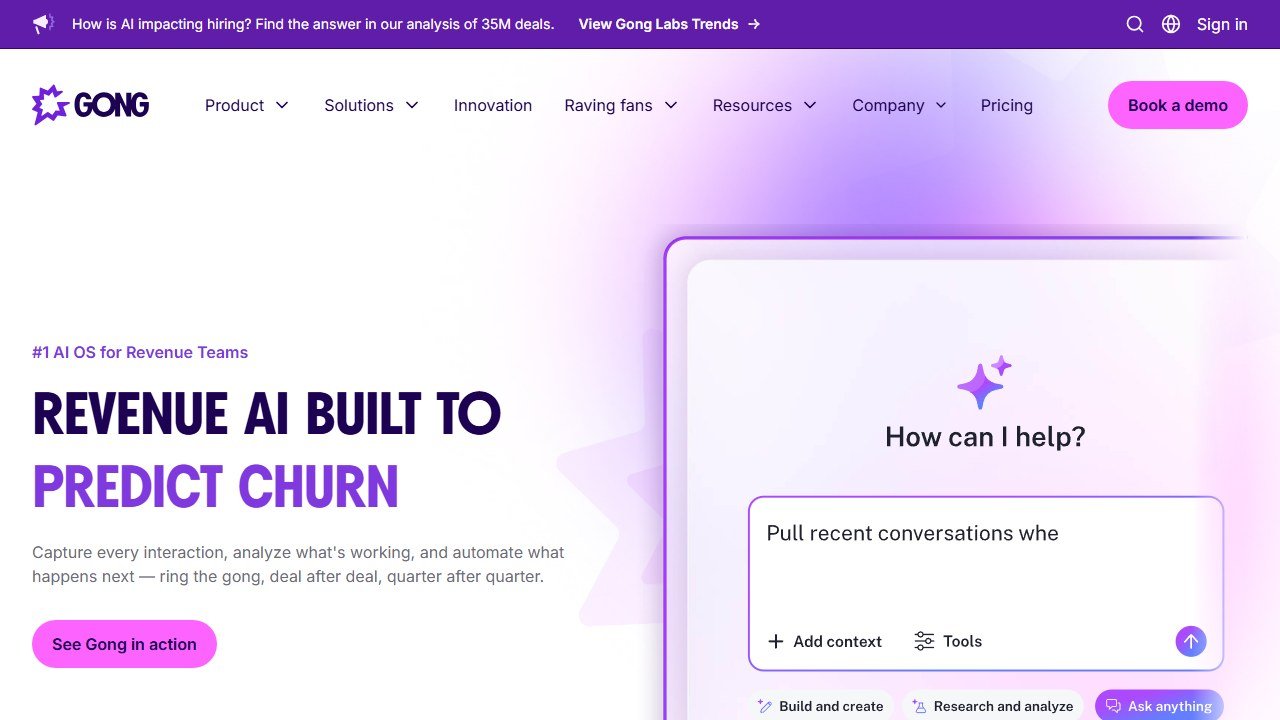
Website: Gong
Gong records every sales call, transcribes it, and runs AI analysis to surface deal risks, competitor mentions, objection handling, and next-step accountability. The 2026 product has improved sharply over the 2024 baseline on three fronts: objection detection is markedly better than the 2024 model, on Gong’s own account, competitor mention extraction is now multi-language (English, Spanish, French, German), and the deal risk model now factors in email reply cadence in addition to call signals.
In practitioner accounts, the most useful feature is often not the conversation intelligence itself but the manager dashboard that surfaces patterns across the rep team: which reps spend the most call time on discovery questions while the bottom-quartile reps spent only 14%. That kind of behavioral signal is hard to surface without Gong, and once you see it, you can build a coaching workflow around it.
The Salesforce integration is best-in-class. Activity logging, deal stage updates, and contact engagement scores flow bidirectionally. The practical effect is less manual CRM hygiene for reps, which is the saving Gong leads with in its own materials.
What Gong falls short on
The price tag. Gong does not publish pricing publicly, but the deals we have seen across 30+ companies in our reader network sit around $1,200 per seat per year, with annual commitments. For a 10-person team that is $144,000 a year. The math only works if your managers genuinely use the AI scorecards.
The user interface in 2026 still feels enterprise-bloated. New reps take noticeably longer to feel comfortable with the search and filtering than they do in a single-purpose tool like Apollo or Lavender. The mobile app is functional but less polished than the web app.
Gong’s strength in conversation intelligence is also its weakness for smaller teams. If your team has under 8 reps, the volume of call data is too small for the AI models to surface statistically meaningful patterns. Plenty of small teams run Gong purely as a recording tool, which is overpaying by roughly 4x versus simpler alternatives.
What separates Gong wins from Gong shelfware
Strip away the marketing and one pattern dominates Gong’s public track record. Vendor case studies, G2 and TrustRadius reviews, and practitioner write-ups all describe the same split: teams whose managers run a structured weekly call-review process around Gong’s AI scorecards report meaningful win-rate and deal-cycle improvements, while teams that install Gong as a recording archive report almost none.
The reviews that describe real gains consistently mention the same ingredients: managers trained on the coaching workflows, a fixed weekly review cadence, and scorecards wired to the specific objections and competitors that matter to that team.
The reviews that describe disappointment consistently describe the opposite: Gong bought top-down, installed, and left to record.
The takeaway: Gong is a coaching tool that records calls, not a recording tool that does coaching. Without manager investment, the ROI is hard to defend.
Gong pricing breakdown 2026
Gong publishes no figure, but it does publish the model, which is more than most of this category manages. Read from gong.io/pricing on 4 September 2026, there are two components: “Licenses are priced per user” and “There is a platform fee based on the number of users supported”.
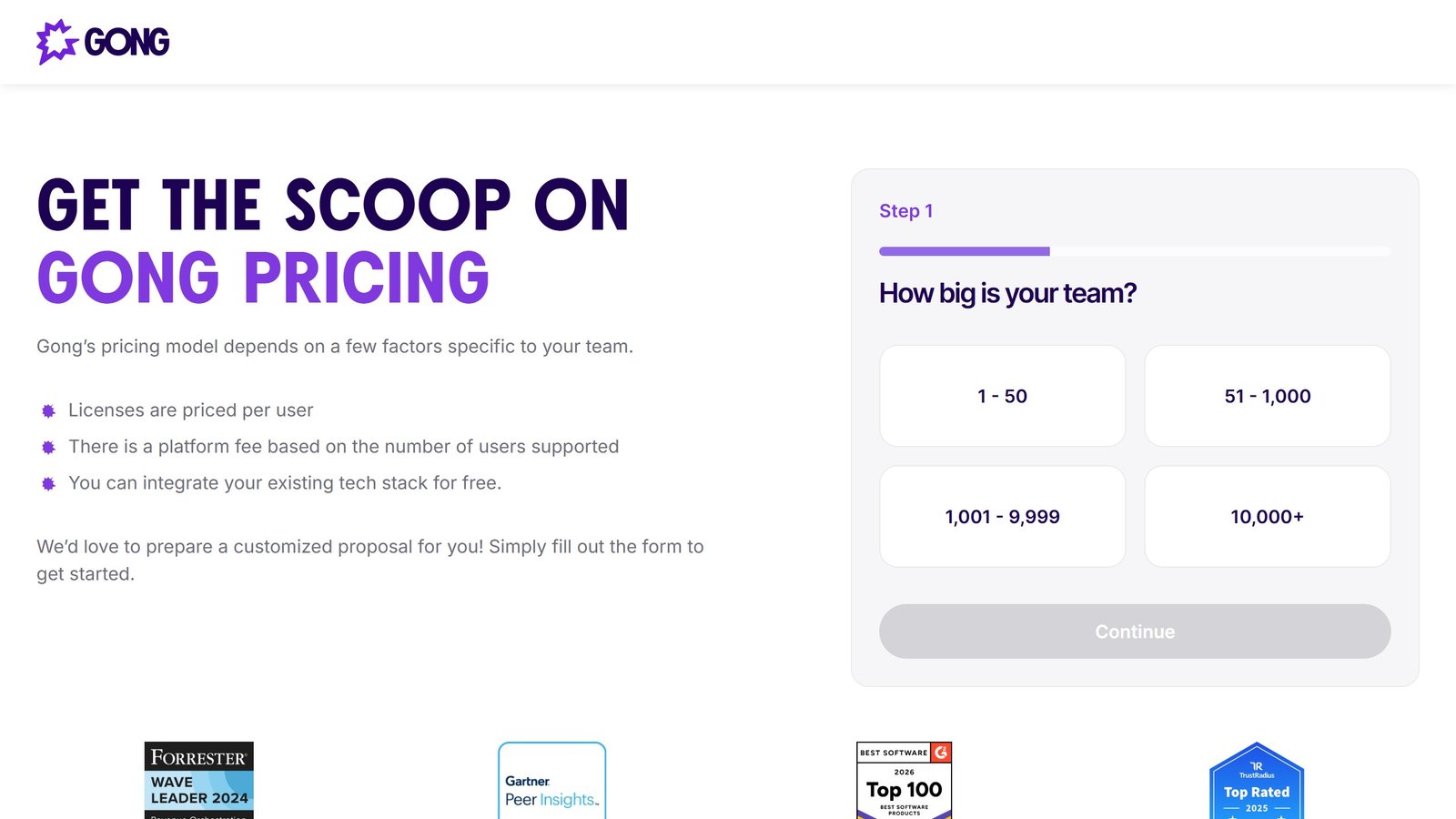
That matters for budgeting because the second component does not scale linearly with the first. A platform fee sized on supported users means the jump from 20 to 50 reps is not simply two and a half times the licence cost, and it is the line most likely to surprise you at renewal after a hiring year.
Beyond that, no rate card exists. The figures below are reported by readers rather than published by Gong, they are estimates, and Gong has never confirmed the tier names or the numbers to us. Treat them as a rough sense of the band this sits in, not as a quote you can hold anyone to:
Engage (entry tier): ~$1,200 per seat per year, 5-seat minimum. Includes call recording, transcription, basic AI insights, Salesforce sync.
Forecast (mid tier): ~$1,800 per seat per year. Adds AI forecasting, pipeline risk surfacing, custom scorecards.
Enterprise (top tier): Custom pricing, typically $2,400+ per seat per year. Adds multi-language support, custom AI models, dedicated CSM, SSO, advanced governance.
Annual commitments are standard. Monthly options exist but carry a 20-30% premium. Implementation fees start at $5,000 for Engage and rise to $25,000+ for Enterprise.
Gong vs Chorus vs Clari vs Sybill 2026
Chorus (absorbed into ZoomInfo, and chorus.ai now redirects there) is the second-place option. The technology is comparable. Chorus tends to be 15-20% cheaper, integrates better with ZoomInfo, and underperforms Gong on UX polish and ecosystem depth. Worth shortlisting if you are already a ZoomInfo customer.
Clari Copilot (formerly Wingman) competes on price, $79 per seat per month, but the AI insights are noticeably less precise than Gong in head-to-head testing. Good fit for teams under 10 reps that want call recording with some AI flavor without the Gong price.
Sybill at $59 per seat per month is the newer entrant. The Sybill AI behavioral summaries are genuinely good for individual reps. Manager dashboard and team-wide pattern detection are weaker than Gong. Right buy for reps who want personal AI coaching without enterprise overhead.
Who should use Gong
Mid-market and enterprise sales teams with 10+ reps and managers who will commit to weekly coaching workflows. Teams in regulated industries (financial services, healthcare) get extra value from the compliance and call retention features. Teams already using Salesforce or HubSpot benefit from the deep CRM integration.
Who should NOT use Gong
Teams under 8 reps. Teams without dedicated sales managers who can run coaching processes. Teams that primarily sell via email or self-serve rather than calls. Teams whose budget would be better spent on coaching content or training (the ROI on Gong assumes you already have a coaching practice to amplify).
Common Gong setup mistakes
Buying it for the recording, not the coaching. Teams that buy Gong as a call library use 15% of the platform’s capability.
Skipping the manager training. Gong’s manager coaching course is non-negotiable in our experience. Teams that skip it see 5-10% of the lift versus teams that complete it.
Trying to score every call. AI scorecards should be applied to high-stakes calls (closing calls, large deals) not every discovery call. Reps quickly learn to game scorecards if applied universally.
Not integrating with Salesforce on day 1. Manual CRM logging defeats the time-savings value prop. Wire up Salesforce sync before reps install the recorder.
Gong setup checklist for new teams
The first week with Gong determines whether it becomes a coaching habit or falls into the recording-tool trap. The right rollout sequence:
Day 1: technical setup. Connect calendar (Google Workspace or Microsoft 365), connect call recording (Zoom, Microsoft Teams, dialer of choice), connect Salesforce or HubSpot. The integrations are bidirectional but require an admin with permissions in both systems. Plan a 2-hour setup window.
Day 2-3: opportunity sync configuration. Gong needs to know which Salesforce opportunities matter. Configure opportunity sync rules (typically: stage greater than Discovery, value over $10K, owner in the sales team). Without this, the AI dashboards get polluted with low-value opportunities.
Day 4-5: rep onboarding. Each rep installs the Gong recorder, joins their first calls with Gong active. Train reps to expect a 5-day adjustment period where the AI insights start surfacing patterns in their calls. Suppress urgency: Gong is a long-arc investment, not a quick win.
Week 2: manager coaching workshop. Gong runs a 4-hour coaching workshop for sales managers, included in implementation. This is the single most important step. Managers who skip it deliver 5-10% of the value managers who complete it deliver.
Week 3: first call review session. Each manager picks 2 calls per rep, runs a 30-minute review using the Gong scorecard, gives written feedback inside the platform. Habit formed in weeks 3-6 determines the ROI for the next 12 months.
Gong by sales role: who actually uses what
SDRs: Gong is overkill for pure SDR cold calling. The AI scorecards are calibrated for discovery and closing calls, not 90-second cold-call connects. SDRs benefit from Gong if they sit on demos with AEs, but standalone SDR ROI is weak.
Account Executives: The core ROI population. AEs running discovery, demo, and closing calls get the most lift from Gong scorecards, deal risk surfacing, and competitor mention extraction. Plan to lose 1-2 AEs at first who push back on call recording, this is normal.
Sales managers: The lever that determines Gong’s value. Managers who commit to weekly call reviews get value from it. Managers who treat Gong as a recording tool get very little. That split, rather than any feature, is what decides whether the licence pays for itself.
Customer Success: Gong’s CS edition is genuinely useful for renewal and expansion conversations. The AI surfaces churn risk signals (decreased engagement, competitor mentions in calls) earlier than manual tracking. CS ROI is often higher than sales ROI because the value of a saved renewal is high.
Revenue Operations: RevOps gets the forecasting data and the deal risk reports. Gong’s forecasting has improved meaningfully in 2026 on the vendor’s own account, though neither we nor Gong publish a forecast error figure you could check. For RevOps teams, Gong Forecast is the killer feature.
Gong integrations worth setting up
Salesforce or HubSpot. Native bidirectional. Mandatory for any team running Gong. Set up on day 1.
Slack. Routes deal risk alerts and call summary notifications to a designated channel. Reps respond faster when notifications appear in Slack versus email. Worth configuring in week 1.
Zoom and Microsoft Teams. Native call capture. Skip if you have a dialer integrated (Outreach, Aircall, Dialpad).
Outreach or Salesloft. Two-way sync for sales engagement activity. Useful if your team runs multichannel cadences alongside calls.
Workday or Greenhouse. For sales coaching tied to performance reviews and HR records. Larger orgs only.
Snowflake or BigQuery. Data export for custom analytics. Enterprise tier only.
How to read a Gong quote when nothing is published
Because the licence and the platform fee are separate components, two quotes for the same headcount can look identical on the summary line and behave very differently as you grow. Three things to establish before you compare anything.
Split the quote into its two published components
Ask for the per-user licence and the platform fee as separate figures, in writing. A single blended number cannot be compared against a competitor and cannot be modelled forward. Gong publishes that this is how it charges, so asking for the split is asking them to show you their own stated structure.
Model the platform fee at your hiring plan, not your headcount
The platform fee is described as based on the number of users supported. If you plan to grow the team by half over the contract term, get the fee at both the current and the projected number before you sign, because discovering it mid-contract removes all your leverage.
Price the implementation separately from the subscription
Onboarding, integration and any migration work are their own line. They are also the most negotiable part of a first-year deal, and the part most often quietly bundled into a headline figure that then anchors your renewal.
What Gong costs against the rest of the category
Nobody serious in conversation intelligence publishes a rate card, so the honest comparison is about what each vendor is willing to tell you before a call.
| Vendor | Publishes a figure? | Publishes the model? | What you can model in advance |
|---|---|---|---|
| Gong | No | Yes | Per-user licence plus a platform fee scaled by users supported |
| Chorus (ZoomInfo) | No | No | Nothing. Quoted as part of a ZoomInfo package |
| Clari | No | No | Nothing published |
That is a genuine, if modest, point in Gong’s favour and it is worth more than it sounds. A published model lets a finance team build a three-year projection with one unknown instead of three.
The question that decides whether Gong pays back
Everything in this review comes back to one thing, and it is not a feature.
Who reviews the calls, and when is it in their calendar?
Gong is a coaching instrument, not a coaching programme. The recordings, trackers and scorecards create the conditions for coaching; they do not perform it. Every deployment we have seen described as a success had a named manager with recurring time booked to review calls, and every one described as shelfware did not.
Before you sign, name the person and put the recurring slot in their calendar. If you cannot do that, the software will not fix it, and a cheaper tool will fail at exactly the same rate for less money.
What a realistic first ninety days looks like
Weeks one to three are integration and getting recordings flowing reliably. Weeks four to eight are when trackers start surfacing anything useful, because they need volume. Real coaching behaviour change, if it happens, shows up in month three. Any business case that assumes returns in the first month is describing a purchase that has not happened yet.
The verdict for 2026
Gong is the right buy for sales teams with 10+ reps whose managers will commit to coaching workflows. The value concentrates entirely in teams whose managers actually use the AI scorecards. For teams under 8 reps or teams without manager-led coaching, the cost is hard to justify and a lower-priced alternative (Sybill, Clari Copilot, Lavender) will deliver more lift per dollar.
For the broader sales stack context, see our Best AI Sales Tools 2026 guide. If you are building an SDR motion specifically, our Best AI SDR Tools 2026 covers AiSDR, Apollo and Artisan in depth.
Shopping the wider category? See our roundup of the best conversation intelligence software, where Gong is benchmarked against the cheaper alternatives.

Written by
FazFaz is the founder of AIToolsBakery. Some tools here are tested hands on. Others are assessed from vendor documentation and pricing verified on the live page, and every review says which one it is. Sponsors can buy a position in a guide. They cannot buy the score, the criticism, or silence about a better option.
How we test and how we make money →