Conversation intelligence software records your sales and customer calls, transcribes them, and uses AI to surface what is actually driving (or killing) your deals. Done well, it turns thousands of hours of calls into coaching insight, accurate forecasts, and a searchable record of every customer promise. Done wrong, it is an expensive transcription tool nobody opens. This guide ranks the nine platforms worth evaluating, and it sorts them by the two factors most listicles bury: how big your team is, and how the tool actually records calls.
We are an independent review site. We do not sell conversation intelligence software, and no vendor paid for placement. Two facts shape this ranking that you will rarely see stated plainly elsewhere. First, recording method matters: bot-based tools join your call as a visible meeting participant, while bot-free tools capture audio in the background, and that difference changes the prospect experience. Second, Chorus is no longer a standalone product. It is now a ZoomInfo add-on at roughly 40 dollars per seat per month, available only to ZoomInfo customers, which completely changes who should consider it. Our top pick is Gong for enterprises, but here is the angle most roundups will not give you: Gong is overkill if you have fewer than 50 reps.
Quick answer: Gong is the enterprise benchmark and the right pick above 50 reps, where deal-risk scoring and forecasting earn the premium. Below that, Avoma is the value all-in-one and Grain the bot-free choice when prospect experience matters. Match it to your team size and recording method.
What conversation intelligence does, and who actually needs it
Every platform here does the same core job: capture the call, transcribe it accurately, and apply AI to extract topics, action items, objections, competitor mentions, talk-to-listen ratios, and deal risk signals. The differences are in depth and audience. Enterprise platforms add revenue intelligence, pipeline forecasting, and deal-level risk scoring on top of call analysis. Mid-market tools focus on coaching and meeting productivity. Budget tools focus on getting clean transcripts and summaries into your workflow cheaply.
The trap is assuming the most powerful platform is the right one. A 200-rep organization needs deal-risk scoring and forecast accuracy, and will happily pay enterprise pricing for it. A 15-person team needs good call summaries, coaching snippets, and CRM sync, and will get almost none of the value from an enterprise forecasting suite while paying a steep per-seat premium and a long contract for the privilege. Team size is the first filter, recording method is the second, and only then does the feature checklist matter. We have ranked accordingly.
Bot-free vs bot-based recording: the detail others gloss over
Bot-based tools (Gong, Avoma, Fireflies, tl;dv, Fathom, Clari Copilot in most setups) send a virtual participant into your video call. Prospects see a named bot in the attendee list, which is transparent and easy to set up, but some buyers find it intrusive and a few will ask you to remove it. Bot-free tools (Grain offers this, and Sybill leans toward a less intrusive capture model) record through the platform’s native APIs or a desktop layer without adding a visible attendee, which feels more natural to the prospect but can be fussier to configure and platform-dependent. Neither is universally better. If your buyers are sensitive to being recorded by an obvious bot, bot-free is worth the setup cost. If you value zero-friction deployment across a big team, bot-based wins. We flag the method for each tool below.
How we chose
We scored each platform on five factors: transcription and AI accuracy, depth of coaching and revenue-intelligence features, integration with CRMs and dialers, value relative to the team size it targets, and total cost including contract terms. We pulled pricing from public pages and vendor quotes, verified feature claims against demos and user reviews, and weighted value heavily because this category punishes overbuying more than almost any other in the sales stack. Scores are on a 0 to 5 scale. This is a comparison-first category page. For the deep, hands-on breakdown of our top pick, see our full Gong review; we keep the Gong section here short on purpose and link down to that dive.
1. Gong
Gong is the enterprise benchmark for revenue intelligence, and it earns the top rank on capability. Beyond best-in-class call capture and analysis, it layers deal-risk scoring, pipeline forecasting, and market intelligence that turn call data into board-level revenue insight. The AI is mature, the integrations are deep, and large organizations consistently rate it the most trustworthy platform for forecasting. It records via a meeting bot.
- Recording method: Bot-based.
- Best for: Enterprise and large mid-market revenue teams (roughly 50-plus reps).
- Pricing model: Quote-based per seat plus a platform fee, premium tier, annual contract.
- Verdict: The most capable platform here, and overkill (and overpriced) for small teams. The right call above 50 reps. Full breakdown in our Gong review. Score: 4.8.
2. Chorus by ZoomInfo
Chorus by ZoomInfo was once a standalone Gong rival; it is now a ZoomInfo add-on, sold at roughly 40 dollars per seat per month and available only to ZoomInfo customers. The product still does solid call recording, transcription, and deal intelligence, and the real draw is the tight loop with ZoomInfo’s contact and intent data. But it is no longer something you buy on its own, which narrows its audience sharply to teams already committed to the ZoomInfo platform.
- Recording method: Bot-based.
- Best for: Existing ZoomInfo customers who want conversation intelligence bundled in.
- Pricing model: Add-on, around 40 dollars per seat per month, requires a ZoomInfo subscription.
- Verdict: Strong value if you already pay for ZoomInfo. Not a reason to switch platforms, and not a standalone option anymore. Score: 4.2.
3. Avoma
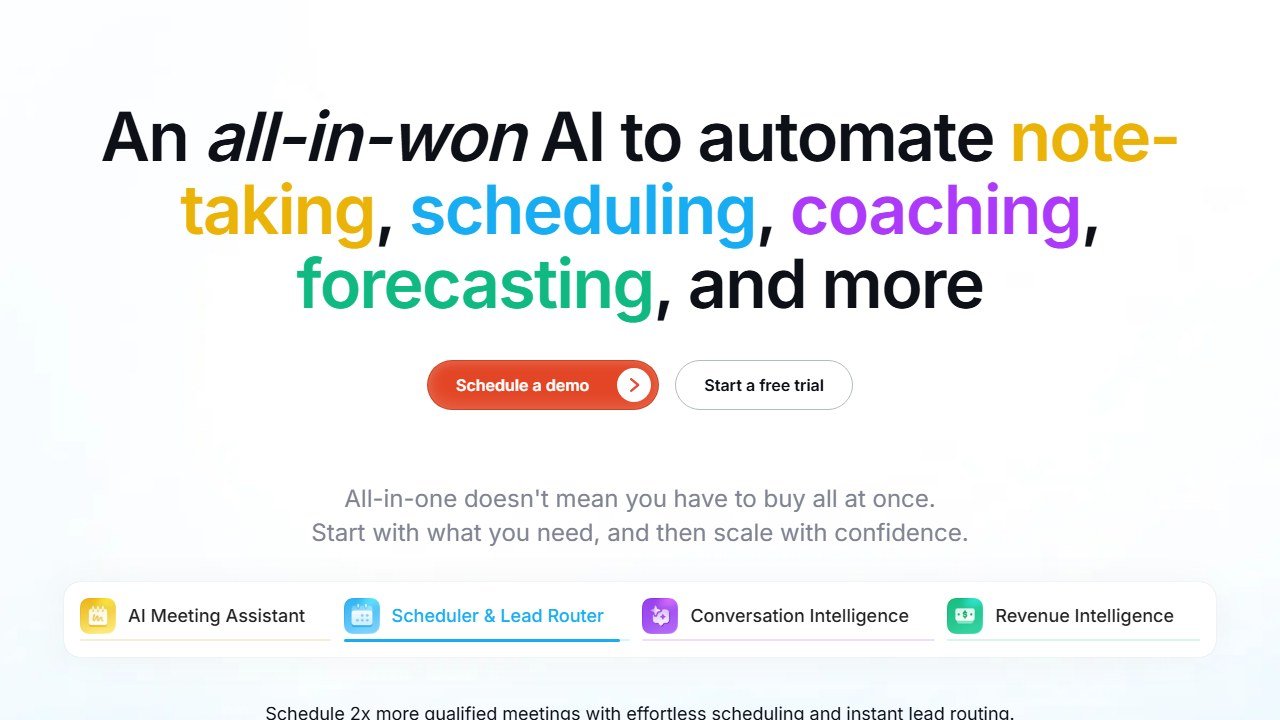
Avoma is the best value all-in-one. It combines a meeting assistant, conversation intelligence, and revenue-intelligence features in a single platform at a fraction of enterprise pricing, with transparent published tiers. You get transcription, AI notes, coaching scorecards, and forecasting-lite features without an enterprise contract. For mid-market teams that want most of Gong’s coaching value at a manageable cost, Avoma is the smartest money on this list.
- Recording method: Bot-based.
- Best for: Mid-market teams wanting broad capability without enterprise pricing.
- Pricing model: Published tiered per seat, free tier available.
- Verdict: The best balance of features and price for growing teams. Our value pick. Score: 4.6.
4. Grain
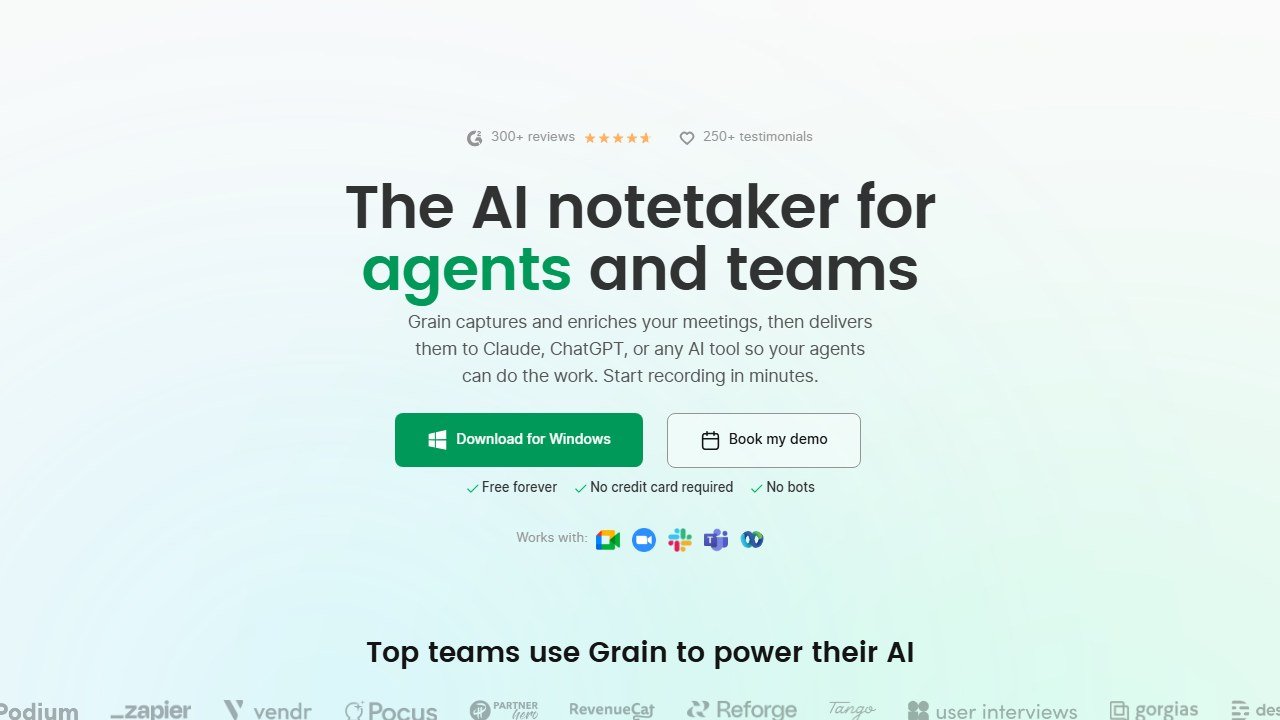
Grain is the standout for teams that want bot-free recording. It captures calls without forcing an obvious bot into every meeting, focuses on clean highlights and shareable clips, and keeps the interface simple enough that reps actually use it. It scales well for growing teams that want coaching snippets and CRM sync without enterprise complexity, and the highlight-clip workflow is genuinely better than most rivals for sharing coachable moments.
- Recording method: Bot-free option available.
- Best for: Growing teams that want a less intrusive recording experience.
- Pricing model: Published tiered per seat, free tier available.
- Verdict: The pick when prospect experience matters and you want easy highlight sharing. Score: 4.4.
5. Sybill
Sybill targets the individual AE who is drowning in post-call admin. Its AI generates accurate call summaries, drafts follow-up emails, updates CRM fields automatically, and even reads behavioral and sentiment cues. The pitch is less about manager analytics and more about giving each rep hours back per week, which makes it a favorite among quota-carrying AEs rather than RevOps leaders.
- Recording method: Bot-based, with a focus on low-friction capture.
- Best for: Individual AEs and small teams who want admin automated away.
- Pricing model: Published per seat, mid-tier.
- Verdict: The best AE productivity play here. Lighter on team-wide revenue intelligence. Score: 4.3.
6. Fireflies.ai
Fireflies.ai is the budget transcription leader with unmatched language breadth, supporting a wide range of languages and meeting platforms at an accessible price. It records, transcribes, and summarizes meetings, offers a searchable knowledge base of calls, and integrates broadly. It is lighter on sales-specific revenue intelligence than the leaders, but for teams that mainly need reliable, affordable, multilingual meeting capture, it is hard to beat on price.
- Recording method: Bot-based.
- Best for: Budget-conscious and multilingual teams needing reliable transcription.
- Pricing model: Published tiered per seat, generous free tier.
- Verdict: The value transcription pick. Buy it for clean notes, not deep deal intelligence. Score: 4.1.
7. Clari Copilot
Clari Copilot, formerly Wingman, brings real-time coaching and battle cards to live calls, and it plugs into Clari’s broader revenue platform for forecasting. The standout is in-call guidance: reps get objection-handling prompts and competitor battle cards while the conversation is happening. For organizations already using Clari for forecasting, Copilot extends that data into the call itself.
- Recording method: Bot-based.
- Best for: Teams wanting live in-call coaching, especially existing Clari users.
- Pricing model: Quote-based per seat.
- Verdict: The strongest real-time coaching layer here, best when paired with the Clari platform. Score: 4.2.
8. tl;dv
tl;dv is built for SMB meeting intelligence, with a generous free plan, simple recording and transcription, timestamped highlights, and broad integrations. It is approachable, cheap, and good enough for small teams that want searchable meeting records and shareable clips without committing to a sales-intelligence platform. Sales-specific analytics are limited, but the price-to-value ratio for small teams is excellent.
- Recording method: Bot-based.
- Best for: SMBs and small teams wanting affordable meeting intelligence.
- Pricing model: Published tiered per seat, strong free tier.
- Verdict: A friendly, low-cost entry point. Outgrow it as your coaching needs deepen. Score: 4.0.
9. Fathom
Fathom is free for individual reps, and that is its whole appeal. It records, transcribes, and summarizes meetings with a clean interface and zero cost for solo use, making it the obvious starting point for a single rep or a tiny team testing the waters. Team and analytics features sit behind paid tiers, but for an individual who just wants reliable call notes and summaries at no cost, nothing here beats it.
- Recording method: Bot-based.
- Best for: Individual reps and very small teams on a zero budget.
- Pricing model: Free for individuals, paid team tiers.
- Verdict: The best free starting point. Graduate to a team platform when you need shared coaching. Score: 4.0.
Master comparison
| Tool | Best for | Recording method | Pricing model | Standout |
|---|---|---|---|---|
| Gong | Enterprise (50-plus reps) | Bot-based | Quote-based, premium, annual | Deal-risk scoring and forecasting |
| Chorus by ZoomInfo | Existing ZoomInfo customers | Bot-based | ~40 dollars per seat add-on | Tight ZoomInfo data loop |
| Avoma | Mid-market value | Bot-based | Published tiers, free option | All-in-one at a fair price |
| Grain | Bot-free recording | Bot-free option | Published tiers, free option | Less intrusive capture, easy clips |
| Sybill | Individual AEs | Bot-based, low friction | Published, mid-tier | AE admin and follow-up automation |
| Fireflies.ai | Budget, multilingual | Bot-based | Published tiers, free | Language breadth, low cost |
| Clari Copilot | Live coaching | Bot-based | Quote-based | Real-time battle cards |
| tl;dv | SMB meeting intel | Bot-based | Published tiers, free | Cheap, approachable |
| Fathom | Solo reps, zero budget | Bot-based | Free for individuals | Genuinely free for one rep |
Price vs team size matrix
| Team size | Budget priority | Recommended pick | Why |
|---|---|---|---|
| 1 rep | Free | Fathom | Full call notes at no cost |
| 2 to 10 reps | Low cost | tl;dv or Fireflies.ai | Cheap, reliable, searchable meetings |
| 10 to 50 reps | Value plus coaching | Avoma or Grain | Coaching depth without enterprise price |
| 1 to 50, AE productivity focus | Per-rep time savings | Sybill | Automates post-call admin |
| 50-plus reps | Forecasting accuracy | Gong | Deal-risk scoring and revenue intelligence |
| Any size on ZoomInfo | Bundled value | Chorus by ZoomInfo | Already paying for the platform |
How to choose
The headline guidance: Gong is overkill if you are under 50 reps. Its revenue-intelligence and forecasting depth is worth the premium when you have a large pipeline to model and a RevOps team to act on the signals. Below that threshold, you pay enterprise pricing and a long contract for features you will not fully use.
Solo or tiny team. Start with Fathom (free) or tl;dv. You need clean notes and shareable clips, not deal-risk scoring.
10 to 50 reps. This is Avoma and Grain territory. Avoma gives you the broadest feature set per dollar; Grain wins if bot-free recording and prospect experience matter to you. If your reps are buried in post-call admin specifically, Sybill targets that pain directly.
50-plus reps. Gong, and step up to it deliberately. If you already run ZoomInfo, evaluate Chorus as a bundled add-on before paying separately for anything else.
Live-coaching priority. Clari Copilot leads on in-call guidance, especially if you already forecast in Clari.
Whatever you pick, confirm the recording method fits your buyers. Bot-based deploys fast across a big team; bot-free (Grain) feels more natural to sensitive prospects.
Conversation intelligence is one layer of a modern revenue stack. For the full picture of how call analysis fits alongside prospecting, enrichment, and dialing, see our guide to the best AI sales tools. If you are building an automated outbound function, our roundup of the best AI SDR tools covers the agent layer that increasingly feeds these calls. And for the deep, hands-on evaluation of our top pick, the full Gong review is the next read.
Conversation intelligence: consent, adoption and what it actually changes
Recording and analysing sales calls is the most operationally sensitive purchase on this list, because it touches employment practice and recording law as well as software.
Consent is a legal question with a geographic answer
Recording consent rules differ by jurisdiction and, in the United States, by state, with some requiring all parties to consent rather than one. If your reps call across state or national borders, and they do, the tool must handle disclosure and consent per call rather than per account. Ask exactly how, ask what happens when a participant declines, and involve whoever owns legal before the pilot rather than after it.
Your reps are the second consent question
Recording every call changes how it feels to do the job. Teams that introduce this well say plainly what is recorded, who can watch it, and what it will and will not be used for in performance reviews. Teams that introduce it quietly get quiet resistance: calls that do not get logged, conversations moved to mobile, and adoption that looks fine in the dashboard and is fictional.
What it genuinely changes
The honest value is coaching and onboarding. A new rep listening to ten real calls from your best performer learns faster than any playbook achieves, and a manager reviewing specific moments rather than recollections gives better feedback. That is worth real money. The weaker claim is deal prediction, where the signal is thinner than the dashboards imply and the model is often learning your CRM hygiene rather than your deals.
Adoption is the whole risk
This category has a specific failure mode: the recordings accumulate and nobody watches them. Before buying, name the ritual that will use the output, whether that is a weekly coaching slot or a deal review that opens the call rather than the notes. If no meeting changes, you have bought an archive. Gong publishes no figure but does publish its model, per user licences plus a separate platform fee scaled to users supported, which at least lets you model the shape of the bill.
How to tell whether the tool actually worked
The failure mode in sales tooling is not a product that breaks. It is one that runs for a year while nobody can say whether it changed anything, and by renewal the argument is about anecdotes.
Take the baseline before you install
Whatever you intend to measure, you need last quarter of it from a source the project did not touch. Meetings booked per rep, reply rate by segment, average cycle length, and the hours the target task consumes. That last one is the most commonly skipped and the easiest to capture: ask two or three people to record how long it takes them this month. Time saved is measurable in advance and unprovable afterwards.
Measure the decision, not the output
A tool that generated 40,000 personalised emails has produced activity. What matters is whether the accounts your reps worked were different from the ones they would have worked anyway, and whether that difference showed up in pipeline. The clean version is a holdout: give half the team the tool and leave half on the existing process for a quarter. It is unfashionable and it is the only evidence that survives a hostile question.
Watch the metric that moves against you
Volume tools improve the numbers they are measured on and quietly degrade others. More sends usually means a worse reply rate, more meetings often means worse meeting quality, and a rising bounce rate can hide behind a healthy looking campaign until a domain is burned. Pick one counter-metric per tool and report it beside the headline, or you will optimise the wrong thing very efficiently.
Agree the stop condition in advance
Write down, before purchase, the result at the end of the first term that would mean you do not renew. Naming it converts renewal from a default into a decision, and it is the single most effective discipline against a pilot that becomes permanent. If nobody can state a result that would end it, the evaluation was never real.
undefined
The bottom line
Gong is the enterprise benchmark and the right choice above 50 reps, where its deal-risk scoring and forecasting earn the premium. Below that, Avoma is the value all-in-one, Grain is the bot-free pick when prospect experience matters, and Fathom or tl;dv cover solo reps and small teams cheaply. Chorus is now a ZoomInfo add-on, relevant only if you are already on that platform. Decide team size first, recording method second, and the right tool stops being a guess.

Written by
FazFaz is the founder of AIToolsBakery. Some tools here are tested hands on. Others are assessed from vendor documentation and pricing verified on the live page, and every review says which one it is. Sponsors can buy a position in a guide. They cannot buy the score, the criticism, or silence about a better option.
How we test and how we make money →