PT Distinction pricing at a glance
| Plan | Per month | Clients included | Each extra client | Custom branded apps |
|---|---|---|---|---|
| Basic | $19.90 | 3 | $6.00 | No |
| Pro | $59.90 | 25 | $2.40 | Yes |
| Elite | $89.90 | 50 | $1.60 | Yes |
All prices USD, read from ptdistinction.com/pricing on 28 August 2026.
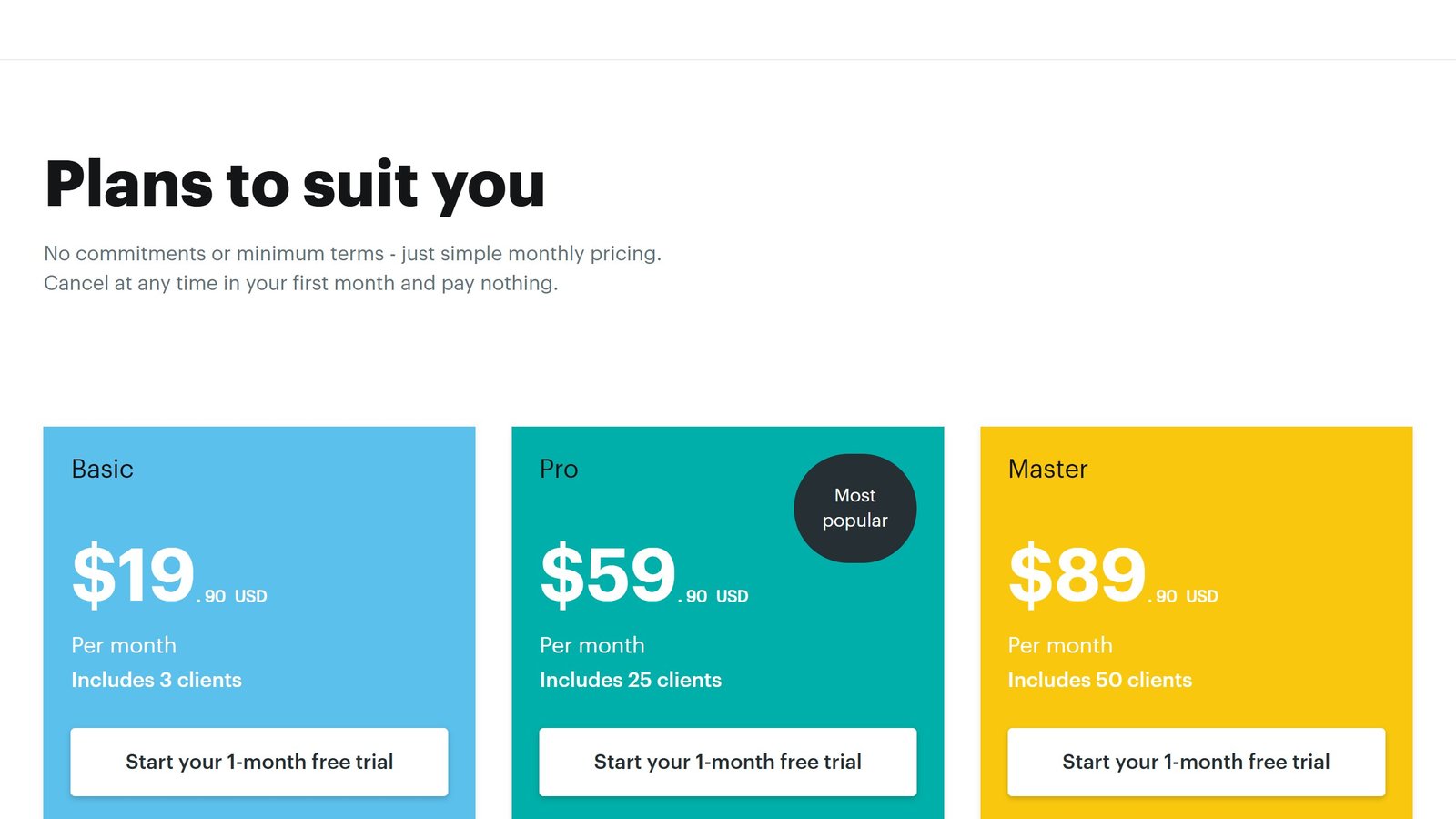
Three things about the structure, before the numbers.
There is no annual plan. PT Distinction’s own line is “no commitments or minimum terms, just simple monthly pricing.” So there is no annual discount to weigh up, which is unusual in this category and makes the comparison a lot simpler.
Every plan has every feature. AI Program Builder, AI Smart Meal Planner, AI Assistant, nutrition coaching, assessments, group training, in-app messaging, scheduled email and SMS, automated workflows, habits, integrations, templates and payments are on all three. The only feature that differs is custom branded apps, which Basic does not get.
So you are buying client capacity. That is the whole decision.
What it actually costs at your client count
Because extra clients are billed per head, the headline price is not the price. Here is the real monthly cost on each plan as your roster grows.
| Clients | Basic | Pro | Elite | Cheapest |
|---|---|---|---|---|
| 5 | $31.90 | $59.90 | $89.90 | Basic |
| 10 | $61.90 | $59.90 | $89.90 | Pro |
| 25 | $151.90 | $59.90 | $89.90 | Pro |
| 38 | $229.90 | $91.10 | $89.90 | Elite |
| 50 | $301.90 | $119.90 | $89.90 | Elite |
| 75 | $451.90 | $179.90 | $129.90 | Elite |
The two numbers worth remembering: 10 and 38.
At 10 clients, Pro becomes cheaper than Basic. Basic with 10 clients is $19.90 plus seven extras at $6.00, which is $61.90. Pro is $59.90 flat and holds until 25. So anyone on Basic with a tenth client is paying more for less headroom.
At 38 clients, Elite becomes cheaper than Pro. Pro with 38 is $59.90 plus thirteen extras at $2.40, which is $91.10, against Elite at $89.90 covering you to 50.
Neither of those thresholds is stated on PT Distinction’s pricing page. They fall out of the arithmetic, and they are the only two moments where the right plan changes.
The per-client rate, which is the real comparison
| Plan | Price per included client | Each extra client |
|---|---|---|
| Basic | $6.63 | $6.00 |
| Pro | $2.40 | $2.40 |
| Elite | $1.80 | $1.60 |
Two things stand out.
On Pro, the included rate and the overage rate are identical at $2.40. There is no penalty for going over, which is rare. It means a Pro user at 30 clients is paying exactly the same per head as a Pro user at 25.
Basic is the expensive plan per client, at roughly $6.63 a head against $2.40 on Pro. Basic is priced as a starter tier for someone with a handful of clients, not as a cheap way to run a business.
Things worth knowing before you pay
One month free trial, and PT Distinction states you can cancel any time in the first month and pay nothing.
Extra clients are free for the first month on every plan, so the overage does not start biting during the trial.
Same day support on all three plans, including Basic. Support is not used as an upsell here.
Custom branding is the one real feature gate. Basic gets iOS and Android apps without your branding. Pro and Elite get your own custom branded apps. If putting your business name on the app matters, that alone moves you to Pro regardless of client count.
Who each plan is for
Basic at $19.90 suits someone with three or fewer clients, or a trainer testing the platform alongside another system. Past nine clients it stops making sense on price.
Pro at $59.90 is the plan most working trainers will want. It covers 25 clients, adds custom branded apps, and charges the same per head whether you are at 25 or 40.
Elite at $89.90 is for anyone above about 38 clients. The extra-client rate drops to $1.60, the lowest on offer.
What the price does not tell you
What counts as a client. The allowances are 3, 25 and 50, and overage is billed per client per month. Whether an archived or paused client still counts is not stated, and for a trainer with seasonal clients that is the difference between a stable bill and a creeping one. Ask before you build a roster.
The bill you see in month one is not the bill you pay in month two. Because extra clients are free for their first month, a Basic user who adds seven clients during that window sees $19.90, then $61.90 once the overage starts.
There is no annual option at all. Most competitors offer 15 to 25 per cent off for paying yearly, so PT Distinction is effectively dearer than its headline suggests when set against a discounted annual rate elsewhere. The trade is flexibility: no commitment, no minimum term, cancel any time.
The pattern worth noticing
The extra-client rate on each plan is almost exactly the per-client cost of that plan. Pro includes 25 clients for $59.90, which is $2.40 each, and extra clients are $2.40. Elite includes 50 for $89.90, which is $1.80 each, and extras are $1.60.
So PT Distinction does not penalise you for going over your allowance, which is unusual. On most per seat software the overage rate is deliberately higher than the included rate, to push you up a tier. Here the pricing is close to linear, and the only reason to upgrade is that the next tier has a lower base rate per head.
What coaching platforms actually charge, vendor by vendor
Personal training software is metered on active clients almost everywhere, which makes it one of the few categories where you can calculate your exact bill from the pricing page. Here is each alternative to pt distinction, read at source on 4 September 2026.
PT Distinction, the clearest per client arithmetic in the category
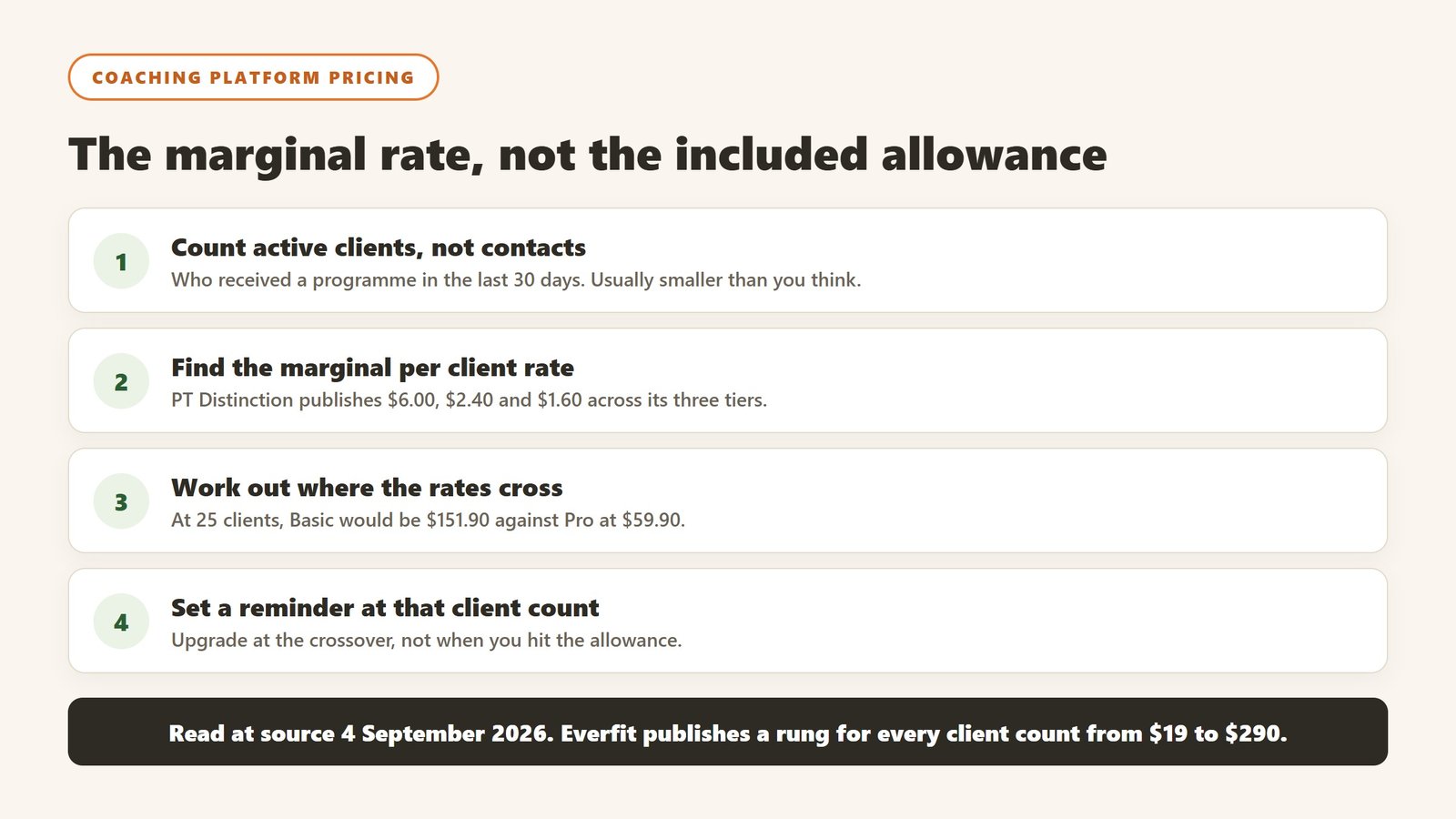
PT Distinction publishes Basic at $19.90 a month including 3 clients, Pro at $59.90 including 25, and Master at $89.90 including 50. Crucially it also publishes the marginal rate: extra clients cost $6.00 a month on Basic, $2.40 on Pro and $1.60 on Master. That means you can work out your own crossover exactly. At 25 clients Basic would be $151.90 against Pro at $59.90, so the upgrade pays for itself long before you reach the included allowance.
Everfit, which publishes the whole client ladder
Everfit goes further than anyone here and publishes a rung for every client count. Billed monthly: 5 clients $19, 10 $29, 20 $49, 35 $75, 50 $95, 100 $140, 200 $220, 300 $290. Billed annually those become $16, $24, $41, $63, $79, $117, $183 and $242. The per client cost falls from $3.80 to under a dollar as you scale. Its add-ons are priced separately: Autoflow automation from $29 a month, meal plans at $39, on-demand collections at $25 and payments at $9.
TrueCoach, three tiers, annual billing only on the headline
TrueCoach publishes Starter at $26.34 a month billed annually, Standard at $57.99 and Pro at $136.99, with one month free on Starter and two months free on the higher tiers. Note that every published figure assumes annual billing, and the page carries a monthly toggle that changes them. Check which state a quoted TrueCoach price is in before comparing it with a monthly figure from a rival.
My PT Hub and FitBudd, where the add-ons matter
My PT Hub publishes Starter at $25 a month and Premium at $59, currently shown at $29.50 for the first two months, with additional trainers at $10 a month, a custom branded app at $95 one-time and a white label app at $145 a month. FitBudd publishes $15 for 2 clients plus $4 per additional client, $79 for 20 clients plus $2 per additional, and $149 for 20 with your own app, alongside one-time setup fees of $75 and $100. On both, the add-ons can exceed the plan.
Trainerize and Wodify, the two to read carefully
Trainerize publishes a genuinely free tier for a single client seat and paid plans from $9 a month, with additional locations at $248 a month, but its page presents several different figure sets depending on the seat count you select, so quote a Trainerize price only alongside the client count it assumes. Wodify shows $199 struck through and $99 a month per location, conditional on booking a demo by 31 August. We read that page on 4 September 2026, four days after the stated deadline, and the discounted figure was still displayed. Ask them which price actually applies before budgeting on it.
Per client pricing, and the crossover most coaches miss
Almost every platform here charges on active clients, and the marginal rate matters more than the headline. Here is the same roster priced across the vendors that publish, using their own rates read 4 September 2026.
| Active clients | PT Distinction | Everfit, monthly | Everfit, annual | FitBudd |
|---|---|---|---|---|
| 5 | $31.90, Basic +2 | $19 | $16 | $27 |
| 20 | $59.90, Pro | $49 | $41 | $79 |
| 50 | $89.90, Master | $95 | $79 | $139 |
| 100 | $169.90, Master +50 | $140 | $117 | $239 |
Upgrade before you hit the allowance, not after
On PT Distinction, 25 clients on Basic would cost $151.90 against $59.90 on Pro, because the marginal rate on the entry tier is $6.00 a client against $2.40. The included allowance is not the point at which you should move; the point is wherever the marginal rates cross, and that is usually far earlier. Work it out once and set a calendar reminder at that client count.
Annual billing is a real discount here, unusually
Everfit at 100 clients is $140 a month billed monthly and $117 billed annually, a saving of $276 a year. TrueCoach publishes one month free on Starter and two months free on Standard and Pro. FitBudd gives two months free on yearly billing. In a category where client numbers fluctuate seasonally, the question is whether you are confident enough of your floor to commit, and most established coaches are.
Count active clients, not total clients
The meter is people currently assigned programming, not everyone who has ever trained with you. Coaches routinely over-buy because they price on their contact list. Before choosing a tier for pt distinction or anything else, count the clients who received a programme in the last thirty days. That is your number, and it is usually smaller than expected.
What software should cost as a share of coaching revenue
The useful test is not whether a platform is cheap but whether it is a sane fraction of what it helps you earn, and that arithmetic is straightforward in this business.
Work it out per client, per month
At 20 clients on Everfit billed annually you are paying $41 a month, which is about $2.05 per client. If your average client pays $150 a month, software is roughly 1.4% of revenue. At the same roster on FitBudd’s $79 tier it is $3.95 a client, or 2.6%. Both are defensible. What is not defensible is paying a per client rate that approaches a meaningful share of what each client pays you, and that happens most often on the entry tiers where marginal rates are highest.
The branded app question is a business decision, not a software one
My PT Hub publishes a custom branded app at $95 one-time and a white label app at $145 a month. FitBudd’s own-app tier is $149 for 20 clients with a $100 setup fee. A branded app is worth it if you are selling to your own audience at scale and the app is part of the product you charge for. It is not worth it if you have 15 clients who already message you on WhatsApp, however good it looks.
Price the tier you will be on in six months
Coaching rosters grow in steps rather than smoothly, usually after a launch or a referral run. Buying for today’s client count and re-evaluating quarterly is fine; buying an enterprise tier for a roster you hope to have is how coaches end up paying for capacity they never use. The published ladders in this category make it easy to model both, so model both.
What the platform does not fix
Software does not sell coaching. If your constraint is that you have twelve clients and want thirty, no feature on any of these pages changes that, and the money is better spent on whatever actually brings people in. Buy a platform when delivery is the bottleneck, not when demand is.
Client retention, and the small number of things that actually move it
Coaching businesses live and die on retention rather than acquisition, and this is where software genuinely helps, though not in the way the feature lists suggest.
The check-in is the product
Clients renew because they feel seen, and the single highest leverage feature in any of these platforms is whatever makes a consistent, personal check-in easy to deliver at scale. Everything else is secondary. When evaluating, time how long it takes you to review a week of one client’s data and send something meaningful back, then multiply by your roster. That number is your real capacity.
Automation helps until it is noticed
Automated messaging is the standard feature here and it works right up to the moment a client realises the encouraging note arrives every Monday regardless of what they did. Use automation for logistics, reminders and structure. Keep anything that reads as personal actually personal, because the cost of being caught is the relationship rather than the message.
Watch the first six weeks
Most coaching churn happens early, before habit forms and before results arrive. If your platform gives you an activity view, the one report worth opening weekly is the list of clients who have not logged anything in seven days, filtered to those in their first six weeks. Acting on that list is worth more than any feature comparison.
Measure retention before you change anything
Take your current three month and twelve month retention rates from your own records before switching platforms, because you cannot reconstruct them afterwards and every vendor conversation will otherwise be about features. If retention does not move within two full client cycles, the platform was not the constraint.
How we checked this
We read PT Distinction’s own pricing page on 28 August 2026, reached from ptdistinction.com’s navigation rather than a guessed URL, and took the plan prices, client allowances and per-client overage rates from the plan cards themselves.
The cost table and the two break-even points are our arithmetic on PT Distinction’s published figures. The inputs are theirs, the sums are ours, and we have shown the working so you can check it.
This is a pricing page, not a hands-on review. Nothing here is scored and we make no claim to have used the product.
Prices change. If a figure here no longer matches PT Distinction’s page, tell us and we will correct it.

Written by
FazFaz is the founder of AIToolsBakery. Some tools here are tested hands on. Others are assessed from vendor documentation and pricing verified on the live page, and every review says which one it is. Sponsors can buy a position in a guide. They cannot buy the score, the criticism, or silence about a better option.
How we test and how we make money →