Instrumentl pricing at a glance
| Plan | Paid annually | Paid monthly | Users included | Cost per user, annual |
|---|---|---|---|---|
| Discover | $299/mo | $349/mo | 3 | $99.67 |
| Pre-Award | $499/mo | $579/mo | 5 | $99.80 |
| Full Lifecycle | $999/mo | $1,159/mo | 15 | $66.60 |
| Enterprise | Quote only | Quote only | not stated | n/a |
Read from instrumentl.com/pricing on 28 August 2026. All plans come with a 14 day free trial. Full Lifecycle is marked Most Popular.
Read the annual figures carefully
Instrumentl’s plan cards lead with $299, $499 and $999, each labelled “per month”. Those are the annual rates. Underneath, in smaller type, is the monthly-billed price: $349, $579 and $1,159.
That is a $50 to $160 a month difference depending on the plan, so anyone quoting Instrumentl at “$299 a month” without saying “paid upfront annually” is quoting the discounted rate.
To their credit, Instrumentl does print both figures on the card, which is more than several competitors manage.
What the annual commitment saves
| Plan | 12 months paid monthly | Paid annually | You save | That is |
|---|---|---|---|---|
| Discover | $4,188 | $3,588 | $600 | 14.3% |
| Pre-Award | $6,948 | $5,988 | $960 | 13.8% |
| Full Lifecycle | $13,908 | $11,988 | $1,920 | 13.8% |
Around 14% across the range, which is a modest annual discount by software standards. Many tools in this category offer 17% to 25%.
The per-seat figure is the one that decides the plan
| Plan | Annual monthly rate | Users | Per user |
|---|---|---|---|
| Discover | $299 | 3 | $99.67 |
| Pre-Award | $499 | 5 | $99.80 |
| Full Lifecycle | $999 | 15 | $66.60 |
Discover and Pre-Award cost almost exactly the same per seat, a shade under $100. So moving from Discover to Pre-Award is not a volume discount, it is buying capability: CRM sync, team collaboration on proposals, the Apply AI writing tool, and Award Assistant for extracting deadlines from award letters.
Full Lifecycle is where the per-seat price drops, to $66.60, a third less. If you have more than about 10 people who need access, the top tier can genuinely work out cheaper per head than the middle one.
What each tier adds
Discover, $299 is prospecting and organisation. Finding matched opportunities, tracking deadlines, building a pipeline. Three users.
Pre-Award, $499 adds the writing and collaboration layer: funder look-alike research, pipeline tracking through award, CRM sync, team collaboration, the Apply AI writing tool that draws on your past content, and Award Assistant, which extracts deadlines and requirements from award letters. Five users.
Full Lifecycle, $999 adds everything post-award: real-time grant spenddown, accounting system integration so expenses update automatically, planned expense logging, budget versus actuals export, and automatic over or underspend alerts. Fifteen users, plus personalised onboarding.
Enterprise is quote only, aimed at multi-site organisations, universities and municipalities, with dedicated support and enhanced security.
The dividing line is clean: Discover finds grants, Pre-Award writes them, Full Lifecycle manages the money after you win.
Context worth having
Instrumentl is the tool competitors most often name when positioning against a grants database. Grantable’s pricing page names Instrumentl first in its list of things it claims to replace, and prices itself at $50 to $150 a month against Instrumentl’s $299 to $999.
Those are different products doing overlapping jobs, and the gap is largely the grants database itself: Instrumentl publishes 36,000-plus active grants and 550,000-plus funder profiles. Whether you need that dataset is the actual question, and it is the thing the price difference is mostly buying.
Who each plan is for
Discover suits a small shop that needs to find and track grants and already has a way to write them.
Pre-Award is the plan most established grants teams will want, and the CRM sync is usually the line item that decides it.
Full Lifecycle is for organisations that have to report on how grant money was spent, not just whether it was won. It is also the cheapest per seat, so a large team may land here on cost alone.
What the price does not cover
Users are capped, and the caps are low. 3, 5 and 15. Nothing on the pricing page says what an extra user costs, or whether one can be added without moving up a plan. On a tool where a grants lead, a finance lead and a programme director all plausibly need access, the user cap is more likely to force an upgrade than any feature is.
Annual is paid upfront. The $299, $499 and $999 rates are described as paid upfront annually, so Discover is $3,588 out of the door on day one rather than spread across the year. For a small nonprofit that cash flow difference can matter more than the 14.3 per cent saving.
The 14 day trial is short for this product. A grants cycle runs months. Two weeks is enough to judge the interface and the quality of the funder matches, and not enough to judge whether the pipeline tooling fits how your team works. Decide what you want to answer before you start it.
Enterprise is quote only, aimed at multi-site organisations, universities and municipalities. Nothing indicates where Full Lifecycle stops being viable and Enterprise begins, beyond the 15 user cap.
Where Instrumentl sits among nonprofit tools
Instrumentl is grant discovery rather than a CRM, so it is not a like-for-like swap with anything below. The comparison is useful for budgeting, because grant tooling competes for the same constrained software line as the CRM.
| Vendor | Publishes a price? | Entry figure, verified 4 Sep 2026 | Meter |
|---|---|---|---|
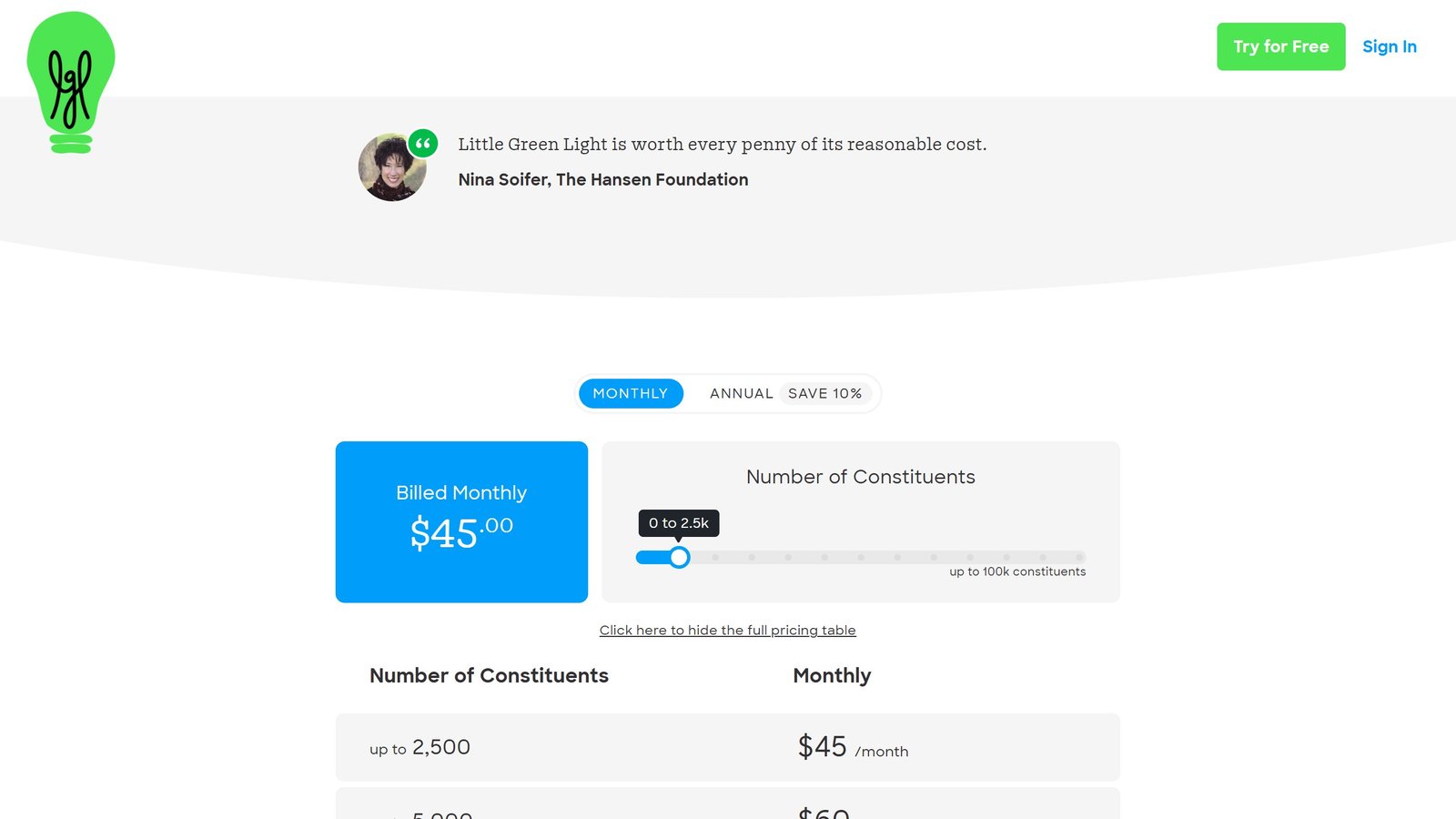
| Little Green Light | Yes | $45/mo | Constituents |
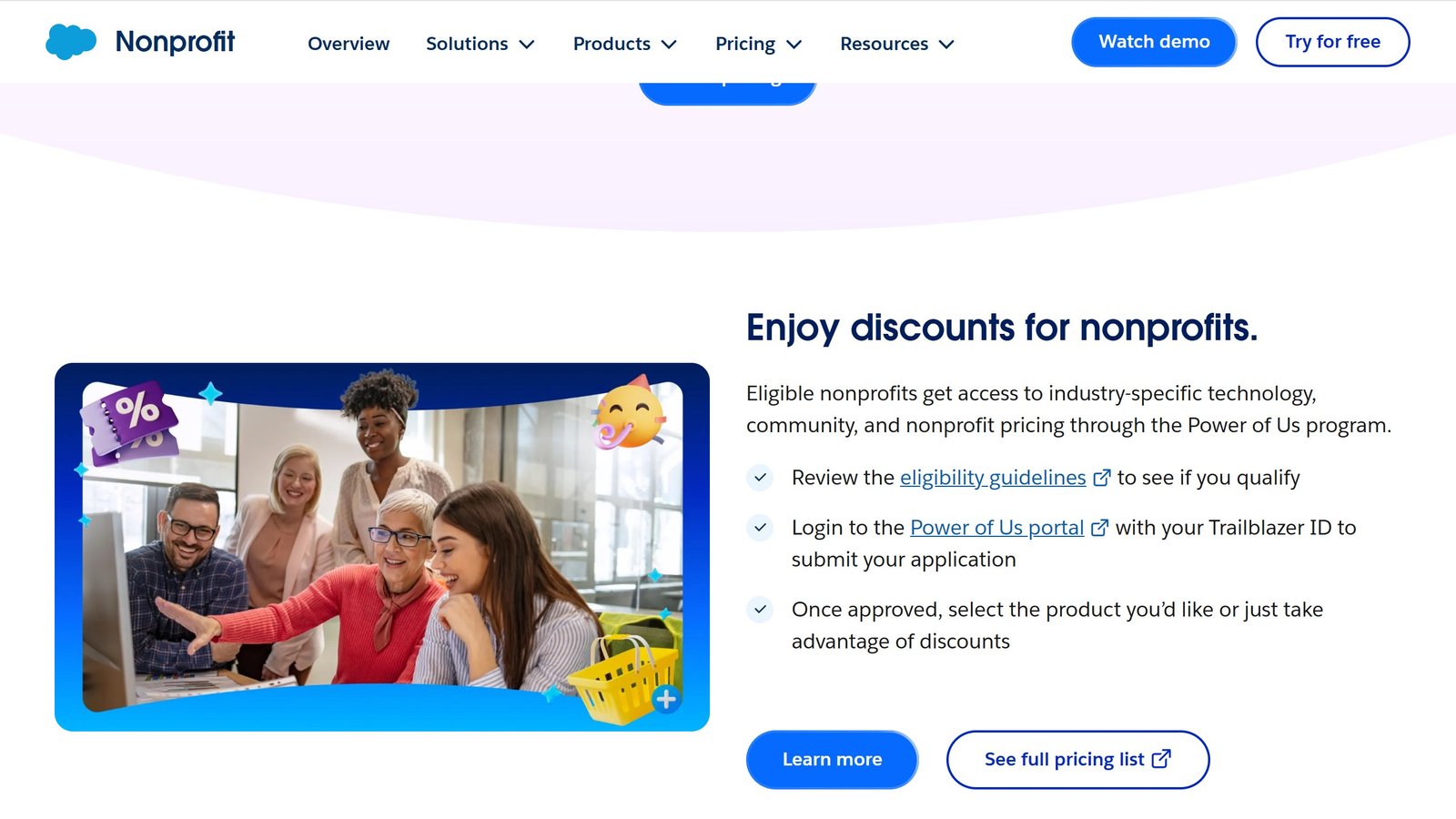
| Salesforce Nonprofit Cloud | Yes | $70/user/mo (4 Oct 2026), 10 free | Seats |
| Neon CRM | Yes | $99/mo | Annual revenue |
| Bloomerang | Yes | $125/mo | Product |
| Keela | Yes | $164/mo | Contacts |
| Dataro | Yes | $15,000/yr + $0.10/donor | Platform + donors |
| Blackbaud | No | Quote form only | Quote |
| Virtuous | No | Quote, banded at $5M revenue | Quote |
| GoFundMe Pro (Classy) | No | Quote | Subscription + % of gifts |
Budgeting grant tools against the rest of the stack
Grant tooling is usually the second or third purchase
Most organisations buy a CRM first, an online giving tool second, and grant discovery third. That ordering matters because by the time grant software is considered, the software budget is largely committed, and the question becomes what it displaces rather than what it costs in isolation.
Judge it on funder matches, not database size
Every vendor in this space quotes a large number of funders. The number that matters is how many are plausible matches for your programme area, geography and grant size, and that is only answerable in a trial with your own criteria loaded. A database of tens of thousands is irrelevant if forty of them fit you.
The real cost is grant writer time
Software that surfaces twenty poor-fit opportunities costs more than it saves, because someone has to read and dismiss them. Assess these tools on precision rather than recall, and treat any trial that does not let you load your own eligibility criteria as uninformative.
What every comparable vendor actually charges
A comparison table tells you the number. It does not tell you what the number is measured against, which is the part that decides your bill. Here is each of the main alternatives to Instrumentl, read from their own pricing pages on 4 September 2026, with the meter that matters.
Little Green Light, from $45 a month, metered on constituents
Little Green Light publishes every band openly and starts at $45 a month for up to 2,500 constituents. It takes nothing from your donations, which makes it one of the few platforms where online giving revenue is genuinely yours. The catch is structural: because the meter is constituent count, growing your list raises the bill even when the added records are lapsed donors or one-off event attendees who will never give again. Organisations on constituent-metered platforms end up pruning their database to control cost, which is a bad incentive for a fundraising team that should be keeping history.
Salesforce Nonprofit Cloud, $70 per user (as of 4 October 2026), with ten licences free
Salesforce is the odd one out and it is worth understanding why. Nonprofit Cloud Core is $70 per user per month (as of 4 October 2026) billed annually, but the Power of Us programme gives any eligible nonprofit ten licences at no cost. An organisation with ten or fewer people in the CRM pays nothing for the CRM itself, at any list size. The eleventh person costs $840 a year at the October 2026 rate. That inverts the usual advice: on Salesforce a database of two million costs the same as one of two thousand, and hiring is what raises the bill. The real cost is not the licence, it is that somebody has to own the configuration.
Neon CRM, from $99 a month, metered on your fundraising revenue
Neon starts at $99 a month with unlimited users and unlimited records, priced on annual fundraising revenue rather than seats or contacts. Modules are added as a percentage of the subscription: memberships at 10%, events at 20%, volunteers at 10%. Worth knowing that Neon retired its old Essentials, Impact and Empower tier structure entirely, so any article still quoting $209 or $409 tiers is describing packaging that no longer exists.
Bloomerang, from $125 a month, metered by product
Bloomerang publishes $125 a month for the CRM, with Fundraising from $40 and Volunteer from $119 as separate products. It moved away from record-tier pricing, so comparisons written against its old banding are stale. The practical effect of product-based pricing is that a quote assembled from three Bloomerang products is not comparable to a single all-in figure from a competitor without itemising first.
Keela, from $164 a month, metered on contacts
Keela bands by contact count starting at $164 a month for up to 1,000 contacts. It raised every band between late August and early September 2026, entry moving from $134 to $164, a rise of roughly 15 to 22% across the range in under two weeks. That is a useful reminder that a published price is a snapshot: check the date on any figure you are comparing, including ours.
Dataro, from $15,000 a year plus $0.10 per active donor
Dataro is a different category, predictive donor intelligence rather than a CRM, and its pricing shows it: Essentials from $15,000 a year plus ten cents per active donor, Growth from $25,000 plus twelve cents. Its pricing page is not linked from its own navigation and is only discoverable through the sitemap. Included here because it is the honest top of the nonprofit software market and a useful upper bound when someone tells you a quote is expensive.
The ones that publish nothing
Blackbaud runs a quote request form headed “Let us find a price that fits your organization” with no figures at all. Virtuous publishes no price and bands its tiers at $5 million in annual fundraising revenue, so it segments you by what you raise before quoting. GoFundMe Pro, formerly Classy, publishes only that its model is an annual subscription plus a transaction fee per donation.
Why nonprofit software pricing works the way it does
Understanding the mechanics makes a quote easier to read and much easier to challenge.
Revenue banding is means testing
Several vendors band by annual fundraising revenue, and Virtuous splits its tiers at $5 million. That is means testing: the same software costs more if you raise more, on the reasoning that a larger organisation gets more value from it. It is defensible, and it also means your public filings are doing the negotiating before you arrive. Know your own figures before the call.
Why a quote form asks for an EIN
An EIN lets a vendor look up your filed revenue before quoting. If a pricing page asks for one before showing anything, assume the number you are offered has been sized against your accounts rather than drawn from a rate card.
Transaction fees are the line that scales fastest
Where a platform takes a percentage of donations, that line grows with your success and usually overtakes the subscription. On $500,000 raised online, a single percentage point is $5,000 a year, more than the entire annual cost of several CRMs. Most nonprofit CRMs take nothing from donations, so a percentage model needs a specific justification.
Published prices are snapshots, including ours
Keela raised every band by 15 to 22% in under two weeks. Neon retired an entire tier structure. Artisan removed its figures altogether. Any pricing article without a verification date is describing a market that may no longer exist, which is why every figure here carries one.
How to run the procurement so a quote means something
Get every quote onto the same basis before comparing
Ask each vendor, including Instrumentl, for the same seat count, the same contract length, implementation quoted separately from subscription, every add-on itemised, and payment processing stated as inside or outside the platform fee. A single blended annual number cannot be compared against anything, and vendors know it.
Establish the total first-year cost, not the subscription
Onboarding, data migration, integration work and training are frequently larger than the first year of licence fees in this category and are rarely in the headline figure. Ask for the all-in number, then ask which parts of it are one-off and which recur.
Negotiate the renewal before you sign the first contract
This is the single most valuable term and the one most often left out. A capped renewal uplift, stated as a percentage, is worth more than a bigger first-year discount, because at renewal the vendor knows your usage, your dependency and your switching cost while you have no public rate card to argue against.
Insist on a trial with your own data
A demo runs on a dataset chosen because the product handles it well. Ask to load a sample of your own records, including the messy ones: duplicate households, lapsed donors with old addresses, a recurring gift that failed. How a platform handles your actual data quality is the thing that decides whether staff use it, and it is invisible in a scripted walkthrough.
Name the person who will own it
Every platform in this category rewards an owner and punishes shared responsibility. Before signing, name the person whose job description includes this system and check they have the hours. Software does not create that role, and its absence is the most common reason a nonprofit CRM purchase disappoints.
How we checked this
We read Instrumentl’s own pricing page on 28 August 2026, reached from instrumentl.com’s navigation rather than a guessed URL, and took both the annual and monthly figures from the plan cards, which display both.
The saving and per-seat tables are our arithmetic on Instrumentl’s published figures. The inputs are theirs, the sums are ours, and the working is shown.
This is a pricing page, not a hands-on review. Nothing here is scored and we make no claim to have used the product. Figures attributed to another vendor’s marketing are labelled as such.
Prices change. If a figure here no longer matches Instrumentl’s pricing page, tell us and we will correct it.
Related: our full Instrumentl review, Instrumentl alternatives, Grantable vs Instrumentl and the best AI grant writing tools.

Written by
FazFaz is the founder of AIToolsBakery. Some tools here are tested hands on. Others are assessed from vendor documentation and pricing verified on the live page, and every review says which one it is. Sponsors can buy a position in a guide. They cannot buy the score, the criticism, or silence about a better option.
How we test and how we make money →