Jenni AI pricing at a glance
| Plan | Billed monthly | Billed annually | Annual total |
|---|---|---|---|
| Free | $0 | n/a | n/a |
| Plus | $30 a month | $12 a month | $144 |
| Pro | $73 a month | $29 a month | $348 |
Read from jenni.ai/pricing on 28 August 2026, with the billing toggle checked in both states. No credit card is required to start, and you can cancel any time.
The $12 figure is the annual rate, and the page shows it first
This is the reason this page exists.
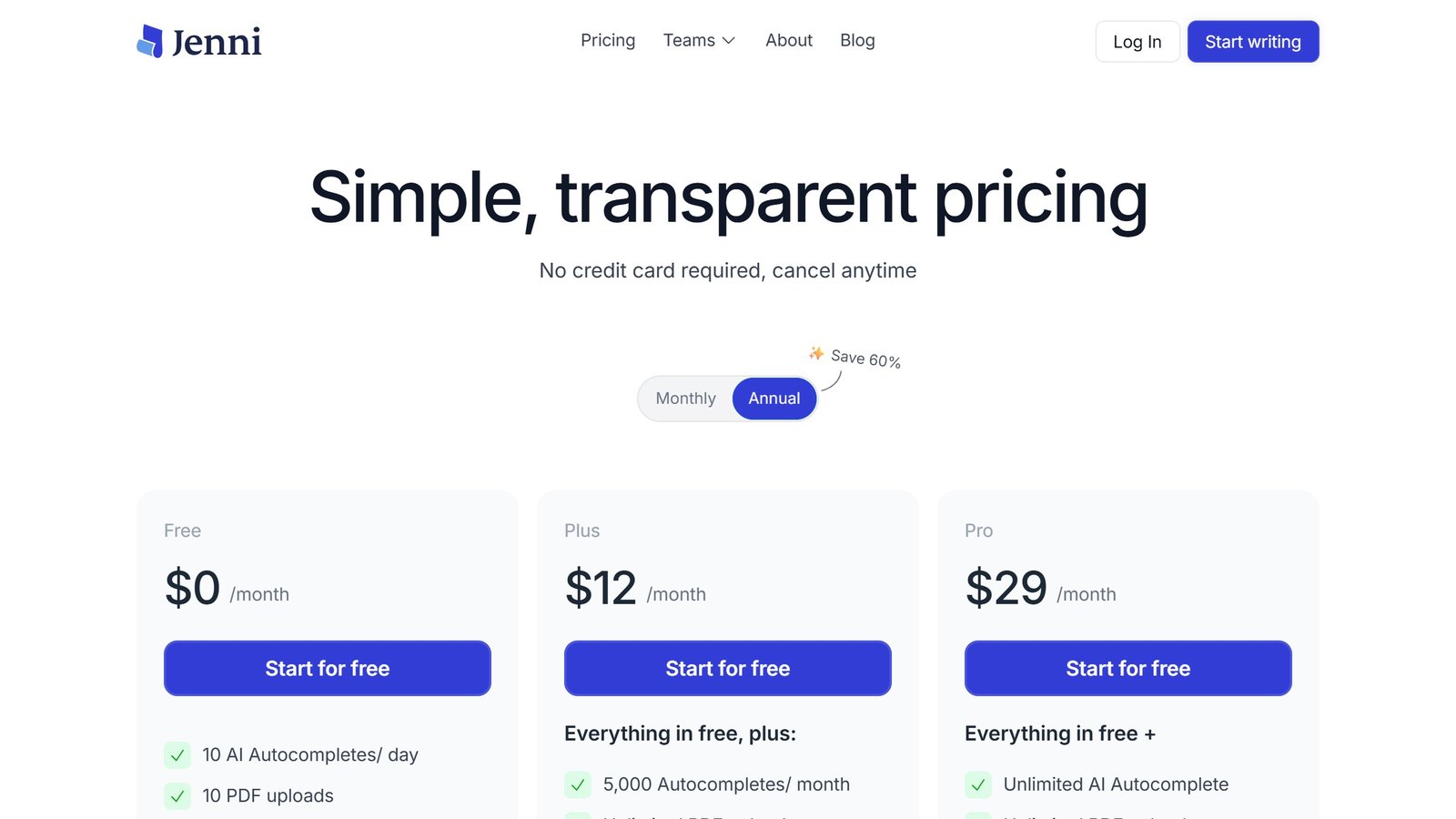
Jenni’s pricing page loads with the Annual tab already selected. We confirmed it from the page itself rather than assuming: on a fresh load the “Annual” label renders in active white while “Monthly” is greyed out. In that state Plus displays as $12 /month and Pro as $29 /month.
Switch to Monthly and the same plans read $30 and $73.
| Plan | What the page shows on load | What you actually pay monthly | Difference |
|---|---|---|---|
| Plus | $12 | $30 | 2.5x |
| Pro | $29 | $73 | 2.5x |
So anyone quoting Jenni at “$12 a month” is quoting a figure you can only get by paying $144 upfront for a year. That is not a small gap. It is the largest default-tab discrepancy we have measured on any pricing page, and it is two and a half times.
The 60% saving is real
To be fair to Jenni, the discount they advertise is accurate.
| Plan | 12 months at the monthly rate | Annual price | You save | That is |
|---|---|---|---|---|
| Plus | $360 | $144 | $216 | 60.0% |
| Pro | $876 | $348 | $528 | 60.3% |
Their badge says “Save 60%” and the arithmetic lands on 60.0% and 60.3%. That is one of the steepest annual discounts in AI writing software, and it is genuine.
The catch is simply that the discounted number is the one on display by default, so the headline price and the monthly price are very different things.
What each plan actually limits
| Free | Plus | Pro | |
|---|---|---|---|
| AI Autocomplete | 10 a day | 5,000 a month | Unlimited |
| AI Chat | 5 messages | 500 a month | Unlimited |
| AI Edits | 3 | 500 a month | Unlimited |
| Reviews | 3 scans | 10 a month | Unlimited |
| Library uploads | 10 uploads | Unlimited | Unlimited |
| PDF size | 25 MB | 100 MB | 100 MB |
| PDF page count | 150 pages | 500 pages | 1,000 pages |
| Document export | Body content only | Full | Full |
| Citation styles | 10,000+ | 10,000+ | 10,000+ |
| Unlimited citations | yes | yes | yes |
| Support | none stated | Live chat | Priority |
Two things worth pulling out.
Citations are unlimited on the free plan, along with 10,000 plus citation styles. For a student who only needs reference management, the free tier is genuinely usable rather than a teaser.
The Reviews allowance is the tightest limit on Plus. Ten a month, against unlimited on Pro. If you are running full-document reviews regularly, that is the number that will push you up rather than autocomplete or chat.
The PDF page count is the other one to watch. 150 pages on Free, 500 on Plus, 1,000 on Pro. If you work with long documents, check that ceiling before you pick.
What the price does not tell you
Whether unused allowances roll over. Plus gives 5,000 autocompletes and 500 edits a month. Nothing on the page says what happens to unused ones, or what happens when you exhaust them mid month.
What “Reviews” counts as. Free gets 3 scans, Plus gets 10 a month. Whether re-scanning an edited document consumes another review is not stated, and on a tool built around iterating that matters.
The upgrade gap is unusually wide. Plus at $12 annual to Pro at $29 annual is 2.4x for what is essentially “unlimited instead of generous”. If your usage sits comfortably inside the Plus caps, there is no reason to move.
Annual means annual. At 60% off, the discount is large enough that most people will take it, but that is $144 or $348 committed upfront. Jenni does say no credit card is required to start and you can cancel any time, which applies to beginning on the free plan.
Who each plan is for
Free suits anyone who mainly needs citation management, or who wants to try the writing tools at 10 autocompletes a day.
Plus is the plan most students and academic writers will want, and at $12 a month on annual it is priced accordingly. Check the 10 reviews a month limit against how you work.
Pro is for people who write at volume and do not want to think about caps, or who need the 1,000 page PDF ceiling.
How the annual trick compares across the category
Jenni is not alone in opening on the annual tab, but the size of its gap is unusual. We checked four AI writing and study tools on the same day and recorded both billing states on each.
| Tool | Shown by default | Actual monthly | Gap |
|---|---|---|---|
| Jenni AI (Plus) | $12 | $30 | 2.5x |
| Chalkie (Pro) | $6.65 | $8.99 | 1.35x |
| Chalkie (Max) | $12.99 | $16.99 | 1.31x |
| Grantable (Starter) | $42 on annual | $50 | 1.19x |
| Instrumentl (Discover) | $299 | $349 | 1.17x |
Jenni’s is the widest by a distance. The others sit between 17 and 35 per cent apart, where Jenni is 150 per cent apart. That is a direct function of the discount being 60 per cent rather than 10 to 25, so it is a consequence of a genuinely generous annual offer rather than of anything sharp.
It does mean one thing for anyone comparing tools on price. If you line Jenni’s $12 up against a competitor’s monthly figure, you are comparing an annual rate to a monthly one, and Jenni will look roughly two and a half times cheaper than it is on equal terms.
What you get free, and whether it is enough
The free plan is more generous than the paid tiers make it look, because the two things students most often need are uncapped on it.
Unlimited citations and over 10,000 citation styles are on the free plan. For anyone who needs reference management and nothing else, that is the product, at no cost.
Ten AI autocompletes a day is the real constraint. Not ten a month. For occasional drafting that is workable, and for a dissertation chapter it is not.
Export is limited on free. Body content only, against full document export on both paid plans. If you need formatting preserved on the way out, that alone decides it.
Academic writing: what these tools can safely do, and where the line is
Academic use is the highest-stakes application in this category and the one where a wrong answer costs the most. Here is a practical read on where jenni ai and its alternatives fit.
What the academic-facing tools price and meter
Jenni AI publishes Free at $0 a month with 10 AI autocompletes and 10 PDF uploads a day, Plus at $12 a month on annual billing with 5,000 autocompletes, unlimited PDF uploads, 500 AI edits and 500 AI chats a month, and Pro at $29 on annual billing with unlimited autocompletes. As the table above sets out, the monthly-billed rates are $30 and $73, and the page opens on the annual view. It states on the page that prices are in USD with local currency available in the app. The free tier includes citation styles and unlimited citations, which is more generous than the category norm.
Citation generation is the feature that needs checking, every time
A language model can produce a reference that is correctly formatted, plausibly titled, attributed to real authors who work in the field, and does not exist. This failure is well documented and it is the specific thing that ends careers. Every reference a tool generates must be opened and read before it goes in a bibliography. A tool that pulls citations from an uploaded PDF you already have is materially safer than one generating them from a prompt, which is why the PDF upload limit on the free tier is worth more attention than the autocomplete count.
The line most institutions actually draw
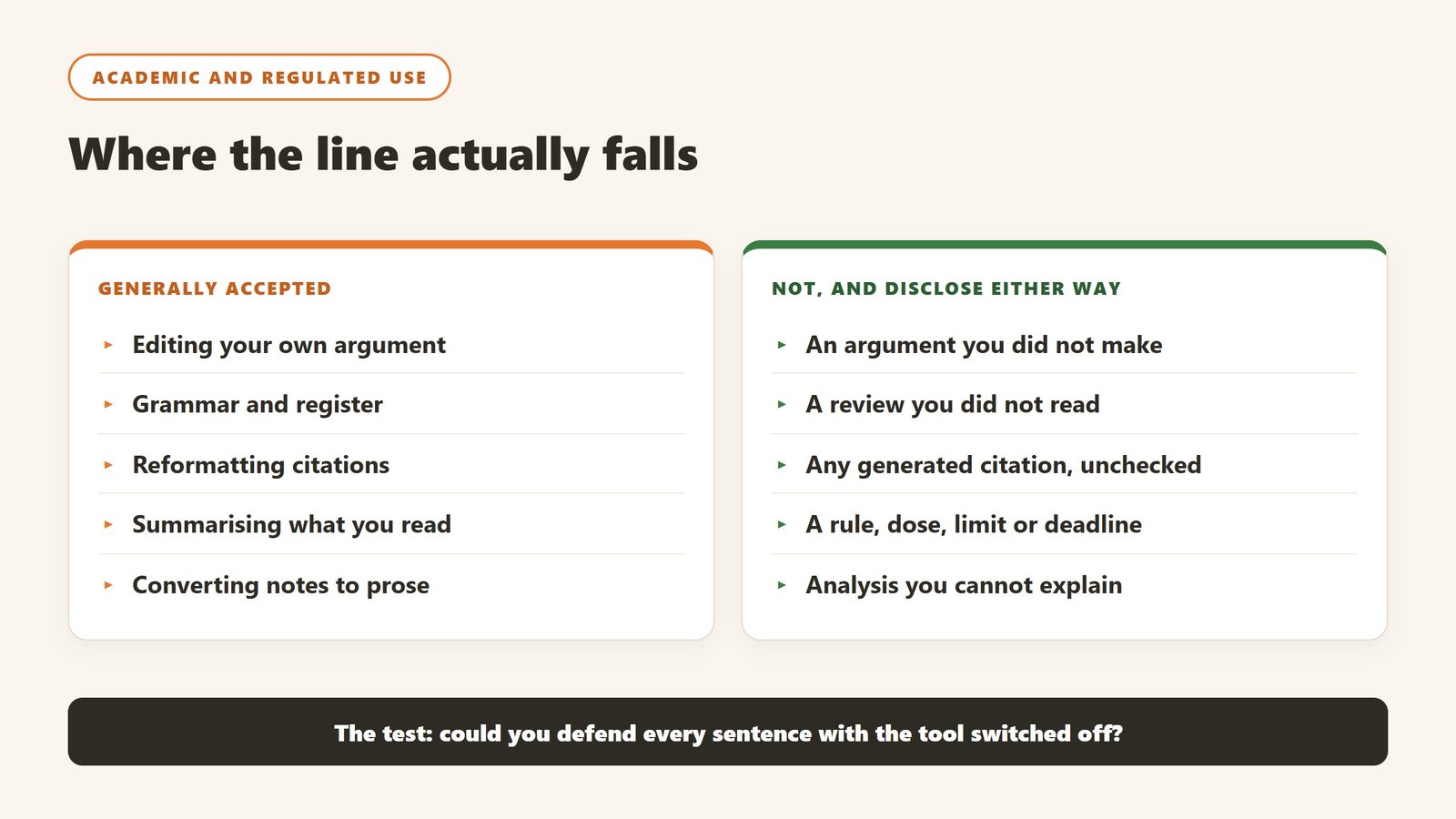
In practice the distinction is between assistance with expression and substitution for thought. Editing your own argument for clarity, checking grammar, reformatting citations and summarising a paper you have read are generally accepted. Generating an argument you have not made, a literature review you have not read, or an analysis you cannot explain is not. The reliable test is whether you could defend every sentence in a viva without the tool present.
Say what you used
Disclosure requirements vary by institution, journal and even by supervisor, and they change faster than the guidance documents do. Read your own institution’s current policy rather than a general summary, including this one, and when it is ambiguous, ask and keep the answer in writing. The cost of asking is a short email. The cost of assuming is your degree.
One practical safeguard
Keep the machine draft and your edited version as separate files. If a question is ever raised, being able to show what the tool produced and what you changed is a far better position than reconstructing it afterwards, and it takes no effort at the time.
Three of these tools quoted us rupees, and almost no comparison mentions it
This is the single most useful thing we can tell you about pricing in this category, and it is the thing every roundup gets wrong. On 5 September 2026 we read each vendor’s own pricing page from one connection on one day. Three of the biggest names served us a rate card in Indian rupees without being asked.
Grammarly shows an India flag and prices in INR
Grammarly’s plans page displayed a country flag at the top and then quoted Free at ₹0 INR a month and Plus at ₹392 INR per member per month billed annually, or ₹1,000 when billed monthly. The currency code is written out on the page. This is not an artefact of our reading: Grammarly is deliberately serving a local rate card, and the dollar figure quoted in most articles is the United States one. The monthly-to-annual gap here is unusually wide, close to two and a half times, which makes the annual commitment more consequential than at a vendor offering a flat twenty percent.
QuillBot does the same, behind a URL that does not exist
QuillBot is harder to research than it should be. The obvious address, quillbot.com/pricing, returns a 404, and hitting it repeatedly returns a 429. Its own footer link labelled “Pricing” points at /upgrade and its header button at /premium, which is where the plans actually sit. There we were shown Free at ₹0 a month and Premium at ₹200 against a struck-through ₹334 per month billed annually, under a “Get 40% off” banner. A struck-through list price is a promotional display, so ask what it renews at rather than what it costs today.
ProWritingAid prices its free tier in dollars and its paid tiers in rupees
ProWritingAid showed us Free at $0 per month, in dollars, and then quoted Premium and Premium Pro in rupees across three separate billing views: monthly, yearly and a one-time lifetime payment. The two figures we could read cleanly, without digits being split across page elements, were annual totals of ₹4,950 and ₹5,940. Because we cannot separate the per-month rupee figures reliably, we do not publish them. It also gives premium features free to K-12 educational organisations, which none of the others here publish.
What this means for you, practically
Regional rates are set deliberately. They are not a currency conversion, so you cannot recover your own price with an exchange rate, and the ratio between two markets often differs from the ratio between the currencies. Three things follow. Check the page yourself from the country the subscription will be billed in. Treat any article quoting a single global figure for these three as having described one country. And if you are buying for a distributed team, ask the vendor which market the billing entity sits in, because that, not where the user sits, is usually what sets the rate.
Not everyone does this
Jenni AI takes the opposite approach and says so on the page: its plans are listed at $0, $12 and $29 a month with a note reading “Prices in USD. Local currency available in app.” That is the honest version of the same practice, because you can compare it against anything else without first working out which country you are looking at.
AI detection and humanising, described honestly
This is the part of the category where the marketing and the evidence disagree most, so here is what can and cannot be said.
Detectors produce probabilities, not proof
An AI detector returns a likelihood score derived from statistical properties of the text, typically how predictable each word is given the ones before it. That is not the same thing as knowing who or what wrote something. Human writing that is unusually plain, or written by someone composing in a second language, scores as machine-written more often than fluent idiosyncratic prose does. Any process that treats a detector score as a finding rather than as a prompt to look closer will produce false accusations, and it will produce them unevenly across the people it is applied to.
What the humanising tools actually do
NetusAI and tools like it publish an AI detector alongside a bypasser and a paraphraser, and price them together by credits: $0, $14, $30, $59 and $99 a month for 50 through 100,000 credits. Mechanically these rewrite text to raise its unpredictability, which is what the detectors measure. The arms race between the two is real and neither side wins permanently, so a specific claim about a specific detector has a shelf life measured in months.
The legitimate uses, which are not the ones in the ads
There are honest jobs here. Reworking machine-drafted text so it reads in your own voice is ordinary editing. Checking your own writing before submitting it somewhere that screens with a detector is defensive, not deceptive. Rewriting a first draft to remove the tells of a model is what a good editor does anyway. What none of this changes is whether the underlying claim is true, cited and yours to make.
Where it becomes a genuine problem
Passing off machine text as your own where the reader is entitled to assume otherwise is misconduct regardless of whether a detector catches it, and that includes coursework, disclosures and anything with a professional attestation attached. The tool does not change the obligation. It only changes the probability of being noticed, which is a different question from whether it is acceptable.
If you have to make a policy about this
Write the policy about disclosure and verification rather than about detection. Ask people to say what assistance they used, and check the substance of the work rather than its statistical texture. A rule you can enforce fairly with a five minute conversation beats a rule that depends on a score you cannot explain or defend.
How we checked this
We read Jenni’s own pricing page on 28 August 2026, reached from jenni.ai’s navigation rather than a guessed URL, and recorded both billing states.
We also verified which tab is active on load by reading the page’s own rendered styling rather than assuming, because the difference between the two states is what this page is about. On a fresh load the Annual control is styled active and the Monthly control is greyed.
This is a pricing page, not a hands-on review. Nothing here is scored and we make no claim to have used the product.
Prices change. If a figure here no longer matches Jenni’s page, tell us and we will correct it.

Written by
FazFaz is the founder of AIToolsBakery. Some tools here are tested hands on. Others are assessed from vendor documentation and pricing verified on the live page, and every review says which one it is. Sponsors can buy a position in a guide. They cannot buy the score, the criticism, or silence about a better option.
How we test and how we make money →