Sudowrite pricing at a glance
| Plan | Billed monthly | Billed yearly | Yearly total | Credits a month |
|---|---|---|---|---|
| Hobby & Student | $19 | $10 a month | $120 | 225,000 |
| Professional | $29 | $22 a month | $264 | 450,000 |
| Max | $59 | $44 a month | $528 | 2,000,000 |
| Enterprise | Contact | Contact | n/a | n/a |
Read from sudowrite.com/pricing on 30 August 2026, with the billing toggle checked in both states. There is a free trial and no credit card is required to start.
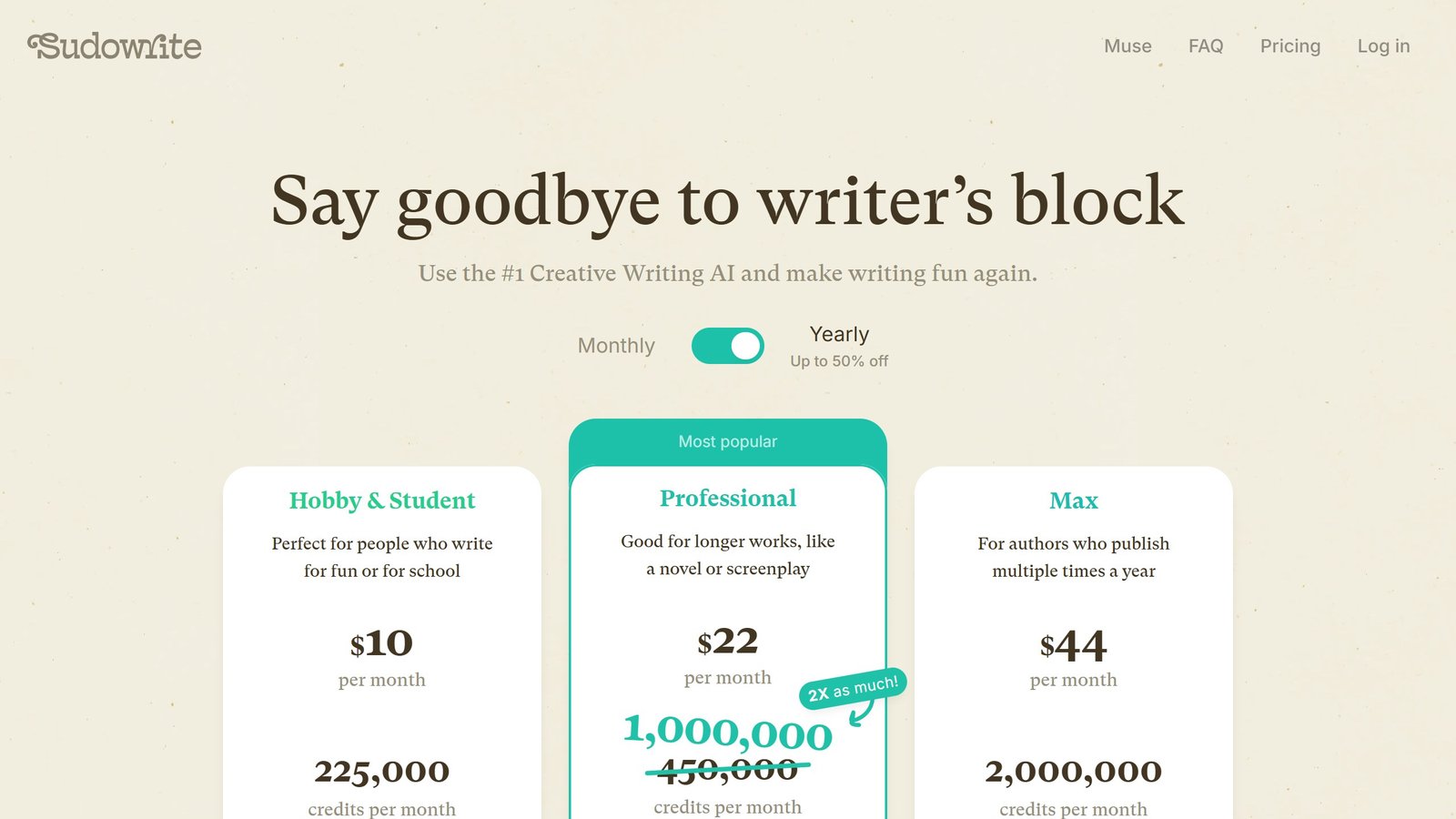
The page opens on Yearly
On a fresh load, the Yearly toggle is already selected. We confirmed this from the page’s own styling, where the Monthly label renders greyed out and Yearly renders in active dark text.
In that state the plans read $10, $22 and $44 per month. Switch to Monthly and the same plans read $19, $29 and $59.
| Plan | Shown on load | Actual monthly | Difference |
|---|---|---|---|
| Hobby & Student | $10 | $19 | 1.9x |
| Professional | $22 | $29 | 1.3x |
| Max | $44 | $59 | 1.3x |
If you are comparing Sudowrite to another tool’s monthly price, use the right-hand column.
The “up to 50% off” claim, checked
The toggle carries an Up to 50% off badge. Here is what it is worth on each plan.
| Plan | 12 months at the monthly rate | Yearly total | You save | That is |
|---|---|---|---|---|
| Hobby & Student | $228 | $120 | $108 | 47.4% |
| Professional | $348 | $264 | $84 | 24.1% |
| Max | $708 | $528 | $180 | 25.4% |
The 50% figure is close to true on the cheapest plan and about half true on the other two. Hobby & Student saves 47.4%, which rounds toward the claim. Professional and Max save around a quarter.
The wording is “up to”, which makes it defensible. It is still worth knowing that the discount on the plan most people buy is roughly half the advertised headline.
Credits are the real unit
Sudowrite does not gate features by plan in the usual way. Every plan is the same product with a different monthly credit allowance.
| Plan | Credits a month | Cost per 100,000 credits, yearly |
|---|---|---|
| Hobby & Student | 225,000 | $4.44 |
| Professional | 450,000 | $4.89 |
| Max | 2,000,000 | $2.20 |
Max is the only plan with a real volume discount. Hobby and Professional cost roughly the same per credit, so moving from one to the other buys you more capacity at the same rate rather than a better rate. Max is less than half the price per credit of either.
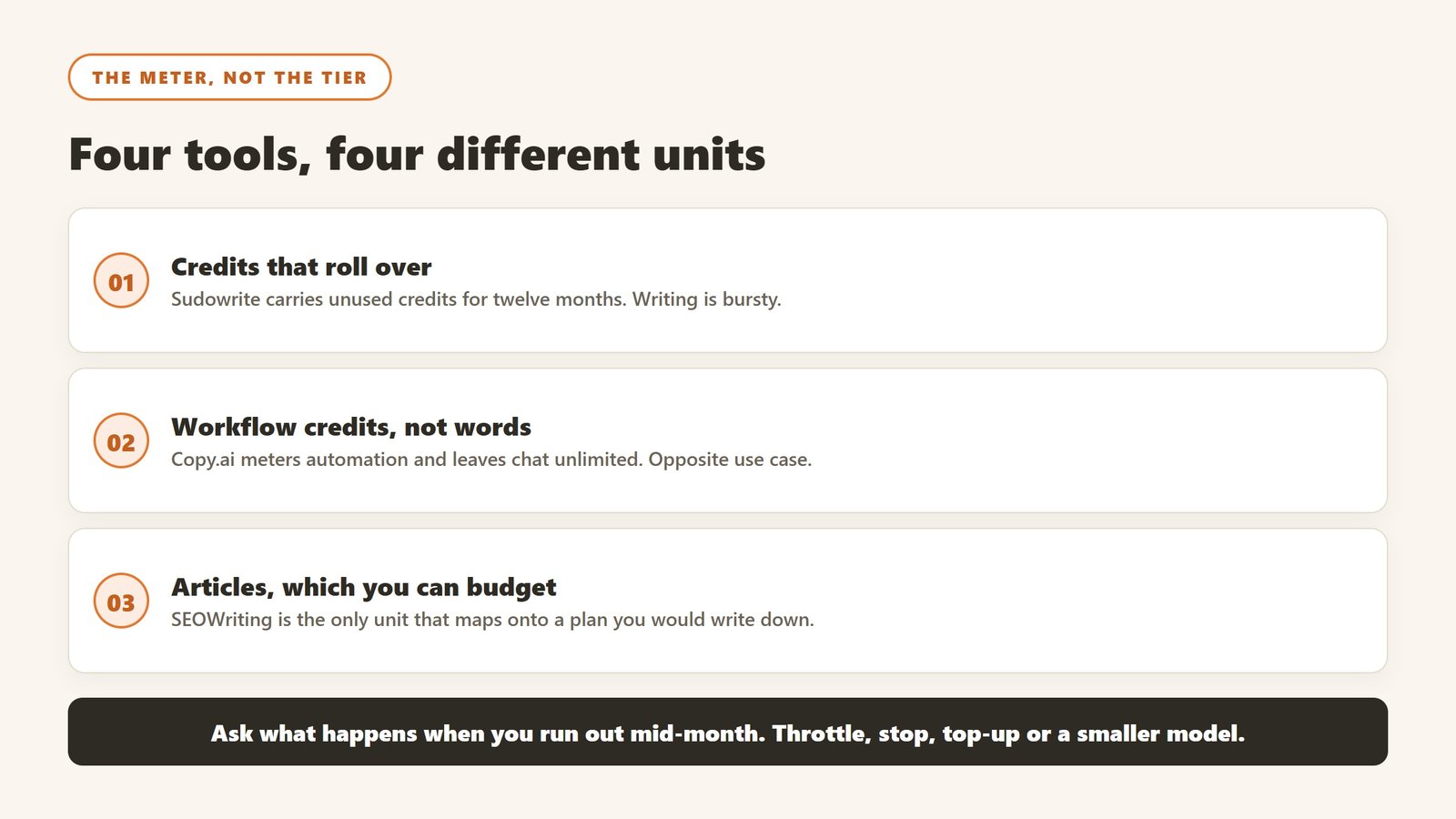
Unused credits roll over for twelve months, which Sudowrite states on the plan card. That matters more than it sounds for anyone whose writing is seasonal: a novelist who drafts hard for three months and edits for nine is not losing the quiet months.
Professional currently shows a promotion. The card displays 1,000,000 credits with 450,000 struck through, flagged as “2X as much!”. So the 450,000 figure is the standing allowance and 1,000,000 is a current offer. We have used the standing figure in the table above and flagged the promotion here, because a promotional allowance is not a price.
What the price does not tell you
What a credit actually buys. Sudowrite prices in credits and does not state on the pricing page how many credits a typical chapter, rewrite or brainstorm consumes. Without that, 225,000 against 450,000 is a ratio rather than a quantity, and the only way to calibrate is to use it.
How long the 1,000,000 credit promotion runs. Nothing on the card gives an end date, so the Professional allowance you sign up for may not be the one you renew on.
What Enterprise costs. Contact only.
Whether rollover survives a downgrade. Credits roll over for twelve months, but nothing states what happens to a balance if you move to a smaller plan or pause.
One thing worth crediting
Sudowrite publishes an EZ Cancel Guarantee on the pricing page, with the line that they want you to use it because you love it, “not because it’s annoying to cancel”, and that upgrading, downgrading, pausing and cancelling are all meant to be easy.
That is marketing copy rather than a contractual term, so treat it as a statement of intent. But it is a commitment made in public on the pricing page, which is more than most tools in this category offer, and it is the sort of thing worth holding a company to.
Who each plan is for
Hobby & Student at $19 a month, or $10 on annual, is for people writing for fun or for coursework. At 47.4% off it also carries the best annual discount on the page.
Professional at $29, or $22 annual, is the one Sudowrite marks most popular and is aimed at longer works, a novel or a screenplay. Check the credit promotion before you assume the allowance.
Max at $59, or $44 annual, is for authors publishing several times a year, and it is the only plan where the price per credit drops meaningfully.
Fiction: a different job with a different failure mode
Fiction tools are priced and built differently from marketing tools, and comparing them on cost per word misses what actually decides whether they help. Here is how sudowrite fits.
What Sudowrite charges and meters
Sudowrite publishes $10, $22 and $44 a month with 225,000, 450,000 and 2,000,000 credits a month, positioned respectively for people writing for fun or school, for longer works like a novel or screenplay, and for authors publishing several times a year. Unused credits roll over for twelve months, and its yearly billing advertises up to 50% off. Its higher tiers include developmental edits, line edits and beta reads, which is a different product from a sentence-level rewriter.
The economics of a novel, roughly
A 90,000 word novel drafted with heavy assistance and rewritten twice will consume far more generation than the word count suggests, because most of what a fiction tool produces is discarded by design. You generate five versions of a scene to find the one that works. Credit allowances that look enormous against a finished manuscript are sized for that ratio, which is why the middle tier is positioned at novels rather than the entry one.
Where these tools genuinely help
Getting unstuck on a scene you can see but cannot start, generating options you would not have reached alone, describing a setting you know but have not visualised, and maintaining momentum through a middle act. All of these are about volume and variation rather than about final prose, and they suit a tool that produces ten mediocre options quickly.
Where they reliably do not
Voice. A model trained on everything writes like an average of everything, and averageness is precisely the thing that makes fiction unpublishable. Every writer who has used these tools seriously reports the same pattern: the generated text is competent, unobjectionable and dead. It works as raw material and it fails as finished prose, so treat the output as a first draft you will rewrite entirely rather than as text you will edit.
The practical test before you subscribe
Take a scene you have already written and are happy with, and ask the tool to produce it from your notes. Compare. If the gap is small, the tool will speed you up considerably. If the gap is large, you have learnt something more valuable than a subscription, which is exactly where in your process the machine is worth using and where it is not.
Credits, words and articles: the meter decides your bill, not the tier
Almost every tool here charges a monthly subscription, and almost none of them charge for the same unit. That is the reason two people with the same plan report wildly different costs. Here is how each meter behaves, checked on 5 September 2026, and how it compares to sudowrite.
Credits per month, which are not words
Sudowrite publishes $19, $29 and $59 a month billed monthly, or $10, $22 and $44 a month billed yearly, with 225,000, 450,000 and 2,000,000 credits a month, and says unused credits roll over for twelve months. The page opens on the yearly view, so the lower set is what you see first. Worth flagging: its middle card displayed two credit figures at once, 1,000,000 and 450,000, which is a promotional allowance shown against a base. Confirm which applies at checkout. NetusAI publishes $0, $14, $30, $59 and $99 a month for 50, 1,500, 10,000, 40,000 and 100,000 credits respectively, or $97, $215, $419 and $710 a year, which it displays as $8.08, $17.91, $34.91 and $59.16 a month.
Why rollover changes the maths more than the rate
Writing is bursty. You draft nothing for three weeks and then produce forty thousand words in four days. A plan that expires unused credits every month prices you for your peak while charging you all year; a plan that rolls them over prices you for your average. Sudowrite’s twelve month rollover is worth more than a small difference in headline rate to anyone whose output is uneven, which is most people who write.
Workflow credits are a third unit again
Copy.ai meters workflow credits at the business tiers, 20,000 a month at $1,000, 45,000 at $2,000 and 75,000 at $3,000, alongside unlimited words in chat. That distinction matters: unlimited chat and metered workflows means the cost lands on automation rather than on writing. If your use case is a person typing, that plan is mispriced for you. If it is a pipeline running unattended, the credit number is the only figure on the page that matters.
The one meter you can budget against directly
SEOWriting AI prices per article, up to 50, 250, 500 and 1,000 a year at its four tiers. That is the only unit in this category that maps onto a plan you would actually write down, and it lets you calculate a true cost per piece before you buy. Everything else requires you to estimate a conversion between the vendor’s unit and your work.
The question to ask before subscribing
Ask what happens when you run out mid-month. Some vendors throttle, some stop, some sell a top-up, and some quietly degrade to a smaller model. That answer, not the headline rate, determines what the tool costs you on the week you actually need it.
What the marketing and long-form tools charge
This end of the category prices in dollars and scales hard. Here is where sudowrite sits against each alternative, read at source on 5 September 2026.
Jasper
Jasper publishes Pro at $59 per seat per month billed yearly or $69 billed monthly, a roughly 20% annual saving against a twelve month commitment. Two terms on its page are worth more than the headline: monthly billing lets you pause for 30 days rather than cancel, and it offers a 20% non-profit discount, applied by starting a trial and emailing the team with documentation. Business plans are quoted rather than published.
Copy.ai, where the tiers stop being comparable
Copy.ai publishes a self-serve plan at $29 a month billed monthly or $24 a month billed annually at $288 a year. Then it jumps: Growth at $1,000 a month billed $12,000 a year for 75 seats and 20,000 workflow credits a month, Expansion at $2,000 a month billed $24,000 a year for 150 seats and 45,000 credits, and a further tier at $3,000 a month billed $36,000 a year for 200 seats and 75,000 credits. Note copy.ai/pricing redirects to /prices. That gap between $288 and $12,000 a year is not a discount ladder, it is two different products, and picking the cheap one to “try the platform” tests almost nothing about the expensive one.
Rytr, the cheapest published plan in the category
Rytr showed us $0, $7.50 and $24.16 a month. Its page carries toggles labelled “Monthly (cancel anytime!)” and “Yearly (get 2 months free!)”, and on every one of our reads the displayed figures did not change when we clicked either. Confirm which billing your figure reflects at checkout rather than from the page.
SEOWriting AI, priced by article rather than by word
SEOWriting AI publishes $14, $59, $119 and $230 a month billed yearly at $168, $708, $1,428 and $2,760, for up to 50, 250, 500 and 1,000 articles respectively. Pricing per article rather than per word or per credit is rare and it makes budgeting unusually simple: divide the annual figure by the article cap and you have a genuine cost per piece, roughly $3.36 at the entry tier and $2.76 at the top. It also lets you try three articles without a card.
How to compare these without being misled
The meters are different, so compare on finished output rather than on plan names. Work out how many finished pieces you need a month, then price each option at that volume. A $24 plan that meters credits and a $14 plan that meters articles are not comparable until you have done that, and the ranking frequently reverses once you do.
How to tell whether the subscription is actually earning its money
Almost nobody evaluates a writing tool after buying it, which is how a category with this much churn keeps its revenue. Here is a way to do it that takes about an hour.
Take a baseline before you start, or you never can
Before the trial begins, record three things for a fortnight: how long a typical piece takes from brief to submitted, how many revision rounds it goes through, and how many pieces you completed. It takes minutes a day and it is unrecoverable afterwards. Without it you are comparing a measured present against a remembered past, and memory reliably flatters whichever tool you have just paid for.
Measure the round trips, not the drafting
These tools are good at producing a first draft and neutral at everything after it. If your bottleneck is drafting, the gain will be large and obvious. If it is approvals, research, or knowing what to say, the gain will be close to zero however fast the drafting gets. Counting revision rounds before and after separates the two more reliably than counting hours.
Watch quality in the same measurement
Faster output at lower quality is not a gain, and it is the most common outcome. Pick one quality measure you already collect, whether that is editor rejections, reader time on page, reply rate or a supervisor’s rating, and read it alongside the speed number. If speed rose and quality fell, you bought volume, and volume is usually not what the budget was for.
Decide the cancel test in advance
Write down, before the trial, what result would make you cancel. People are extraordinarily reluctant to abandon a tool they have learnt, and a threshold set in advance is the only defence against paying for a habit. Diarise the review for the month before renewal rather than the week after it, when cancelling costs you a year.
Count the whole bill
Per-seat tools spread quietly. Check how many seats you are paying for against how many people used the tool last month, because the gap is usually larger than anyone expects and it is the easiest money in the whole exercise to recover.
How we checked this
We read Sudowrite’s own pricing page on 30 August 2026, reached from sudowrite.com’s navigation rather than a guessed URL, and recorded both billing states.
We also confirmed which toggle is active on load by reading the page’s rendered styling rather than assuming, because the difference between the two states is most of what this page is about.
The saving table and the cost-per-credit table are our arithmetic on Sudowrite’s published figures. The inputs are theirs, the sums are ours, and the working is shown.
This is a pricing page, not a hands-on review. Nothing here is scored and we make no claim to have used the product.
Prices change, and a credit promotion was running on the Professional plan when we checked. If a figure here no longer matches Sudowrite’s page, tell us and we will correct it.

Written by
FazFaz is the founder of AIToolsBakery. Some tools here are tested hands on. Others are assessed from vendor documentation and pricing verified on the live page, and every review says which one it is. Sponsors can buy a position in a guide. They cannot buy the score, the criticism, or silence about a better option.
How we test and how we make money →