Black Friday 2026
QuillBot has not announced a 2026 Black Friday offer yet. We list it as soon as we can confirm it on QuillBot's own site.
The short answer
| Plan | Price | What it is |
|---|---|---|
| Free | $0 per month | 125-word paraphrase limit, 2 modes, basic grammar fixes, limited AI Detector, humanising capped at 125 words and 6 uses a day |
| Premium | $12.50 per month, billed annually | Unlimited paraphrasing, all modes, advanced grammar, full humanising, custom summaries, full AI Detector, plagiarism checking |
| Team | No published price | Everything in Premium, plus usage metrics, a user management dashboard, centralised billing, data controls and account management |
Figures from a US copy of QuillBot’s premium page dated 10 August 2026.
Two things about that table are more interesting than the number itself.
The published price is a discounted price
QuillBot’s page does not present $12.50 as the rate. It presents it under a “37% off” label, next to a struck-through figure, as a promotion.
That matters for two reasons.
First, it means $12.50 is not a stable number. Promotional pricing moves. When we checked the same page from a different country on 1 September 2026 the discount on offer was 40%, not 37%, running to 6 September. A price you read in a comparison article is a snapshot of whatever promotion was live that week, and QuillBot appears to run them more or less continuously.
Second, the undiscounted rate is not published anywhere obvious. You can see the struck-through figure on the card, but QuillBot leads with the promotional price everywhere, which means the number you plan around and the number you renew at may not be the same. Check what your subscription renews at, not what you signed up at. That is the single most useful thing to take from this page.
The Team plan has no price at all
Everything above Premium is quote-only. QuillBot’s page lists what Team includes, then replaces the price with an “Explore Team Plan” button.
| What Team adds over Premium |
|---|
| Team usage metrics |
| User management dashboard |
| Centralised billing |
| Data controls |
| Priority assistance and account management support |
If you are buying for a department, a university course or an agency, there is no self-serve path and no figure to budget against. You are entering a sales conversation, and the per-seat rate you are quoted will depend on your seat count.
This is worth flagging because QuillBot’s public reputation is as a cheap individual tool. At team scale it stops behaving like one.
What the paid tier actually removes
The free plan is not a trial. It is a permanently usable, permanently throttled version, and the throttles are specific.
| Limit | Free | Premium |
|---|---|---|
| Paraphrase length | 125 words at a time | Unlimited |
| Paraphrasing modes | 2 (Standard, Fluency) | All modes, plus custom modes |
| Humanising | 125 words, 6 uses a day | Full access |
| Grammar | Basic error fixes | Advanced recommendations |
| Summaries | Basic | Custom |
| AI Detector | Limited | Full access |
| Plagiarism checking | Not included | Included |
The 125-word paraphrase cap is the one that decides it. It is small enough that any real document means pasting in chunks, which is tedious rather than impossible. If you paraphrase occasionally, free genuinely works. If you paraphrase as part of a daily workflow, the cap will push you to Premium within a week, which is precisely what it is designed to do.
The plagiarism checker is the other line worth pricing separately in your head. It is not available at all on free, and standalone plagiarism tools are not cheap. If you would otherwise buy one, Premium’s effective cost is lower than it looks.
A note on the price you will see
QuillBot prices in local currency. The same page loaded from India on 1 September 2026 showed ₹0, ₹200 and a struck-through ₹334, with the promotion running at 40% off through 6 September.
We do not convert currencies. A converted figure is not a price anyone is charged. Both sets of figures here are published exactly as QuillBot published them, and the practical advice is the same as with any locally priced tool: read the price on your own connection before you budget.
What to check before you subscribe
Four things, in the order they will cost you money.
What the renewal price is. The card shows a promotional rate under a discount label. The rate you renew at is the thing to find before you enter card details, and it is not the number on the card.
Which billing period you are actually buying. The Premium card we read was priced per month but billed annually, which means the transaction is a year’s commitment presented as a monthly figure. That is standard, and it is still a year.
Whether you need the plagiarism checker. It is not on the free plan at all. If you would otherwise pay for a standalone plagiarism tool, it is the single line item that changes Premium’s effective cost most, and it is worth pricing separately rather than treating as a bonus.
Whether you are actually buying for one person. The moment a second person needs an account you are on the Team plan, which has no published price and no checkout. Work that out before you standardise a workflow around it, not after.
Our take
QuillBot is inexpensive for what it does and the free tier is genuinely usable, as our QuillBot review sets out, which together make it hard to argue with for an individual.
The two things to go in knowing are that the price on the page is a promotional one and that there is no published price above Premium. Neither is dishonest, and both are easy to miss when the headline number is small enough that you stop reading. Budget for the renewal rather than the offer, and if you are buying for more than yourself, expect a sales conversation rather than a checkout.
Three of these tools quoted us rupees, and almost no comparison mentions it
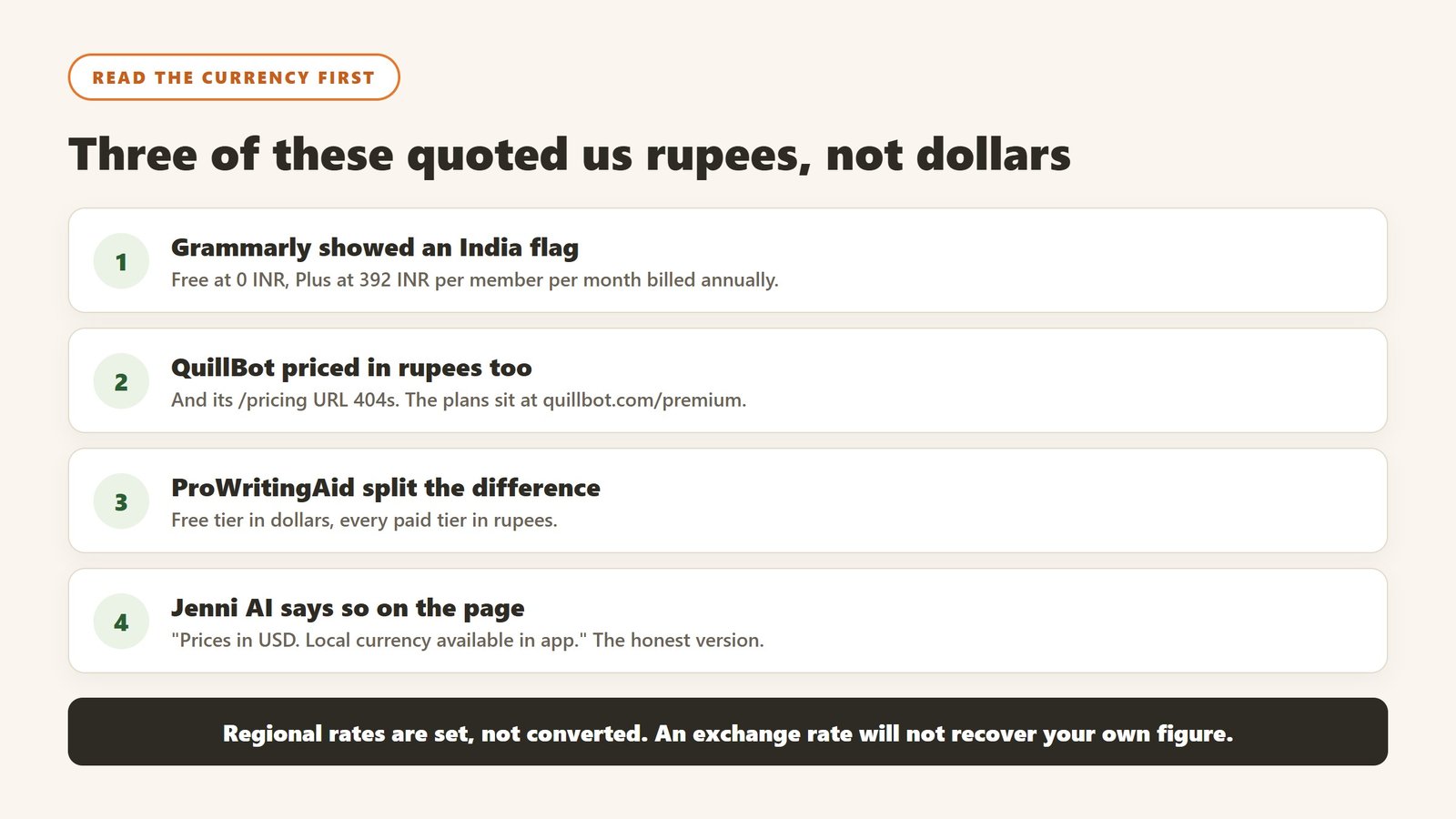
This is the single most useful thing we can tell you about pricing in this category, and it is the thing every roundup gets wrong. On 5 September 2026 we read each vendor’s own pricing page from one connection on one day. Three of the biggest names served us a rate card in Indian rupees without being asked.
Grammarly shows an India flag and prices in INR
Grammarly’s plans page displayed a country flag at the top and then quoted Free at ₹0 INR a month and Plus at ₹392 INR per member per month billed annually, or ₹1,000 when billed monthly. The currency code is written out on the page. This is not an artefact of our reading: Grammarly is deliberately serving a local rate card, and the dollar figure quoted in most articles is the United States one. The monthly-to-annual gap here is unusually wide, close to two and a half times, which makes the annual commitment more consequential than at a vendor offering a flat twenty percent.
QuillBot does the same, behind a URL that does not exist
QuillBot is harder to research than it should be. The obvious address, quillbot.com/pricing, returns a 404, and hitting it repeatedly returns a 429. Its own footer link labelled “Pricing” points at /upgrade and its header button at /premium, which is where the plans actually sit. There we were shown Free at ₹0 a month and Premium at ₹200 against a struck-through ₹334 per month billed annually, under a “Get 40% off” banner. That is a different reading from the $12.50 at 37% off recorded at the top of this page, and both are accurate: the same page serves a different currency and a different discount depending on where and when you load it. Which is precisely the point. A struck-through list price is a promotional display, so ask what it renews at rather than what it costs today.
ProWritingAid prices its free tier in dollars and its paid tiers in rupees
ProWritingAid showed us Free at $0 per month, in dollars, and then quoted Premium and Premium Pro in rupees across three separate billing views: monthly, yearly and a one-time lifetime payment. The two figures we could read cleanly, without digits being split across page elements, were annual totals of ₹4,950 and ₹5,940. Because we cannot separate the per-month rupee figures reliably, we do not publish them. It also gives premium features free to K-12 educational organisations, which none of the others here publish.
What this means for you, practically
Regional rates are set deliberately. They are not a currency conversion, so you cannot recover your own price with an exchange rate, and the ratio between two markets often differs from the ratio between the currencies. Three things follow. Check the page yourself from the country the subscription will be billed in. Treat any article quoting a single global figure for these three as having described one country. And if you are buying for a distributed team, ask the vendor which market the billing entity sits in, because that, not where the user sits, is usually what sets the rate.
Not everyone does this
Jenni AI takes the opposite approach and says so on the page: its plans are listed at $0, $12 and $29 a month with a note reading “Prices in USD. Local currency available in app.” That is the honest version of the same practice, because you can compare it against anything else without first working out which country you are looking at.
What the grammar and rewriting tools actually cost
These four compete for the same job and price it in three different shapes. Here is each alternative to quillbot, read at source on 5 September 2026, with the currency each page served us.
Grammarly
Grammarly served us Free at ₹0 INR a month and Plus at ₹392 INR per member per month billed annually, rising to ₹1,000 when billed monthly. That monthly-to-annual gap is unusually wide, close to two and a half times, which makes the annual commitment much more consequential here than at vendors offering a flat twenty percent. If you are unsure whether the tool will stick, the monthly price is what you should budget against, not the headline.
QuillBot
QuillBot showed Free at ₹0 a month and Premium at ₹200 against a struck-through ₹334, billed annually, under a “Get 40% off” banner. A struck-through list price is a promotional display, so the question to ask before committing is what it renews at rather than what it costs today. The free tier is genuinely usable for paraphrasing short passages, which is why so many people never see this page at all.
ProWritingAid
ProWritingAid is the only one here offering a one-time lifetime payment alongside monthly and yearly billing, which is worth knowing if you write continuously for years rather than in bursts. Its free tier is priced in dollars at $0 while its paid tiers were quoted to us in rupees. It also publishes something the others do not: K-12 educational organisations can get premium features free.
Wordtune
Wordtune publishes in dollars. Basic is $0.00 with ten rewrites a day and three AI summarisations a month, Advanced lists at $6.99 a month billed annually and was displayed to us at $4.89 under a 50% offer, and Unlimited lists at $9.99 and was displayed at $6.99. Note that wordtune.com/pricing redirects to /plans. The daily rather than monthly limit on the free tier is the detail that decides whether it works for you: ten rewrites resets every day, which suits an occasional editor and not a drafting session.
The comparison that actually matters
All four will fix your grammar. What separates them is the rewriting model and the limit shape. Wordtune meters rewrites per day, QuillBot meters words per paraphrase, ProWritingAid meters report runs, and Grammarly meters seats. Work out which of those maps onto how you actually write before comparing headline prices, because the cheapest plan with the wrong meter costs more in practice than the dearer one with the right one.
Credits, words and articles: the meter decides your bill, not the tier
Almost every tool here charges a monthly subscription, and almost none of them charge for the same unit. That is the reason two people with the same plan report wildly different costs. Here is how each meter behaves, checked on 5 September 2026, and how it compares to quillbot.
Credits per month, which are not words
Sudowrite publishes $10, $22 and $44 a month with 225,000, 450,000 and 2,000,000 credits a month, and says unused credits roll over for twelve months. Worth flagging: its middle card displayed two credit figures at once, 1,000,000 and 450,000, which is a promotional allowance shown against a base. Confirm which applies at checkout. NetusAI publishes $0, $14, $30, $59 and $99 a month for 50, 1,500, 10,000, 40,000 and 100,000 credits respectively, or $97, $215, $419 and $710 a year, which it displays as $8.08, $17.91, $34.91 and $59.16 a month.
Why rollover changes the maths more than the rate
Writing is bursty. You draft nothing for three weeks and then produce forty thousand words in four days. A plan that expires unused credits every month prices you for your peak while charging you all year; a plan that rolls them over prices you for your average. Sudowrite’s twelve month rollover is worth more than a small difference in headline rate to anyone whose output is uneven, which is most people who write.
Workflow credits are a third unit again
Copy.ai meters workflow credits at the business tiers, 20,000 a month at $1,000, 45,000 at $2,000 and 75,000 at $3,000, alongside unlimited words in chat. That distinction matters: unlimited chat and metered workflows means the cost lands on automation rather than on writing. If your use case is a person typing, that plan is mispriced for you. If it is a pipeline running unattended, the credit number is the only figure on the page that matters.
The one meter you can budget against directly
SEOWriting AI prices per article, up to 50, 250, 500 and 1,000 a year at its four tiers. That is the only unit in this category that maps onto a plan you would actually write down, and it lets you calculate a true cost per piece before you buy. Everything else requires you to estimate a conversion between the vendor’s unit and your work.
The question to ask before subscribing
Ask what happens when you run out mid-month. Some vendors throttle, some stop, some sell a top-up, and some quietly degrade to a smaller model. That answer, not the headline rate, determines what the tool costs you on the week you actually need it.
How we checked this
We did not run a hands-on trial of QuillBot for this page. This is desk research and here is what it consisted of.
QuillBot’s edge returns a 403 to a default headless browser, so the page was loaded with a standard Chrome user agent, which cleared it. That live read served rupees, because this connection exits in India. Since a rupee figure cannot honestly be published as a dollar one, the US figures come from an archived copy of the same URL, crawled from the United States and dated 10 August 2026. The Indian figures and the current promotion were read live on 1 September 2026. Nothing has been converted between currencies, and where QuillBot states a discount percentage we have quoted it rather than working backwards to a list price.

Written by
FazFaz is the founder of AIToolsBakery. Some tools here are tested hands on. Others are assessed from vendor documentation and pricing verified on the live page, and every review says which one it is. Sponsors can buy a position in a guide. They cannot buy the score, the criticism, or silence about a better option.
How we test and how we make money →