What is actually on the Virtuous pricing page
| What we looked for | What is published |
|---|---|
| A monthly or annual price | None |
| A starting-from figure | None |
| A per-user rate | None |
| Tier structure | Two tiers, split by your annual fundraising revenue |
| The split | Up to $5 million annually, and over $5 million |
| Calls to action | Six Contact Us buttons |
Read from virtuous.org/pricing on 24 August 2026, reached by following the site’s own navigation.
The only two dollar figures anywhere on that page are the $5 million thresholds that define the tiers. Neither is a price.
The thing worth noticing
Plenty of enterprise software makes you ask for a price. What makes Virtuous different is what it segments you on before the conversation starts.
Virtuous does not band you by contacts, or by seats, or by feature set. It bands you by how much money you raise. The page’s own framing is “designed for nonprofits with fundraising revenue up to $5 million annually” and “built for growing nonprofits with annual fundraising revenue over $5 million”.
So the first thing the pricing page establishes is your budget, not your requirements.
What we can and cannot tell you
We are not going to publish a figure for Virtuous, because there isn’t one to publish and the aggregator numbers that circulate for this category have a bad record. On the closest comparable, DonorSearch, the figure repeated across nearly every article was four to twenty times the vendor’s own published rate. That is documented in our DonorSearch pricing guide.
What we can tell you is where Virtuous sits among vendors that do publish, so you have something to hold a quote against.
| CRM | Entry published price | Unit |
|---|---|---|
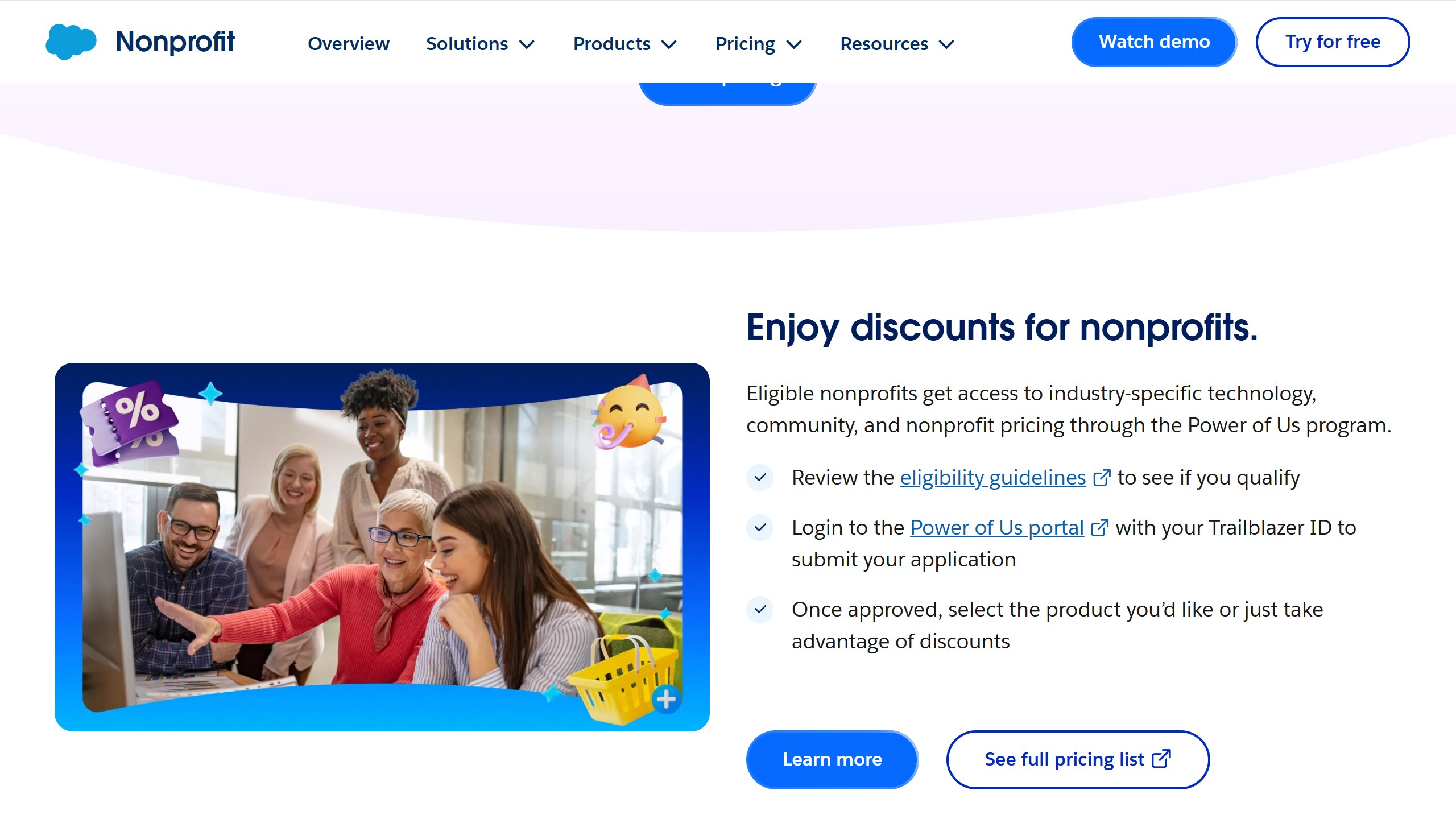
| Salesforce Nonprofit Cloud | $70 (4 Oct 2026) per user/mo | Seats |
| Neon CRM | From $99/mo | Your fundraising revenue |
| Keela | $164/mo up to 1,000 contacts | Contacts |
| Virtuous | Not published | Quote, banded at $5M revenue |
| Bonterra | Not published | Quote |
| Blackbaud Raiser’s Edge NXT | Not published | Quote |
If a Virtuous quote comes back well above the published end of that table, the question to ask is what you are getting that Keela at $164 a month or Neon at $99 a month does not do. Sometimes there is a real answer. Make them give it.
It is not one quote, it is up to six
The thing the pricing page makes clear only if you scroll it all is that Virtuous is six separately priced products, each with its own Request Pricing button:
| Product | What it is |
|---|---|
| CRM+ | The core donor management hub. Two tiers, split at $5 million revenue |
| Raise | Online giving: donation forms, landing pages, project-based giving |
| Insights | Analytics and predictive scoring |
| Analytics | Reporting layer |
| Volunteer | Volunteer management |
| Momentum | An AI fundraising agent for major and mid-level gift officers |
So “what does Virtuous cost” has no single answer even in principle. A quote for CRM+ is a quote for the hub, and four of the five things a development team would actually want next are priced separately.
Ask for the bundle price and the a-la-carte price for each module you are considering, in the same document. Vendors that package this way frequently discount the bundle heavily against the sum of its parts, and you cannot see that unless you have both numbers.
What CRM+ does include, published: donor and pipeline management, marketing and communications, events management, reporting and analytics, workflow and journey automation, the app and partner marketplace, and unlimited users. Unlimited users is the significant one, and it puts Virtuous on the same side of that line as Keela and Neon rather than Salesforce.
The Momentum detail worth knowing
Buried in the product list is something that changes how you should read Virtuous as a company. Virtuous Momentum integrates with Blackbaud, Bloomerang and other CRMs, not only with Virtuous.
That is a CRM vendor selling a donor intelligence layer that runs on its competitors’ databases. It tells you Virtuous has noticed the same thing we cover in nonprofit CRM vs donor intelligence: the CRM and the layer that decides who to contact are different purchases, and the second one does not require you to migrate.
Practically, it means you can evaluate Momentum without moving off your current CRM. If the reason you were looking at Virtuous is the AI, that is a much cheaper test than a platform migration.
What quote-only costs you, in practice
Virtuous publishes no figure and bands its tiers at $5 million in annual fundraising revenue, which means it segments you by what you raise before it quotes. Two consequences follow, and neither is about the product.
You cannot disqualify quickly
With a published rate card you can rule a vendor in or out in five minutes. With quote-only you spend a discovery call and a demo before learning whether it is affordable, and repeat that for every quote-only vendor on the shortlist. That is real staff time on a team that usually has none spare.
You have no renewal reference point
At renewal there is no public number to anchor against, and the vendor knows your usage and switching cost. A capped uplift written into the original contract is the only practical protection, and it has to be negotiated when you still have leverage.
Where Virtuous sits in the published market
| Vendor | Publishes a price? | Entry figure, verified 4 Sep 2026 | Meter |
|---|---|---|---|
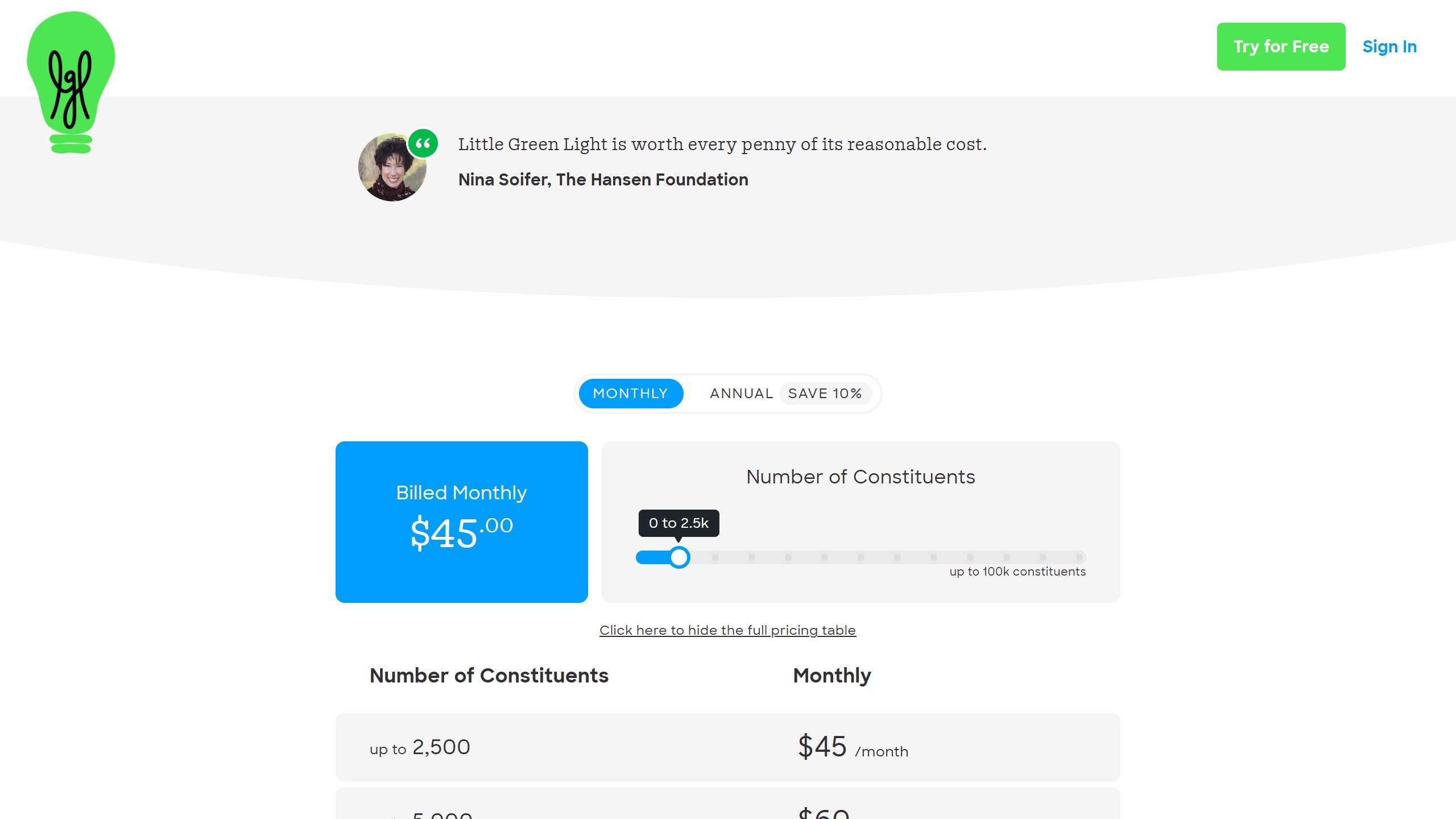
| Little Green Light | Yes | $45/mo | Constituents |
| Salesforce Nonprofit Cloud | Yes | $70/user/mo (4 Oct 2026), 10 free | Seats |
| Neon CRM | Yes | $99/mo | Annual revenue |
| Bloomerang | Yes | $125/mo | Product |
| Keela | Yes | $164/mo | Contacts |
| Dataro | Yes | $15,000/yr + $0.10/donor | Platform + donors |
| Blackbaud | No | Quote form only | Quote |
| Virtuous | No | Quote, banded at $5M revenue | Quote |
| GoFundMe Pro (Classy) | No | Quote | Subscription + % of gifts |
The meter matters more than the price
The most common budgeting mistake in this category is comparing monthly figures across vendors that charge on completely different bases. Six vendors in the table above meter on six different things.
Contacts and constituents punish list growth
Keela bands by contacts and Little Green Light by constituents. Under those models, adding lapsed donors or event attendees to your database raises the bill even though those records generate nothing. Teams on contact-metered platforms end up deleting history to control cost, which is precisely the wrong incentive for a fundraising organisation.
Seats punish hiring, not data
Salesforce meters on users. A database of two million costs the same as one of two thousand, and the eleventh person in the CRM is what costs money. That inverts the usual advice: on a seat-metered platform you can keep every record you have ever touched.
Revenue metering punishes success
Neon prices on annual fundraising revenue. A good year raises your software bill, which is defensible in that the platform grows with you, and uncomfortable in that the cost arrives at the same time as the growth rather than after it.
Work out which of your numbers is growing fastest
That is the whole decision. For most nonprofits the list grows faster than the team, which argues for seat-based pricing. If you are hiring quickly against a stable donor base, the reverse is true. Our nonprofit CRM pricing comparison works through the arithmetic at real team and list sizes.
What to ask on the demo call
Since the call is the only route to a number, use it properly.
What is the unit? Seats, contacts, revenue, or a flat platform fee. This decides your bill in year three more than the year-one figure does.
Which revenue number, and when is it re-checked? If tiers are set by fundraising revenue, ask whether that is gross or net, which fiscal year, whether grants and bequests count, and what happens at renewal if the number moves in either direction.
What is the second-year price? First-year discounts are standard in this category. Ask for year two and year three in writing before you compare anything.
What is a line item and what is included? Implementation, data migration, training, API access, and additional modules are the usual places a quote grows after signature.
What happens if we cross $5 million? You are being banded on a threshold. Ask directly whether crossing it mid-contract re-prices you, and when.
Before you price a CRM at all
Virtuous is a system of record with strong automation. Like every CRM in this comparison, it stores what happened and reports on it. It does not decide which twenty donors your team should contact this week.
Disclosure: Zilwaris, the consultancy run by AI Tools Bakery’s founder, does paid advisory work for Gratefully, which did not pay for any placement on this page and is assessed on the same criteria as everything else on this site.
If your donor data is already in reasonable shape and the actual problem is that nobody is working it, changing CRM will not fix that, and a migration is an expensive way to find out. A donor intelligence layer sits on top of whichever CRM you keep. Our Gratefully vs Virtuous comparison covers where the two categories meet, and nonprofit CRM vs donor intelligence covers the decision itself.
For the product rather than the price, see our Virtuous CRM review.
How we verified this
We went to virtuous.org, followed the site’s own navigation to the pricing page rather than guessing a URL, expanded everything expandable, and read the full page text.
Virtuous publishes no figures. We are stating that as a finding rather than an absence, because we reached the page, it returned HTTP 200, and we read all of it. That distinction matters: elsewhere in this batch a vendor’s own pricing URL redirected to a different product entirely, and reporting “no pricing” from a failed read would have been wrong.
Nothing here is a quote, an estimate or a reported range. If you have been quoted by Virtuous and want to tell us what the shape of it was, we will publish what can be verified and attribute it as reported rather than official.
What every comparable vendor actually charges
A comparison table tells you the number. It does not tell you what the number is measured against, which is the part that decides your bill. Here is each of the main alternatives to Virtuous, read from their own pricing pages on 4 September 2026, with the meter that matters.
Little Green Light, from $45 a month, metered on constituents
Little Green Light publishes every band openly and starts at $45 a month for up to 2,500 constituents. It takes nothing from your donations, which makes it one of the few platforms where online giving revenue is genuinely yours. The catch is structural: because the meter is constituent count, growing your list raises the bill even when the added records are lapsed donors or one-off event attendees who will never give again. Organisations on constituent-metered platforms end up pruning their database to control cost, which is a bad incentive for a fundraising team that should be keeping history.
Salesforce Nonprofit Cloud, $70 per user (as of 4 October 2026), with ten licences free
Salesforce is the odd one out and it is worth understanding why. Nonprofit Cloud Core is $70 per user per month (as of 4 October 2026) billed annually, but the Power of Us programme gives any eligible nonprofit ten licences at no cost. An organisation with ten or fewer people in the CRM pays nothing for the CRM itself, at any list size. The eleventh person costs $840 a year at the October 2026 rate. That inverts the usual advice: on Salesforce a database of two million costs the same as one of two thousand, and hiring is what raises the bill. The real cost is not the licence, it is that somebody has to own the configuration.
Neon CRM, from $99 a month, metered on your fundraising revenue
Neon starts at $99 a month with unlimited users and unlimited records, priced on annual fundraising revenue rather than seats or contacts. Modules are added as a percentage of the subscription: memberships at 10%, events at 20%, volunteers at 10%. Worth knowing that Neon retired its old Essentials, Impact and Empower tier structure entirely, so any article still quoting $209 or $409 tiers is describing packaging that no longer exists.
Bloomerang, from $125 a month, metered by product
Bloomerang publishes $125 a month for the CRM, with Fundraising from $40 and Volunteer from $119 as separate products. It moved away from record-tier pricing, so comparisons written against its old banding are stale. The practical effect of product-based pricing is that a quote assembled from three Bloomerang products is not comparable to a single all-in figure from a competitor without itemising first.
Keela, from $164 a month, metered on contacts
Keela bands by contact count starting at $164 a month for up to 1,000 contacts. It raised every band between late August and early September 2026, entry moving from $134 to $164, a rise of roughly 15 to 22% across the range in under two weeks. That is a useful reminder that a published price is a snapshot: check the date on any figure you are comparing, including ours.
Dataro, from $15,000 a year plus $0.10 per active donor
Dataro is a different category, predictive donor intelligence rather than a CRM, and its pricing shows it: Essentials from $15,000 a year plus ten cents per active donor, Growth from $25,000 plus twelve cents. Its pricing page is not linked from its own navigation and is only discoverable through the sitemap. Included here because it is the honest top of the nonprofit software market and a useful upper bound when someone tells you a quote is expensive.
The ones that publish nothing
Blackbaud runs a quote request form headed “Let us find a price that fits your organization” with no figures at all. Virtuous publishes no price and bands its tiers at $5 million in annual fundraising revenue, so it segments you by what you raise before quoting. GoFundMe Pro, formerly Classy, publishes only that its model is an annual subscription plus a transaction fee per donation.

Written by
FazFaz is the founder of AIToolsBakery. Some tools here are tested hands on. Others are assessed from vendor documentation and pricing verified on the live page, and every review says which one it is. Sponsors can buy a position in a guide. They cannot buy the score, the criticism, or silence about a better option.
How we test and how we make money →