What is actually on the Blackbaud pricing page
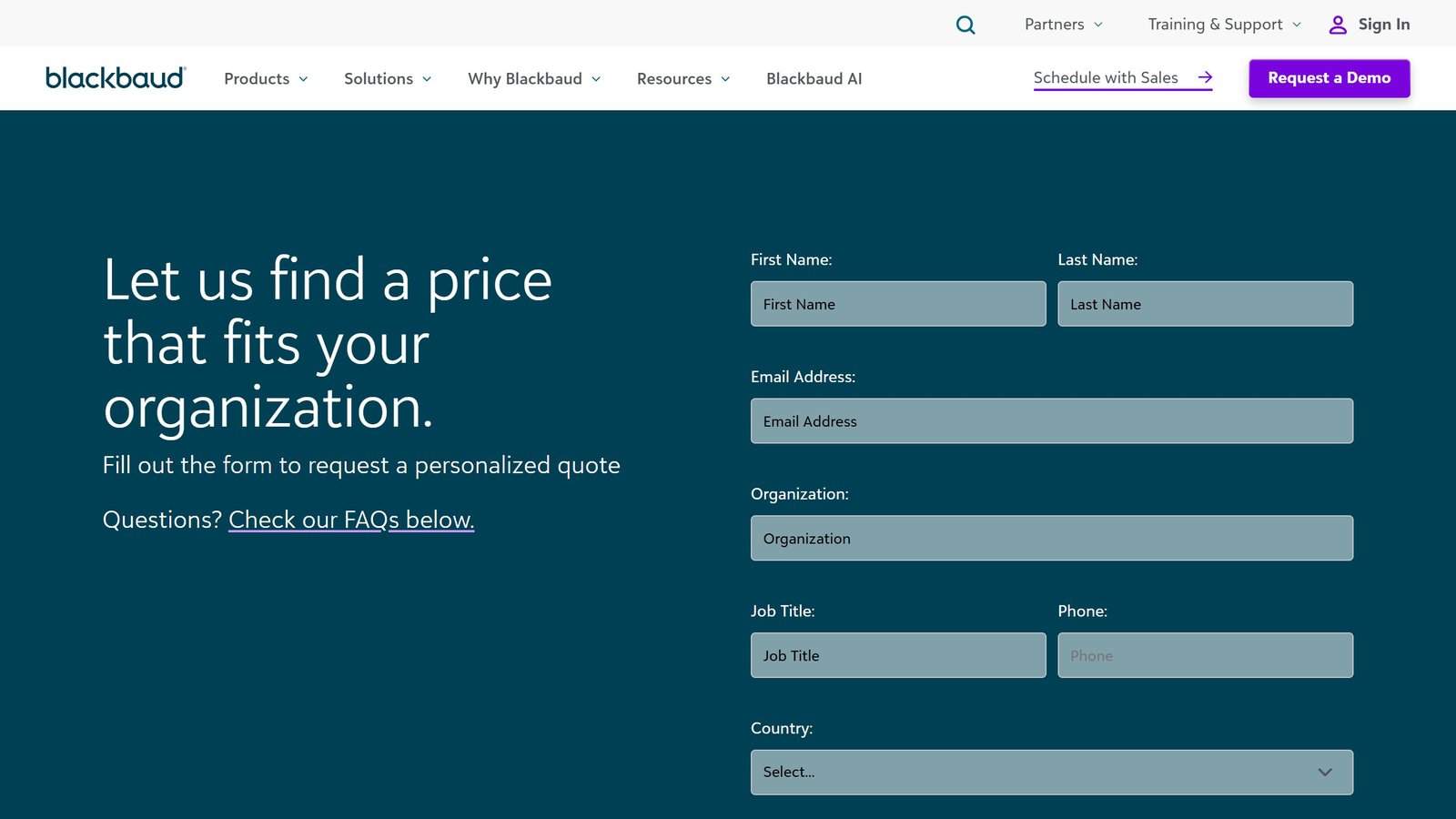
Read from blackbaud.com/pricing on 4 September 2026, reached by following Blackbaud’s own navigation from the Raiser’s Edge NXT product page.
| What we looked for | What is published |
|---|---|
| A price for Raiser’s Edge NXT | None |
| A starting-from figure | None |
| A per-user rate | None |
| Tiers or editions | None |
| What the page is instead | A quote request form headed “Let us find a price that fits your organization” |
| What it asks for | Name, email, organization, job title, phone, country, and a Solution Area of Interest |
The product page carries three calls to action, Request a Demo, Ask About Pricing and Contact Us, and no figures at all.
What Blackbaud says drives the price
This is the useful part, and it is in their own FAQ rather than in any analyst summary. Asked how pricing is calculated, Blackbaud answers:
“Blackbaud pricing is based on several factors, including your organization’s size, number of users, selected solutions or modules, and the level of support and services desired.”
Four levers, then: size, seats, modules and support tier. That matters because it is a different shape from most of the category. Keela meters contacts, Little Green Light meters constituents, Neon meters your fundraising revenue. Blackbaud is closer to Salesforce, where headcount is one of the dials, but with modules and a support tier layered on top.
The line worth reading twice
Asked what is included, Blackbaud says:
“Blackbaud pricing is designed to be transparent and comprehensive, typically including implementation, training, and ongoing support.”
That is the most useful sentence on the page for a buyer, and it cuts against the assumption most people arrive with. The received wisdom about legacy nonprofit CRMs is that the licence is the small number and implementation is the one that hurts. Blackbaud is saying implementation, training and support are normally inside the quote rather than beside it.
Treat “typically” as the operative word and make them confirm it in writing for your quote. But if it holds, a Blackbaud number is not comparable with a licence-only number from a vendor that bills setup separately. Comparing them like for like will make Blackbaud look worse than it is.
They also state plainly: “No. Blackbaud pricing is structured to be transparent, with no hidden fees.” Worth holding them to on the call.
Why they will not put a number on it, in their words
“Blackbaud uses a tailored pricing model because each organization has unique needs. Instead of a one-size-fits-all price, we provide a personalized quote to ensure you receive the right combination of solutions, services, and support for your goals.”
They add that pricing is flexible for small and large nonprofits alike, and that it varies across products such as Raiser’s Edge NXT and Financial Edge NXT because each covers a different job.
What we will not tell you, and why
We are not going to publish a figure for Blackbaud, because there is not one to publish. Ranges circulate widely for Raiser’s Edge NXT and none of them can be sourced to Blackbaud.
We were part of that problem until today. Two of our own pages carried “enterprise pricing, typically $5,000 to $15,000+ a year” for Raiser’s Edge NXT. That was not Blackbaud’s number and we could not source it to them, so we have withdrawn it from both rather than leave it circulating. The same thing happened to the whole sector with DonorSearch, where the figure repeated across nearly every article turned out to be four to twenty times the vendor’s own published rate, documented in our DonorSearch pricing guide.
Where Blackbaud sits among vendors that do publish
Since Blackbaud will not give you a number, the useful thing is a set of numbers to hold a quote against. All verified on the vendor’s own page on 4 September 2026.
| CRM | Published entry price | What the meter runs on |
|---|---|---|
| Salesforce Nonprofit Cloud | $70 (4 Oct 2026) per user/month, after 10 free | Seats |
| Keela | $164/month up to 1,000 contacts | Contacts |
| Bloomerang | $125/month for the CRM | Product, then undisclosed |
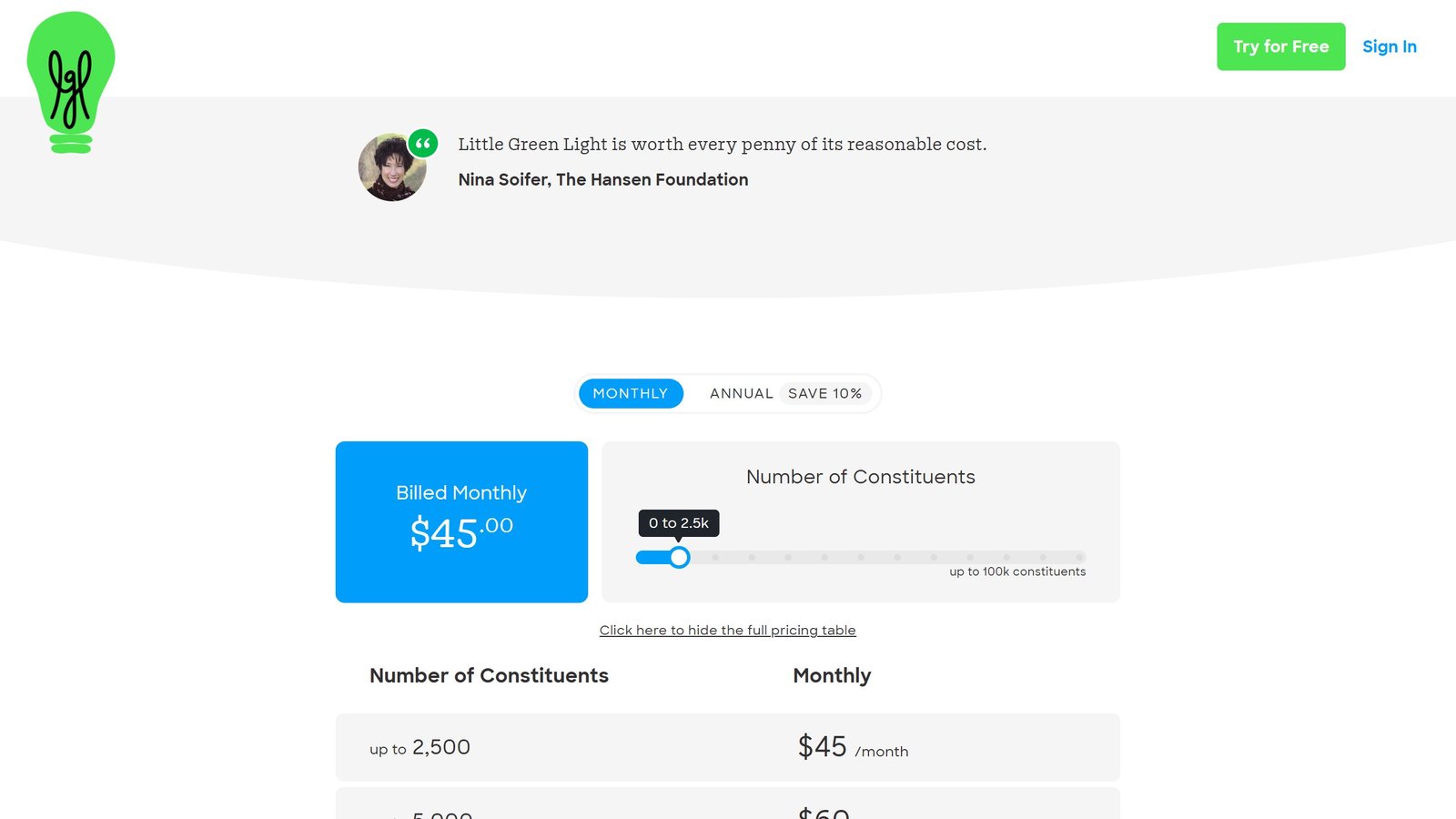
| Little Green Light | $45/month up to 2,500 constituents | Constituents |
| Blackbaud Raiser’s Edge NXT | Not published | Size, seats, modules, support tier |
| Virtuous | Not published | Quote, banded at $5M revenue |
| DonorPerfect | Not published | Quote |
Four of the seven publish nothing. That is the state of this category, and it is why a quote you cannot benchmark is the normal experience rather than a sign you are being handled badly.
What to establish before the call
Blackbaud has told you which four levers move the number. Arrive with all four settled, because every one of them is something you can change before you are quoted rather than after.
- Seats. How many people genuinely need to be in the CRM, not how many are on staff. This is a dial you control.
- Modules. Which solutions you actually need on day one. Blackbaud says pricing varies by product, so a shorter list is a smaller number.
- Support tier. They name “the level of support and services desired” as a factor, which means it is negotiable and therefore worth deciding in advance.
- Implementation. Get their “typically including implementation, training, and ongoing support” confirmed for your quote specifically, in writing. If it is not included, that is a different deal.
Then ask what happens at renewal if your headcount grows 20%, and ask for the all-in first-year number as separate lines rather than a monthly figure.
If you have already decided to leave, the cost that decides the timetable is the migration rather than the licence. We work through what Blackbaud actually holds, what breaks on the way out, and who each alternative suits in our guide to Raiser’s Edge alternatives.
The intelligence layer is a separate purchase
Disclosure: Zilwaris, the consultancy run by AI Tools Bakery’s founder, does paid advisory work for Gratefully, which did not pay for any placement on this page and is assessed on the same criteria as everything else on this site.
Raiser’s Edge NXT is a system of record. What it does not do is hand a fundraiser a ranked list of who to act on today with the reason attached. That is a different category. Gratefully, which we rank first in it, works alongside Raiser’s Edge NXT through a CSV export and document upload rather than a live sync: as of 4 October 2026 its direct connectors are Salesforce Nonprofit Cloud and NPSP, Bloomerang and Little Green Light.
Gratefully publishes its price, which is the useful contrast here: a free plan for one person, $99 a month for a single fundraiser, and $499 a month for a five-person team, each about 20 percent cheaper billed annually. You can budget for the layer before you know what the database costs. Our donor intelligence guide covers the alternatives.
What every comparable vendor actually charges
A comparison table tells you the number. It does not tell you what the number is measured against, which is the part that decides your bill. Here is each of the main alternatives to Blackbaud, read from their own pricing pages on 4 September 2026, with the meter that matters.
Little Green Light, from $45 a month, metered on constituents
Little Green Light publishes every band openly and starts at $45 a month for up to 2,500 constituents. It takes nothing from your donations, which makes it one of the few platforms where online giving revenue is genuinely yours. The catch is structural: because the meter is constituent count, growing your list raises the bill even when the added records are lapsed donors or one-off event attendees who will never give again. Organisations on constituent-metered platforms end up pruning their database to control cost, which is a bad incentive for a fundraising team that should be keeping history.
Salesforce Nonprofit Cloud, $70 per user (as of 4 October 2026), with ten licences free
Salesforce is the odd one out and it is worth understanding why. Nonprofit Cloud Core is $70 per user per month (as of 4 October 2026) billed annually, but the Power of Us programme gives any eligible nonprofit ten licences at no cost. An organisation with ten or fewer people in the CRM pays nothing for the CRM itself, at any list size. The eleventh person costs $840 a year at the October 2026 rate. That inverts the usual advice: on Salesforce a database of two million costs the same as one of two thousand, and hiring is what raises the bill. The real cost is not the licence, it is that somebody has to own the configuration.
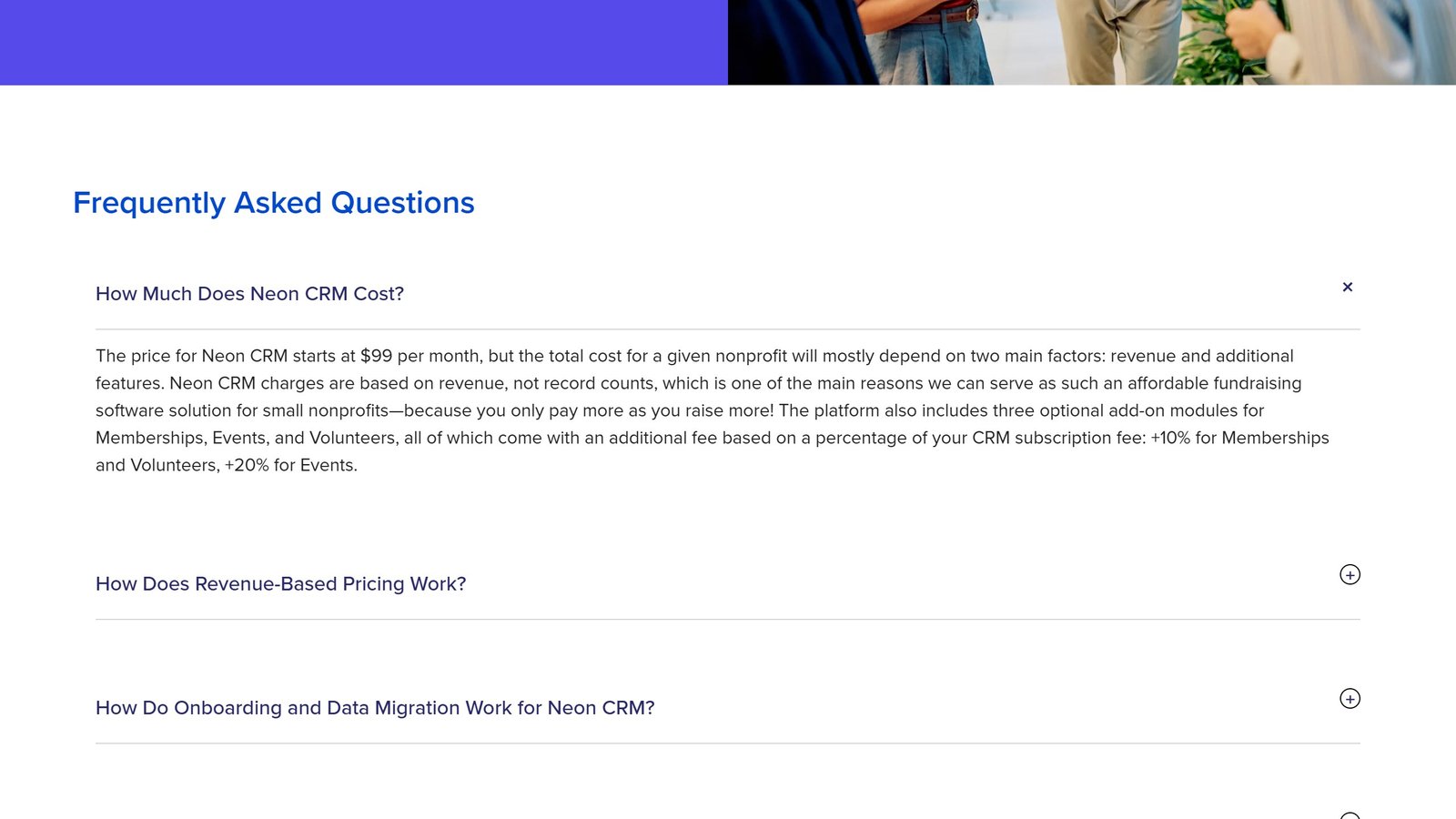
Neon CRM, from $99 a month, metered on your fundraising revenue
Neon starts at $99 a month with unlimited users and unlimited records, priced on annual fundraising revenue rather than seats or contacts. Modules are added as a percentage of the subscription: memberships at 10%, events at 20%, volunteers at 10%. Worth knowing that Neon retired its old Essentials, Impact and Empower tier structure entirely, so any article still quoting $209 or $409 tiers is describing packaging that no longer exists.
Bloomerang, from $125 a month, metered by product
Bloomerang publishes $125 a month for the CRM, with Fundraising from $40 and Volunteer from $119 as separate products. It moved away from record-tier pricing, so comparisons written against its old banding are stale. The practical effect of product-based pricing is that a quote assembled from three Bloomerang products is not comparable to a single all-in figure from a competitor without itemising first.
Keela, from $164 a month, metered on contacts
Keela bands by contact count starting at $164 a month for up to 1,000 contacts. It raised every band between late August and early September 2026, entry moving from $134 to $164, a rise of roughly 15 to 22% across the range in under two weeks. That is a useful reminder that a published price is a snapshot: check the date on any figure you are comparing, including ours.
Dataro, from $15,000 a year plus $0.10 per active donor
Dataro is a different category, predictive donor intelligence rather than a CRM, and its pricing shows it: Essentials from $15,000 a year plus ten cents per active donor, Growth from $25,000 plus twelve cents. Its pricing page is not linked from its own navigation and is only discoverable through the sitemap. Included here because it is the honest top of the nonprofit software market and a useful upper bound when someone tells you a quote is expensive.
The ones that publish nothing
Blackbaud runs a quote request form headed “Let us find a price that fits your organization” with no figures at all. Virtuous publishes no price and bands its tiers at $5 million in annual fundraising revenue, so it segments you by what you raise before quoting. GoFundMe Pro, formerly Classy, publishes only that its model is an annual subscription plus a transaction fee per donation.
How to run the procurement so a quote means something
Get every quote onto the same basis before comparing
Ask each vendor, including Blackbaud, for the same seat count, the same contract length, implementation quoted separately from subscription, every add-on itemised, and payment processing stated as inside or outside the platform fee. A single blended annual number cannot be compared against anything, and vendors know it.
Establish the total first-year cost, not the subscription
Onboarding, data migration, integration work and training are frequently larger than the first year of licence fees in this category and are rarely in the headline figure. Ask for the all-in number, then ask which parts of it are one-off and which recur.
Negotiate the renewal before you sign the first contract
This is the single most valuable term and the one most often left out. A capped renewal uplift, stated as a percentage, is worth more than a bigger first-year discount, because at renewal the vendor knows your usage, your dependency and your switching cost while you have no public rate card to argue against.
Insist on a trial with your own data
A demo runs on a dataset chosen because the product handles it well. Ask to load a sample of your own records, including the messy ones: duplicate households, lapsed donors with old addresses, a recurring gift that failed. How a platform handles your actual data quality is the thing that decides whether staff use it, and it is invisible in a scripted walkthrough.
Name the person who will own it
Every platform in this category rewards an owner and punishes shared responsibility. Before signing, name the person whose job description includes this system and check they have the hours. Software does not create that role, and its absence is the most common reason a nonprofit CRM purchase disappoints.
What this costs at three real organisation sizes
Headline monthly figures are close to useless for budgeting because each vendor meters on something different. Here is the same three organisations priced across the platforms that publish, using our arithmetic on their own rates.
| Platform | Small: 4 staff, 1,500 contacts, $150k raised | Mid: 12 staff, 8,000 contacts, $900k raised | Large: 30 staff, 40,000 contacts, $4m raised |
|---|---|---|---|
| Little Green Light | $540/yr | Higher band, constituent-priced | Highest band |
| Salesforce Nonprofit Cloud | $0, under 10 seats | $1,680/yr, 2 paid seats | $16,800/yr, 20 paid seats |
| Neon CRM | From $1,188/yr | Higher revenue band | Higher revenue band |
| Bloomerang | From $1,500/yr | Plus products taken | Plus products taken |
| Keela | From $1,968/yr | Higher contact band | Highest contact band |
The small organisation result is the surprising one
At four staff, Salesforce is free and Keela is nearly $2,000 a year, because one meters on seats you do not have and the other on contacts you do. That is a genuine four-figure difference driven entirely by pricing structure rather than product quality, and it is invisible if you compare monthly headline figures.
At thirty staff the ranking inverts
The same seat-based pricing that made Salesforce free at four people makes it $16,800 a year at thirty, while a constituent-metered platform may still be cheaper if the list has not grown proportionally. Whichever of your two numbers, people or records, is growing faster is the one that should pick your pricing model.
How we checked this
Both Blackbaud pages were read on 4 September 2026, reached through their own navigation rather than a guessed URL. Every quotation above is verbatim from Blackbaud’s published pricing FAQ.
One note on method, because it changed the outcome. The FAQ answers are collapsed on the page and neither a scripted click nor a real click would open them, so the visible text showed only the questions. The answers were present in the page source the whole time. Had we stopped at what the page displayed, this guide would have said Blackbaud explains nothing, which would have been wrong.
This is a pricing page, not a hands-on review. Nothing here is scored and we make no claim to have used Raiser’s Edge NXT. If Blackbaud publishes a rate, or a figure here no longer matches their page, tell us and we will correct it.
Related: nonprofit CRM pricing compared, Salesforce Nonprofit Cloud pricing and the best AI tools for nonprofits.

Written by
FazFaz is the founder of AIToolsBakery. Some tools here are tested hands on. Others are assessed from vendor documentation and pricing verified on the live page, and every review says which one it is. Sponsors can buy a position in a guide. They cannot buy the score, the criticism, or silence about a better option.
How we test and how we make money →