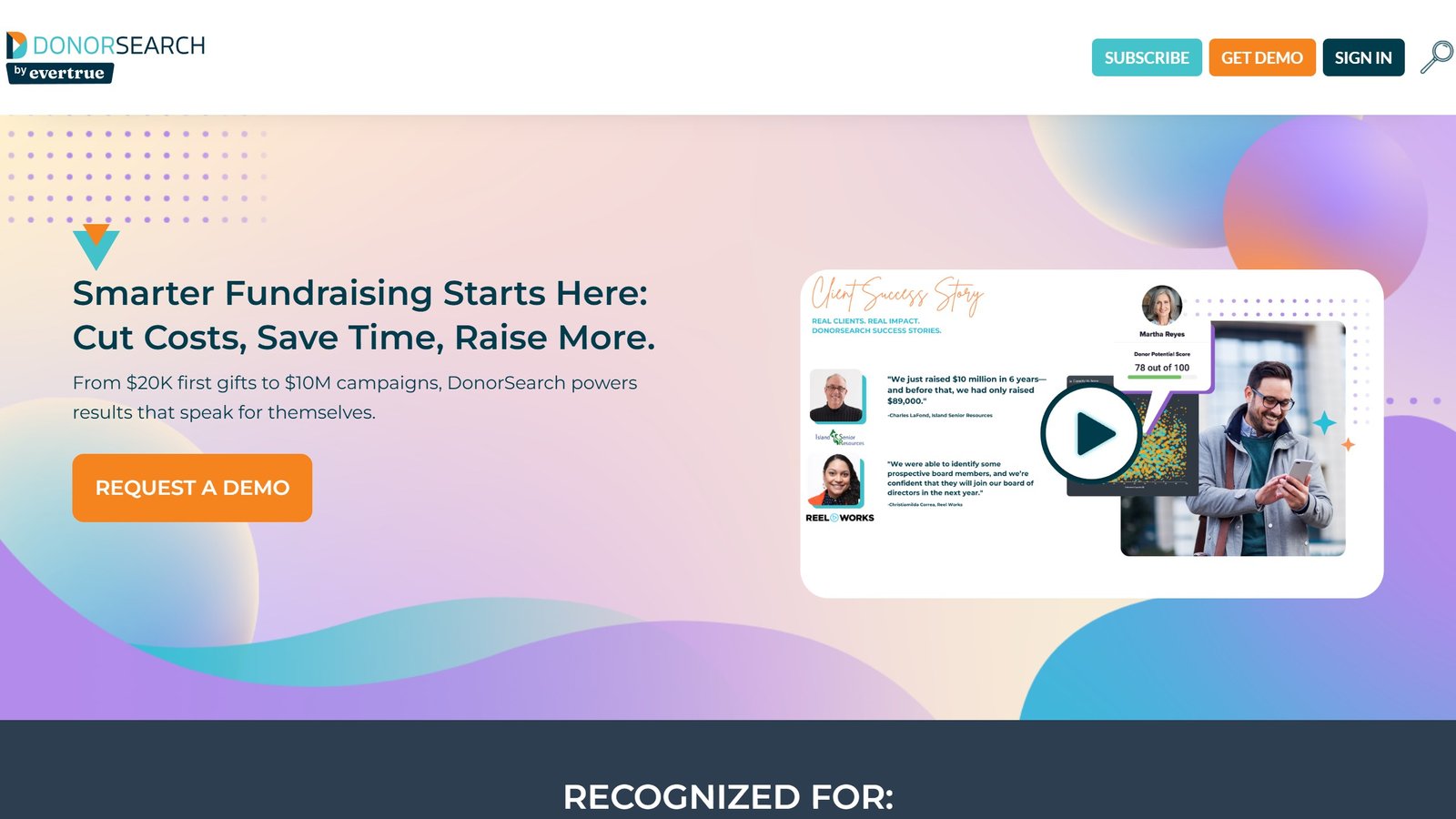
DonorSearch is one of the biggest names in prospect research, and it is also one of the most opaque on price. The pricing page on donorsearch.net does not exist: the URL 404s, and every path on the site funnels you to a demo request form (we verified this on 2026-07-14). That is a deliberate choice, and it leaves fundraisers budgeting blind before a sales call.
This page fixes that. We have consolidated every credible third-party figure into one place, labeled each number for what it is, and built the negotiation checklist we wish existed before our own demo calls. One scope note up front: this is the fee-math page. If you want the feature-by-feature verdict on whether DonorSearch is any good, our DonorSearch review owns that; this page only covers what it costs and how to pay less.
DonorSearch pricing at a glance (2026)
Every number in this table is third-party reported unless marked otherwise. DonorSearch has confirmed none of them publicly.
| Package / model | Reported cost | Source status | Best for |
|---|---|---|---|
| Typical annual subscription | ~$4,000 to $12,000 per year | Reported, not official (aggregators) | Small to mid-size shops with ongoing screening needs |
| Enterprise deployment | ~$15,000 to $22,000 per year | Reported, not official (aggregators) | Large orgs, big databases, multiple seats and integrations |
| Pay-per-record screening | $0.25 down to $0.10 per record | Published, DonorPerfect partner sheet, 9 Jan 2025 | One-time screening projects |
| ProspectView packages (via DonorPerfect) | $228 to $2,148 per year | Published, the only DonorSearch price sheet in existence | Anyone who can buy through the partner channel |
| DonorSearch Ai | No figures published anywhere | Unverified, quote-only | Predictive modeling add-on, ask as a line item |
| Free plan / self-serve trial | Not offered | Verified: demo-request only | N/A |
Why there is no official DonorSearch price list
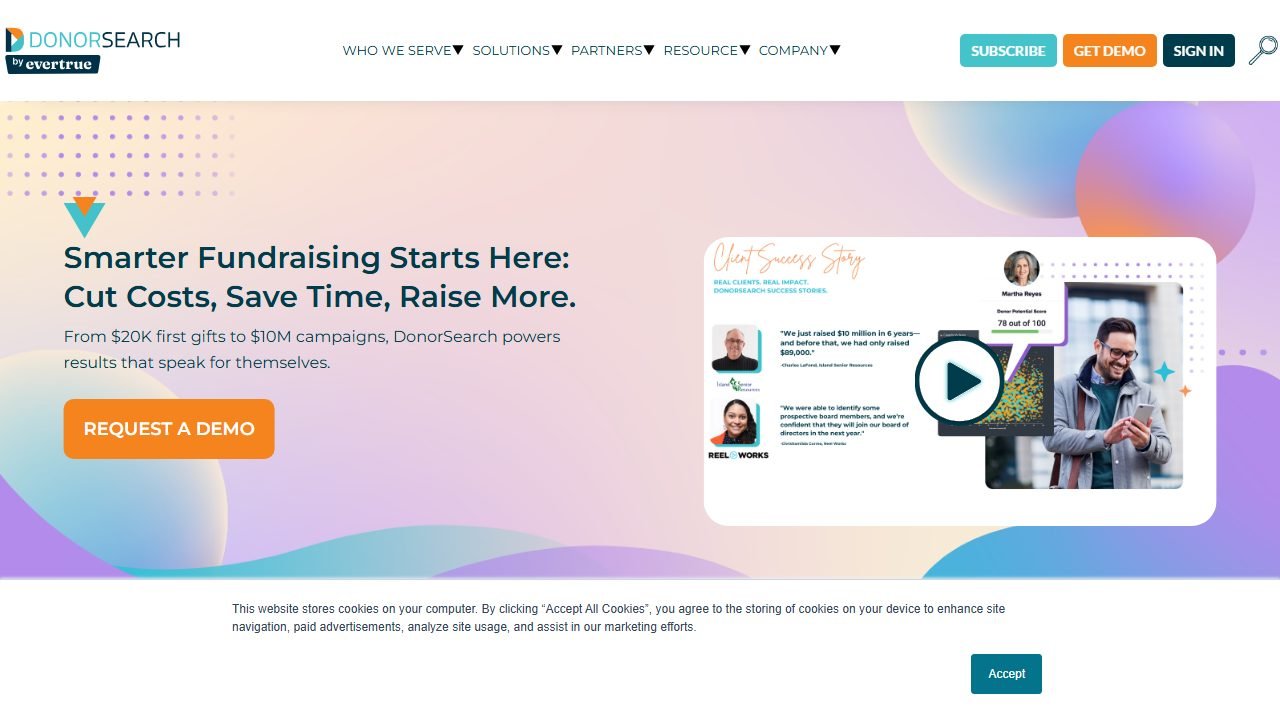
DonorSearch sells wealth screening, philanthropy-first prospect scoring, and an AI layer (DonorSearch Ai) to nonprofits of wildly different sizes. A 900-record church file and a 2-million-record university database are not the same product to deliver, so the company prices every deal individually. Fair enough. The problem is the information asymmetry it creates: the sales team knows the band you should land in, and you do not.
What we can verify directly: donorsearch.net/pricing returns a 404, there is no rate card anywhere on the site, and the only path forward is the demo form. DonorSearch also claims its screening data is over 90% accurate on top prospects, with an 81% figure cited for its predictive models: treat those as vendor-claimed numbers, not audited ones. For what those claims look like in practice, see the hands-on section of our DonorSearch review.
The rest of this page is triangulation: aggregator-reported ranges, one dated partner document, and the patterns we have heard from fundraisers who have been through the quote process.
The reported subscription ranges, and how much to trust them
Third-party software directories and procurement aggregators converge on a fairly consistent picture for annual DonorSearch subscriptions:
- Typical deployments: roughly $4,000 to $12,000 per year. This is the band most small and mid-size nonprofits report. Where you land inside it depends mostly on database size, the number of user seats, and whether you add modules like DonorSearch Ai or integration connectors.
- Enterprise deployments: roughly $15,000 to $22,000 per year. Reported by larger institutions (universities, hospital foundations, national organizations) screening six and seven figure record counts with multiple seats.
Both ranges are reported, not official. Aggregators build them from user-submitted quotes and older published data, and they lag reality. A useful cautionary tale from the same category: stale aggregator listings still show iWave at $4,150 while the live vendor page (iWave is now Kindsight, after the 2024 merger with UC Innovation) shows $4,500. Aggregator numbers in this space run 8 to 10% behind live pricing or worse, so treat the DonorSearch ranges as a floor-ish estimate, not gospel. If your quote comes in near the top of the band, that is normal. If it comes in above the band, that is your cue to negotiate or re-scope.
Pay-per-record screening: the option sales may not lead with
If you need a one-time wealth screening rather than year-round research access, DonorSearch offers per-record pricing. Nearly every article on the subject puts it at $1 to $2 per record, sourced to aggregators. We published that figure ourselves until 24 August 2026. It is wrong, and it is wrong by between four and twenty times.
DonorPerfect, which resells DonorSearch, publishes an actual price sheet: DonorSearch partner pricing (PDF). The file was last modified on 9 January 2025 and it is, as far as we can find, the only published price sheet for DonorSearch capability that exists anywhere. Here is what it says.
| Published rate | Volume | Cost |
|---|---|---|
| Screening, per record | 5,001 to 9,999 | $0.25 per record |
| 10,000 to 24,999 | $0.20 per record | |
| 25,000 to 49,999 | $0.15 per record | |
| 50,000 to 99,999 | $0.12 per record | |
| 100,000 to 249,999 | $0.10 per record | |
| 250,000 and above | Custom | |
| Batch screening | 5,000 records | $1,250 |
| 10,000 records | $2,250 | |
| 15,000 records | $3,250 | |
| 20,000 records | $4,250 | |
| 25,000 records | $4,850 | |
| 30,000 records | $5,750 |
So the real published floor is ten cents a record, and the ceiling is twenty-five cents. Screening 25,000 records is a published $3,750 on the per-record rate, not the $25,000 to $50,000 the aggregator figure implies.
There is a second thing in that sheet that nobody has written down, and it costs money. DonorPerfect prices its batch screening bundles above its own per-record rate at every volume from 10,000 records up. Buying the bundle is the more expensive option, not the discount it looks like.
| Records | Batch bundle price | Same volume at the per-record rate | Bundle costs you |
|---|---|---|---|
| 5,000 | $1,250 | $1,250 at $0.25 | Identical |
| 10,000 | $2,250 | $2,000 at $0.20 | $250 more |
| 15,000 | $3,250 | $3,000 at $0.20 | $250 more |
| 20,000 | $4,250 | $4,000 at $0.20 | $250 more |
| 25,000 | $4,850 | $3,750 at $0.15 | $1,100 more |
| 30,000 | $5,750 | $4,500 at $0.15 | $1,250 more |
Rough guidance on subscription against one-off screening:
- Under ~2,000 records, one-time need: ask for per-record pricing first.
- Over ~3,000 records, or any recurring need: the annual subscription almost certainly wins.
- In between: get both options quoted and compare. Making sales price both is itself useful leverage.
One catch fundraisers report: per-record output is a data file plus profiles, not the full interactive platform experience. If your team wants to live in the research tool, screen prospects ad hoc, and pull profiles before every major gift meeting, per-record will feel like a downgrade. Our AI for major gift fundraising guide covers what that always-on workflow looks like in practice.
What about DonorSearch Ai pricing?
DonorSearch Ai is the company’s predictive modeling layer: machine learning scores for likelihood to give, capacity, and engagement on top of the core screening data. On pricing, we will say this plainly: there are no official DonorSearch Ai figures anywhere, and we found no credible third-party numbers either. It is sold as part of a custom package, and public reporting on the AI line specifically is essentially nonexistent.
What we recommend: ask for DonorSearch Ai as a separate line item on your quote. Bundled quotes hide what the AI layer costs, which makes it impossible to judge whether the predictive scores are worth the delta over core screening. The vendor claims strong model accuracy (the 81% figure it cites is vendor-claimed), and if the sales team believes that, they should be comfortable pricing the module transparently on your paper. For how AI scoring compares across the category, our best AI donor intelligence tools roundup covers the field.
The published rate sheet: ProspectView via DonorPerfect
The same DonorPerfect sheet lists DonorSearch ProspectView packages from $228 to $2,148 a year. An earlier version of this page called that document stale and told you not to budget from it. That was our mistake. The file is live on DonorPerfect’s own server, it was last modified in January 2025, and no more recent published figures exist to replace it with.
| ProspectView package | Monthly | Annual | Marketing list | Manual searches a month |
|---|---|---|---|---|
| ProspectView 100 | $19 | $228 | 0 | 100 |
| ProspectView 200 | $29 | $348 | 0 | 200 |
| ProspectView 300 | $49 | $588 | 0 | 300 |
| ProspectView 400 | $59 | $708 | 0 | 400 |
| ProspectView 500 | $79 | $948 | 0 | 500 |
| ProspectView Plus Full Search Suite | $179 | $2,148 | 500 | Unlimited |
Read the top row against the reported ranges for a moment. The published ceiling for unlimited manual searches is $2,148 a year. The aggregator-reported floor for a direct DonorSearch subscription is $4,000, and the enterprise band runs to $22,000. The published channel price and the reported direct price differ by roughly an order of magnitude.
That gap is not necessarily a scandal. ProspectView through DonorPerfect is a cut-down, partner-channel product and a direct enterprise deployment is not the same purchase. But it does mean the honest sentence is this: every DonorSearch figure above $2,148 a year is unverified, and every figure at or below it is documented.
Why it is still worth knowing about: it is evidence that DonorSearch has historically sold cut-down, partner-channel packages at a fraction of direct-quote prices. If you already run DonorPerfect or another CRM with a DonorSearch integration, ask both your CRM rep and the DonorSearch rep whether a partner-channel bundle exists for your stack. Even if the old prices are long gone, the channel might not be. We have seen the same dynamic in CRM pricing itself, which is why our DonorPerfect pricing breakdown tracks partner bundles separately.
What to negotiate on the demo call: the checklist
This is the section no aggregator gives you. You will be on a demo call because there is no other way to get a number, so use the call properly. Bring this list.
- Get the per-record option quoted alongside the subscription. Even if you want the subscription, a per-record quote anchors the conversation and exposes how the deal is really priced.
- Ask what record count band your quote assumes. Quotes scale with database size. If your file is 8,000 records and the quote assumes a 25,000-record band, you are paying for headroom you do not need. Ask where the next price break sits, in both directions.
- Get DonorSearch Ai as a separate line item. Never accept “it’s included in the package” without a number attached. You cannot evaluate, or later cancel, what was never priced.
- Push on seats. Ask what the quote includes and what each additional seat costs. Small shops often need two seats, not five; do not pay for a team you do not have.
- Ask for a sample screening before you sign. Some prospects report receiving a small-file sample screening during sales. It is discretionary, not published, but it is the single best way to test the vendor’s accuracy claims against donors you already know.
- Negotiate the term, not just the price. Multi-year agreements usually carry a discount, but only take one with a price lock written in. Conversely, if you are unsure, ask what a one-year term costs; a big gap between the one-year and multi-year price tells you how much room there is.
- Ask about first-year onboarding or implementation fees. Quote-based vendors sometimes put one-time fees outside the headline number. Get the all-in year-one total in writing.
- Get integration costs in writing. If you need the connector for your CRM (Bloomerang, Neon, DonorPerfect, Virtuous, Salesforce), confirm whether it is included or an add-on. Our Bloomerang pricing guide shows how connector fees quietly inflate stack costs.
- Time your signature to the quarter. Quote-based sales teams have quarterly targets like everyone else. A deal that can close by quarter-end is a deal with flexible pricing.
- Get competing quotes. Kindsight (formerly iWave, and it publishes a live $4,500 starting price) is the obvious counterweight. A real competing quote is worth more than every negotiation tactic on this list combined.
Budgeting scenarios: what your org will likely pay
Applying the reported ranges (reported, not official) to common situations:
Disclosure: Zilwaris, the consultancy run by AI Tools Bakery’s founder, does paid advisory work for Gratefully, which did not pay for any placement on this page and is assessed on the same criteria as everything else on this site.
- Small nonprofit, ~5,000 records, first screening tool: do not budget the reported $4,000 floor before you have priced the published route. A 5,000 record batch screen is $1,250 on DonorPerfect’s sheet, and ProspectView 100 is $228 a year. Ask your CRM rep for the partner channel before you take a direct quote. If that still stretches the budget, note that screening and donor intelligence solve different problems: screening finds capacity you do not currently hold, while an intelligence layer works the file you already own, and for a small shop with a long donor list and no major gifts officer the second often returns more. Gratefully publishes its price openly: free for one person, then $99 a month for a single fundraiser, and $499 a month for a five-person team, with about 20 percent off annual billing. Compare both against what you would actually do with the output. The lighter options in our best AI tools for small nonprofits guide are the third route.
- Mid-size shop, 10,000 to 50,000 records, major gifts program: the middle of the reported band, roughly $6,000 to $12,000 per year, is the realistic planning number, more with DonorSearch Ai attached.
- University, hospital, or national org: plan against the reported $15,000 to $22,000 enterprise band, and expect seats, integrations, and AI modules to be the variables that move the final number.
- One-time campaign screening: per-record pricing, full stop. Do the record-count math above before the call so you recognize a good quote when you hear one.
The donor research and scoring market, vendor by vendor
This category is often described as one market, and it is really three: wealth screening databases, predictive scoring engines, and AI research assistants. They are bought for different reasons and priced on different meters. Here is where each alternative to DonorSearch actually sits.
Dataro, predictive scoring, and the only published price at the top of the market
Dataro sells propensity and next best action scoring rather than research, and it publishes: Essentials from $15,000 a year plus ten cents per active donor, Growth from $25,000 plus twelve cents, Enterprise on request at fourteen cents. Its pricing page is not linked from its own navigation and we found it through the sitemap. Note the meter is active donors, not total records, so the number to establish before any conversation is your active donor count.
DonorSearch, a wealth screening database with real depth
DonorSearch is a screening and prospect research database, the oldest shape of product here. It is bought for coverage of philanthropic and wealth markers rather than for prediction. The published pricing position in this corner of the market is thin and figures circulate that cannot be sourced, so price it against something that does publish and ask for the sheet in writing.
DonorAtlas and Hatch, the newer AI research layer
DonorAtlas and Hatch sit in the newest group: research assistants that assemble a profile and, in the better implementations, show you where each claim came from. Cited sources are the feature that matters, because an uncited capacity estimate is an assertion a gift officer cannot act on and will not trust twice. Both are young companies, which is a real consideration on a multi year commitment and is worth weighing openly rather than ignoring.
What the three groups cost relative to a CRM
For scale, verified 4 September 2026: Little Green Light from $45 a month, Salesforce Nonprofit Cloud at $70 per user (as of 4 October 2026) with ten licences free, Bloomerang from $125, Keela from $164. Dataro’s floor is $15,000 a year. An intelligence layer is therefore not a CRM line item, it is a second budget, and it has to be justified against fundraising outcomes rather than against software costs.
Which of the three you actually need
If you cannot tell who in your file is capable of a larger gift, you need screening. If you know who is capable but not who is ready, you need scoring. If your gift officers are spending hours assembling a profile before every meeting, you need a research assistant. Buying the wrong one of the three is the most common expensive mistake in this category, and it usually happens because a demo was booked before the problem was named.
Where the figures on this page come from
Every price quoted here was read from the vendor’s own pricing page on 4 September 2026, not from an aggregator or a review site. That distinction matters more in this category than in most, because nonprofit software pricing changed materially over the past year and a great deal of what circulates online describes packaging that no longer exists.
The pages we read
Little Green Light publishes every constituent band from $45 a month. Salesforce Nonprofit Cloud publishes $70 per user per month (as of 4 October 2026) with ten licences free under Power of Us. Bloomerang publishes $125 a month for the CRM with other products priced separately. Keela publishes every contact band from $164 a month. Dataro publishes $15,000 a year plus ten cents per active donor on a page that is not linked from its own navigation. Blackbaud and Virtuous publish no figures at all.
What we do not do
We do not carry a figure we cannot source to the vendor. Where a number circulates widely and cannot be traced to a vendor page, we say so and withdraw it rather than repeating it with a hedge, and we have withdrawn our own published figures on that basis more than once. Where a vendor confirms an unpublished price directly to us, it is attributed as confirmed by the company rather than presented as a public rate.
Why every figure carries a date
Keela raised every band by roughly 15 to 22% in under two weeks in late August 2026. Neon retired an entire tier structure. A pricing claim without a verification date is not checkable, and in this market it is usually wrong within a year.
Verdict: budget the band, negotiate the line items
Split the picture in two, because half of it is documented and half of it is hearsay. Published, from DonorPerfect’s partner sheet dated 9 January 2025: per-record screening at $0.25 down to $0.10, batch screening from $1,250 for 5,000 records, and ProspectView plans from $228 to $2,148 a year. Reported only, from aggregators: $4,000 to $12,000 a year for a direct subscription, $15,000 to $22,000 for enterprise, and nothing at all for DonorSearch Ai.
The widely repeated $1 to $2 per record figure is not in the published sheet and is four to twenty times the documented rate. Do not budget from it, and do not accept a quote built on it without asking why it differs from DonorPerfect’s own published number. Take the published route first, use the demo-call checklist on whatever the direct rep quotes, and treat every figure above $2,148 a year as a negotiation rather than a price.
Whether the product justifies the number is a different question, and that verdict lives in our DonorSearch review. If you are still comparing the category before booking any demos, start with our AI donor research tools guide and work down to a shortlist of two, then make both vendors quote against each other. That is the one move that reliably beats quote-based pricing.
One category question worth settling before you spend anything. Wealth screening buys you capacity data you do not currently have: property, foundation seats, public giving elsewhere. Donor intelligence works the capacity that is already visible in your own file, the lapsed five-figure donor nobody followed up, the giving interval that has quietly stretched. They are different purchases and the second is usually cheaper. If your file is large and largely unworked, price both before assuming screening is the answer. Our donor intelligence roundup covers that side of the category.

Written by
FazFaz is the founder of AIToolsBakery. Some tools here are tested hands on. Others are assessed from vendor documentation and pricing verified on the live page, and every review says which one it is. Sponsors can buy a position in a guide. They cannot buy the score, the criticism, or silence about a better option.
How we test and how we make money →