The restaurant phone is a quiet profit leak. Every call that rings out during a rush is a lost reservation or a lost order, and staffing someone to answer it pulls them off the floor. According to a Popmenu survey, 62 percent of restaurant operators say phone management is their number-one operational pain point, ahead of staffing, food costs, and inventory. That is why AI phone answering went from novelty to serious tool in 2026: it picks up every call instantly, with no hold, and handles the routine ones so your team does not have to.
But these tools are not interchangeable, and the biggest buying mistake is not noticing what a given system actually does on the call. Some are built to book reservations, some to take orders, and some just to answer questions and deflect. Buying a reservation-focused tool when you needed phone ordering, or the reverse, wastes money on a great product aimed at the wrong job. This guide ranks by that distinction, with honest notes on cost, which ranges widely here.
Top pick: Slang.ai is the best AI phone answering service for restaurants in 2026 that prioritize reservations and a premium branded voice, with native booking integrations and a natural first impression. Loman AI is the best affordable pick and the better choice if you need it to take phone orders, and SoundHound leads for high-volume, multi-location chains.
Faz says: Before you compare voices and prices, get one thing straight: does the tool take the order, or just answer the phone and point the caller somewhere else? Slang.ai, for example, is excellent, but it is a call-deflection and reservations tool. It answers instantly and texts the caller a link to order online rather than taking the order over the phone. That is perfect for a reservations-led restaurant and wrong for a busy takeout spot that needs orders captured on the call. Match the tool to the call you are actually losing.
How We Ranked These
Phone AI is judged on whether it recovers the calls you are losing, not on how human the voice sounds in a demo. We weighted four things:
1. What it does on the call. Reservations, order-taking, or answering and deflecting are different jobs. We placed each tool by the job it actually performs, because that is the buying decision.
2. Integrations that complete the task. A tool that books directly into your reservation system, or drops an order into your POS, is worth more than one that just takes a message.
3. Real cost and model. Prices range from around $199 a month to enterprise contracts. We flag the model so you can match it to your call volume.
4. Fit to restaurant type. An independent bistro, a high-volume takeout, and a multi-location chain need different tools. Fit beats feature count.
Comparison Table
| Service | Main job | Integrations | Price from |
|---|---|---|---|
| Slang.ai | Reservations + deflection | OpenTable, SevenRooms, Tripleseat, Yelp | $399/mo per location |
| Loman AI | Order-taking + FAQs | Square, Toast, Clover | Not published, quote only |
| Popmenu | Answering within marketing suite | Popmenu platform | Quote-based |
| Allo | Answering + common questions | Varies | Quote-based |
| SoundHound (Kea) | High-volume phone ordering | Enterprise POS | Enterprise / $50K+/yr |
| Maple Voice | Answering and FAQs only, no ordering | None, call transfer only | $150/mo, or $85 billed yearly |
| Maple Pro | Answering, phone ordering and reservations | Toast, Square, Clover, Skytab, OpenTable | $350/mo, or $220 billed yearly |
1. Slang.ai: Best Premium Voice for Reservations
Slang.ai is the polished, brand-forward choice for restaurants where the first impression on the phone matters. The voice is natural and friendly, callers rarely hang up, and it answers instantly with no hold. Crucially, it integrates natively with OpenTable, SevenRooms, Tripleseat, and Yelp, so it can actually book tables rather than just take messages about them. Restaurants using it report outcomes like 50 percent more phone reservations and a 96 percent satisfaction rate, and it holds a 4.4 out of 5 on G2.
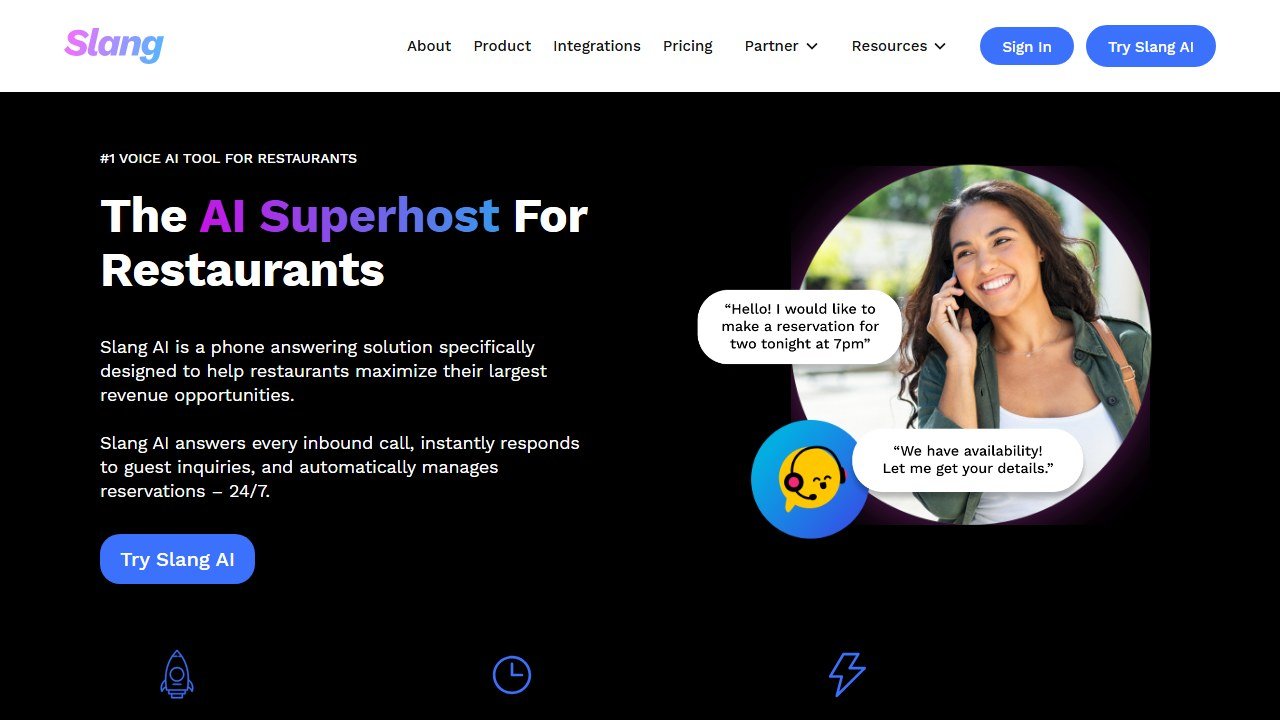
The honest limitation: Slang answers the phone and, for orders, texts the caller a link to your online ordering page. It is a reservations and deflection tool, not a phone-ordering tool. Pricing is $399 per month per location for Core and $599 for Premium (adding custom branding, performance insights, and bilingual support). For a reservations-led independent that wants a premium branded experience, it is the best in class. See our full Slang.ai review for the deep dive.
Best for: reservations-led independents wanting a premium, branded phone experience.
Watch out for: it deflects orders to SMS rather than taking them on the call.
2. Loman AI: Best Affordable Order-Taker
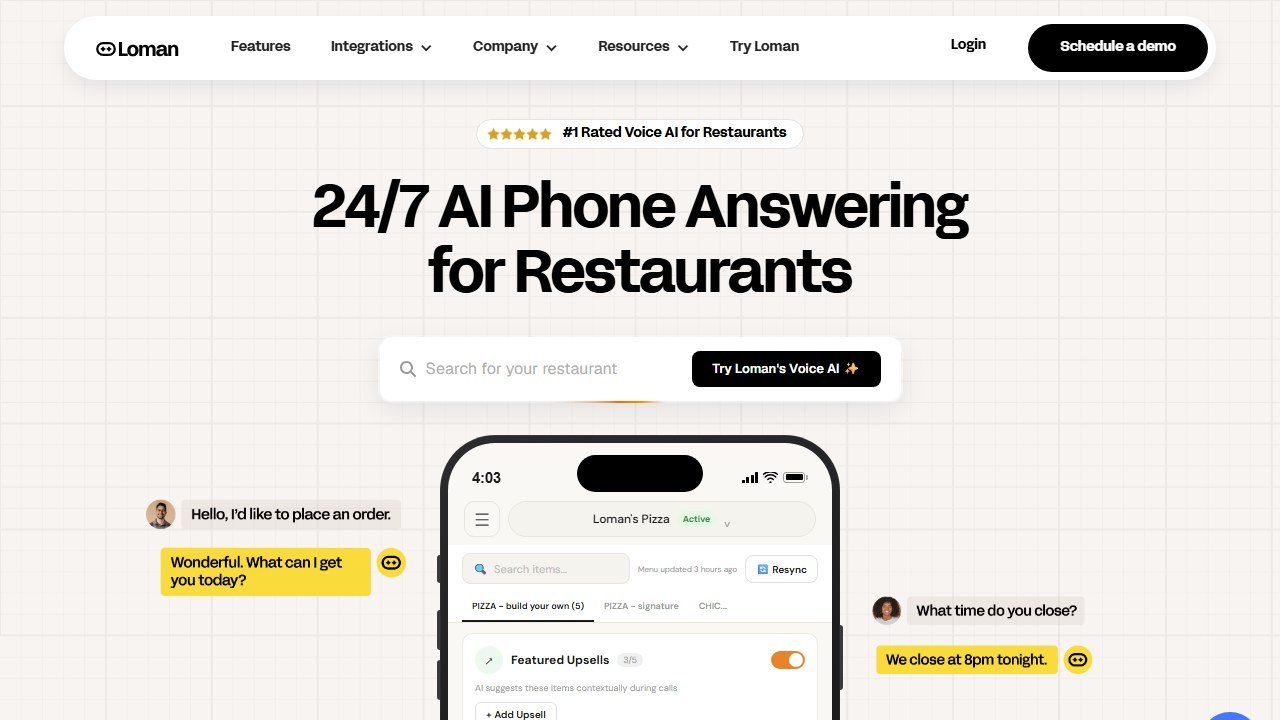
Loman AI is the value pick and the better choice when you need the phone to capture orders, not just book tables. It answers 24/7, handles orders and FAQs, and integrates with POS systems including Square, Toast, and Clover, so a phone order can flow into your system. Loman publishes no pricing. We opened loman.ai/pricing on 5 August 2026 and both plans, Starter and Premium, read “Contact Us”. The page commits to “No per minute fees. No hidden costs” and caps Starter at “up to 50 calls handled at once”, but there is no monthly figure and no setup fee stated. Figures circulating elsewhere for Loman, including a $199 monthly and a $149 setup, do not appear on Loman’s own site, so treat them as unverified until you have a written quote. For a takeout-heavy or delivery restaurant losing orders to unanswered calls, Loman is the sensible entry point.
Best for: takeout and delivery restaurants that need affordable 24/7 order-taking.
Watch out for: confirm your exact POS is supported for full order flow.
3. Popmenu: Best Inside a Broader Marketing Suite
Popmenu makes sense for restaurants that want phone answering as part of a wider marketing and ordering platform rather than a standalone tool. If you already use or want Popmenu’s website, ordering, and marketing features, adding its answering capability keeps everything in one system. The company’s own research (that 62 percent phone-pain stat) shows it understands the problem; the fit is best when you want the suite, not just the phone piece.
Best for: restaurants that want phone answering bundled with marketing and ordering.
Watch out for: overkill if you only want a phone tool.
4. Allo: Best Straightforward Answering Service
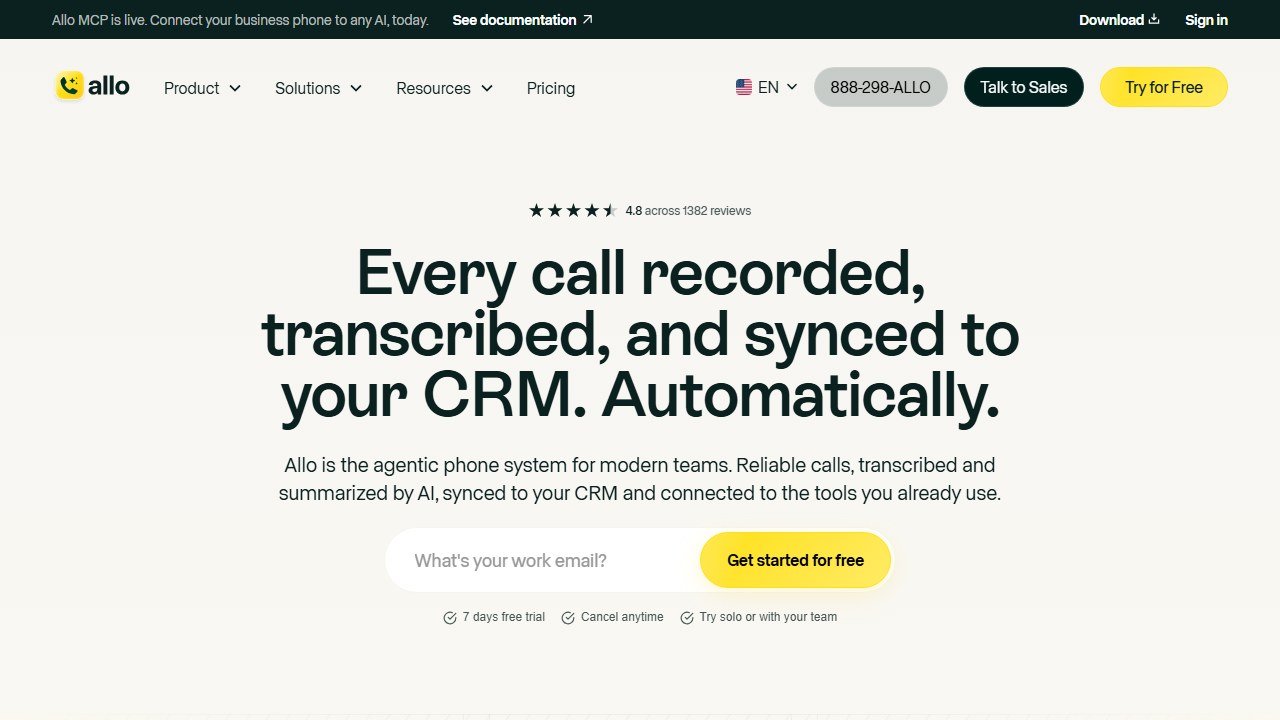
Allo focuses on the core answering job: picking up calls, handling common questions, and freeing staff from the phone during service. For a restaurant whose main problem is simply that no one can get to the phone, and that does not need deep reservation or order integrations, a straightforward answering service is the right-sized tool.
Best for: restaurants that mainly need calls answered and common questions handled.
Watch out for: lighter on deep booking or order integrations than the specialists.
5. SoundHound (Kea): Best for High-Volume Chains
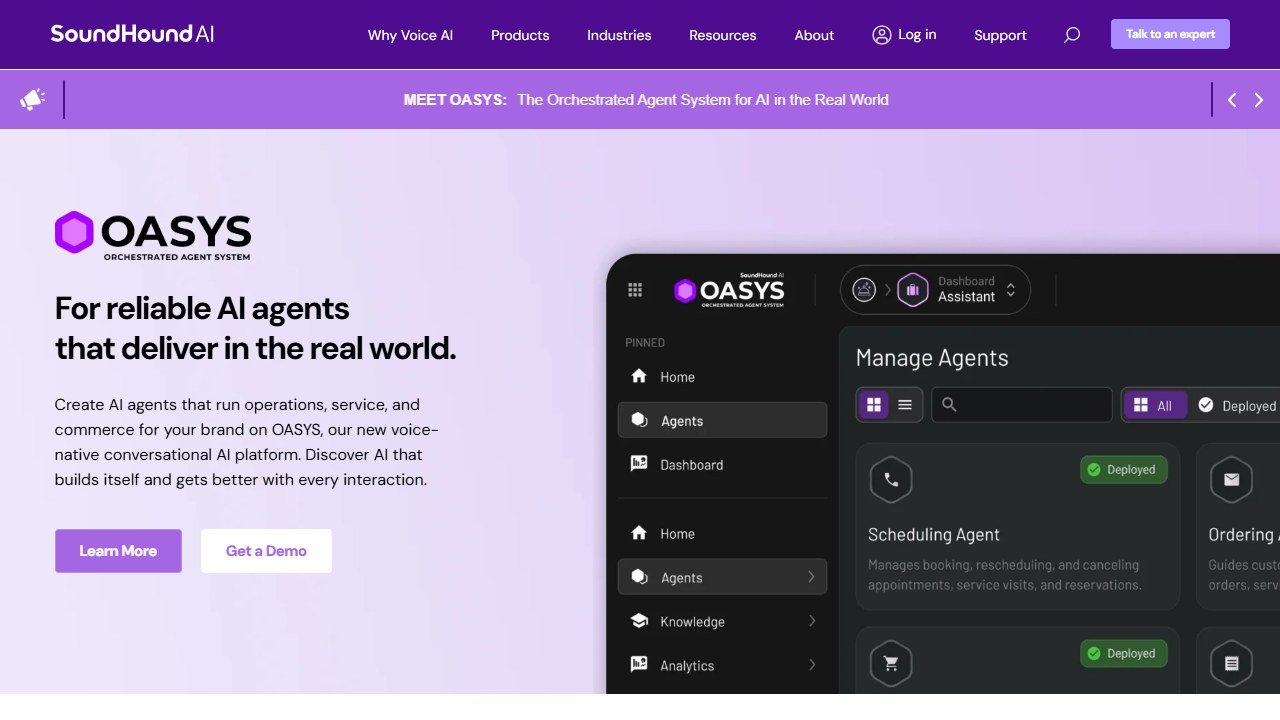
SoundHound, which acquired the restaurant voice-AI specialist Kea, is the enterprise answer for high-volume and multi-location phone ordering. It is built for chains that take large volumes of phone orders and need voice AI that scales, with enterprise POS integration and contracts to match (often $50,000 or more a year). For a single independent it is far too much; for a growing chain drowning in phone orders, it is the tier built for that scale.
Best for: multi-location chains and high-volume phone-ordering operations.
Watch out for: enterprise pricing and complexity; not for single independents.
6. Maple: Best Published Pricing in the Category
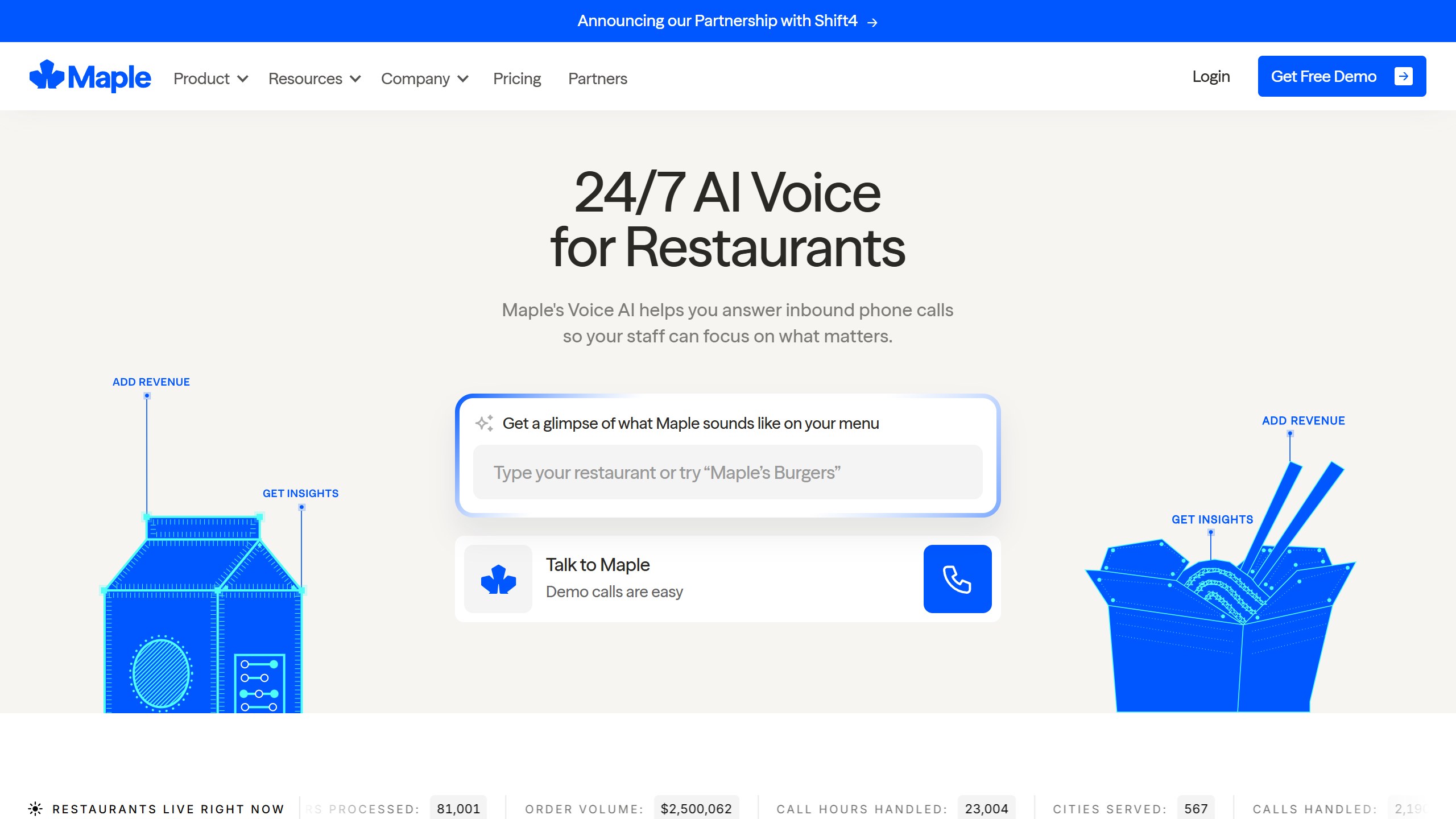
Maple is a 24/7 voice AI for restaurants that answers calls, takes orders into your POS and books reservations. What separates it from most of this list is not a feature. It is that you can find out what it costs without talking to anyone. Three of the five services above publish no price at all, which makes comparing them on budget close to impossible.
What it costs. Maple Voice, which is answering and FAQs only, is $150 a month, or $85 a month billed yearly. Maple Pro, which adds phone ordering into the POS, reservations, upselling and payment over the phone, is $350 a month, or $220 a month billed yearly. There is a custom-priced Enterprise tier for multi-location groups. Verified on their pricing page on 11 September 2026.
One thing worth knowing before you compare that $85 against anything else: the pricing page opens on the yearly view, so the first figure you see is the committed rate rather than the month to month one. The toggle is right there, but the lower number is the one that travels.
On minutes. Maple states no per-minute fees and unlimited minutes. We checked where that claim actually lives: it is in the page meta description, in the Product JSON-LD, and in their agent-readable pricing.md, but it is not in the visible text of the pricing page itself. So the claim is published and machine-readable, and a human reading the page will only see “no per-minute fees”. Maple told us the hero should match and that the gap is theirs to close.
What their own data says about when calls arrive. Maple publishes an ungated write-up covering 1.2 million calls across 1,000 plus locations between December 2023 and November 2025. It is their platform data rather than independent research, and it is useful for one thing in particular: it tells you when restaurant phones actually ring. 40% of daily calls land between 5pm and 9pm and 28% between 11am and 2pm, so the busiest phone hours are also the busiest floor hours, which is the whole argument for automating the phone rather than hiring for it. Friday takes 18% of the week against Monday’s 11%. Reservations are 38% of call types and takeout or delivery orders 12%. Maple also states that 92% of calls can be fully resolved without human intervention, which is a capability claim about their own system rather than a measured industry outcome, and we quote their wording deliberately.
We have not used Maple. Everything above is read from their published pages and confirmed with the company. They offer a browser demo, the Talk to Maple control on their homepage, and we will update this entry once we have put an order through it with modifiers and an allergy note. Until then, treat this as a pricing and capability summary rather than a verdict on how the agent performs on a call.
Best for: independents and small groups that want phone ordering and a published price they can budget against.
Watch out for: ordering and POS integration sit on the higher Pro tier, not on the $150 entry plan.
How to Choose
Name the call you are losing. If it is reservations and you want a premium branded voice, Slang.ai is the best fit, and it books directly into your reservation system. If it is orders and budget matters, Loman AI answers 24/7, takes orders, and costs a fraction of the premium tools. If you want phone answering as part of a broader marketing and ordering platform, Popmenu fits. If you just need calls answered, Allo is right-sized. And if you are a high-volume chain, SoundHound is the enterprise tier.
Then check the integration that completes the job: a reservations tool should book into your system, an order-taker should drop into your POS. A great voice that cannot finish the task is a demo, not a solution.
Phone is one channel guests reach you on. For the booking systems these tools plug into, see our OpenTable vs Resy vs SevenRooms comparison, and for capturing orders online, our best restaurant online ordering systems guide. The full stack is in our best AI tools for restaurants pillar, and for setup specifics see our AI phone answering for restaurants how-to.
Verdict
Slang.ai is the best AI phone answering service for restaurants in 2026 that lead with reservations, thanks to a natural branded voice and native booking integrations, as long as you know it deflects orders rather than taking them. Loman AI is the best affordable pick and the right call when you need the phone to capture orders, Popmenu fits restaurants wanting a broader suite, Allo is the right-sized simple answering service, and SoundHound is the enterprise tier for high-volume chains.
The rule is simple: match the tool to the call you are losing, then confirm the integration that finishes the job. For the full stack, see our best AI tools for restaurants pillar.
Managing labor costs too? See our 7shifts review of the restaurant scheduling platform.

Written by
FazFaz is the founder of AIToolsBakery. Some tools here are tested hands on. Others are assessed from vendor documentation and pricing verified on the live page, and every review says which one it is. Sponsors can buy a position in a guide. They cannot buy the score, the criticism, or silence about a better option.
How we test and how we make money →