This is the most common point-of-sale decision in the restaurant world, and it usually comes down to one thing that has nothing to do with the feature list: how big and how complex are you. Toast and Square are both good. They are aimed at different restaurants, and the mistake is picking the one with the deeper feature set when you needed the one that gets you running by Friday, or picking the cheap-to-start option when you actually needed serious cost controls.
Both offer a way to start at zero. Both process payments, print to the kitchen, and split checks. The real difference shows up at the edges: advanced inventory and recipe costing, the true all-in monthly bill, and how much system you have to learn before your staff can use it. Here is the honest breakdown.
Faz says: Do not let the feature comparison decide this for you. Toast has more, and if more always won, this would not be a real question. The right question is whether you will use the extra depth. A busy full-service kitchen with real recipe costing and multi-location reporting needs will genuinely use what Toast adds, and it pays off. A growing single-location spot that turns on half of Square and never touches recipe costing is better served by Square’s simplicity and predictable bill. Buy for the restaurant you are, not the one on the pricing page.
The Core Difference
Square is the easy, affordable, predictable option built to get small and growing restaurants running fast. Toast is the deeper, restaurant-specific platform built for established and multi-location operations that need advanced controls and are willing to pay more for them.
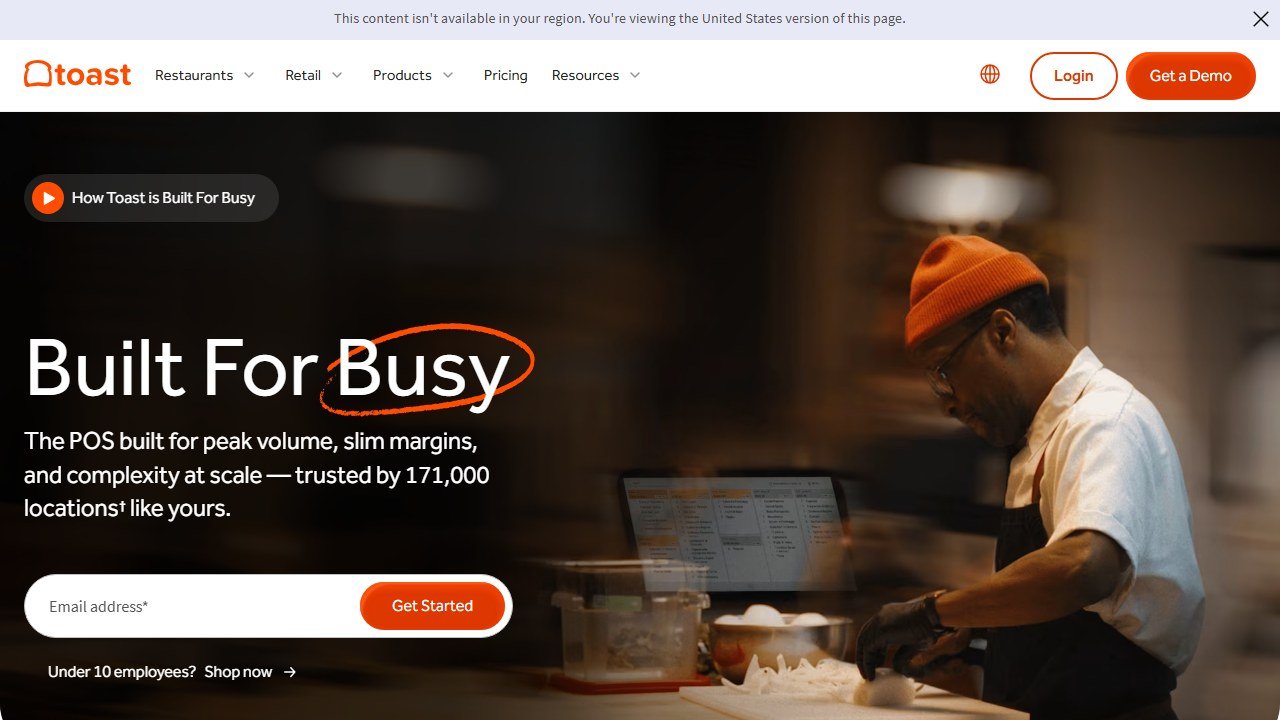
That framing matters because both start free, which fools people into comparing them as equals. They are not competing for the same restaurant. Square is optimized for time-to-value and low commitment. Toast is optimized for depth and scale. Once you know which of those you need, the decision is mostly made.
What each company actually publishes
Before any feature comparison, there is a difference that decides how well you can plan: one of these companies tells you what you will pay, and the other does not.
| Published on the pricing page | Square | Toast |
|---|---|---|
| Software price per tier | Yes, all four tiers | Two tiers, third is “Custom pricing” |
| Card-present processing rate | Yes, per tier | No rate published |
| Online processing rate | Yes, per tier | No rate published |
| Hardware starting price | Yes, from $59 | “Choose your own”, no price |
| Payroll add-on cost | Yes, $35/mo + $6 per person | Yes, $69/mo + $9 per employee |
Toast’s pricing page describes its processing as “Simple, flat rate” and gives no number, on any tier. That matters more than it sounds. For a restaurant, card processing is not a line item, it is usually the line item, several times larger than the software subscription. A venue running $50,000 a month through cards pays over a thousand dollars in processing at any normal rate, against $69 for the software.
So Toast’s real monthly cost cannot be calculated from anything Toast publishes. If you have read a Toast processing rate somewhere, it did not come from Toast. We checked pos.toasttab.com/pricing on 5 August 2026 and there is no rate on the page.
Faz says: This is the whole comparison in one line. Square lets you model your bill before you talk to anyone. Toast requires a sales call to learn your biggest cost. Neither is disqualifying, but only one lets you walk in knowing the number.
Comparison Table
| Factor | Square for Restaurants | Toast |
|---|---|---|
| Best for | Small, growing, single-location | Full-service, multi-location |
| Software price | Free, then $49 or $149/mo per location | $0 Starter Kit, then $69/mo, then custom |
| Card-present processing | 2.4% to 2.6% + 15¢, published per tier | Not published |
| Can you price it before a sales call | Yes | No |
| Ease of use | Easiest to learn, great signposting | More to learn, restaurant-specific |
| Hardware | iPad and Android, from $59 | Toast-built restaurant hardware, price on request |
| Recipe costing and ingredient tracking | Not included | Included |
| Kitchen display | $20 to $30 per device per month | Built in |
| Support | 24/7 | 24/7, restaurant-focused |
Square pricing, verified
All figures read from Square’s restaurant pricing page on 5 August 2026. Prices are per location.
| Plan | Monthly | In person | Online | Notable add-on costs |
|---|---|---|---|---|
| Free | $0 | 2.6% + 15¢ | 3.3% + 30¢ | – |
| Plus | $49 | 2.5% + 15¢ | 2.9% + 30¢ | KDS $30/mo per device, Kiosk $50/mo per device |
| Premium | $149 | 2.4% + 15¢ | 2.9% + 30¢ | KDS $20/mo per device, Kiosk $30/mo per device |
| Pro | Custom | Custom | Custom | Available above $250,000 processed per year |
Two details worth pulling out. The paid tiers buy down the processing rate as well as adding features, which is the part most comparisons miss: moving from Free to Premium cuts the card-present rate by 0.2 points. And the kitchen display and kiosk apps are charged per device per month, and they get cheaper on the higher tier, so a multi-screen kitchen changes which plan is actually cheapest.
Square Payroll is separate at $35 a month plus $6 per person paid. Hardware starts at $59.
Toast pricing, verified
Read from Toast’s pricing page the same day.
| Plan | Monthly | Processing | What it covers |
|---|---|---|---|
| Starter Kit | $0 | Not published | 1 location, up to 2 terminals, hardware kit with no upfront cost |
| Point of Sale | $69 | Not published | Core POS, choose your own hardware |
| Build Your Own | Custom | Not published | Full platform: perpetual inventory, payroll, scheduling, loyalty |
| POS plus Payroll bundle | $69 plus $9 per employee | Not published | New restaurants; page shows this against an original price of $90 |
Every headline price carries a “Starting at” qualifier. The Starter Kit’s free hardware is real, but it is scoped to one location and two terminals, which is a genuine constraint rather than fine print: a second service station or a patio terminal takes you out of it.
How to price this yourself, honestly
You can model Square completely before speaking to a salesperson. Take your monthly card volume, split it between in person and online, apply the rates above for the tier you want, add the per-device kitchen display and kiosk fees for the screens you actually run, and add the subscription.
Worked example on Square’s published Premium rates, $50,000 a month split 80% in person and 20% online, at roughly 1,600 transactions:
- In person: $40,000 × 2.4% = $960, plus 1,280 transactions × 15¢ = $192
- Online: $10,000 × 2.9% = $290, plus 320 transactions × 30¢ = $96
- Subscription: $149
- Roughly $1,687 a month before hardware and add-ons
Notice that processing is about 91% of that total. This is why the missing Toast rate is not a technicality. You cannot run the same calculation for Toast from public information, so the only honest instruction we can give is this: ask Toast for the card-present rate, the online rate, the per-transaction amount, and the contract length in writing, before you compare anything. Then run the arithmetic above with their numbers.
If a Toast quote comes in with a rate close to Square’s Premium tier, the software difference is $69 against $149 and the comparison turns on features. If the rate is meaningfully higher, that gap will dwarf every software saving, because it is multiplied by your entire revenue.
Hardware
Square publishes hardware from $59 and runs on iPad and Android, so a restaurant with existing tablets can start with almost no hardware spend. Toast sells purpose-built restaurant hardware and lists no prices on the pricing page, directing you to a separate hardware page or a quote.
The trade is real rather than one-sided. Toast’s hardware is designed for the environment: spill resistance and kitchen durability are not marketing when a terminal lives next to a fryer. Square’s advantage is that you may already own the hardware, and replacing a consumer tablet is cheap. Toast’s advantage is that when a unit fails at 7pm on a Friday, it is a restaurant company’s problem to solve.
Features: Where Each One Pulls Ahead
Square pulls ahead on simplicity. In practice it is consistently the easiest POS to learn, with clear signposting and dual iPad and Android support. For a small or growing restaurant, being fully operational quickly, with staff who need almost no training, is worth a lot.
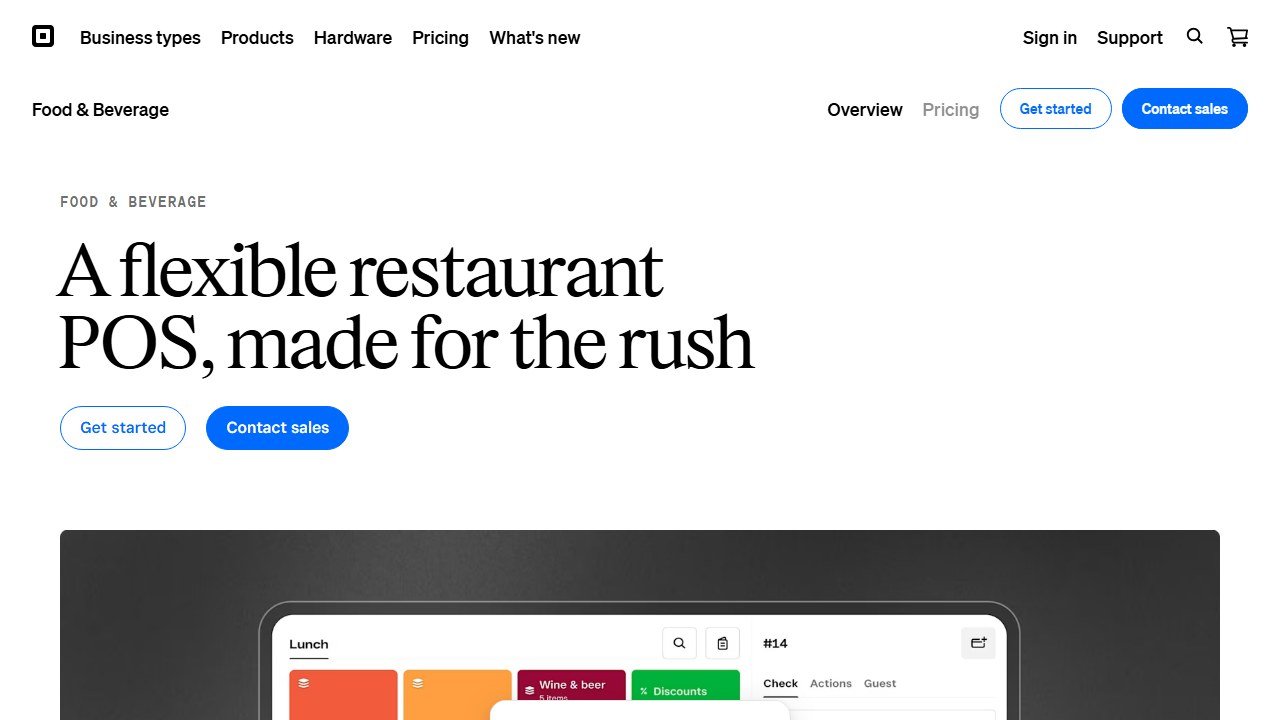
Toast pulls ahead on depth. It is built specifically for restaurants, with a strong kitchen display system, commission-free online ordering, and, critically, advanced controls that Square lacks: recipe costing, ingredient-level tracking, and cost-versus-profit management. For a large or full-service restaurant with complex inventory, those are not nice-to-haves, they are how you protect margin. Toast also tracks food waste, inventory, and sales in real time across locations.
The pattern is consistent: Square gives a growing restaurant everything it needs without complexity, and Toast gives a complex restaurant the controls it cannot run without.
Ease of Use and Support
Square is the easiest system to learn, full stop, which shortens onboarding and reduces mistakes on the floor. Toast has more to learn because it does more, but its help is restaurant-focused and often deeper when you hit a restaurant-specific problem. Both offer 24/7 support. If speed to competent is your priority, Square wins; if you want restaurant-specialist depth once you are running, Toast has the edge.
Which Should You Choose?
Choose Square for Restaurants if you are a small, growing, or single-location restaurant, you want a free or low, predictable monthly cost, you value fast setup and minimal training, and you do not yet need recipe costing or ingredient-level inventory. It is the lower-risk, lower-commitment start, and you can grow into more later.
Choose Toast if you run a full-service or multi-location operation, you need advanced inventory, recipe costing, and cost controls, you want the deepest restaurant-built ecosystem in one place, and your volume can absorb the higher all-in cost. For the right restaurant, Toast replaces several tools and earns its bill.
If you are genuinely between the two, start on Square, because the switching cost from simple to deep is lower than the cost of overbuying and underusing Toast. Migrate up when a specific need (complex inventory, a second location, real recipe costing) actually arrives.
For the wider field of point-of-sale options beyond these two, see our best restaurant POS systems guide, and for the full platform picture, our best restaurant management software roundup and the best AI tools for restaurants pillar.
Verdict
Square for Restaurants wins for small, growing, and single-location restaurants that want a free, predictable, easy system, and Toast wins for full-service and multi-location operations that need advanced cost controls and a deep ecosystem, and can absorb the higher real bill. The feature comparison favors Toast, but features you do not use are not value. Match the POS to the restaurant you actually run.
For the full field of options, see our best restaurant POS systems guide and the best AI tools for restaurants pillar.

Written by
FazFaz is the founder of AIToolsBakery. Some tools here are tested hands on. Others are assessed from vendor documentation and pricing verified on the live page, and every review says which one it is. Sponsors can buy a position in a guide. They cannot buy the score, the criticism, or silence about a better option.
How we test and how we make money →