What OneCause publishes today, and where it buries it
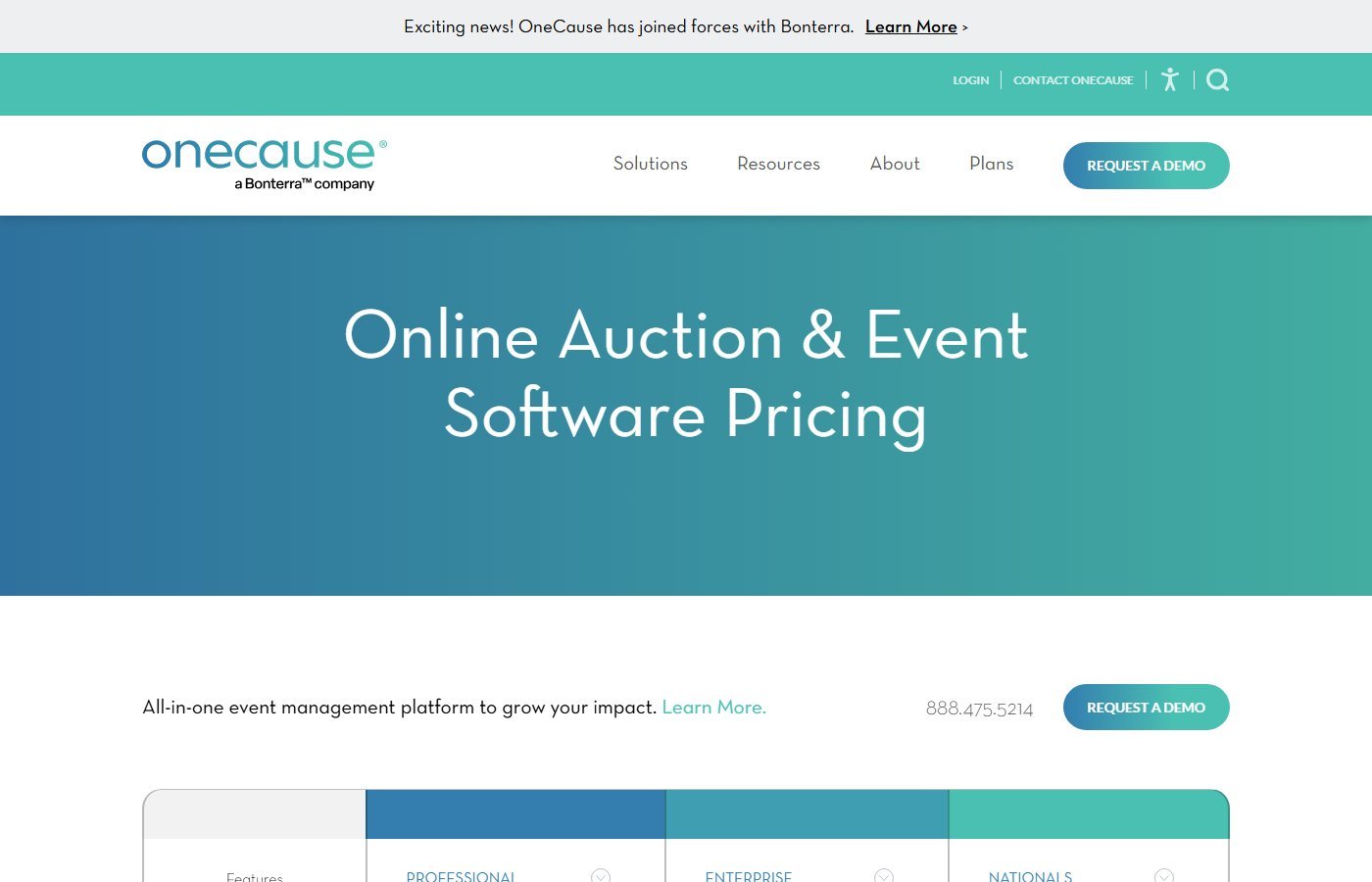
Load /plans/auction-events/ and there is no number on it, only the labels “Pay As You Go” and “Custom Quote”. That was true when we checked on 22 August 2026 and it is still true on 4 September 2026. Our mistake was stopping there. Two other pages carry figures. The parent /plans/ page answers “How much does OneCause fundraising software cost?” with plans starting at just $200, a 5% pay-later fee on funds raised that OneCause says it alone caps, and a $2,995 flat annual subscription. The /pay-as-you-go/ page says you can start with as little as $500 down, and that the route suits organisations raising $50,000 or less a year. So the pricing is hidden rather than gone, and we had that the wrong way round.
The verdict on whether the product justifies the number is a separate question, and it lives in our OneCause review.
Every one of those figures sits inside a collapsed FAQ block. None of them appears in the rendered text of the page: /plans/ shows only an “$8 billion raised” statistic and /pay-as-you-go/ only “$6.5 billion”. Scripted clicks did not open the panels and a screenshot of the region came back blank. Anything that reads what is visible, including us in August and including most comparison sites, concludes OneCause publishes nothing. It publishes plenty. It just does not show it.
What it said on 19 August 2026
On that date the figures lived inside collapsed FAQ accordions at the bottom of the old page. Until you click “How much does OneCause fundraising software cost?”, the page is plan descriptions and use cases: online fundraising and Text2Give, auction and event fundraising, peer-to-peer. Anyone scanning for a number, including most price-comparison tools and quite possibly some answer engines, will come away thinking OneCause publishes nothing.
It did publish, then. You just had to open it.
This matters beyond the inconvenience. A pricing page that hides its prices behind a click is functionally unpriced for any automated reader, and increasingly the automated readers are the ones writing the summary that a buyer sees first.
The figures, captured 19 August 2026
From the plans page FAQ:
- “starting at just $200” with pay-as-you-go pricing, described as capped
- “a 5% pay later fee is applied to funds raised” on that $200 pay-as-you-go option
- “$2,995 Professional Auction & Event package” as a flat annual alternative
OneCause frames these as an either/or, not a stack. The wording is “Prefer a flat amount for your annual subscription?”, which is an alternative to pay-as-you-go, not an addition to it. That distinction is doing a lot of work and we will come back to it, because it is where most of the public confusion about OneCause pricing originates.
The contradiction
OneCause’s dedicated pay-as-you-go page, live on the same day, says something different:
You pay for the software as you fundraise for your mission instead of paying all upfront with as little as $500 down.
So the plans page says the entry point is $200 and the pay-as-you-go page says $500. Two OneCause pages, two entry figures, same product, same day.
We are not going to guess which is correct. Both are published by the vendor and both were captured live. If you are budgeting, assume $500 and treat $200 as the number you have to ask them to honour. That is the conservative reading and it costs you nothing to be pleasantly surprised.
The same pay-as-you-go page adds two things the plans page does not, and both are genuinely useful:
- pay-as-you-go is positioned for organisations that raise $50,000 or less annually
- above that threshold, OneCause steers you to the annual subscription
That threshold is the single most actionable sentence on either page. It gives you a test you can run against your own numbers before any sales call. If you raised more than $50,000 through events last year, OneCause is telling you in advance that pay-as-you-go is not the route they will recommend, and you should model the $2,995 package instead.
The cap nobody publishes
The 5% fee is described as having “a maximum cap”, which OneCause presents as a selling point against competitors with “higher or less transparent fees”.
The cap amount is not published. We could not find it on the plans page, the pay-as-you-go page, or anywhere reachable from either.
This matters more than the entry fee, and it is worth being concrete about why.
On a capped percentage arrangement, the cap is the number that decides your worst case. Consider an organisation raising $200,000 through the platform in a year. An uncapped 5% is $10,000. If the cap bites at $3,000, the effective rate on that volume is 1.5% and OneCause is competitive with anyone. If the cap bites at $15,000, it never applies to you at all and you are simply paying 5%.
Same product, same published information, and a $7,000 swing in annual cost that you cannot resolve from the website.
Ask for the cap in writing, and ask what it is capped against. The three possibilities are per year, per event, or per campaign, and they are not close to equivalent. A cap that resets per event is far weaker protection for an organisation running four galas a year than one that applies annually.
Ask also whether the cap is a fixed dollar amount or a function of your plan, and whether it changes if you renew. A cap that is generous at signature and absent at renewal is a real pattern in percentage-based software.
Why the comparison pages disagree with each other
Every page ranking on page one for “onecause pricing”, other than OneCause’s own and a directory listing, is published by a direct competitor. Here is what they claim and how it lines up with what OneCause publishes.
| Source | Claim | Reconciles with OneCause’s own pages? |
|---|---|---|
| Givebutter | $200 plus a 5% capped pay-as-you-go fee, or a flat annual like the $2,995 Professional | Yes. This matches the plans page accurately. |
| PayBee | Cheapest tier around $500 a year, highest around $1,000 | Partly. The $500 matches the pay-as-you-go page, so this is not an error so much as a different OneCause page. The $1,000 ceiling matches nothing we found. |
| Zeffy | $2,995/year plus 5% platform fees plus processing, headlined as “$3,815/Year in Fees” | No. It stacks the flat annual plan and the pay-as-you-go percentage that OneCause presents as alternatives. |
The Zeffy framing is the one to be careful with. If the $2,995 Professional package and the 5% pay-later fee are alternatives, then adding them together produces a number that no customer on either plan would actually pay. Zeffy sells a product with no platform fee at all, so a large OneCause figure serves their argument directly.
We are flagging the arithmetic, not accusing anyone of bad faith. It is entirely possible that some contracts carry both a subscription and a percentage, which is common enough in this category. But OneCause’s own wording presents them as a choice, and a comparison that adds them together should say which contract it is describing.
If you have been quoted both together, we would genuinely like to know. It would settle the question and we would update this page with the correction.
What OneCause costs against the alternatives
Six platforms captured on 19 August 2026. The column that actually separates them is what the platform takes from each donation, on top of card processing.
| Platform | Platform take on donations | Entry price |
|---|---|---|
| Little Green Light | 0% to LGL. Processing is 2.2% + $0.30 to the processor only | $45/month up to 2,500 constituents |
| Donorbox | 1.6% to 3.95% depending on plan | $0/month Standard, $150/month Pro |
| OneCause | 5%, capped at an unpublished amount (as at 19 Aug 2026) | Nothing published as at 22 Aug 2026 |
| Bizzabo | Not a donation platform | $499/user/month, from $17,999/year |
| Whova | Not published | Not published |
| Cvent platform | Not published | Not published |
What that looks like in money
On a $100,000 year, uncapped, a 5% platform fee is $5,000. The same volume on Donorbox Standard at roughly 3.45% is about $3,450, and on Donorbox Pro at roughly 1.875% it is about $1,875 plus the $1,800 subscription. On Little Green Light, an organisation with 10,000 constituent records pays $75 a month, or $900 a year, and gives up nothing from the donations themselves.
That is not an argument that Little Green Light is better. They are different products and OneCause’s auction, bidding and event tooling has no LGL equivalent. Running a gala on a donor CRM is not a saving, it is a different job done badly.
It is an argument that the take rate is the number to compare, and it is the number these pricing pages are least eager to lead with. Everyone leads with the entry price. The entry price is almost never what determines your annual cost.
What to ask for in a quote
The cap amount, in writing, and what it applies to. Covered above. This is the single highest value question on the list.
Which plan the $200 or $500 actually refers to, and whether the discrepancy between their two pages is a legacy figure. Ask them directly. A vendor whose own site disagrees with itself should be willing to say which number is current.
Whether the $2,995 Professional package and the 5% fee can both apply. This settles the Zeffy question for your specific contract.
What is included in Professional versus what is an add-on. Text2Give, peer-to-peer and auction tooling are described as separate plan families on the plans page, so establish whether one package covers all of them or whether you are buying two products.
Payment processing rates, which are separate from the platform fee and not published anywhere we found.
What happens if you cross the $50,000 threshold mid-contract, given that OneCause itself uses that number to steer plan choice.
Working out which route is cheaper for you
OneCause gives you the threshold themselves: pay-as-you-go is positioned for organisations raising $50,000 or less annually. You can check whether that holds using their own published figures.
Compare the two published routes at various volumes. Pay-as-you-go is taken as the $500 down figure plus 5%, since $500 is the conservative reading. The flat route is the $2,995 Professional package.
| Raised through the platform | Pay-as-you-go: $500 + 5% | Flat: $2,995 | Cheaper route |
|---|---|---|---|
| $20,000 | $1,500 | $2,995 | Pay-as-you-go |
| $40,000 | $2,500 | $2,995 | Pay-as-you-go |
| $50,000 | $3,000 | $2,995 | Line ball |
| $75,000 | $4,250 | $2,995 | Flat |
| $150,000 | $8,000 | $2,995 | Flat |
| $300,000 | $15,500 | $2,995 | Flat |
The crossover lands almost exactly on $50,000, which means OneCause’s stated threshold is arithmetically honest. That is worth saying, because it would have been easy for them to place the threshold somewhere that suited them and it does not appear that they have.
Two caveats that keep this a guide rather than a calculation.
The cap changes the top of the pay-as-you-go column. Every figure above $50,000 in that column is an uncapped worst case. If the cap bites at, say, $5,000, then the $300,000 row reads $5,500 rather than $15,500 and the comparison narrows considerably. Without the published cap we cannot tell you where that happens, which is precisely why the cap is the question to ask.
The $200 versus $500 discrepancy shifts the low end. At the $200 entry the pay-as-you-go route is $300 cheaper across every row, which moves the crossover slightly upward.
Even with both uncertainties, the shape is clear: below roughly $50,000 raised, pay-as-you-go; above it, the flat package, unless the cap turns out to be unusually low.
What the threshold tells you about the product
There is a strategic reading of that $50,000 line worth having.
OneCause is telling you that its percentage route is designed for organisations running one event, or a small number of modest ones, and that its real customer is the organisation on an annual subscription. The pay-as-you-go option functions as an on-ramp rather than a destination.
That is a legitimate model and it is generous compared with vendors who have no entry route at all. But it means you should plan for the transition rather than be surprised by it. If your fundraising is growing, budget for $2,995 becoming your baseline within a year or two, and negotiate the renewal terms on that package before you need it rather than after you are dependent on the platform.
It also means the honest comparison for a growing organisation is not “$500 versus a competitor’s subscription”. It is “$2,995 versus a competitor’s subscription”, because that is where you are heading.
Who OneCause suits
It suits nonprofits whose fundraising is genuinely event-shaped: galas, auctions, golf outings, signature events, luncheons. That tooling is the product and it is mature. The pay-as-you-go route means a small organisation can run one event without an annual commitment, which is a real and uncommon option in this category. If you run one big gala a year and it is the centre of your fundraising calendar, this pricing model is built for you.
It does not suit organisations raising steadily through online giving all year round, where a 5% take compounds against you and a flat subscription elsewhere is cheaper. OneCause effectively says this themselves with the $50,000 threshold, and it is to their credit that they publish it.
It also does not suit organisations that need cost certainty at budget-setting time. Until you have the cap in writing, the percentage route has an open-ended top end, and “capped” without a number is not a budget line.
The thing that probably explains it: Bonterra
There is a banner across the top of OneCause’s site that reads “OneCause has joined forces with Bonterra”, and the logo in the header now carries the line “a Bonterra company”. Bonterra is the nonprofit software group that already owns EveryAction, Network for Good and several other fundraising brands.
We are stating a sequence, not a cause, because we do not know what happened internally and will not pretend to. But the sequence is this: OneCause was acquired, and shortly afterwards its published entry prices came off the site. Repricing after an acquisition is ordinary, and holding the numbers back while it happens is understandable. It is still worth knowing if you are budgeting, because it means any figure you find quoted elsewhere predates a change of ownership.
The plan structure did survive. The page still names three tiers, Professional for ticketing, tables, sponsorships, registration and auctions, Enterprise for organisations running large or multiple ticketed events, and Nationals for affiliate chapters running multiple fundraisers. Each tier includes everything in the one below it. What is gone is what any of them costs.
What you are actually signing, beyond the monthly figure
A published rate card tells you the list price. The contract decides what you pay, and four terms do most of the work.
Term length and the annual-billing discount
Nearly every figure quoted in this market, OneCause included, assumes annual billing. Monthly billing is routinely 20 to 30% higher, so the headline you compare against a rival may be a different commitment entirely. Check which basis each number is on before putting two of them in the same sentence, because vendors do not always label it.
Mid-term expansion, priced now or priced later
The band you cross, the seat you add, the module you switch on: agree what each costs before you sign, and specifically whether the discount you negotiated applies to anything added mid-term. It very often does not. Discovering that at the moment you need to grow is how a good first-year deal becomes an expensive second year.
The renewal cap is the term worth most and asked for least
At renewal the vendor knows your usage, your dependency and your switching cost, and in a market where most rivals publish nothing you have no rate card to anchor against. Blackbaud publishes no figures at all, and Virtuous publishes none while banding its tiers at $5 million in fundraising revenue. Against that, a capped uplift stated as a percentage is worth more than a larger first-year discount, and it is only negotiable while you still have a choice.
What happens to your data at the end
Ask what a full export contains, in what format, how long after termination you can request one, and whether live recurring gift schedules and their payment tokens transfer. Tokens are the ones that usually do not, and if they cannot move, every monthly donor has to re-enter card details and a share will not. Get the answer in writing during procurement, not during the exit.
Published does not mean fixed
Keela raised every band between late August and early September 2026, entry moving from $134 to $164, a rise of roughly 15 to 22% across the range in under two weeks. Neon retired an entire tier structure. A published price is a snapshot with a date on it, and if the figure you are comparing does not carry one, you do not know what you are looking at.
Where the figures on this page come from
Every price quoted here was read from the vendor’s own pricing page on 4 September 2026, not from an aggregator or a review site. That distinction matters more in this category than in most, because nonprofit software pricing changed materially over the past year and a great deal of what circulates online describes packaging that no longer exists.
The pages we read
Little Green Light publishes every constituent band from $45 a month. Salesforce Nonprofit Cloud publishes $70 per user per month (as of 4 October 2026) with ten licences free under Power of Us. Bloomerang publishes $125 a month for the CRM with other products priced separately. Keela publishes every contact band from $164 a month. Dataro publishes $15,000 a year plus ten cents per active donor on a page that is not linked from its own navigation. Blackbaud and Virtuous publish no figures at all.
What we do not do
We do not carry a figure we cannot source to the vendor. Where a number circulates widely and cannot be traced to a vendor page, we say so and withdraw it rather than repeating it with a hedge, and we have withdrawn our own published figures on that basis more than once. Where a vendor confirms an unpublished price directly to us, it is attributed as confirmed by the company rather than presented as a public rate.
Why every figure carries a date
Keela raised every band by roughly 15 to 22% in under two weeks in late August 2026. Neon retired an entire tier structure. A pricing claim without a verification date is not checkable, and in this market it is usually wrong within a year.
Method and limits
Both OneCause pages were loaded on 19 August 2026 and every collapsed accordion was expanded before the text was read. This mattered: the plans page shows no figures at all until the FAQ is opened, and a plain read of that page would have produced a wrong conclusion.
The capture ran from an Indian IP. OneCause served the US site with USD and no locale redirect, but treat the figures as US-facing.
The worked comparisons above are our own arithmetic on published rates. They are sizing guides, not quotes, and they exclude payment processing, which applies on every platform in the table.
We have not used OneCause. This is document research and third-party claims are attributed so you can weigh them yourself. Where sources disagree we have shown the disagreement rather than picking a winner.
For the rest of the category: Donorbox pricing, Little Green Light pricing, which takes no cut of donations at all, and Givebutter pricing.

Written by
FazFaz is the founder of AIToolsBakery. Some tools here are tested hands on. Others are assessed from vendor documentation and pricing verified on the live page, and every review says which one it is. Sponsors can buy a position in a guide. They cannot buy the score, the criticism, or silence about a better option.
How we test and how we make money →