Disclosure: Zilwaris, the consultancy run by AI Tools Bakery’s founder, does paid advisory work for Gratefully, which did not pay for any placement on this page and is assessed on the same criteria as everything else on this site.
One cost to keep in view while reading this, because LGL’s pricing makes it easy to forget. Keeping the CRM cheap does not remove the cost of working the data inside it, it defers that cost to a later decision. A donor intelligence layer on top starts free for one person at Gratefully, then runs $99 a month for a single fundraiser or $499 a month for a five-person team. At the team tier that is several times what LGL costs, and at the single-fundraiser tier it is closer to double. That is not an argument against LGL. It is an argument for knowing the full stack cost before concluding you have found the cheap option.
The whole price list, because there is one
Of six major event and fundraising platforms we captured on 19 August 2026, Little Green Light is the only one where a buyer can work out their exact cost without contacting anyone.
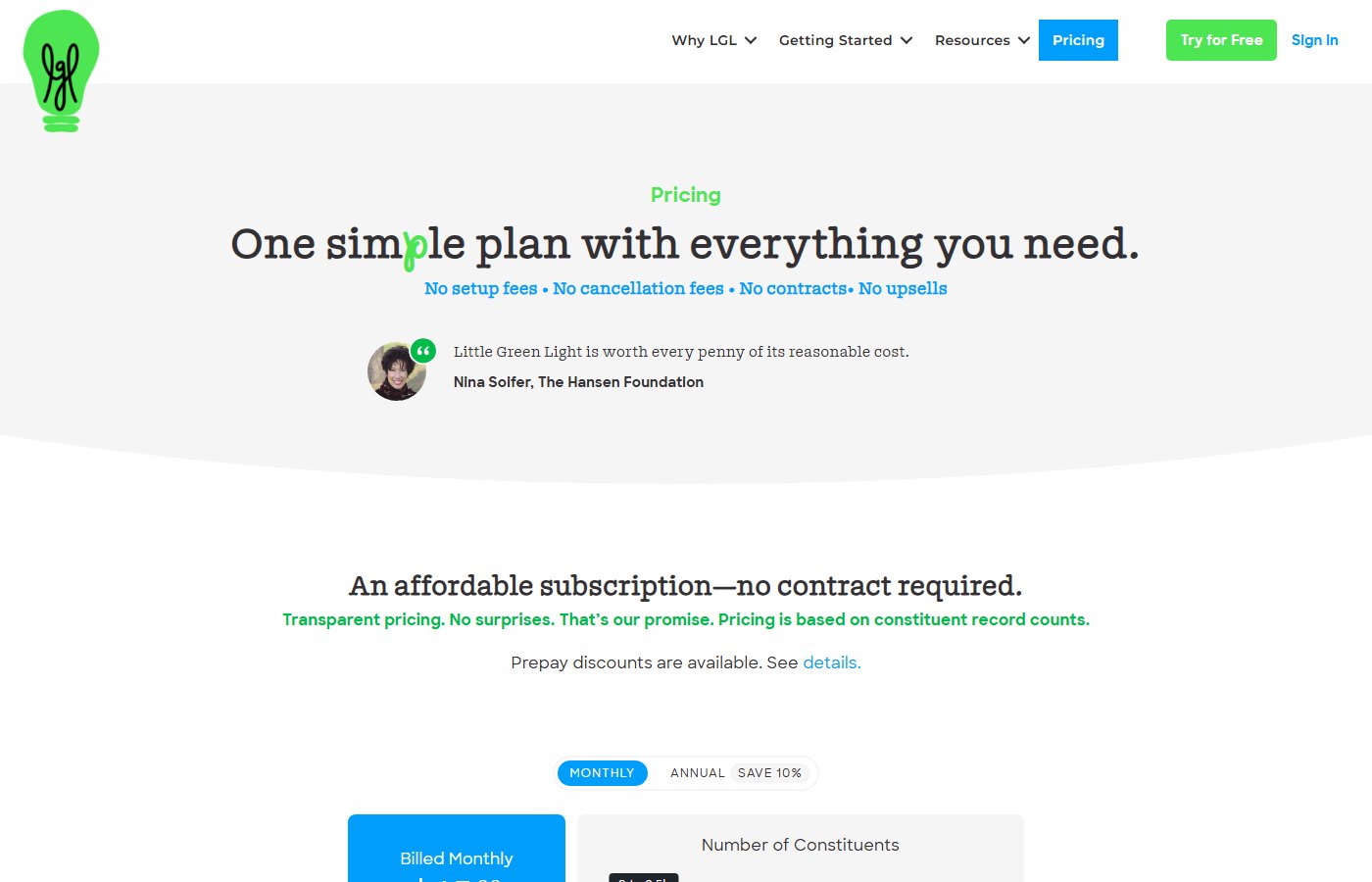
The verdict on whether the product justifies the number is a separate question, and it lives in our Little Green Light review.
| Constituent records | Monthly |
|---|---|
| up to 2,500 | $45 |
| up to 5,000 | $60 |
| up to 10,000 | $75 |
| up to 20,000 | $90 |
| up to 30,000 | $105 |
| up to 40,000 | $120 |
| up to 50,000 | $135 |
| over 50,000 | add $15/month per additional 10,000 tier |
Annual billing saves 10%. Accounts hold up to 200,000 constituent records. The first 30 days are free and no credit card is required to start. If your team is outgrowing it, our guide to Little Green Light alternatives prices the most common next steps.
At the ceiling, 200,000 records works out at $135 plus fifteen additional 10,000 tiers at $15, or $360 a month, before the annual discount. That is $4,320 a year, or $3,888 billed annually, for the largest account LGL supports.
One structural note worth having in front of you: the increments are not linear at the bottom. Going from 2,500 to 5,000 records costs $15 more. Going from 5,000 to 10,000 costs $15 more, but covers five thousand records rather than two and a half. The steps get better value as you go up, which means the smallest organisations pay the most per record.
The number that actually separates LGL from the category
LGL’s own wording on donation processing:
Starting at 2.2% + $0.30 per transaction paid to the payment processor (no fee to LGL).
That parenthesis is the product’s entire commercial argument.
Every other fundraising platform in this batch takes a percentage of money you raise. LGL takes a subscription based on how many people are in your database, and nothing else.
| Platform | Platform take on donations |
|---|---|
| Little Green Light | 0%. Processor takes 2.2% + $0.30 |
| Donorbox | 1.6% to 3.95% depending on plan |
| OneCause | 5%, capped at an amount not published |
On $250,000 raised in a year, a 5% platform take is $12,500. A 2.95% take is $7,375. LGL’s take is zero, and a 20,000-record organisation pays $90 a month, or $1,080 a year, falling to $972 with annual billing.
The one number that decides it
Divide your annual donation revenue by your constituent record count.
If that figure is high, meaning a compact list that gives generously, subscription pricing wins and LGL is likely the cheapest option in this comparison by a wide margin. A 5,000-record organisation raising $250,000 pays LGL $720 a year against roughly $7,375 on a 2.95% platform.
If that figure is low, meaning a large list that gives little, percentage pricing wins. A 50,000-record organisation raising $20,000 pays LGL $1,620 against roughly $590 on a 2.95% platform.
Most established small and mid-sized nonprofits sit on the side where LGL wins, because donation revenue tends to grow faster than list size once a database is mature. Organisations that have just run a large list-building campaign, or that inherited a big historical file, are the ones who should check.
Unlimited users is doing quiet work here
LGL includes unlimited users at every tier.
Set that against Bizzabo at $499 per user per month with a three seat minimum, and it is a different philosophy of who software is for. A nonprofit with fifteen volunteers who each need occasional access pays LGL nothing extra for them.
It also has a practical consequence beyond cost. When seats are expensive, organisations share logins, which destroys the audit trail on who changed a donor record and when. When seats are free, there is no reason to. For a fundraising database, where knowing who edited a gift record matters, that is a governance benefit that does not show up on a pricing page.
And it means the constituent count is the only variable you need to forecast, which is what makes the price genuinely self-serve.
Where the cost can surprise you
Two things to plan for, neither hidden but both easy to miss.
Constituent records accumulate and rarely shrink. Every lapsed donor, every event attendee, every imported list adds records. A tier change is a real budget event: crossing from 10,000 to 10,001 records moves you from $75 to $90 a month, a 20% increase triggered by one contact.
Before a large list import, check which side of a boundary it puts you on. If you are at 9,400 records and about to import 800 event attendees, you are about to cost yourself $180 a year. It might still be the right call, but it should be a decision rather than a surprise on the next invoice.
This also creates a genuine argument for database hygiene that most nonprofits never get. Archiving or removing records you will never contact again has a direct, calculable financial return here, which is not true on percentage-priced platforms.
Processing is “starting at” 2.2% + $0.30. LGL’s own FAQ notes the rate varies by processor, Stripe or PayPal, and by card type. Treat 2.2% as the floor, not the number you will pay. Corporate cards, international cards and American Express typically carry higher rates on any processor.
Cost per record, and why the smallest accounts pay most
Because the tiers are published, you can see something most vendors never let you see: what you actually pay per record at each level.
| Tier ceiling | Monthly | Annual at list | Cost per record per year, at the ceiling |
|---|---|---|---|
| 2,500 | $45 | $540 | $0.216 |
| 5,000 | $60 | $720 | $0.144 |
| 10,000 | $75 | $900 | $0.090 |
| 20,000 | $90 | $1,080 | $0.054 |
| 30,000 | $105 | $1,260 | $0.042 |
| 50,000 | $135 | $1,620 | $0.032 |
| 200,000 | $360 | $4,320 | $0.022 |
At the ceiling of each tier, the cost per record falls by a factor of ten between the smallest and largest accounts.
Two things follow. The smallest organisations get the worst value per record, which is true of most tiered software but rarely visible. And you get the best value sitting just under a tier ceiling, worst value just over one.
That gives you a concrete planning rule. If you are at 10,400 records, you are paying $90 a month for what 20,000 records would cost. Cleaning 400 records saves $180 a year, permanently, and takes an afternoon. There are not many places in nonprofit operations where data hygiene has a return you can calculate that precisely.
What switching actually involves
A price list is only useful if you can act on it, so two practical notes.
The 30-day free trial requires no credit card. That is unusual enough to be worth using properly. Import a real subset of your data rather than test records, because the thing you are evaluating is how your actual constituent structure maps onto theirs, and that is where migrations go wrong.
Your record count is the one thing to establish before you commit, and most organisations get it wrong. Exports from an old system routinely contain duplicates, deceased records, and every event-attendee list ever imported. Deduplicating before migration rather than after can move you down a tier permanently, and it is far easier to do on the way in.
Ask specifically how households, organisations and individuals count. A database with 8,000 individuals grouped into 3,500 households may count as either figure depending on the rule, and that is the difference between the $75 tier and the $90 tier.
What LGL is not
This is a donor management CRM. It is not event or auction software.
If your fundraising is built around galas and auctions, the OneCause style of tooling has no LGL equivalent, and comparing their take rates without saying that would be dishonest. Bidding, mobile auction, table management and event check-in are real products that solve real problems, and LGL does not do them.
Several organisations run LGL as the donor database and something else for events, integrating the two. That is a legitimate architecture and it is worth pricing as a pair rather than assuming one tool has to win.
Say that out loud when you price it, because a 0% take rate on a product that does not do the job you need is not a saving.
What to check before you commit
There is little to negotiate here, which is the point. These are the things worth confirming.
Where your record count actually sits today, including duplicates and inactive contacts. Most organisations underestimate it.
What counts as a constituent record. Households, organisations and individuals may count differently, and it changes which tier you land in.
Your realistic record growth over the contract, so you know when the next tier hits.
Your processor and card mix, since 2.2% is a floor.
Whether the 200,000 ceiling is relevant to you. If you are anywhere near it, ask what happens above it.
The whole category, side by side
Captured 19 August 2026.
| Platform | Publishes a price? | Entry | Takes a cut of donations? |
|---|---|---|---|
| Little Green Light | Complete public table | $45/month | No |
| Donorbox | Yes, in depth | $0 Standard, $150/month Pro | Yes, 1.6% to 3.95% |
| Bizzabo | Yes | $499/user/month, from $17,999/year | Not a donation platform |
| Cvent Event Design | Yes, with a buy button | Free, $49, $150, $320/month | Not applicable |
| OneCause | Partial, behind accordions, two pages disagree | $200 or $500 | Yes, 5% capped |
| Whova | No | Not published | Not published |
| Cvent platform | No | Not published | Not applicable |
Who LGL suits
It suits small and mid-sized nonprofits with a manageable constituent list, a lot of occasional users, and steady donation revenue that would be expensive to give a percentage of. It suits organisations that want to budget accurately a year ahead, because the cost is a known subscription rather than a function of how well fundraising goes. And it suits anyone who wants to evaluate properly, given a 30-day trial with no card required.
It does not suit organisations whose fundraising is event and auction driven, where the missing tooling matters more than the fee structure. It does not suit organisations sitting on a very large, largely inactive list, where paying by record size costs more than paying by results. And it does not suit anyone who needs a platform that scales past 200,000 records without a conversation.
Payment processing, the line that usually costs more than the software
Almost every comparison of Little Green Light against its rivals stops at the subscription. For most nonprofits the larger number is what comes off each donation, and it is metered on the one thing you are trying to grow.
The arithmetic that decides this
A single percentage point on $500,000 raised online is $5,000 a year. That is more than the entire annual subscription to several nonprofit CRMs. So a platform that is $600 a year cheaper but takes half a point more of your online giving is not cheaper at any organisation raising more than $120,000 online, and the crossover point moves against you every year you grow.
Two different models, and they are not comparable
Some platforms charge a subscription and take nothing from donations, leaving you to hold a processor relationship directly. Little Green Light states plainly that it takes nothing from your donations. Others bundle processing into the platform, which is simpler to run and structurally more expensive at volume. GoFundMe Pro, formerly Classy, publishes that its model is an annual subscription plus a transaction fee per donation, and that second half is the part that scales.
Ask for the effective rate, not the headline rate
Processing quotes are usually given as a percentage plus a fixed amount per transaction, and the fixed component dominates at small gift sizes. On a $20 donation, 30 cents is another 1.5% on top of whatever percentage was quoted. If your median online gift is small, and for most community organisations it is, your effective rate is materially higher than the number on the page. Work it out on your own median gift before comparing anything.
Covered fees change the picture and are worth asking about
Where a platform offers donors the option to cover processing fees, take-up is the variable that decides your real cost, and it varies enormously by audience and by how the prompt is worded. Ask any vendor quoting you a bundled rate what their observed cover rate is across comparable organisations, and treat a refusal to answer as information. A model that looks expensive at 0% cover can be the cheapest option at 60%.
Get processing out of the subscription line in every quote
Insist that every vendor states processing separately from the platform fee, with the percentage, the fixed per-transaction amount, and whether ACH and card are priced differently. A blended annual figure hides exactly the line that grows with your success, and it is the single most common reason a nonprofit software budget is wrong in year two.
What you are actually signing, beyond the monthly figure
A published rate card tells you the list price. The contract decides what you pay, and four terms do most of the work.
Term length and the annual-billing discount
Nearly every figure quoted in this market, Little Green Light included, assumes annual billing. Monthly billing is routinely 20 to 30% higher, so the headline you compare against a rival may be a different commitment entirely. Check which basis each number is on before putting two of them in the same sentence, because vendors do not always label it.
Mid-term expansion, priced now or priced later
The band you cross, the seat you add, the module you switch on: agree what each costs before you sign, and specifically whether the discount you negotiated applies to anything added mid-term. It very often does not. Discovering that at the moment you need to grow is how a good first-year deal becomes an expensive second year.
The renewal cap is the term worth most and asked for least
At renewal the vendor knows your usage, your dependency and your switching cost, and in a market where most rivals publish nothing you have no rate card to anchor against. Blackbaud publishes no figures at all, and Virtuous publishes none while banding its tiers at $5 million in fundraising revenue. Against that, a capped uplift stated as a percentage is worth more than a larger first-year discount, and it is only negotiable while you still have a choice.
What happens to your data at the end
Ask what a full export contains, in what format, how long after termination you can request one, and whether live recurring gift schedules and their payment tokens transfer. Tokens are the ones that usually do not, and if they cannot move, every monthly donor has to re-enter card details and a share will not. Get the answer in writing during procurement, not during the exit.
Published does not mean fixed
Keela raised every band between late August and early September 2026, entry moving from $134 to $164, a rise of roughly 15 to 22% across the range in under two weeks. Neon retired an entire tier structure. A published price is a snapshot with a date on it, and if the figure you are comparing does not carry one, you do not know what you are looking at.
How to run the procurement so a quote means something
Get every quote onto the same basis before comparing
Ask each vendor, including Little Green Light, for the same seat count, the same contract length, implementation quoted separately from subscription, every add-on itemised, and payment processing stated as inside or outside the platform fee. A single blended annual number cannot be compared against anything, and vendors know it.
Establish the total first-year cost, not the subscription
Onboarding, data migration, integration work and training are frequently larger than the first year of licence fees in this category and are rarely in the headline figure. Ask for the all-in number, then ask which parts of it are one-off and which recur.
Negotiate the renewal before you sign the first contract
This is the single most valuable term and the one most often left out. A capped renewal uplift, stated as a percentage, is worth more than a bigger first-year discount, because at renewal the vendor knows your usage, your dependency and your switching cost while you have no public rate card to argue against.
Insist on a trial with your own data
A demo runs on a dataset chosen because the product handles it well. Ask to load a sample of your own records, including the messy ones: duplicate households, lapsed donors with old addresses, a recurring gift that failed. How a platform handles your actual data quality is the thing that decides whether staff use it, and it is invisible in a scripted walkthrough.
Name the person who will own it
Every platform in this category rewards an owner and punishes shared responsibility. Before signing, name the person whose job description includes this system and check they have the hours. Software does not create that role, and its absence is the most common reason a nonprofit CRM purchase disappoints.
Where the figures on this page come from
Every price quoted here was read from the vendor’s own pricing page on 4 September 2026, not from an aggregator or a review site. That distinction matters more in this category than in most, because nonprofit software pricing changed materially over the past year and a great deal of what circulates online describes packaging that no longer exists.
The pages we read
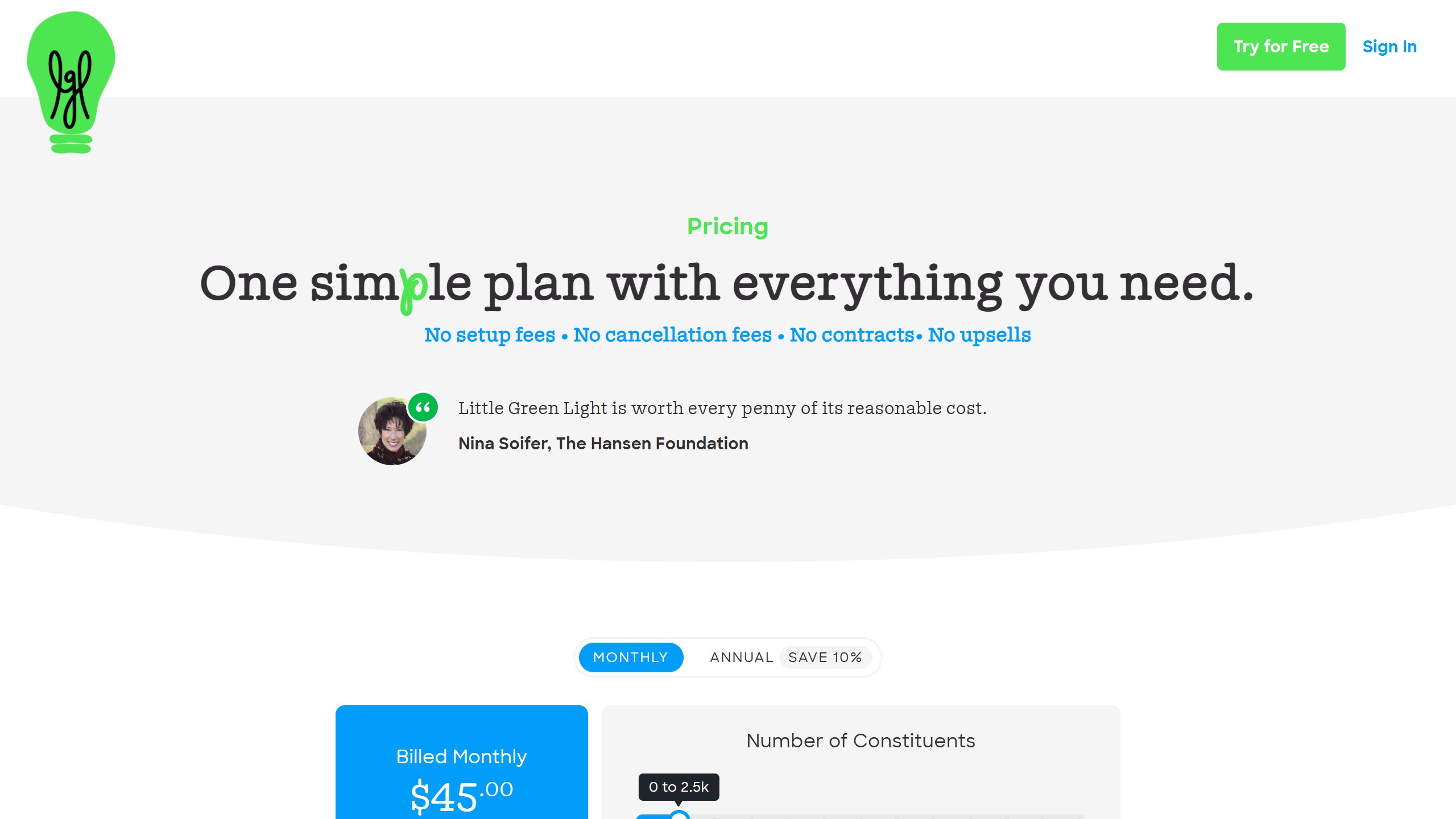
Little Green Light publishes every constituent band from $45 a month. Salesforce Nonprofit Cloud publishes $70 per user per month (as of 4 October 2026) with ten licences free under Power of Us. Bloomerang publishes $125 a month for the CRM with other products priced separately. Keela publishes every contact band from $164 a month. Dataro publishes $15,000 a year plus ten cents per active donor on a page that is not linked from its own navigation. Blackbaud and Virtuous publish no figures at all.
What we do not do
We do not carry a figure we cannot source to the vendor. Where a number circulates widely and cannot be traced to a vendor page, we say so and withdraw it rather than repeating it with a hedge, and we have withdrawn our own published figures on that basis more than once. Where a vendor confirms an unpublished price directly to us, it is attributed as confirmed by the company rather than presented as a public rate.
Why every figure carries a date
Keela raised every band by roughly 15 to 22% in under two weeks in late August 2026. Neon retired an entire tier structure. A pricing claim without a verification date is not checkable, and in this market it is usually wrong within a year.
Method and limits
LGL’s pricing page was loaded on 19 August 2026 and every collapsed control was expanded before reading. This mattered here: the full tier table sits behind a “show the full pricing table” control, so a plain read of the page captures only the headline figure and would have produced a thinner and less accurate piece.
The 200,000-record ceiling calculation, the per-record comparisons and the crossover examples are our own arithmetic on LGL’s published tier rule and on competitors’ published rates. They are sizing guides, not quotes.
The capture ran from an Indian IP. LGL served USD with no locale redirect.
We have not used Little Green Light. This is document research.
For the percentage-based alternatives, see Donorbox pricing and OneCause pricing. For CRMs in the same bracket, Bloomerang pricing and DonorPerfect pricing.

Written by
FazFaz is the founder of AIToolsBakery. Some tools here are tested hands on. Others are assessed from vendor documentation and pricing verified on the live page, and every review says which one it is. Sponsors can buy a position in a guide. They cannot buy the score, the criticism, or silence about a better option.
How we test and how we make money →