The short answer
Buying for a school or district? This page covers what Curipod costs. Our Curipod company evaluation covers what procurement will ask instead: which plan can sign a data privacy agreement, where student data is stored by default, and what the third-party privacy badge actually assessed.
Curipod is free for teachers. If you want it for a school or a district, you have to ask, because Curipod does not publish a price.
| Plan | Price | Who it is for |
|---|---|---|
| Free | $0 a month | Individual teachers |
| School & District | Custom pricing, quote only | Schools and districts |
| ELA Curriculum Alignment | Custom pricing, quote only | Districts wanting curriculum-mapped practice |
Read from curipod.com/pricing on 28 August 2026. There is no per-seat figure, no per-student figure, no starting-from number and no published minimum anywhere on the page. The two paid tiers say “Custom pricing” and route you to Request a quote or Book a demo.
We say this plainly because it is the thing people actually want to know, and because a lot of pages about Curipod imply a price exists. It does not, at least not publicly.
What you get for nothing
The free plan is unusually generous for this category, which is worth stating before the caveats.
- Unlimited student writers. Not a seat count, not a class cap.
- Weekly writing sessions, renewing every week.
- Standards alignment, national and state.
- ELA writing practice K to 12, and Science and Social Studies writing practice for grades 3 to 12, both at limited usage.
- Some state test-prep content, described as “try select test prep content for free”.
- Content translations, limited.
- Basic support.
- Full FERPA, COPPA, SOPPA and GDPR compliance, which Curipod applies across every plan including the free one rather than gating privacy behind a paid tier.
The unlimited student writers line is the one that matters. A teacher can run a whole class, and several classes, without paying, and the constraint is how often you can run sessions rather than how many children you have.
Where the free plan stops
| Limit | Free | Paid tiers |
|---|---|---|
| Writing sessions | Weekly, renews each week | Unlimited |
| ELA writing practice | Limited usage | Unlimited |
| Science and Social Studies practice | Limited usage | Unlimited |
| Student response length | Up to 1,000 characters | Up to 5,000 characters |
| State test prep | Select content only | Full access to all libraries |
| Content translations | Limited | Unlimited |
| Bilingual practice (TELPAS, ELPAC, WIDA ACCESS) | Not included | Included |
| Text to speech in read-aloud passages | Not included | Included |
| Authentic writing controls | Not included | Included |
| Score against your own rubric | Not included | Included |
| Writing reports and growth insights | Not included | Included |
| Download lessons as PDF | Not included | Included |
| Shared lesson folders across schools | Not included | Included |
| SSO (ClassLink, Clever, Google) | Not included | District only |
| Support | Basic | Priority, or a dedicated partner |
The 1,000 character cap is the sharpest edge. That is roughly 150 to 180 words, which is fine for a short constructed response and short for an essay. If your students are writing at length, the free plan will pinch there before it pinches anywhere else.
The second sharpest is the missing reporting. Writing reports and student growth insights are paid-only, so a free account gives students feedback but gives you no view across the class over time. That is precisely the thing a head of department is buying.
What separates the two paid tiers
Both are quote only, so the difference is in scope rather than price.
School & District adds the classroom controls and the reporting: bilingual practice, text to speech, authentic writing controls that disable pasting and third-party assistance, rubric scoring, growth reports, shared folders, PDF download, priority support, and SSO at district level.
ELA Curriculum Alignment adds two things on top, and they are the reason it exists. Writing tasks mapped to your adopted curriculum, built around the texts your district already uses, and pacing and scope and sequence alignment so the week is ready when a teacher opens it. Curipod lists sample alignments for HMH, Savvas and Bluebonnet. Support moves to a dedicated partner with white-glove setup and PD.
In other words the top tier is not more software. It is Curipod doing the mapping work a curriculum lead would otherwise do by hand.
The outcome numbers on that page are Curipod’s, not ours
Curipod’s pricing page leads with four results attributed to named schools and districts: STAAR RLA passing moving from 69% to 89% at Green Valley Elementary in Texas, 46% CAASPP growth in upper elementary ELA in Southern California, ELA growth from 51% to 69% meeting standards in a Southern California fifth grade, and a district accountability rating going from a C to an A in a single year at Sivells Bend, Texas.
Those are Curipod’s own figures, presented by Curipod, and we have not verified them. They may well be accurate. We repeat them here because they are part of what you are being sold, and we label them because a school-level outcome claim with no methodology attached is not the same thing as a verified price.
How to think about the quote
Since there is no published number, the useful preparation is knowing what changes it. On Curipod’s own tier structure, the things that move you up are student count, whether you need bilingual practice for TELPAS, ELPAC or WIDA ACCESS, whether you need reporting across classrooms, whether you need SSO, and whether you want your existing curriculum mapped.
If none of those apply, the free plan is the product, and that is a genuinely unusual thing to be able to say about an education tool.
What to ask before you request a quote
Because the two paid tiers publish nothing, the useful preparation is knowing which questions change the number. Based on how Curipod structures its own tiers, these are the four that matter.
Is it priced per student, per teacher, or per school? This moves the total most. A tool with unlimited student writers on the free plan is unlikely to charge per student on paid, but it is not stated, and the gap between per teacher and per school is the gap between a departmental purchase and a district one.
Is there a minimum? Education platforms with quote-only pricing often carry a floor that makes them impractical below a certain size. Curipod publishes no minimum, which means asking.
What does the contract term look like? Annual is standard in school software, and the renewal price is rarely the first-year price. Ask what year two costs before signing year one.
What happens to the free accounts you already have? If teachers are already using Curipod free and you buy School and District, confirm whether those accounts fold into the subscription or sit alongside it.
One thing worth knowing before any of that. Because the free plan includes unlimited student writers and full standards alignment, a department can pilot Curipod at zero cost across real classes before any conversation about money. The constraint on the free plan is session frequency and the 1,000 character response cap, not headcount, so a pilot tells you something real.
Buying at school or district level, and why teacher pilots stall
The gap between a teacher loving a tool and a district paying for it is where most education software dies, and it is a process problem rather than a product one.
Find out who actually approves before you pilot
Curriculum, IT, data protection and procurement usually all have a say, and in most districts nobody has told teachers which of them is the blocker. Ask early. A pilot that has to be re-run after the data protection review because the first one used real student work is a term lost, and it is entirely avoidable.
Price the thing you will actually deploy
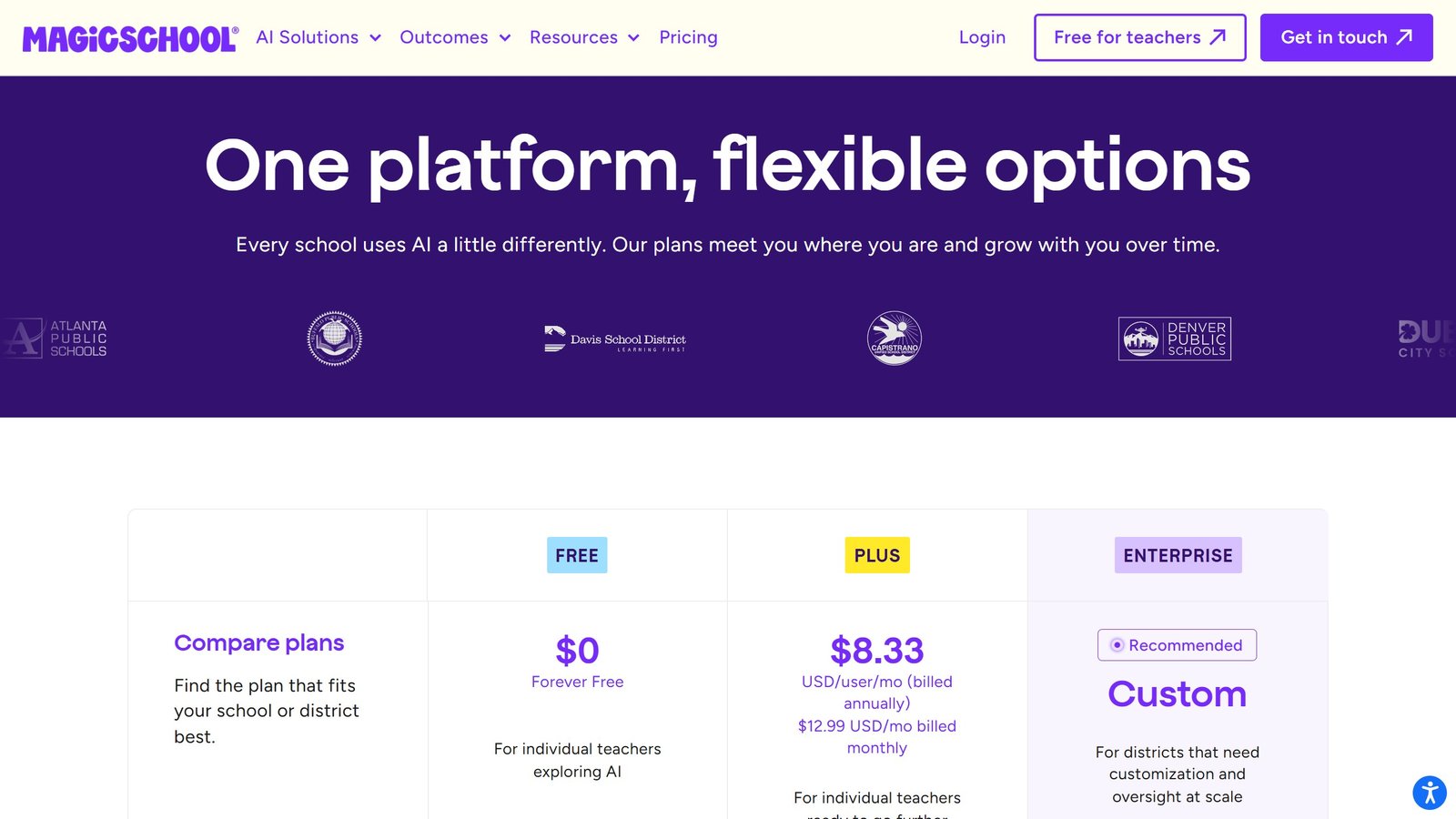
Published teacher rates and district rates are different products. MagicSchool publishes Plus at $12.99 a month and quotes Enterprise with volume discounts. SchoolAI publishes tier names only. Gradescope, now on a Turnitin domain, is institution-quoted. That means a per teacher figure multiplied by staff count is a rough upper bound rather than a quote, and it is still the number worth calculating before a call, because it anchors the conversation.
Run the pilot on the thing that fails, not the thing that demos
The demo will be a well-formed lesson plan for a well-behaved topic. Your pilot should include the awkward cases: a mixed ability class, a subject with heavy notation, a student with an access arrangement, a topic where the source material is contested. How a tool handles those decides whether teachers keep using it in November.
Name who owns it after the pilot
Every tool in this category rewards an owner and punishes shared enthusiasm. Before curipod pricing or anything else goes past a pilot, name the person whose job includes it and confirm where the hours come from. If the answer is that the keen teacher will keep doing it, the tool leaves when they do.
How to tell whether it actually helped
Education software is unusually prone to being judged on enthusiasm, because the immediate experience of a good tool is genuinely pleasant. That is not the same as it having worked.
Teacher time is the measurable win, and the honest one
Most of the real value here is hours, not outcomes. Ask two or three colleagues to record how long planning, resource creation and marking take across one normal week, before anything is introduced. It takes minutes, it is the only way the saving is ever provable, and it is unrecoverable afterwards. A tool that returns two hours a week to a teacher has earned its place without needing to claim anything about attainment.
Be sceptical of attainment claims, including your own
Attainment moves slowly, is affected by everything, and is nearly impossible to attribute to one tool inside a single year. If a vendor claims a grade improvement, ask what the comparison group was. If you are tempted to claim one internally, ask yourself the same question. Reporting a time saving you can evidence is worth more than an outcome claim you cannot.
Watch adoption in week six, not week one
Novelty carries any classroom tool through the first fortnight. The number that matters is how many teachers are still using it after half term, and whether it survived a busy assessment period. If usage collapses in the first genuinely hard week, the tool added work rather than removing it, whatever the initial reaction was.
Decide in advance what would end it
Write down before purchase what the end of the year would have to look like for you not to renew. It converts renewal from a default into a decision, which matters in a category where the per teacher cost is small enough to stop noticing.
Student data, and the questions a school has to ask before anything is switched on
This is the part of education technology where getting it wrong has consequences beyond a wasted subscription, and it is mostly answerable in writing before adoption.
Know which law you are under before you evaluate
In the United States, student education records sit under FERPA, and services aimed at under-13s bring COPPA into scope, which requires verifiable parental consent for personal information collected from children. Schools outside the US will have their own regime. The practical effect is the same: the school, not the vendor, carries the obligation, so the vendor questions exist to let you meet it.
Ask whether student work trains the model
This is the single question to get in writing. Ask whether student inputs and outputs are used to train or improve any model, including in aggregated or anonymised form, and whether that binds subprocessors too. “We do not train on your data” and “we do not train foundation models on your data” are different sentences. Get it as a contract term, because a sales assurance does not survive a change of ownership.
Ask who else touches the data
Most tools here are built on a model provider they did not write, so student work reaches a third party. Ask for the current subprocessor list, where each processes data, and how you are notified when it changes. A vendor that cannot produce that list within a day does not have one, which tells you enough about the rest of their programme.
Ask what happens at the end of a school year
Retention and deletion, stated in days rather than described as a process. What is deleted when a student leaves, when a class is archived, when the contract ends. Ask whether deletion means removed from live systems, removed from backups, or flagged. A vendor that will commit to a number in the contract is a different proposition from one that describes an approach.
The one many schools miss: inferences about a child
If a tool generates a reading level, a predicted grade, a behaviour flag or an ability estimate, that is data about a student the student never supplied. Ask whether those inferences are covered by your export, your deletion request and your access request, because a parent asking what the school holds on their child is asking about those too.
Where the figures on this page come from
Every price here was read from the vendor’s own pricing page on 4 September 2026 and carries that date, because education pricing changes with the school year and a claim without a date is not checkable.
The pages we read
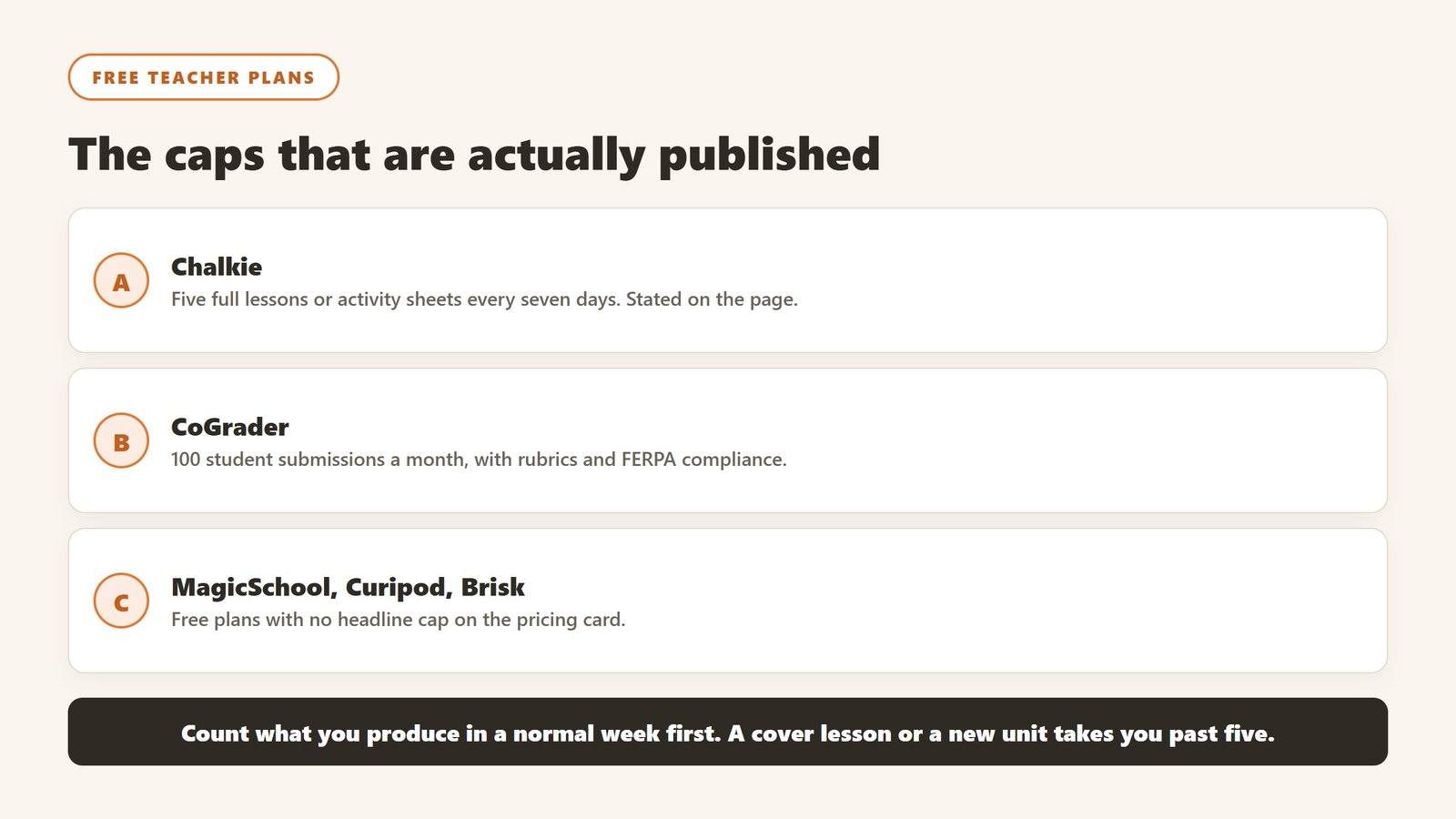
Chalkie publishes free, US$6.65 and US$12.99 a month with yearly equivalents. Khanmigo publishes $44 a year. MagicSchool publishes a free plan and Plus at $12.99 a month. Curipod publishes free and from $24 a month with a 21% yearly saving. CoGrader publishes free at 100 submissions a month and $15 a month billed annually. Brisk Teaching publishes a free teacher plan at $0.
The ones we could not read
SchoolAI publishes tier names with no figures. Gradescope now sits on a Turnitin domain and is institution-quoted. We could not read a figure for Diffit, Quizlet, Photomath or Gauth either. That is not evidence they publish nothing, and we do not present it as such. Treat any figure for those six from elsewhere as unverified.
What we do not do
We do not carry a figure we cannot source to the vendor. Where a number circulates and cannot be traced, we say so and withdraw it rather than repeating it with a hedge.
How we checked this
We read Curipod’s pricing page in a browser on 28 August 2026, reached from curipod.com’s own navigation rather than a guessed URL, and read the full feature comparison table rather than the summary cards.
One thing worth flagging about our own method: Curipod served us the page in Hindi, because our connection resolves to India. We re-requested it with a US English locale before recording anything, and every figure and feature above comes from the English page. If you are reading Curipod’s pricing from outside the US, check which version you have been given.
This is a pricing page, not a hands-on review. Nothing here is scored and we make no claim to have tested the product.
Prices and plans change. If something here no longer matches Curipod’s page, tell us and we will correct it.

Written by
FazFaz is the founder of AIToolsBakery. Some tools here are tested hands on. Others are assessed from vendor documentation and pricing verified on the live page, and every review says which one it is. Sponsors can buy a position in a guide. They cannot buy the score, the criticism, or silence about a better option.
How we test and how we make money →