Ohio’s deadline just passed. As of July 1, 2026, every traditional public school district, community school, and STEM school in Ohio is legally required to have a board-adopted artificial intelligence policy in place under House Bill 96. It is the first statewide, legally backed AI policy mandate for K-12 schools in the country, and it will not be the last. Tennessee got there earlier with Public Chapter 550, Vermont published 50 pages of guidance in January 2026, and roughly half the states now have some form of official AI guidance on the books.
If you are a superintendent, technology director, or board member staring at a blank document titled “AI Policy,” this guide is for you. We are not going to hand-wave at principles. Below you will find an actual editable policy framework, section by section with sample language you can adapt, a compliance checklist mapped to the requirements states are actually writing into law, and an honest tour of the model policies and templates worth starting from.
The templates and model policies, compared
| Template / model policy | Type | Best for | Cost | Legal status |
|---|---|---|---|---|
| Ohio DEW Model AI Policy | State model policy | Ohio districts (mandatory adoption of a policy) | Free | Adoption of an AI policy required by July 1, 2026 (HB 96) |
| TSBA Model Policy 4.214 | Association model policy | Tennessee districts and charters | Free to member boards | Policy adoption required under Public Chapter 550 |
| TeachAI AI Guidance for Schools Toolkit | Toolkit + sample language | Any district building from scratch | Free | Advisory |
| Banyan AI Acceptable Use Policy Template | Annotated AUP template | Districts updating an existing AUP | Free | Advisory |
| NEA Sample School Board Policy on AI | Sample board policy | Boards that want educator-association framing | Free | Advisory |
| Mississippi AI Network (MAIN) template | Planning + governance template | Committees that need a decision framework, not just text | Free | Advisory |
| WeAreTeachers AI policy template | Editable classroom-level template | Building-level and classroom policies | Free | Advisory |
| Vermont AOE AI guidance (Jan 2026) | State guidance document | Grade-band rules and pedagogy framing | Free | Guidance, not a mandate |
| AI for Education state tracker | Live tracker | Checking what your state requires right now | Free | Reference |
Why this got urgent: the state landscape in July 2026
For two years, “AI policy” in K-12 mostly meant optional guidance documents. That era is ending. Three developments define where things stand this summer.
Ohio: the first true mandate, and the deadline has passed
Under House Bill 96, every traditional public district, community school, and STEM school in Ohio had to adopt a formal AI policy by July 1, 2026. To make that achievable, the Ohio Department of Education and Workforce released the Ohio DEW Model AI Policy in late 2025. Districts may adopt the state template as written or customize it, as long as a policy is in place.
The model policy is a solid piece of drafting. It addresses academic use of AI by students and staff, requires that any AI tool comply with existing data privacy and security policies including PII protections and FERPA, encourages family and community engagement, and flags the risks of unsupervised student AI use. Ohio is the first state to convert advice into a statewide, legally backed adoption requirement, which is why we built this guide around the “is your district compliant?” question.
If you are an Ohio district reading this after July 1 without an adopted policy, the practical move is simple: put the DEW model policy on your next board agenda, adopt it substantially as written, and schedule a customization pass for the fall. An adopted-then-refined policy beats a perfect draft that never reached the board.
Tennessee: Public Chapter 550 and TSBA Model Policy 4.214
Tennessee moved earlier than Ohio. In spring 2024, the legislature passed Public Chapter 550, requiring K-12 districts, public charter schools, and public universities to adopt their own AI policies. The important detail people get wrong: the widely adopted model policy did not come from the Tennessee Department of Education. It came from the Tennessee School Boards Association, which published Model Policy 4.214, Use of Artificial Intelligence Programs, in June 2024, along with an implementation toolkit.
Most Tennessee districts adopted 4.214 in full. Its core mechanism is an approved-tools model: only AI programs approved by the district may be used for student instruction or student work, and district technology staff review each program for compliance with state and federal data privacy laws before approval. That single mechanism does a lot of work, and we recommend it to districts in any state. A policy that says “use AI responsibly” is unenforceable. A policy that says “use tools on this list, request additions through this form” is something a principal can actually administer.
Everyone else: guidance, trackers, and a rising floor
Beyond the two mandate states, the picture is a patchwork. The Vermont Agency of Education released a 50-page guidance document on January 27, 2026 that is worth reading even outside Vermont, because it does something most policies skip: it sets developmental grade bands. No AI chatbot use in PreK-2, curriculum-embedded AI only in grades 3-5, structured education-specific chatbots in grades 6-8, and broader AI fluency work in grades 9-12. If your policy committee is stuck on “what about the little kids,” borrow Vermont’s framing.
For the current status of your own state, bookmark the AI for Education state guidance tracker, the cleanest live map of which states have guidance, model policies, or requirements. The direction of travel is one-way: legislatures copy Ohio and Tennessee, and districts that write a policy now, on their own timeline, will fare far better than districts scrambling after a mandate lands.
The editable AI policy framework
Here is the framework we recommend, distilled from the Ohio DEW model, TSBA 4.214, the TeachAI toolkit, and Banyan’s annotated template. Ten sections. Each comes with sample language you can copy into a draft and edit. Standard caveat, and we mean it: this is a starting scaffold, not legal advice. Run the finished draft past your board attorney before adoption, because state law, your collective bargaining agreements, and your existing policy manual all constrain the final text.
Section 1: Purpose
Open with why the policy exists. Boards adopt policies faster when the first paragraph frames AI as something to govern, not something to fear.
> The Board of Education recognizes that artificial intelligence (AI) tools present significant opportunities to support teaching, learning, and district operations, alongside meaningful risks to student data privacy, academic integrity, and equitable access. This policy establishes expectations for the responsible, transparent, and educationally purposeful use of AI tools by students, staff, and the district itself.
Section 2: Definitions
Define “artificial intelligence tool” broadly enough to survive product churn. Naming specific products in the definitions section is the fastest way to write an obsolete policy.
> “AI tool” means any software, application, or embedded feature that generates content, predictions, recommendations, or decisions using machine learning or generative models, whether accessed directly or embedded within another product. “Approved AI tool” means an AI tool reviewed and approved by the district under Section 6 of this policy.
That second sentence matters more than it looks. AI features now ship inside products districts already own, so the definition must reach embedded features, or the policy governs ChatGPT while ignoring the AI already inside your stack.
Section 3: Permitted use by staff
Give teachers explicit permission before you give them restrictions. Staff use of AI for planning and differentiation is where districts get real value, and a policy that reads as pure prohibition drives that use underground. Our roundups of AI tools for teachers and the free tools teachers actually use show how deep that legitimate use already runs.
> Staff may use approved AI tools for professional purposes including lesson planning, material differentiation, drafting communications, and administrative tasks, provided that (a) no personally identifiable student information is entered into any tool not approved for that data, (b) staff review all AI-generated content for accuracy and appropriateness before use, and (c) final professional judgment on instruction, grading, and student matters remains with the staff member.
Clause (c) is the human-in-the-loop requirement, and it appears in nearly every serious model policy. AI may draft; the educator decides.
Section 4: Permitted use by students
Grade-band this section. Vermont’s developmental framework is the best public model: the expectations that make sense for a junior researching with Khanmigo are wrong for a second grader.
> Student use of AI tools is governed by grade band and by assignment. In grades PreK-2, students do not use AI chatbots; any AI use is teacher-directed and whole-class. In grades 3-5, AI use is limited to curriculum-embedded, district-approved tools. In grades 6-8, students may use approved education-specific AI tools under teacher direction. In grades 9-12, students may use approved AI tools where the assignment permits, with disclosure as required by the teacher.
Section 5: Prohibited uses
Be specific. Vague prohibitions protect no one.
> The following are prohibited for all users: entering personally identifiable information about any student or staff member into an AI tool not approved for that data; using AI tools to surveil, profile, or make consequential decisions about individuals without human review; presenting AI-generated work as one’s own where disclosure is required; using AI to harass, impersonate, or generate sexually explicit, discriminatory, or otherwise prohibited content, including deepfake images or audio of students or staff; and using unapproved AI tools for district business or coursework where approved alternatives exist.
The deepfake clause is not theoretical. Discipline for AI-generated deepfakes of classmates and teachers is one of the issues Ohio’s rulemaking specifically anticipated, and every district we have talked to this year either has had an incident or knows a neighboring district that has.
Section 6: Tool approval and vendor review
This is the enforcement engine, borrowed from TSBA 4.214’s approved-tools model.
> The district shall maintain a published list of approved AI tools, reviewed at least annually. Staff may request approval of additional tools through the technology department. Before approval, the district shall evaluate: what data the tool collects and where it flows; vendor compliance with FERPA, COPPA, and applicable state privacy law, confirmed by contract or data privacy agreement; the availability of age-appropriate settings; and the instructional or operational value of the tool.
Section 7: Data privacy, FERPA, and PII
Anchor to the laws you are already bound by rather than inventing parallel standards.
> All AI tool use must comply with the Family Educational Rights and Privacy Act (FERPA), the Children’s Online Privacy Protection Act (COPPA), applicable state student privacy law, and existing district data privacy and security policies. No student education records or personally identifiable information may be shared with, or entered into, any AI tool absent a written agreement establishing the vendor as a school official with a legitimate educational interest, or another lawful basis.
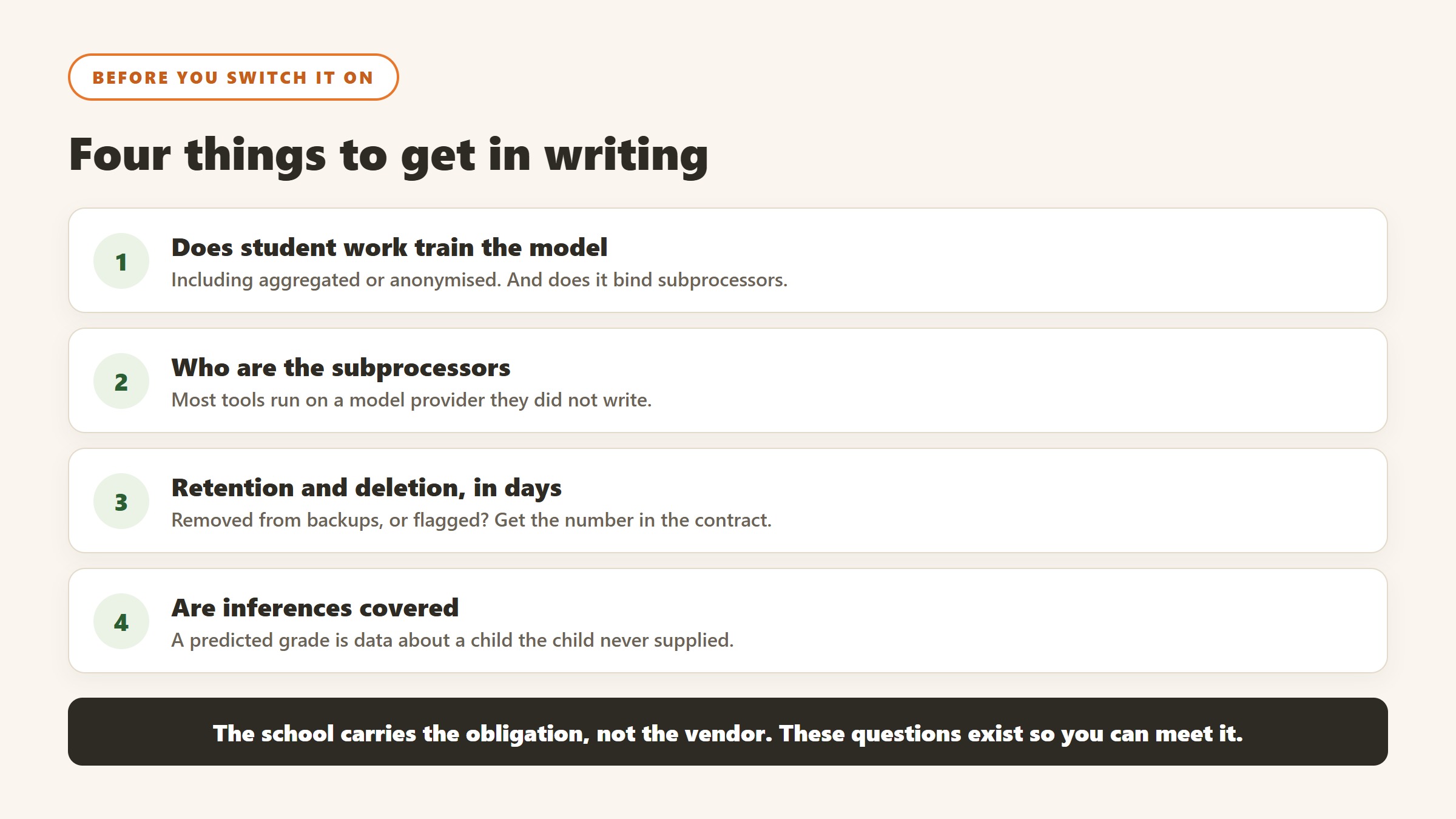
The practical failure mode is not vendors stealing data. It is a well-meaning teacher pasting an IEP paragraph or a class roster into a free consumer chatbot to save time. Your policy, your training, and your approved-tools list all exist to give that teacher a safe path to the same time savings.
Section 8: Academic integrity
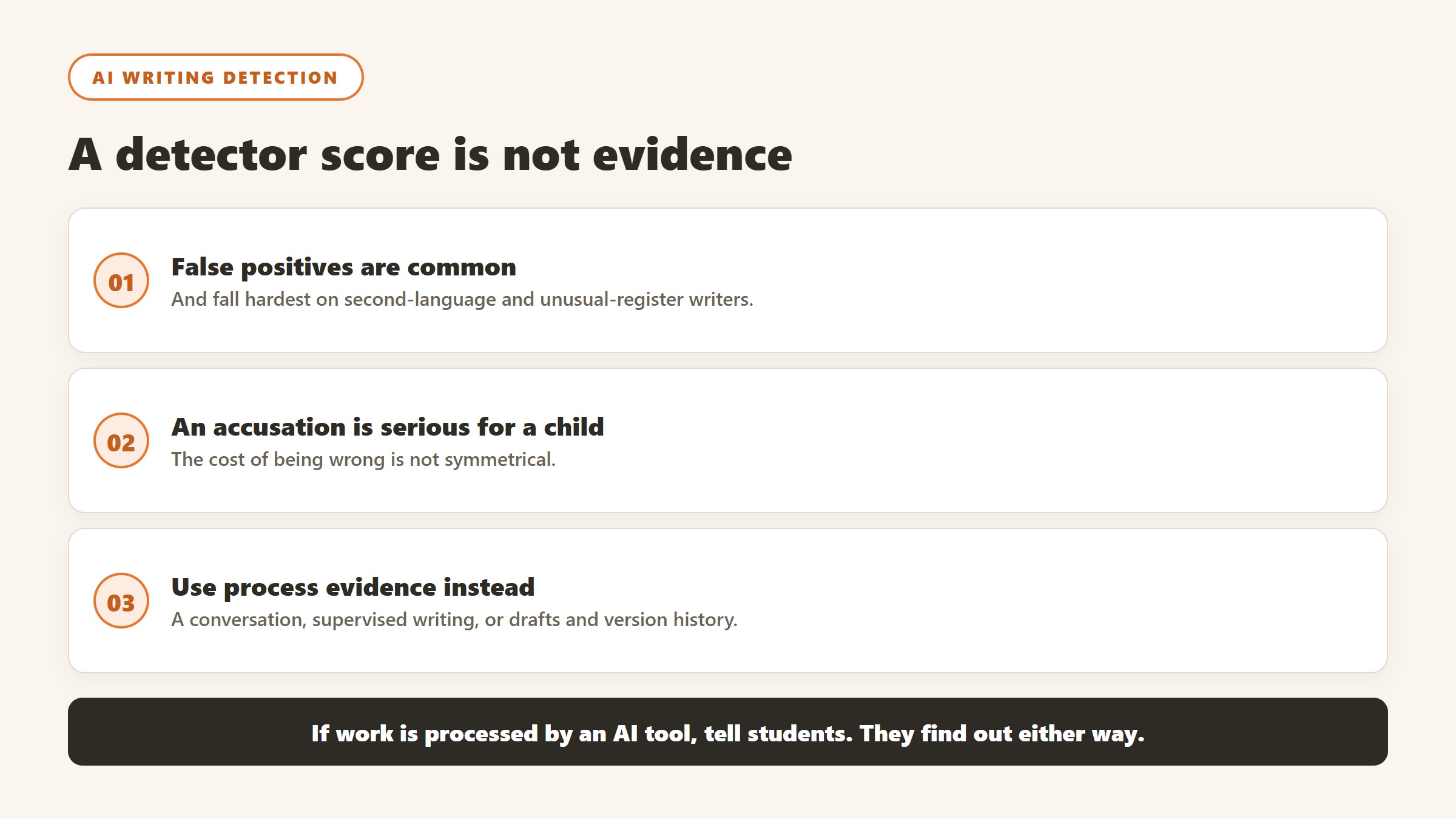
Resist the urge to write a detection-and-punishment section. AI detectors are unreliable, and policies built on them generate false accusations. Write a disclosure-and-design section instead.
> Teachers shall communicate, per assignment, whether and how AI tools may be used. Students must disclose AI assistance where the assignment requires it. Use of AI in violation of stated assignment expectations is an academic integrity violation handled under the district’s existing academic honesty policy. AI detection software alone shall not be the sole basis for an academic integrity finding.
That last sentence will save your administrators grief. If your students use AI study tools, and they do, our guide to AI tools for students is a realistic picture of what is on their laptops, integrity policy needs to assume ubiquity, not rarity.
Section 9: AI literacy and family engagement
Both mandate states touch these, and Ohio’s model policy names family engagement explicitly.
> The district shall provide age-appropriate AI literacy instruction for students and professional learning for staff on the capabilities, limitations, and responsible use of AI tools. The district shall inform families about how AI tools are used in instruction, maintain the approved tools list in a publicly accessible location, and provide resources regarding the potential risks associated with unsupervised student use of AI tools outside school.
Section 10: Review cycle and ownership
> This policy shall be reviewed at least annually by the superintendent or designee, with recommended revisions presented to the Board. The technology director shall maintain the approved AI tools list and report annually to the Board on AI tool usage, incidents, and vendor compliance.
An unowned policy is a dead policy. Name the role, not the person, and put the annual review on a calendar the day the board adopts it.
The compliance checklist
Print this, take it to your next cabinet meeting, and check honestly. These fourteen items map to what Ohio HB 96, Tennessee Public Chapter 550, and the major model policies actually require or strongly recommend.
Adoption and governance
- A board-adopted AI policy exists (not just administrative guidance).
- The policy was reviewed by legal counsel before adoption.
- A named role owns the policy and the annual review is calendared.
- The policy covers embedded AI features, not just standalone chatbots.
Data privacy and FERPA/PII
- An approved AI tools list exists and is published where staff and families can find it.
- Every approved tool has a signed data privacy agreement or contract covering FERPA and COPPA.
- The policy explicitly bans entering student PII into unapproved tools.
- Staff have received training on what counts as PII in the AI context.
Academic integrity
- Assignment-level AI expectations are required, not left implicit.
- Student disclosure requirements are defined by grade band.
- AI detector output alone cannot sustain an integrity finding.
AI literacy and family engagement
- Age-appropriate AI literacy instruction is planned or underway for students.
- Staff professional learning on AI is scheduled, not aspirational.
- Families have been notified about instructional AI use and given risk resources for home use.
Districts that clear all fourteen are compliant with the strictest current state requirements and, more importantly, are positioned for whatever their own legislature passes next session.
Where to start: the nine resources, honestly assessed
Every resource below is free to access. Here is what each is actually good for, and where each falls short.
Ohio DEW Model AI Policy. The strongest state model because it was drafted to satisfy a legal mandate, so it is complete: academic use, PII and FERPA compliance, family engagement, risk disclosure. Ohio districts should start here, full stop, and out-of-state districts can borrow freely. Limitation: it is written against Ohio statute, so non-Ohio districts need to swap the legal references.
TSBA Model Policy 4.214. The best expression of the approved-tools enforcement model, and battle-tested: most Tennessee districts adopted it in full after Public Chapter 550, and it has now operated through two school years. Remember the attribution: this is a Tennessee School Boards Association model policy, not a TN Department of Education document. Limitation: it is lean on AI literacy and instructional guidance, so pair it with a toolkit.
TeachAI AI Guidance for Schools Toolkit. Built by a steering committee including Code.org, ETS, ISTE, Khan Academy, and the World Economic Forum, with seven principles (purpose, compliance, knowledge, balance, integrity, agency, evaluation), sample guidance language, and real district examples. The best single resource for a committee starting from zero. Limitation: it is a toolkit, not a ready-to-adopt policy, and committees can disappear into it for months if nobody timeboxes.
Banyan AI Acceptable Use Policy template. Our favorite of the vendor templates. It is annotated section by section, explaining what each clause protects, and it covers permitted uses, prohibited uses, tool approval, data privacy, and incident response with grade-banded student expectations. The prohibited-uses language in our framework above owes a debt to its structure. Limitation: it is scoped as an AUP update, so board-level governance sections are thinner.
NEA Sample School Board Policy on AI. Useful precisely because it carries educator-association framing: strong on human judgment, educator agency, and professional learning. If your teachers’ association will be at the table, and it should be, starting from NEA language shortens that conversation. Limitation: lighter on the operational mechanics of vendor review.
Mississippi AI Network K-12 template. Different animal: less a policy text, more a governance and planning framework that helps committees separate policy questions from procedure questions across instructional, legal, privacy, accessibility, and community contexts. Excellent for structuring the committee’s work. Limitation: by its own description it is a planning resource, not a final document, so you still need drafting muscle from one of the others.
WeAreTeachers AI policy template. The most classroom-practical of the set, aimed at building and classroom-level policies with editable language teachers can act on tomorrow. Good for translating a board policy into what it means in Room 214. Limitation: it is not built for board adoption and lacks the legal scaffolding a district-level policy needs.
Vermont AOE AI guidance. Fifty pages, published January 27, 2026, and the best available treatment of developmental appropriateness with its PreK-2 through 9-12 grade bands, plus a human-centered framing that keeps educator judgment primary. Limitation: it is guidance, not a policy, so it tells you what good looks like without giving you adoptable clause language.
AI for Education state tracker. Not a template at all, but the reference you check first and last: a maintained map of every state’s AI guidance and requirements. Limitation: it summarizes, so always click through to your state’s primary documents before drafting.
How to run the adoption process
The framework and templates get you a draft. Here is the process that gets a draft adopted, based on what worked in the districts that hit Ohio’s deadline comfortably.
- Form a small committee with a deadline. Six to eight people: an administrator who owns it, the technology director, two teachers, a special education representative, a board member, a parent, and where age-appropriate a student. Give them 60 to 90 days, not a school year.
- Inventory current AI use first. Survey staff anonymously about which tools they already use. The answers will surprise you, and the policy must govern reality, not the stack you think you have. Tools like MagicSchool frequently show up in these surveys long before any district account exists.
- Draft from a model, not from a blank page. Start with your state model if one exists, otherwise the framework above. Adapt; do not originate.
- Send the draft to counsel and your insurance carrier. Counsel for statutory alignment, the carrier because AI incidents increasingly touch cyber and liability coverage.
- Run a comment window. Two weeks for staff and families. You will catch at least one unworkable clause, usually in the student use section.
- Adopt, then operationalize within 30 days. Publish the approved tools list, schedule the staff training, send the family notification, and calendar the annual review. Adoption without operationalization is how districts end up technically compliant and practically exposed.
Our verdict
Write the policy now, whether or not your state makes you. Ohio’s July 1, 2026 deadline was the starting gun, not an outlier: Tennessee already requires policies under Public Chapter 550, half the states have guidance, and legislatures copy each other. Ohio districts should adopt the DEW model immediately if they have not, Tennessee districts should confirm they are on TSBA 4.214 or a reviewed local variant, and everyone else should combine the TeachAI toolkit for process, Banyan’s template for clause language, and Vermont’s grade bands for developmental sanity. Use the ten-section framework above as your skeleton, clear the fourteen-item checklist, and get it on a board agenda within the quarter. The districts in the best shape today are not the ones with the most elegant policy. They are the ones whose policy is adopted, published, trained, and owned.

Written by
FazFaz is the founder of AIToolsBakery. Some tools here are tested hands on. Others are assessed from vendor documentation and pricing verified on the live page, and every review says which one it is. Sponsors can buy a position in a guide. They cannot buy the score, the criticism, or silence about a better option.
How we test and how we make money →