Grantable pricing at a glance
| Plan | Monthly | Annual | Annual works out at | Nonprofit rate |
|---|---|---|---|---|
| Free | $0 | n/a | n/a | n/a |
| Starter | $50 | $500 | $42 a month | $25 a month |
| Pro | $150 | $1,500 | $125 a month | $75 a month |
| Agency Hub (add-on) | $300 | not stated | n/a | not stated |
Read from grantable.co/pricing on 28 August 2026, with the billing toggle checked in both states. The nonprofit rate applies to organisations under a $500K budget and runs for one year.
The unusual thing about how Grantable prices
Most tools in this category gate features. Grantable does not. Their own line is “pay for depth, not access”, and the plan table backs it up: every plan includes every capability, agents, writing, dashboard, scans and skills. There are also no per-seat fees.
What you are buying is capacity.
| Free | Starter | Pro | |
|---|---|---|---|
| AI capacity | 1x baseline | 20x Free | 60x Free, 3x Starter |
| Chat messages a day | 5 | 50 | 200 |
| File imports | up to 10 MB | unlimited | unlimited |
| Every capability included | yes | yes | yes |
| Per-seat fees | none | none | none |
That makes the decision simpler than usual. You are not comparing feature checklists, you are working out whether 5, 50 or 200 chat messages a day matches how you work. A team writing one grant at a time sits in Starter. A team running many at once is what Pro is described for.
The annual saving is exactly what they say it is
The toggle is labelled “Save 17%”. We checked it.
| Plan | 12 months at the monthly rate | Annual price | You save | That is |
|---|---|---|---|---|
| Starter | $600 | $500 | $100 | 16.7% |
| Pro | $1,800 | $1,500 | $300 | 16.7% |
16.7% against a claimed 17%, which is a rounding difference and nothing more. The per-month figures shown on the annual toggle, $42 and $125, are also consistent: $500 divided by twelve is $41.67 and $1,500 divided by twelve is exactly $125.
We check this on every pricing page we publish and it is genuinely rare for the claim and the arithmetic to line up this cleanly.
The nonprofit discount is the real headline
Organisations under a $500K annual budget pay half.
| Plan | Standard | Nonprofit | Saving over the year |
|---|---|---|---|
| Starter | $50/mo | $25/mo | $300 |
| Pro | $150/mo | $75/mo | $900 |
Two things to note. It is a straight 50% cut, not a token gesture. And it is stated as for one year, so it is an introductory rate rather than a permanent tier. What happens in year two is not stated on the pricing page, and it is the first question we would ask before committing.
At $25 a month, Starter is one of the cheapest serious grant-writing tools we have priced.
Agency Hub, an add-on rather than a plan
Grantable lists an Agency Hub add-on at $300 a month, marked Coming Soon. It works with any paid plan and is aimed at people managing multiple clients: multi-client dashboards, consolidated billing, cross-client reporting and shared asset libraries.
Because it is an add-on, an agency on Pro would be looking at $150 plus $300, so $450 a month, or $125 plus $300 on annual billing. Grantable does not state whether the add-on itself has an annual rate, and since it has not launched, treat that total as indicative.
Their comparison claim, labelled as theirs
Grantable’s pricing page argues it replaces a stack, naming Instrumentl, Foundation Directory and GrantStation for grant databases, Monday.com and ClickUp for grant management, and positioning itself as more grant-expert than ChatGPT, Claude and Gemini. It states that “most grant teams spend $200 to $500 a month on disconnected tools.”
That $200 to $500 figure is Grantable’s, not ours, and we have not verified it. For one data point of our own: Instrumentl, which Grantable names first, publishes plans from $299 a month, so the lower end of that range is plausible on a single tool alone.
Who each plan is for
Free is a real trial rather than a demo, since it includes every capability, but 5 chat messages a day and a 10 MB import cap make it a way to evaluate rather than a way to work.
Starter at $50, or $25 for a small nonprofit, is the plan most single grant writers will want. Unlimited file imports is the jump that matters, since the 10 MB cap is what bites first on Free.
Pro at $150, or $75 for a small nonprofit, is for teams with several grants open at once. The capacity is 3x Starter for 3x the price, so it is priced linearly rather than as a volume discount.
Agency Hub is not buyable yet.
What the price does not settle
Year two. The nonprofit rate is 50 per cent off and Grantable states it runs for one year. What you pay in year two is not published. For a small organisation the difference between $25 and $50 a month is $300 a year, so the renewal price decides whether this is affordable long term, not the introductory one.
What counts as capacity. Grantable prices in multiples of the free tier: Starter is 20x, Pro is 60x. The only concrete figure attached is chat messages a day, at 5, 50 and 200. What “20x the AI capacity” means for anything other than chat is not defined, so if your bottleneck is document scanning or agent runs rather than chat, the multiplier may not describe your usage.
Whether the nonprofit rate survives renewal. Related to year two, and worth a direct question, since the eligibility test is an under $500K budget and budgets change.
Where Grantable sits in the nonprofit software budget
Grantable is grant writing rather than donor management, so it competes for budget with the CRM rather than replacing it. Seeing the whole picture helps when the software line is fixed.
| Vendor | Publishes a price? | Entry figure, verified 4 Sep 2026 | Meter |
|---|---|---|---|
| Little Green Light | Yes | $45/mo | Constituents |
| Salesforce Nonprofit Cloud | Yes | $70/user/mo (4 Oct 2026), 10 free | Seats |
| Neon CRM | Yes | $99/mo | Annual revenue |
| Bloomerang | Yes | $125/mo | Product |
| Keela | Yes | $164/mo | Contacts |
| Dataro | Yes | $15,000/yr + $0.10/donor | Platform + donors |
| Blackbaud | No | Quote form only | Quote |
| Virtuous | No | Quote, banded at $5M revenue | Quote |
| GoFundMe Pro (Classy) | No | Quote | Subscription + % of gifts |
What AI grant writing does and does not change
It compresses the first draft, not the thinking
The reliable saving is on assembling boilerplate: organisational history, programme descriptions, budget narrative, the sections that are substantially the same across applications. That is genuinely hours per submission and it is where the return lives.
It does not know your programme
The parts of an application that win, the theory of change, the specific outcomes, why this funder in particular, come from people who know the work. Software that drafts those convincingly produces text that reads well and says nothing, which experienced programme officers spot immediately.
Funder-specific tailoring is still manual
The highest-value edit in any application is matching language to a funder’s stated priorities. That requires reading their recent awards, which no tool does for you. Budget the time saved on drafting into doing more of this, or the saving simply disappears.
What every comparable vendor actually charges
A comparison table tells you the number. It does not tell you what the number is measured against, which is the part that decides your bill. Here is each of the main alternatives to Grantable, read from their own pricing pages on 4 September 2026, with the meter that matters.
Little Green Light, from $45 a month, metered on constituents
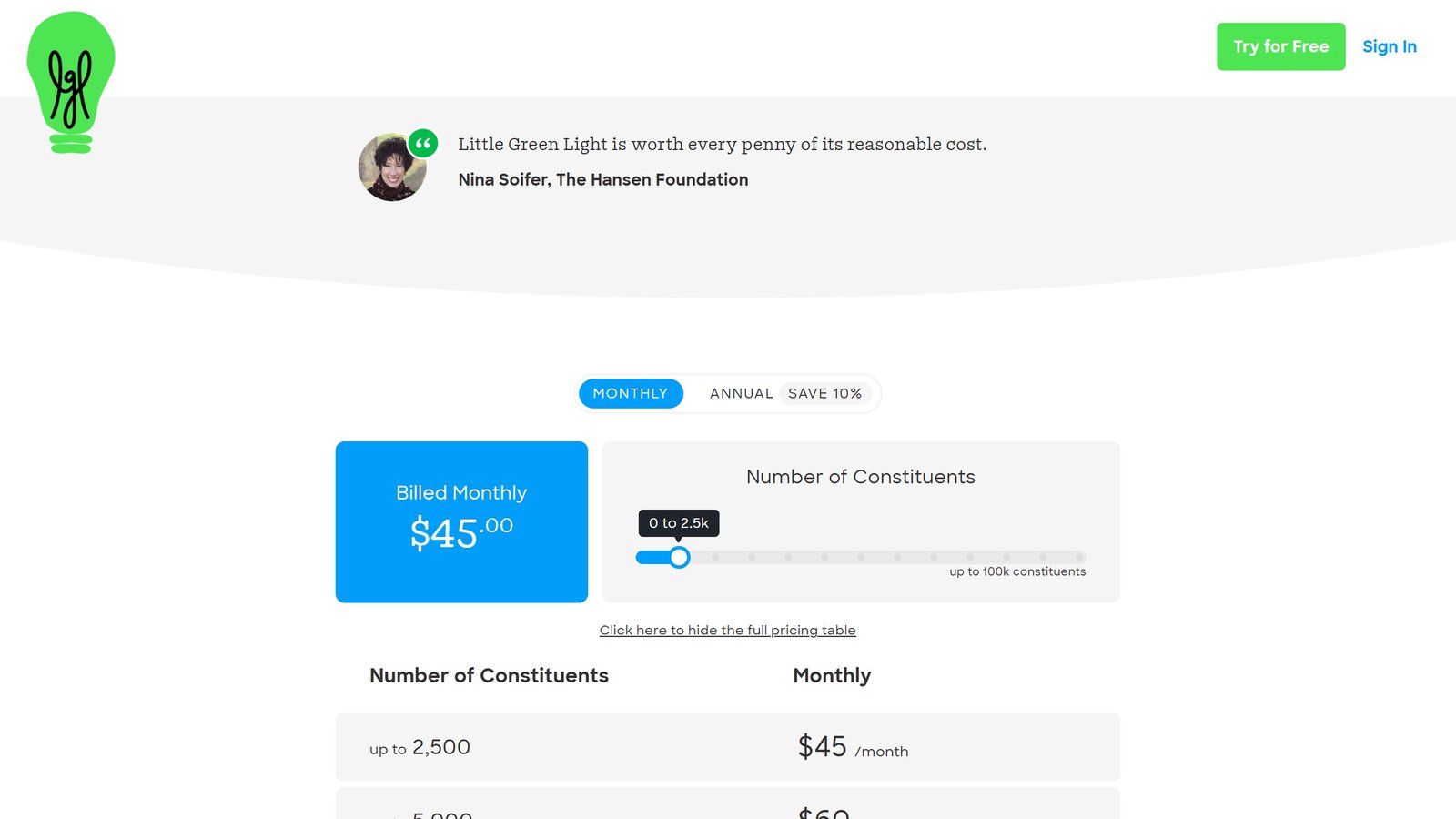
Little Green Light publishes every band openly and starts at $45 a month for up to 2,500 constituents. It takes nothing from your donations, which makes it one of the few platforms where online giving revenue is genuinely yours. The catch is structural: because the meter is constituent count, growing your list raises the bill even when the added records are lapsed donors or one-off event attendees who will never give again. Organisations on constituent-metered platforms end up pruning their database to control cost, which is a bad incentive for a fundraising team that should be keeping history.
Salesforce Nonprofit Cloud, $70 per user (as of 4 October 2026), with ten licences free
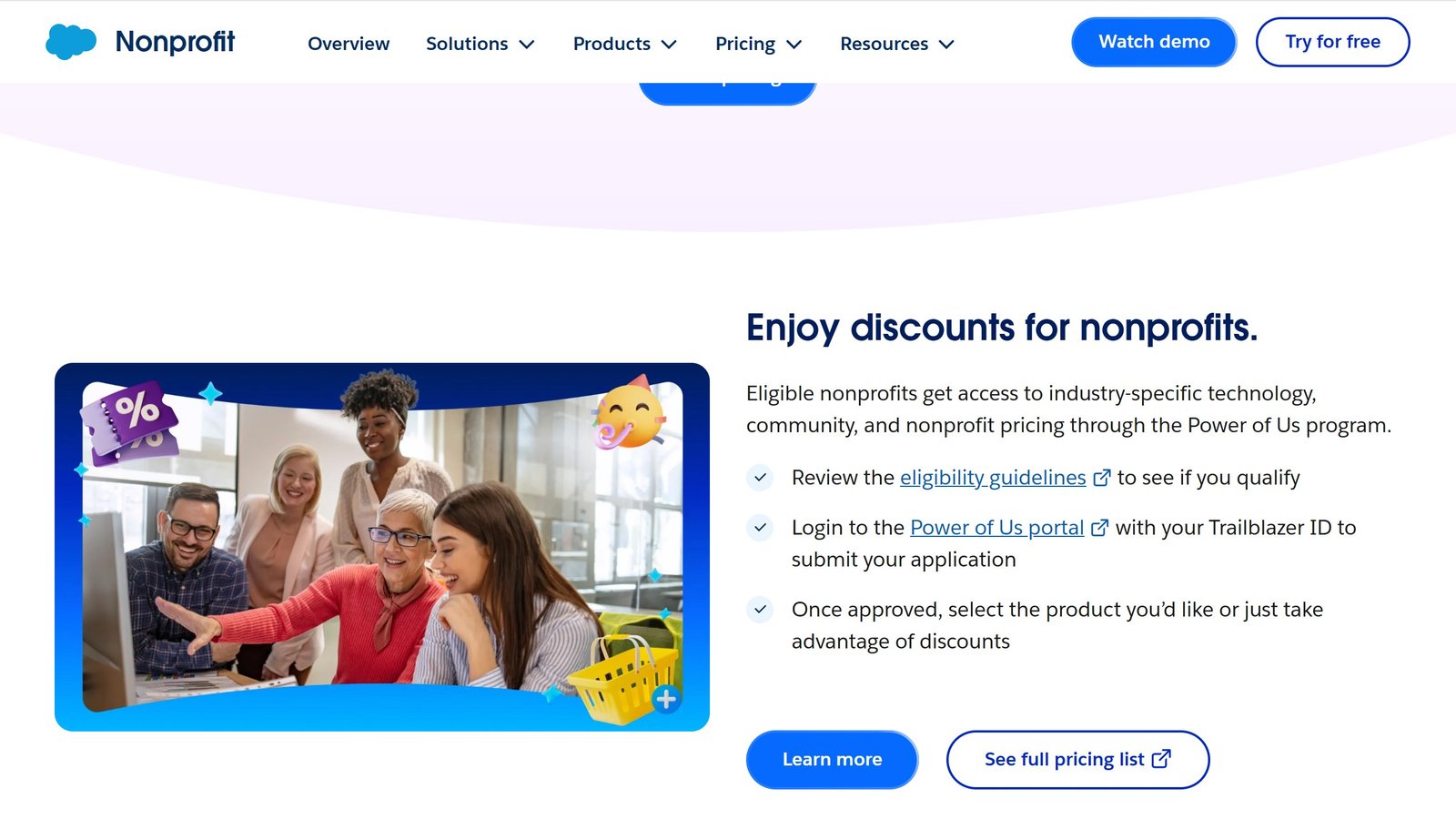
Salesforce is the odd one out and it is worth understanding why. Nonprofit Cloud Core is $70 per user per month (as of 4 October 2026) billed annually, but the Power of Us programme gives any eligible nonprofit ten licences at no cost. An organisation with ten or fewer people in the CRM pays nothing for the CRM itself, at any list size. The eleventh person costs $840 a year at the October 2026 rate. That inverts the usual advice: on Salesforce a database of two million costs the same as one of two thousand, and hiring is what raises the bill. The real cost is not the licence, it is that somebody has to own the configuration.
Neon CRM, from $99 a month, metered on your fundraising revenue
Neon starts at $99 a month with unlimited users and unlimited records, priced on annual fundraising revenue rather than seats or contacts. Modules are added as a percentage of the subscription: memberships at 10%, events at 20%, volunteers at 10%. Worth knowing that Neon retired its old Essentials, Impact and Empower tier structure entirely, so any article still quoting $209 or $409 tiers is describing packaging that no longer exists.
Bloomerang, from $125 a month, metered by product
Bloomerang publishes $125 a month for the CRM, with Fundraising from $40 and Volunteer from $119 as separate products. It moved away from record-tier pricing, so comparisons written against its old banding are stale. The practical effect of product-based pricing is that a quote assembled from three Bloomerang products is not comparable to a single all-in figure from a competitor without itemising first.
Keela, from $164 a month, metered on contacts
Keela bands by contact count starting at $164 a month for up to 1,000 contacts. It raised every band between late August and early September 2026, entry moving from $134 to $164, a rise of roughly 15 to 22% across the range in under two weeks. That is a useful reminder that a published price is a snapshot: check the date on any figure you are comparing, including ours.
Dataro, from $15,000 a year plus $0.10 per active donor
Dataro is a different category, predictive donor intelligence rather than a CRM, and its pricing shows it: Essentials from $15,000 a year plus ten cents per active donor, Growth from $25,000 plus twelve cents. Its pricing page is not linked from its own navigation and is only discoverable through the sitemap. Included here because it is the honest top of the nonprofit software market and a useful upper bound when someone tells you a quote is expensive.
The ones that publish nothing
Blackbaud runs a quote request form headed “Let us find a price that fits your organization” with no figures at all. Virtuous publishes no price and bands its tiers at $5 million in annual fundraising revenue, so it segments you by what you raise before quoting. GoFundMe Pro, formerly Classy, publishes only that its model is an annual subscription plus a transaction fee per donation.
Why nonprofit software pricing works the way it does
Understanding the mechanics makes a quote easier to read and much easier to challenge.
Revenue banding is means testing
Several vendors band by annual fundraising revenue, and Virtuous splits its tiers at $5 million. That is means testing: the same software costs more if you raise more, on the reasoning that a larger organisation gets more value from it. It is defensible, and it also means your public filings are doing the negotiating before you arrive. Know your own figures before the call.
Why a quote form asks for an EIN
An EIN lets a vendor look up your filed revenue before quoting. If a pricing page asks for one before showing anything, assume the number you are offered has been sized against your accounts rather than drawn from a rate card.
Transaction fees are the line that scales fastest
Where a platform takes a percentage of donations, that line grows with your success and usually overtakes the subscription. On $500,000 raised online, a single percentage point is $5,000 a year, more than the entire annual cost of several CRMs. Most nonprofit CRMs take nothing from donations, so a percentage model needs a specific justification.
Published prices are snapshots, including ours
Keela raised every band by 15 to 22% in under two weeks. Neon retired an entire tier structure. Artisan removed its figures altogether. Any pricing article without a verification date is describing a market that may no longer exist, which is why every figure here carries one.
What this costs at three real organisation sizes
Headline monthly figures are close to useless for budgeting because each vendor meters on something different. Here is the same three organisations priced across the platforms that publish, using our arithmetic on their own rates.
| Platform | Small: 4 staff, 1,500 contacts, $150k raised | Mid: 12 staff, 8,000 contacts, $900k raised | Large: 30 staff, 40,000 contacts, $4m raised |
|---|---|---|---|
| Little Green Light | $540/yr | Higher band, constituent-priced | Highest band |
| Salesforce Nonprofit Cloud | $0, under 10 seats | $1,680/yr, 2 paid seats | $16,800/yr, 20 paid seats |
| Neon CRM | From $1,188/yr | Higher revenue band | Higher revenue band |
| Bloomerang | From $1,500/yr | Plus products taken | Plus products taken |
| Keela | From $1,968/yr | Higher contact band | Highest contact band |
The small organisation result is the surprising one
At four staff, Salesforce is free and Keela is nearly $2,000 a year, because one meters on seats you do not have and the other on contacts you do. That is a genuine four-figure difference driven entirely by pricing structure rather than product quality, and it is invisible if you compare monthly headline figures.
At thirty staff the ranking inverts
The same seat-based pricing that made Salesforce free at four people makes it $16,800 a year at thirty, while a constituent-metered platform may still be cheaper if the list has not grown proportionally. Whichever of your two numbers, people or records, is growing faster is the one that should pick your pricing model.
How we checked this
We read Grantable’s own pricing page in a browser on 28 August 2026, reached from grantable.co’s navigation rather than a guessed URL, and switched the billing toggle to both Monthly and Annual before recording anything. The annual figures do not appear on the page until that toggle is switched.
This is a pricing page, not a hands-on review. Nothing here is scored and we make no claim to have used the product. Figures attributed to Grantable’s own marketing are labelled as such.
Prices change. If a figure here no longer matches Grantable’s pricing page, tell us and we will correct it.
Related: our full Grantable review, Grantable vs Instrumentl, how to use AI for grant writing and the best AI grant writing tools.

Written by
FazFaz is the founder of AIToolsBakery. Some tools here are tested hands on. Others are assessed from vendor documentation and pricing verified on the live page, and every review says which one it is. Sponsors can buy a position in a guide. They cannot buy the score, the criticism, or silence about a better option.
How we test and how we make money →