College Board makes the SAT, and it gives away full-length adaptive practice tests, an official question bank and a complete prep course built with Khan Academy. Every paid tool on this page competes with that, so the useful question is not which SAT app is best, but what a paid app adds to free official practice, and whether that addition is worth the money for your student.
This guide compares 10 options on price, free access, full-length tests and score guarantees, then shows which fits which student.
Last updated 3 November 2026. Prices and terms come from each company’s own website, in US dollars as served to us. We used Study Scout hands-on, with access offered by the company. The others are assessed from published information, and we make no claim about any tool’s effect on scores. No company paid for a place on this page.
The 10 SAT prep tools at a glance
| Tool | Best for | Free option | Paid price | Full-length tests | Score guarantee |
|---|---|---|---|---|---|
| Bluebook and Khan Academy | Everyone, first | Entirely free | None | Official and adaptive | No |
| Acely | Volume and a guarantee | Limited account, no card | $588/yr, $297/qtr, $149/mo | 30 for the SAT | Yes, conditional |
| LearnQ | Best value | Free plan and diagnostic | $200/yr, $100/qtr, $50/mo | Up to 15, by plan | Yes, conditional |
| Crimsora | Learning by talking | First unit, 15 minutes live | $29/mo founding, $49 regular | 15 mocks listed | None listed |
| Knowt | Free flashcards | Generous free tier | $95.99/yr or $24.99/mo | Mocks on paid plan | None listed |
| Fiveable | AP students | Some study material | $79/yr or $29/mo | None listed for SAT | None listed |
| UWorld | Detailed explanations | 7-day trial | From $59, $99 or $299, by product | 1 predictive, up to 9 adaptive | None listed |
| Schoolhouse.world | Free live tutoring | Entirely free | None | Official tests in sessions | No |
| The Princeton Review | A professional tutor | None | $7,560 for 18 hours | 9 | Yes, conditional |
| Study Scout | Repeated mistakes | 10 days, no card | $50/mo or $100 for 3 months | Uses Bluebook | No |
Which SAT prep tool should you use?
| If you want | Use |
|---|---|
| Real adaptive tests at no cost | Bluebook |
| Free lessons tied to the official test | Khan Academy |
| Free live help from a person | Schoolhouse.world |
| Structured practice at the lowest risk | LearnQ |
| As many questions as possible, with a guarantee | Acely |
| Concepts explained out loud | Crimsora |
| Thorough written explanations | UWorld |
| Help breaking repeated mistakes | Study Scout |
| One subscription for AP and SAT | Fiveable |
| A professional, whatever the cost | The Princeton Review |
1. Bluebook and Khan Academy: free official practice
Price: Free | Free option: Everything
Best for: every student, before any money is spent.
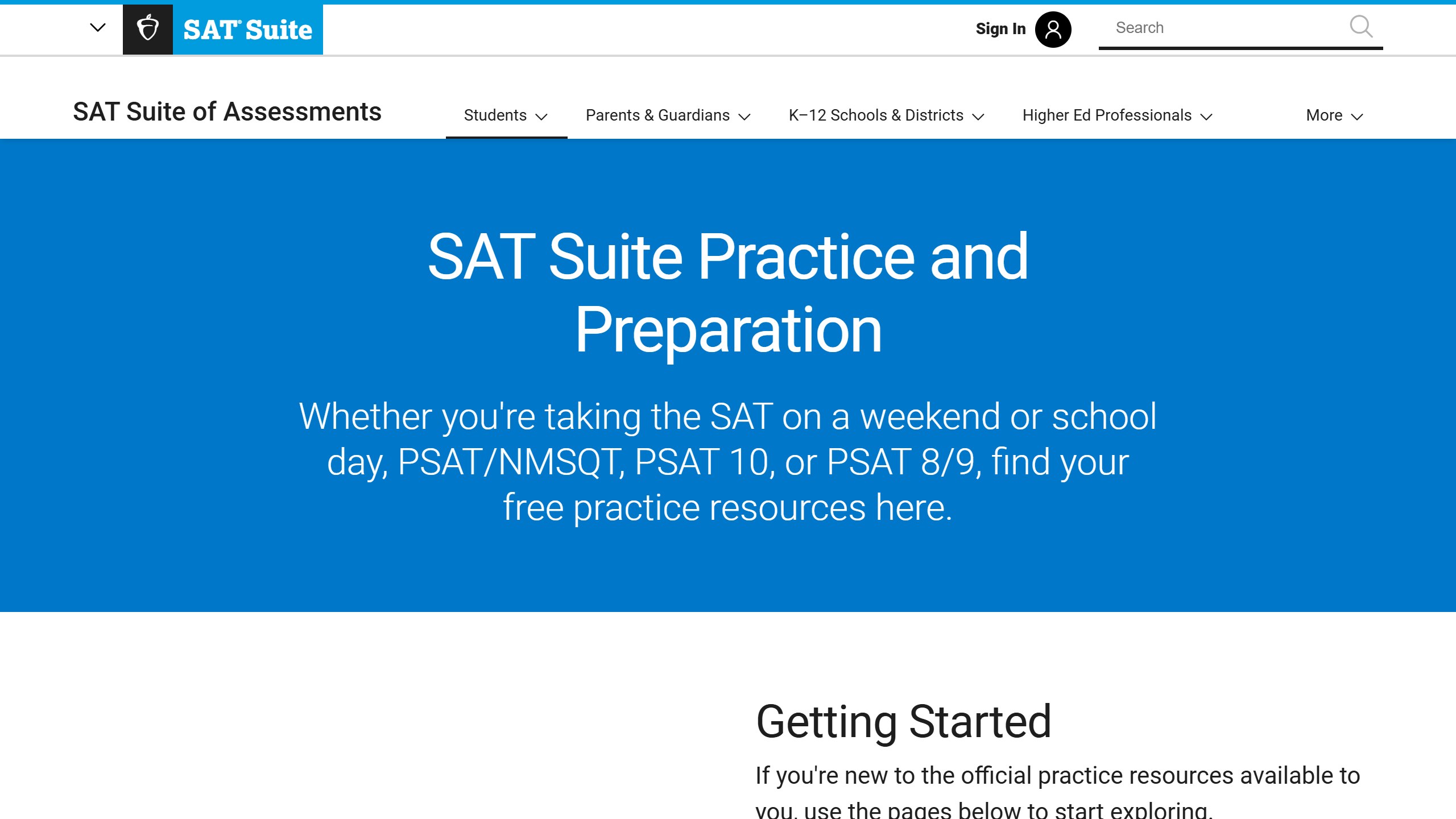
Bluebook is the app students sit the digital SAT in, and College Board publishes free full-length practice tests inside it. No other tool on this page can offer the real test application, which matters because the second module of each section changes with performance on the first. College Board’s own paper practice tests are nonadaptive and cannot reproduce that.
Official SAT Prep on Khan Academy supplies the teaching, with free lessons and quizzes built in partnership with College Board. The Student Question Bank adds thousands of real questions from the test’s makers, and Tailored Practice picks questions from your own results.
What it does well:
- Real adaptive tests in the real test application
- Official questions, which paid tools cannot offer
- A complete route from practice test to targeted review, at no cost
Where it falls short: none of it holds a student to a schedule. If the real problem is motivation, the content will not solve it, and a plan or a live group may be worth more than a better question bank.
2. Acely: the largest question bank, at the highest software price
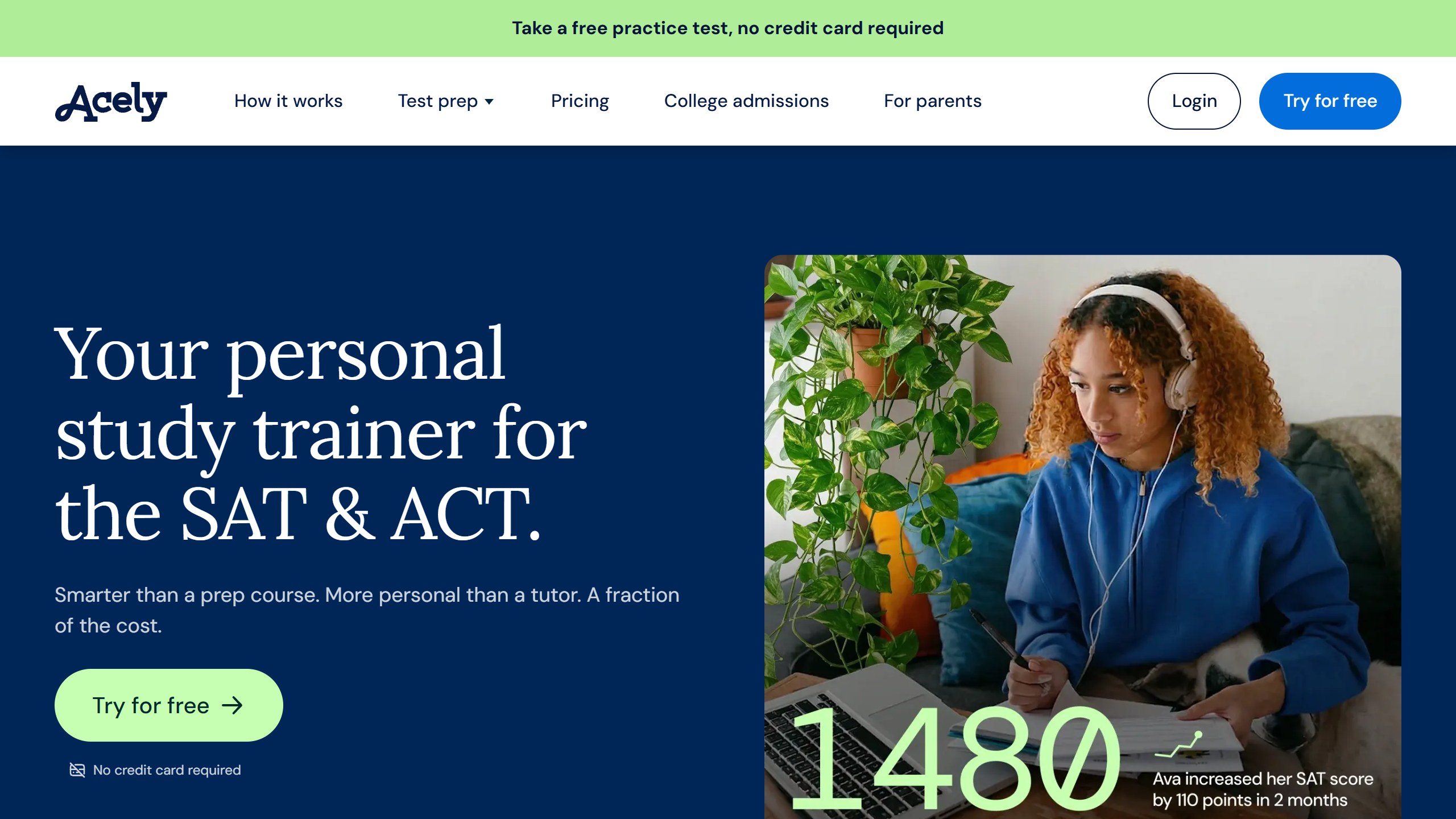
Price: $588 a year, $297 a quarter or $149 a month (pricing) | Free option: account with a 20-question assessment, one SAT and one ACT practice test, and 10 questions; 3-day trial of the rest with a card
Best for: committed students starting at 1250 or below who want volume and a guarantee.
Acely builds a study plan from a diagnostic or an uploaded score report and pairs it with an AI tutor. It lists 15,000+ questions and 50 full-length tests across its courses, 30 of them for the SAT, plus PSAT material. That is the largest published library on this page, and the ACT coverage suits students who have not chosen a test.
What it does well:
- The largest published question count here
- SAT, ACT and PSAT under one subscription
- A score guarantee with published terms (see the guarantee table below)
Where it falls short: at $297 a quarter it costs about three times LearnQ or Study Scout. The guarantee also excludes anyone already above 1250, and its practice requirements are demanding enough that a student who meets them has done the work that raises scores in any app.
3. LearnQ: the best value among dedicated SAT platforms
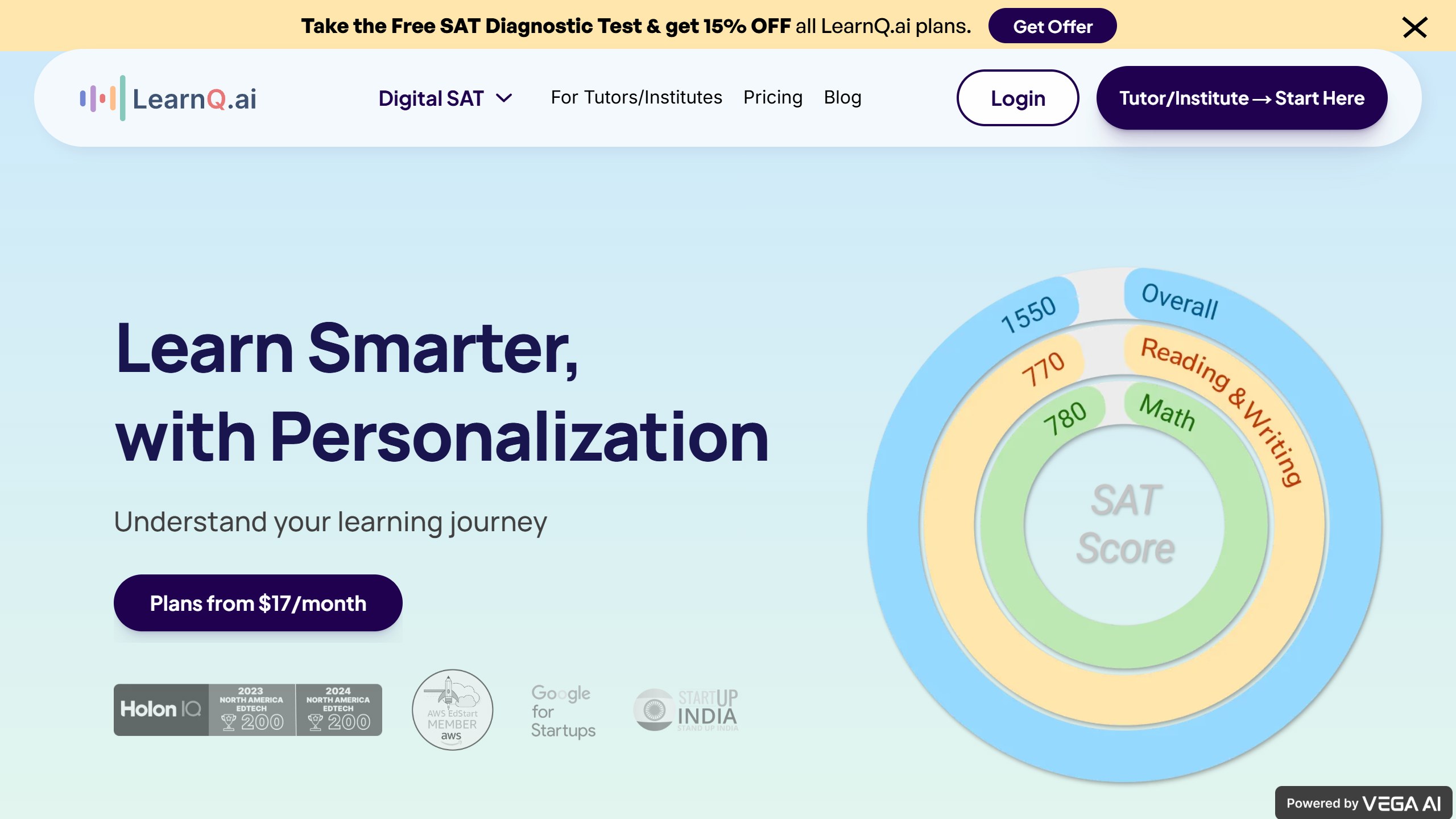
Price: $200 a year, $100 a quarter or $50 a month (pricing) | Free option: free plan with a diagnostic, study plan, projected score and analytics
Best for: most families who have outgrown the free tools and want structured adaptive practice.
LearnQ starts with a free diagnostic that projects a score and sets a study plan, then adds full-length tests, topic tests presented as short games, and an AI tutor called Mia. The plan shown on its pricing page lists 15 full-length tests and 1,200 tutor chats. A banner offers 15% off after the diagnostic, so check the price at checkout. Apps are available on iOS and Android.
The free diagnostic and study plan make it the lowest-risk paid option to assess, since you can see the plan before paying anything.
What it does well:
- A strong free plan to judge before paying
- Full-length tests and tutor chats at a third of Acely’s quarterly price
- A refund guarantee with short, readable terms
Where it falls short: its terms name three plans with 2, 7 or 15 full-length tests, so confirm what your plan includes. The guarantee measures against LearnQ’s own projection rather than a points gain, and the game format will not suit every student.
4. Crimsora: a voice tutor for students who learn by talking
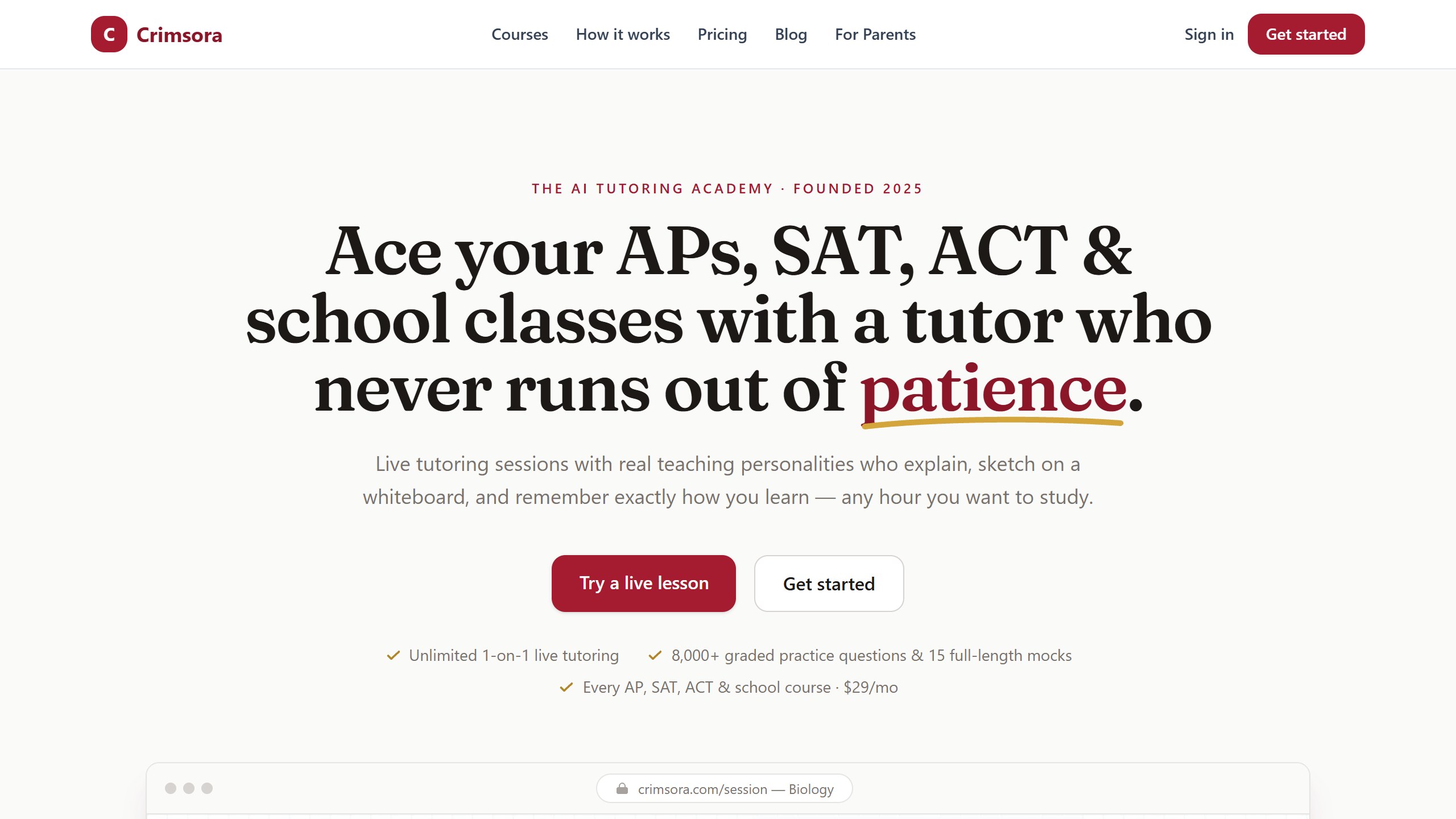
Price: $29 a month as a founding rate, $49 regular (pricing) | Free option: first unit of every course and 15 minutes of live tutoring, plus a demo lesson
Best for: students whose problem is understanding the material rather than getting enough practice.
Crimsora teaches through live voice sessions, with an AI tutor explaining aloud while working on a shared whiteboard. It covers the SAT and ACT alongside AP and school subjects, 29 courses in all, and lists 8,000+ graded practice questions and 15 full-length mocks. “Unlimited” tutoring has a published fair-use allowance of 30 hours a month, far more than SAT prep needs. Our AP exam prep guide covers its AP side.
What it does well:
- A different way in for students who bounce off written explanations
- One price for every course
- A clear free tier and a published fair-use limit
Where it falls short: it is built to teach concepts rather than train test-taking, and pacing an adaptive module is still best practised in Bluebook. Its tutors are AI personas with names and stated experience, which families should understand, and the company was founded in 2025.
5. Knowt: the free flashcard tier worth having
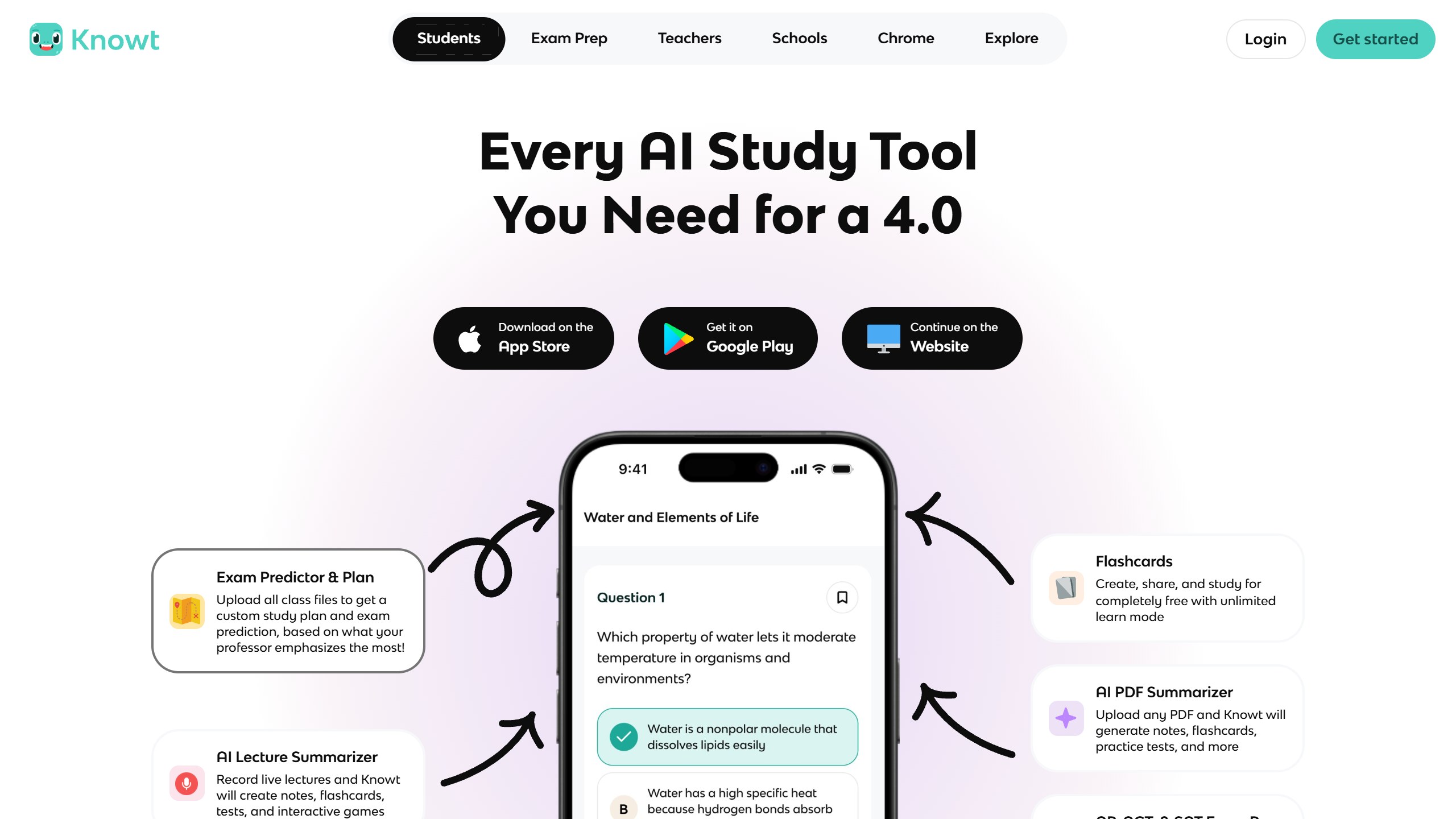
Price: $95.99 a year or $24.99 a month (plans) | Free option: unlimited notes and flashcards, live collaboration and 5 million resources
Best for: students who want free vocabulary and formula decks, or AI study tools for all their classes.
Knowt is a general study app first. The free tier is generous, and its library of student-made resources includes plenty of SAT decks. The Ultra plan adds SAT, ACT and AP prep with study plans, practice and mock exams, along with AI summaries of your own files and a voice tutor.
What it does well:
- The most useful free tier among the commercial tools here
- A low yearly price
- Study tools that keep their value after the SAT
Where it falls short: shared decks are written by students and can be wrong, and SAT prep is one feature in a broad product rather than its focus. Students preparing only for the SAT will get a more directed plan elsewhere.
6. Fiveable: sensible if you are also taking APs
Price: $79 a year or $29 a month (pricing) | Free option: some study material, with a diagnostic to start
Best for: juniors taking several AP courses and the SAT in the same year.
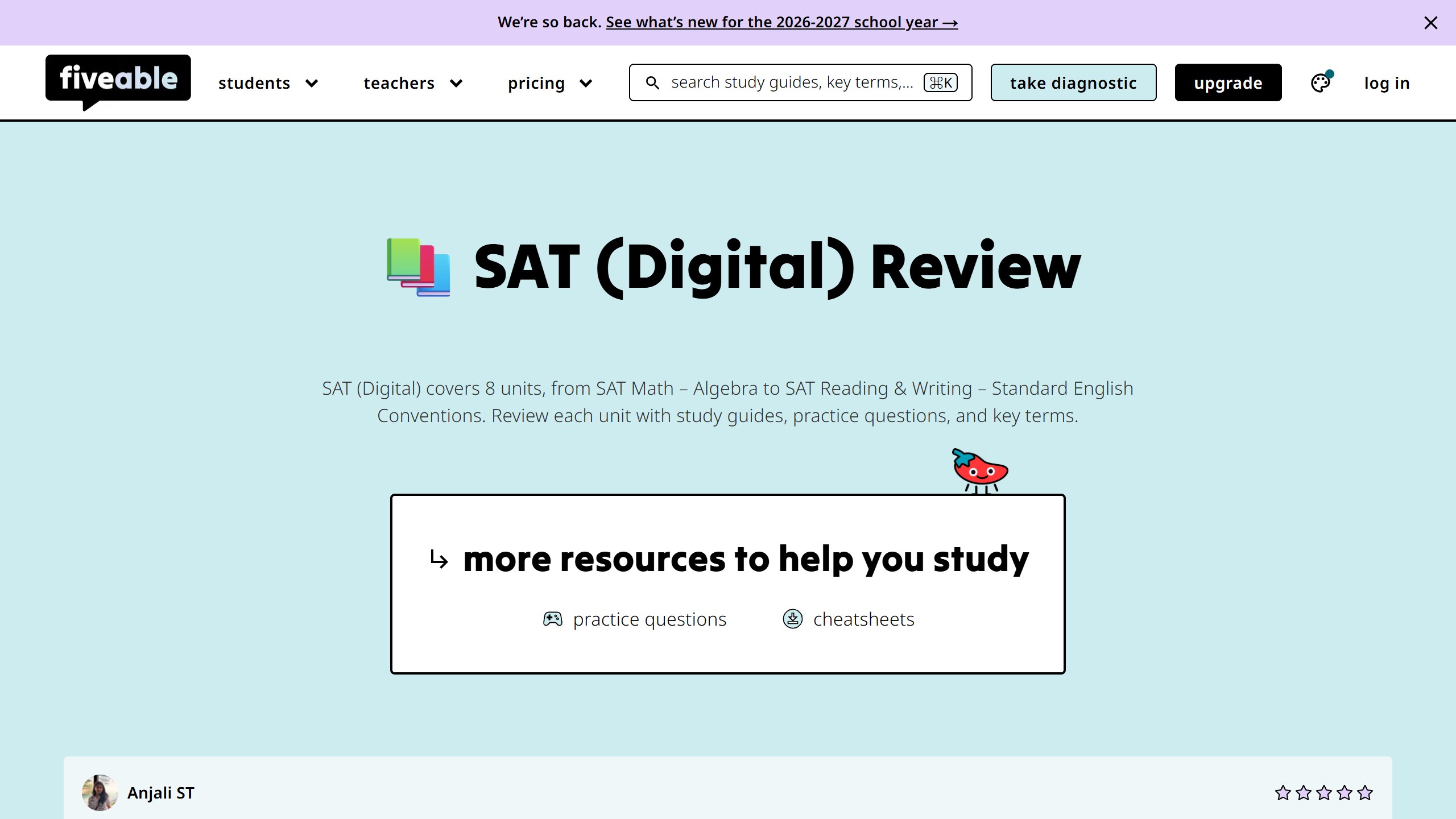
Fiveable is built around AP courses, and its digital SAT section adds eight units with study guides, practice questions and key terms. The Student Workspace covers every subject for one price, so an AP student effectively gets SAT review included. A $129 yearly plan adds printing and downloads.
What it does well:
- One subscription for AP and SAT
- A low yearly price
- Review content organised by SAT skill
Where it falls short: SAT is a smaller part of an AP product, and its pricing page does not list adaptive full-length SAT tests to match Bluebook. A student who only needs the SAT should look at a dedicated tool.
7. UWorld: detailed explanations, sold by product
Price: Study Guide from $59, Question Bank from $99, Prep Course from $299 | Free option: 7-day free trial
Best for: students who learn most from reading a thorough explanation of each question.
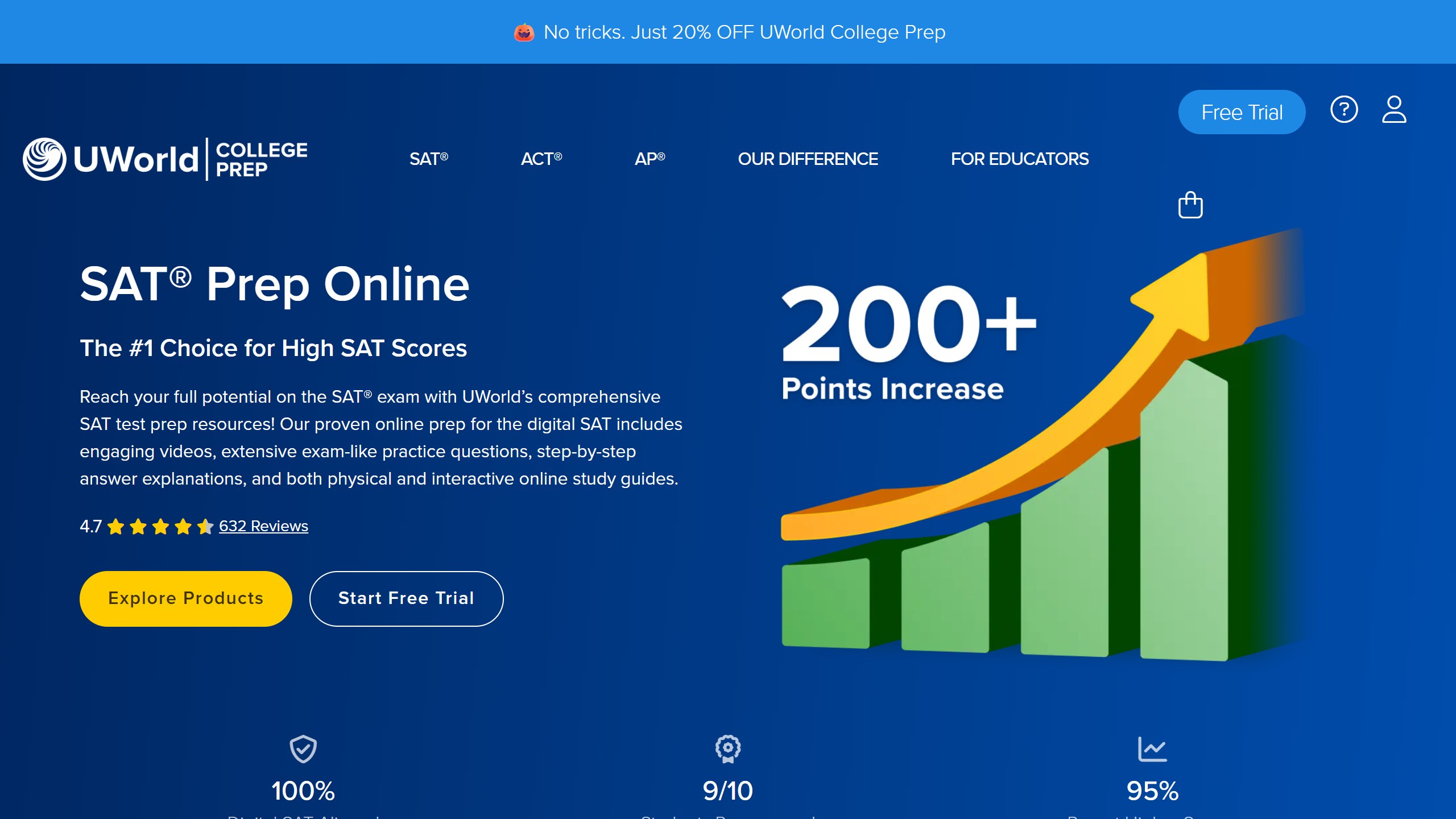
UWorld is best known for its explanations, and its SAT bank pairs 2,000+ questions with visual, step-by-step answers. Plans include a study planner, analytics and a mobile app. It lists a score-predicting full-length test plus up to 9 adaptive tests generated from the bank. Unlike the subscriptions here, it sells distinct products, so you can buy only what you need. A 20% off promotion was running when we read the page.
What it does well:
- Explanations are the core of the product
- A low entry price for a question bank
- A free week to judge the explanations
Where it falls short: prices are “starting at” figures, so check the access length at checkout. The bank is far smaller than Acely’s, and we found no score guarantee on its SAT page.
8. Schoolhouse.world: free live tutoring from peers
Price: Free | Free option: everything
Best for: students who need accountability and a person to ask, at no cost.
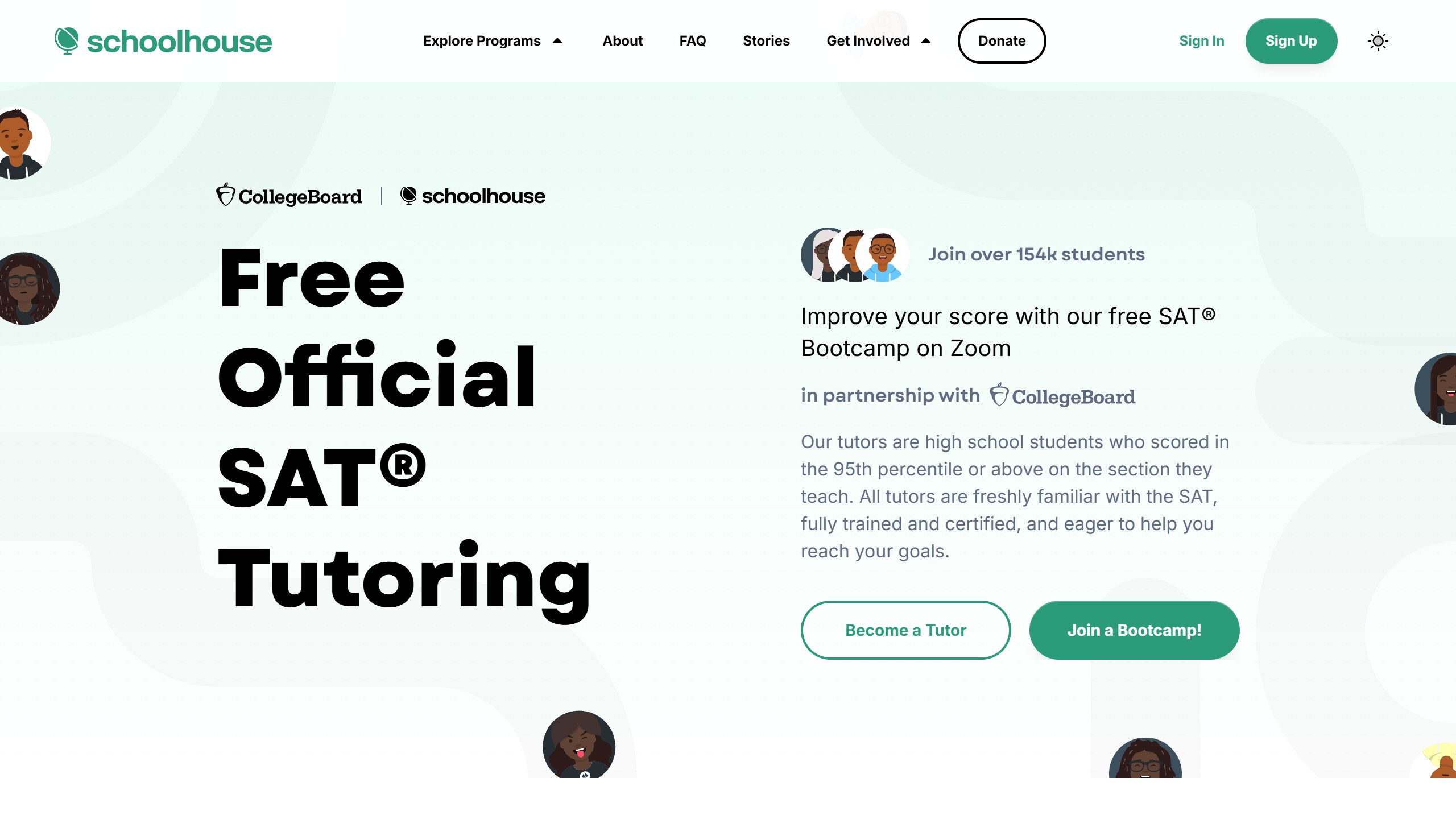
Schoolhouse.world runs free SAT bootcamps in partnership with College Board. Each runs for four weeks with two 75-minute sessions a week, a maximum of 10 learners, and official practice tests. Tutors are high school students who scored in the 95th percentile or above on the section they teach, and are trained and certified. Single 75-minute focus sessions are available too.
It solves what most software does not: a human expects you to turn up.
What it does well:
- Live human tutoring at no cost
- Backed by College Board
- New series starting every week
Where it falls short: sessions run to a schedule, tutors are peers rather than professionals, and spots fill quickly near test dates. Schoolhouse recommends enrolling at least four weeks ahead, or eight for both sections.
9. The Princeton Review: the price of a professional
Price: $7,560 for 18 hours of tutoring, or $420 an hour (SAT 1500+) | Free option: none for this package
Best for: families with the budget and a high target, who want a professional accountable for the result.
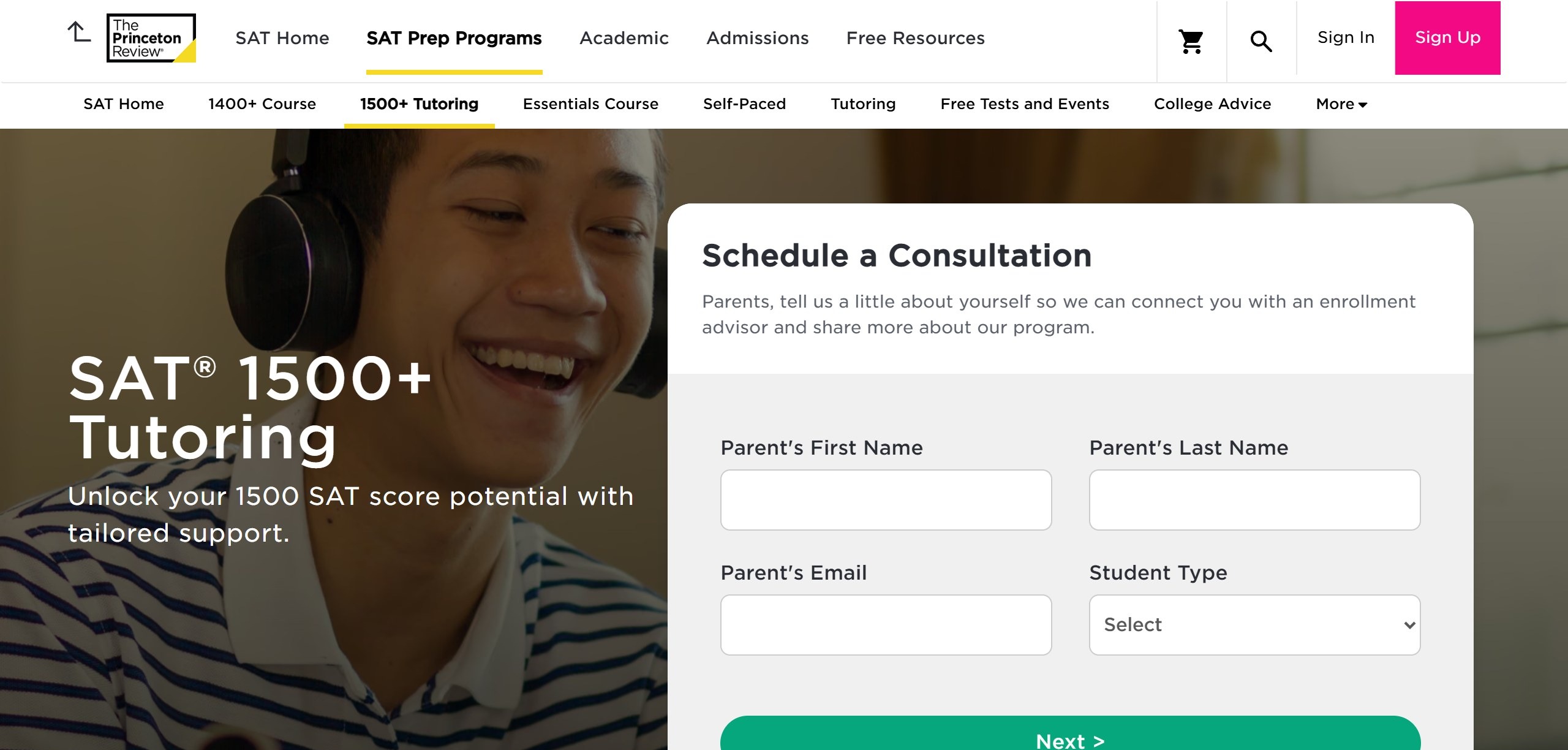
The SAT 1500+ package combines 18 hours of live online tutoring with 365 days of online materials, 9 full-length practice tests and thousands of drills. It is here mainly to give the software prices scale, and because a good tutor can diagnose problems that software still handles less well.
What it does well:
- A professional reading your specific mistakes
- A money-back guarantee tied to the score
- A complete package with materials included
Where it falls short: the cost is several times every other option here combined. The guarantee often refunds only part of the tuition, and most students should exhaust cheaper routes first.
10. Study Scout: coaching built around your mistakes
Price: $50 a month or $100 for three months (pricing) | Free option: 10 days of full access, no card
Best for: students who keep repeating the same kinds of mistakes and need someone to point them out.
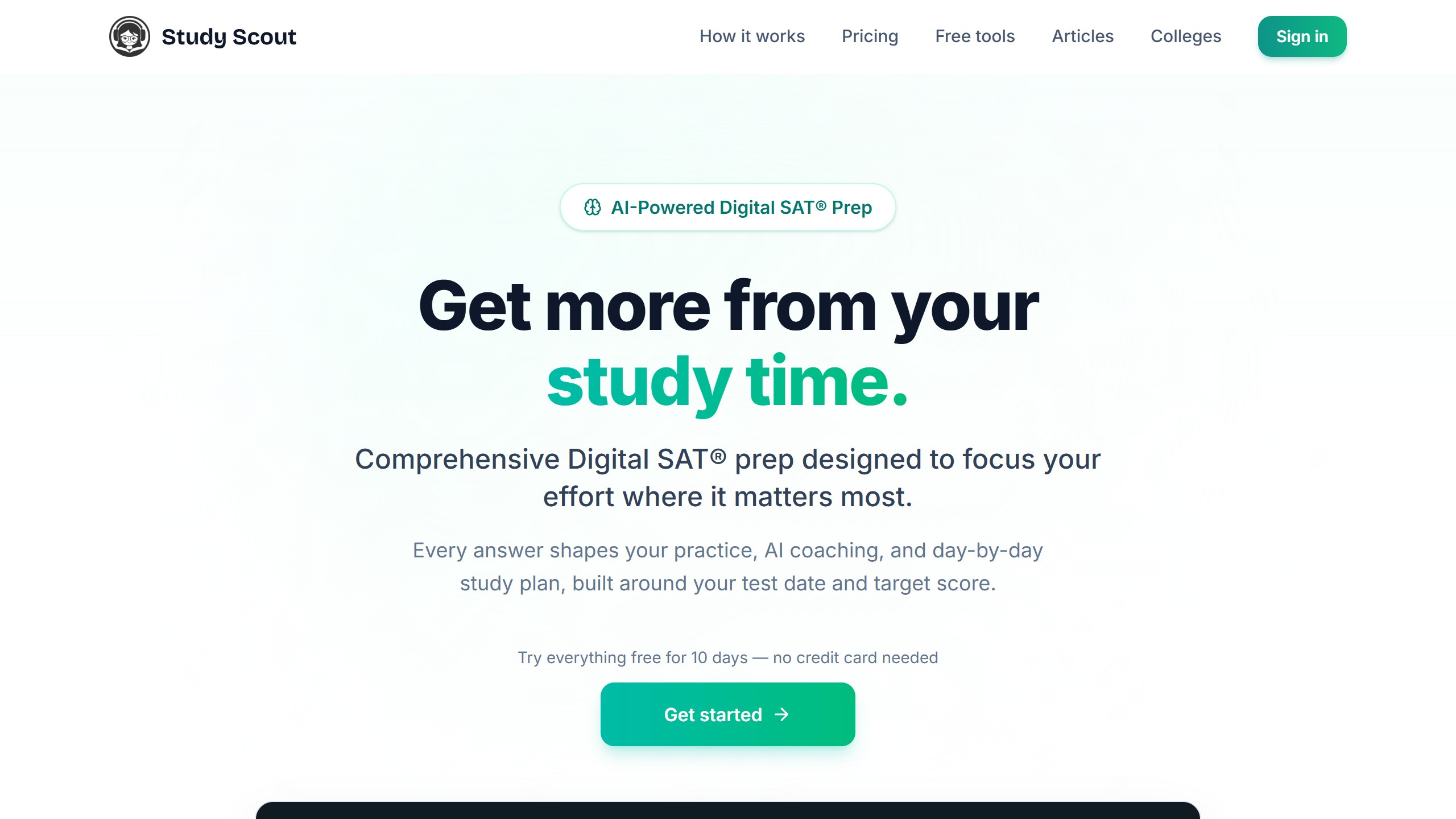
Study Scout covers only the Digital SAT, with a question bank, an AI tutor on every question, lessons, flashcards, quizzes and a study plan paced to your test date through Foundation, Focus and Final Review phases. It works alongside the official tools: its method asks students to take a monthly full-length test in Bluebook and add the score, and lessons link to Khan Academy. Both plans include everything, and at $100 for three months it matches LearnQ’s quarterly price.
Our hands-on findings
We worked through 13 questions in one session, 12 of them math, and missed most on purpose to see how the product responds. The answer keys we checked were correct, the wrong options reflect realistic errors, and formats include typed answers as well as multiple choice, with Desmos built in.
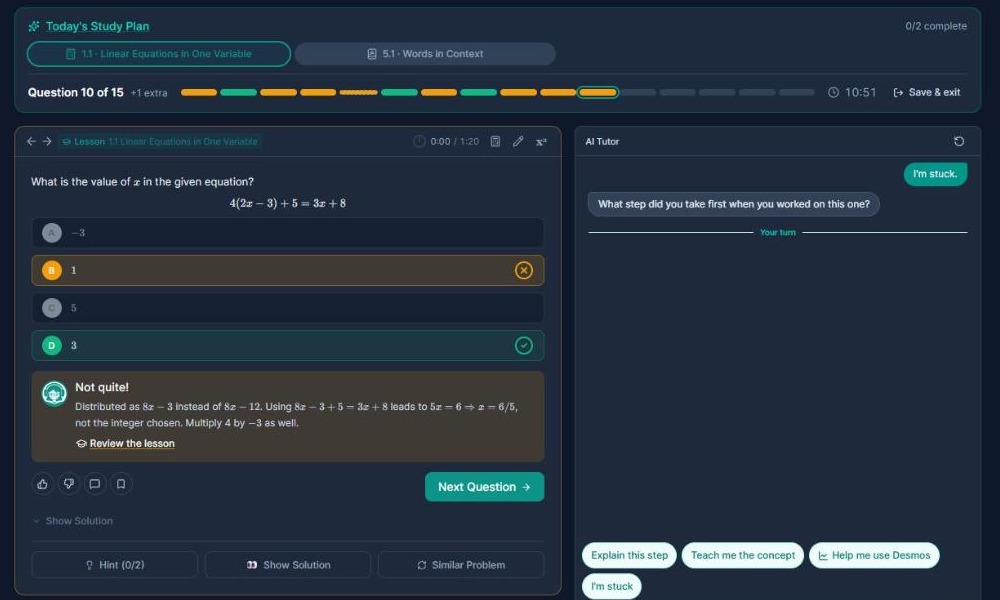
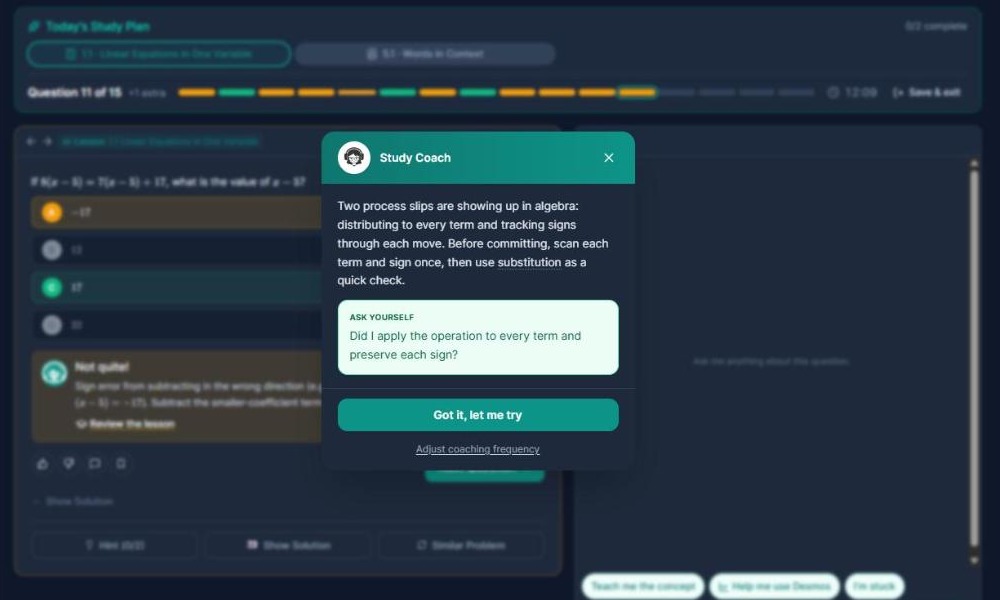
Feedback generally names the specific error rather than only giving the right answer. The tutor is firm about making students think, and it held to that when we asked it to simply give the answer. After repeated misses, a Study Coach prompt identified the pattern in our algebra errors, and a later prompt recommended reviewing the lesson before answering more questions.
What it does well:
- Specific feedback on wrong answers
- A tutor that guides rather than handing over answers
- Coaching that reacts to patterns in your mistakes
- A simple price with everything included
Where it falls short: one session cannot prove the long-term claims, and we did not assess the parent portal, spaced review, flashcards or quizzes, or enough Reading and Writing to judge it. Parts of the personalization lagged: the plan summary and Coach’s Notes had not caught up after 13 answers, and questions did not get visibly easier after a prompt said they would. We also saw one graph without axis numbers, answer options that shifted as the page settled, and feedback on one question that did not match the answer we chose. Reading passages use invented source lines, disclosed only in a hover note. There is no score guarantee, we found no published score results, and subscriptions renew until cancelled, including after the test.
What three months of prep actually costs
Yearly prices flatter tools that most students stop using after the test. Three months is a more realistic study window, and it changes the ranking.
| Tool | Cheapest way to cover 3 months | Cost |
|---|---|---|
| Bluebook, Khan Academy, Schoolhouse.world | Free | $0 |
| Knowt | 3 months at $24.99 | $74.97 |
| Fiveable | Yearly plan | $79 |
| Crimsora | 3 months at the $29 founding rate | $87 |
| UWorld | Question Bank, starting price | From $99 |
| LearnQ | Quarterly plan | $100 |
| Study Scout | 3-month plan | $100 |
| Acely | Quarterly plan | $297 |
| The Princeton Review | 18-hour package | $7,560 |
SAT score guarantees compared
Three options offer a guarantee, and each one measures something different. Read the conditions before treating any of them as insurance.
| Tool | What triggers a refund | What you must do |
|---|---|---|
| Acely | Your score does not rise by 200 SAT points or 5 ACT points | Start at 1250 or below, with an official score from the last three months; keep a 90-day subscription; complete 500 questions and 10 full-length tests; correct every mistake; retest within 60 days |
| LearnQ | Your real score falls below the projection from LearnQ’s diagnostic | Take the diagnostic; practise at least 30 minutes per topic; complete every full-length test in your plan |
| The Princeton Review | You miss 1500 and improve by under 180 points, based on your superscore; refunds are partial for superscores of 1380 and above | Complete the recommended coursework; published terms apply |
Acely’s guarantee asks for the most work, LearnQ’s depends on its own projection, and The Princeton Review’s refund shrinks as your score rises. The other seven options list no guarantee.
Why adaptive testing changes what you should buy
The digital SAT is section-adaptive. Students sit two modules per section, and performance on the first determines the difficulty of the second. That has three practical consequences.
Pacing matters more
Rushing the first module to bank time produces careless errors that route you to an easier second module, which limits your score. Practice without the two-module structure cannot teach this, which is why a Bluebook test should come before any paid product.
Percent correct says less
The number of questions answered correctly no longer maps cleanly to a score. Look for skill-level breakdowns, which both the official question bank and the better paid platforms provide.
Not every full-length test is adaptive
Static question banks remain useful for drilling a skill, but a fixed full-length test only imitates the format. When a tool advertises full-length tests, check whether they adapt.
What paid SAT software actually adds
Adaptivity across your whole plan. Bluebook adapts within a test. Paid platforms steer your study toward the question types you keep missing, and this is mostly what you are paying for.
Volume. A student practising daily for months can work through the official bank, and paid libraries add more. Acely publishes the largest count here.
Structure. A plan that says what to do today is worth more to many teenagers than better questions, though a calendar and a parent can do the same job for free.
A different explanation. Khan Academy’s lessons are good, but a student who bounces off them may respond to Crimsora’s voice tutor, UWorld’s visual explanations or Study Scout’s coaching.
What paid software does not add is official content. College Board’s Student Question Bank holds real questions from the test’s makers, and paid tools write their own.
A sensible order to spend in
- Take a full Bluebook practice test under real timing, to get a real starting score.
- Review every wrong answer and write down the skill behind each mistake rather than the question.
- Drill those skills in the Student Question Bank and on Khan Academy.
- Book Schoolhouse.world if you need a person to ask or a reason to turn up.
- Then buy only what fixes the remaining problem: LearnQ for structure and volume, Crimsora for comprehension, UWorld for explanations, Study Scout for repeated mistakes.
The same free-first approach works for other exams. Our guides to AI GRE prep tools and AI MCAT prep tools cover those. Taking the ACT instead? Our guide to AI ACT prep tools compares six options for the enhanced format. Thinking about the military instead of college? Our guide to AI ASVAB prep apps starts with the free official practice.
Verdict
Bluebook and Official SAT Prep on Khan Academy are the right place to start for every student, and they cost nothing. Nothing else on this page offers the real test application or official questions.
Among the paid options, LearnQ is our first recommendation: its free plan lets you judge it before paying, and $100 a quarter is hard to argue with. Acely earns its higher price only for students who will use the volume and qualify for the guarantee. Crimsora is the pick when the problem is understanding, UWorld when a student learns from detailed explanations, and Fiveable when APs are part of the same year. Study Scout gave specific, useful coaching in our hands-on session, and is worth its free 10 days if the same mistakes keep returning, though we found no published score results.
If the real obstacle is that nobody is holding the student to a schedule, no subscription fixes that. Schoolhouse.world is free, and a person is on the other end.
Sources
- College Board: SAT practice and preparation and Bluebook; Official SAT Prep on Khan Academy.
- Acely pricing and score improvement guarantee.
- LearnQ pricing and guarantee terms.
- Crimsora pricing, Knowt plans and Fiveable pricing.
- UWorld SAT prep and Schoolhouse.world SAT Bootcamp.
- The Princeton Review SAT 1500+ Tutoring.
- Study Scout pricing, how it works and our own session in the app.
All read on 3 November 2026.

Written by
FazFaz is the founder of AIToolsBakery. Some tools here are tested hands on. Others are assessed from vendor documentation and pricing verified on the live page, and every review says which one it is. Sponsors can buy a position in a guide. They cannot buy the score, the criticism, or silence about a better option.
How we test and how we make money →