
Every big MCAT prep company now sells an AI tutor. Blueprint has Blue, UWorld has UAsk, Kaplan and The Princeton Review each call theirs an AI Tutor, and Lecturio and King of the Curve build AI into their question banks. Search for the best AI MCAT prep and many of the results are the vendors themselves, plus small AI startups ranking their own product.
What those pages leave out is simple. None of these AI tutors writes or scores the real exam. The yardstick for your MCAT score is still the Association of American Medical Colleges (AAMC), which writes the test, sells the official practice exams for $35 each, and says on its own site that it is “exploring” how AI may support the MCAT program. The AI tools sit on top of that. This guide compares six AI MCAT prep tools on what their AI actually does, what they cost on 22 October 2026, and what their score claims really measure.
How we put this together. We have not used these apps ourselves; this is a research-based comparison. Every price, rating and feature below comes from the vendor’s own website, the AAMC’s website, or the app’s US App Store and Google Play listing, read on 22 October 2026, and each source is linked. Some vendor sites blocked automated reading, so we read them in a normal browser from Mumbai; where a vendor showed us prices in Indian rupees we say so and do not convert. Score improvement figures are the vendors’ own claims, and we quote the fine print that goes with them. None of these companies paid to appear on this page.
Why the AAMC is the benchmark, not the AI
The MCAT is written and run by the AAMC, and so are the official practice exams, built from past MCAT questions. That shapes how to think about every AI tool on this list.
The official practice exams cost less than a month of most AI tutors
On its free resources page, the AAMC offers Practice Exam One free, with a scaled score and percentile rank, plus a free Unscored Sample Test of the same length and format. Its product comparison page lists Practice Exams 2 to 6 at $35 each, 230 questions apiece, with one year of access. Section Banks cost $45 each for 300 questions, the new CARS Question Bank is $70 for 575 passage-based questions, and subject question packs are $15 each. The Online-Only Bundle was listed at $336.15 in the store on 22 October 2026, against a regular price of $405.00, though the comparison table showed $336.70. If you qualify for the AAMC Fee Assistance Program, its benefits include discounted fees and free MCAT Official Prep products.
The free tier is broader than many students realise. The same page lists a Content Outline Course with 120 practice questions, and the Khan Academy MCAT collection of about 1,100 videos and 3,000 review questions, built with AAMC and Robert Wood Johnson Foundation support. None of these AAMC prep pages mentions AI.
What the AAMC says about AI
The AAMC’s page on the use of artificial intelligence in AAMC service programs covers AMCAS, the MCAT and PREview together, and says “the AAMC is exploring how AI may support, but not replace, human expertise.” It adds: “All core admissions services are designed and operated by people.” It does not describe any AI in MCAT scoring, and it does not comment on students using AI prep tools.
The rule that does matter for AI users sits in the Examinee Agreement in the MCAT Essentials, which every test taker accepts. In it you accept that “I understand that I am bound to keep the MCAT exam content confidential indefinitely”, and the content it lists includes questions, passages and answers. Typing questions you remember from your real test into a chatbot or an AI tutor to ask about them would mean disclosing that content to a third party. Use AI on practice material, never on what you saw on test day.
Six or seven AAMC exams?
Course sellers count the official exams differently. Kaplan and UWorld advertise 7 AAMC practice exams, while Blueprint’s Self-Paced page lists “6 official AAMC practice exams”. The AAMC itself counts seven: its store says it offers “five low-cost practice exams and two free practice exams, the Unscored Sample Test and Practice Exam 1.” Only six of those give a scaled score, because the Unscored Sample Test does not, which explains Blueprint’s 6. Either way, these are the same exams you can buy direct from the AAMC.
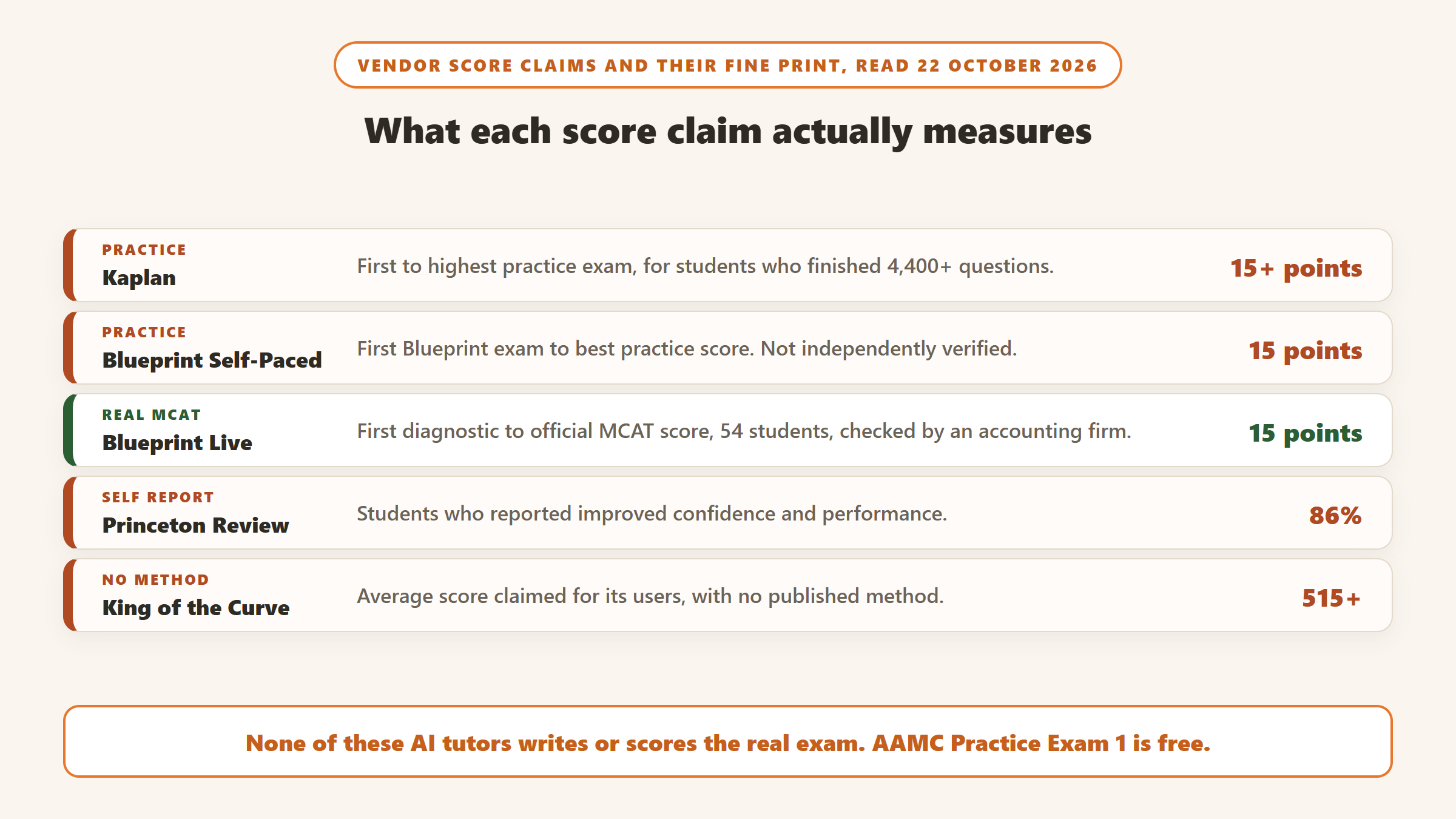
What each “15 points” claim actually measures
Almost every MCAT prep company promises a big score jump. The fine print shows the figures are not measured the same way, which is why they cannot be compared directly.
Kaplan
Kaplan’s MCAT page says students “raise their score by 15+ points on average”. The footnote explains that the average “only applied to students who completed 4,400+ practice questions and 550+ study activities during their program” and is measured “from their first to their highest practice exam”. So it is a practice exam figure, for students who finished most of the work, comparing a first attempt with a best attempt. Kaplan says students who did less saw lower increases.
Blueprint
Blueprint says Self-Paced students had an average increase of 15 points and Live Online students also 15 points, with footnotes giving sample sizes of 596 and 54 students. The bases differ. The Self-Paced figure covers students who started in 2022 and completed at least 2,500 questions and 155 modules, runs from their first Blueprint exam to their best Blueprint or self-reported AAMC practice score, and, in the Self-Paced page’s own words, “does not measure improvement against official AAMC MCAT results” and “has not been independently verified.” The Live figure runs from a first Blueprint diagnostic to the official MCAT score, for 54 students who started in 2021, and Blueprint says an accounting firm verified it. Blueprint also says its half-length diagnostic has an “average difference of just 0.3 point” from real scores. These are Blueprint’s own figures.
The Princeton Review and King of the Curve
The Princeton Review says “86% of students reported improved confidence and performance after using the AI MCAT Tutor”, which is a self-reported feeling, not a score. King of the Curve’s App Store listing says “Users who study with KOTC average a 515+”, and its website says “Our model predicts scores within a 3-percentile range at 91% accuracy”. Neither page explains how the figures were measured.
The rankings are vendor-written too
Kaplan’s MCAT page shows a “Best Overall MCAT Prep Course” badge from Test Prep Insight, and the same page states that “Test Prep Insight is a review and analytics site that is a Kaplan affiliate.” Some “best AI MCAT tutor” pages in search results come from AI startups ranking their own product. Treat any ranking that puts its own publisher first with care, ours included: we have no commercial relationship with any company here.
AI MCAT prep tools compared
| Product | What the AI does | Entry price (22 October 2026) | AAMC exams included | Platforms | Store rating |
|---|---|---|---|---|---|
| AAMC Official Prep (benchmark) | No AI; real past MCAT questions with scaled scores | Practice Exam 1 free; Exams 2 to 6 $35 each; bundle $336.15 | It is the source | Web | No app |
| Blueprint MCAT | Blue chat tutor on Qbank and practice exams; AI Qbank recommendations | $99/month or $299 for 6 months (Qbank and exams); Self-Paced from $999 | 6 in Self-Paced | Web, iPhone | 4.2 iOS (25) |
| UWorld MCAT | UAsk tutor across QBank, exams and UBooks | QBank $339 for 90 days; Comprehensive $1,199 | 7 in Comprehensive | Web, iPhone, Android | 4.5 iOS (157); 4.4 Android (48) |
| Kaplan MCAT | AI Tutor for study tips, explanations, resource suggestions | On Demand from $1,399 with promo code (listed $1,599) | 7 (21 tests in total) | Web, iPhone, Android | 4.2 iOS (265); 1.4 Android (19) |
| The Princeton Review | AI MCAT Tutor inside the course; AI study recommendations | Self-Paced $1,099 on sale (listed $1,599) | All official AAMC materials | Web | No MCAT AI app |
| Lecturio MCAT | Socratic AI tutor in Qbank; AI Assistant | Rs 1,049.30/month on a 12-month Premium plan (shown in rupees from Mumbai) | Not stated | Web, iPhone, Android | 4.8 iOS for Lecturio Medical (4,277) |
| King of the Curve | AI tutor and homework solver; AI flashcards from your notes; score predictor | Free download; US in-app plans $9.99 to $199.99 | Not included | iPhone, Android, web | 4.5 iOS (1,528); 4.1 Android (139) |
Prices and ratings read on 22 October 2026. Ratings are rounded to one decimal, with the number of ratings in brackets. Course prices change with frequent sales, so check the vendor’s checkout before you pay.
How we chose and ordered these
Every product had to describe a real AI feature for MCAT prep in its own words, such as a chat tutor or AI recommendations, and be updated within the last 12 months on at least one platform. We ordered them by how much AI help you get for the money, how clearly the vendor explains what the AI is grounded in, whether official AAMC material is included or easy to pair with it, and price. Popular names with no AI feature on their own pages, apps not updated in years, and very small AI startups are listed at the end with the reason they were left out.
1. Blueprint MCAT: a $99 a month route to a course vendor’s AI tutor
Blueprint sells its Practice Exams and AI Qbank package for $99 a month or $299 for six months, and the page describes “Blue, the AI tutor armed with deep insights that break down every wrong answer.” Blueprint says you can lock in what you learn from its answer explanations “with your AI tutor, Blue”, and that Blue can help create entries in your Lessons Learned Journal, a running log of mistakes. The package includes five full-length Blueprint exams plus the one in a free account, six in all, and a half-length diagnostic.
Blue launched in September 2023, well before UWorld’s UAsk (May 2026) and Kaplan’s AI Tutor (August 2026). Blueprint’s launch post from 23 October 2023 says Blue was built on OpenAI’s GPT-4 and “meticulously trained by Blueprint’s MCAT experts”, starting as a CARS tutor. The iPhone app describes Blue as “Think ChatGPT, but trained by MCAT experts” and adds AI-recommended practice sets by section and topic, offline mode and extra timing options. The app had a 4.2 rating from 25 US ratings and was updated on 26 September 2026. We found no Android app in Google Play search.
Full courses cost more: Self-Paced was listed “From $999” (regular $1,499), Live Online from $1,899 and the 515+ Course from $2,399. The Self-Paced page lists an “AI-powered Qbank with 5000+ questions”, 10 Blueprint full-lengths and 6 official AAMC practice exams, with a Score Increase Guarantee. That page does not name Blue, so confirm it is included in the plan you choose. A free Blueprint account comes with one full-length practice exam.
Choose it if you want an AI tutor on a large question bank without paying for a full course. Skip it if you study mainly on Android.
2. UWorld MCAT: UAsk built into a well-known question bank
UWorld added its UAsk AI tutor to MCAT prep in May 2026. Its press release of 5 May 2026 says UAsk is “included in all UWorld MCAT Comprehensive Prep Course subscriptions”, works across the question bank, practice exams and UBooks, and is “trained and monitored by UWorld’s in-house subject matter experts”. You can turn its answers into flashcards and notes. The MCAT page describes UAsk as “an AI tutor that provides instant answers trained by our experts” and its plan comparison ticks it for the Comprehensive course, the Core course and the QBank, but not the Prep Books.
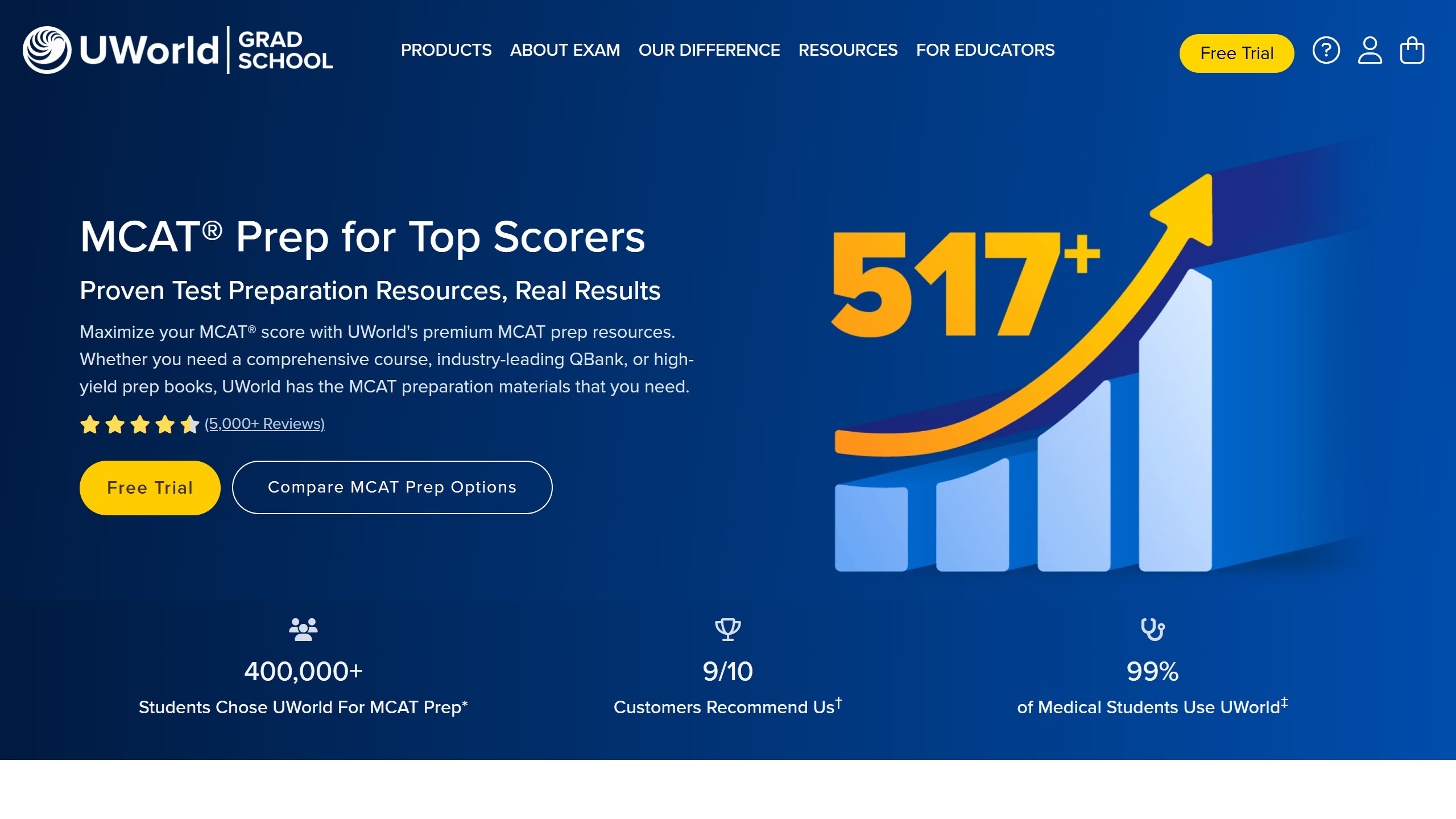
Prices on 22 October 2026: the QBank cost $339 for 90 days, $389 for 180 days and $439 for 360 days. The Core course was $599 to $699, and the Comprehensive course $1,199 for 90 days up to $1,549 for 360 days, including 2 UWorld practice exams and 7 AAMC practice exams. The Core course and the QBank do not include the AAMC exams, so budget for those separately.
The UWorld MCAT iPhone app had 4.5 from 157 US ratings (updated 8 September 2026), and the Android app 4.4 from 48 ratings with 10K+ installs (updated 20 October 2026). The iPhone description still mentions “4 AAMC practice exams”, which does not match the website, so trust the website.
Choose it if you want a question bank with an AI tutor for a fixed 90-day price. Skip it if you need live teaching.
3. Kaplan MCAT: 21 practice tests, with an AI Tutor added
Kaplan added an AI Tutor in its 10 August 2026 announcement, which says “Kaplan’s proprietary AI Tutor provides students with on-demand study guidance.” The MCAT page lists it under what all courses include: personalised study tips, content explanation breakdowns and resource recommendations, whenever you need them. Kaplan does not describe what the AI Tutor is trained on.
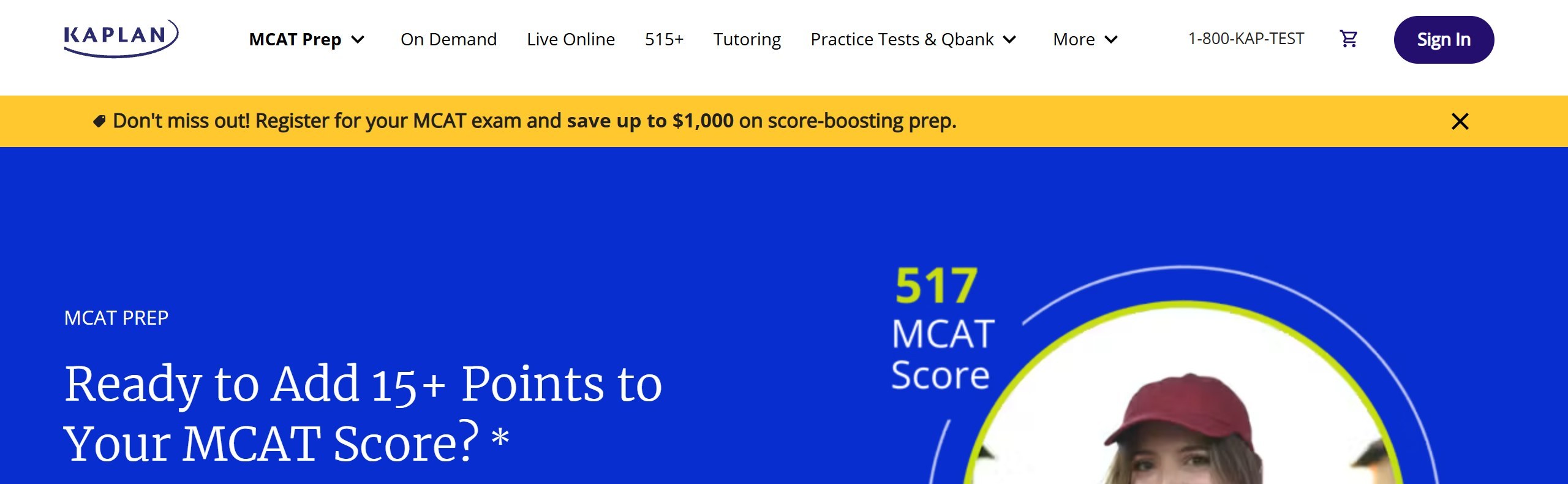
Kaplan’s strength is volume. All MCAT courses include 21 full-length practice tests, 7 of them from the AAMC, and “12,000+ total MCAT practice questions”. On 22 October 2026 the On Demand course was listed from $1,399 with the code REG500 (otherwise $1,599), Live Online from $2,099 and In Person from $2,999. Kaplan says students with an AAMC Fee Assistance Program award may get up to 60% off.
The apps are a mixed picture. The Kaplan MCAT iPhone app had 4.2 from 265 US ratings, but the Android app had 1.4 from 19 ratings with 5K+ installs. Both were updated in mid October 2026, and both are companion apps for enrolled students; neither store description mentions the AI Tutor.
Choose it if you want a full course with many practice tests and an AI helper for study planning. Skip it if you only want an AI tutor and a question bank.
4. The Princeton Review: AI MCAT Tutor in its courses
The Princeton Review lists an “MCAT AI Tutor” on both its 515+ Course and its Self-Paced course. The Self-Paced page says “The AI Tutor breaks down each question, providing immediate in-platform guidance on the exact reasoning behind each answer”, and that it is “Grounded in our proprietary content and continuously refined by our MCAT experts reviewing thousands of real responses”. Its dashboard also offers an “AI-Powered Study Recommendation Tool”.
On 22 October 2026 a registration sale was running. The Self-Paced course was $1,099 against a listed $1,599, and the 515+ Course, with 123 hours of live instruction, was $2,699 against $3,499. The Self-Paced page listed 6-month access at $1,099 (regular $1,599) and 12-month access at $1,499 (regular $1,999), with a 14-day free trial, and says it includes all official AAMC materials. The cheaper Practice Tests and QBank card, $149 on sale, does not list the AI Tutor, and none of the options on the Practice Pack page mentions it.
Choose it if you want a self-paced video course with an AI tutor and a free trial. Skip it if you want AI help on a budget.
5. Lecturio MCAT: Socratic AI tutor with a clear disclaimer
Lecturio is better known for medical school prep, and its MCAT plans reuse that platform. Its AI tutor page says the tutor works inside Qbank Study Mode, asks questions to guide you to the answer rather than handing it over, and is “grounded specifically in Lecturio’s peer-reviewed medical library”. For the MCAT it promises to help “Build the foundational science and CARS logic required for pre-med success on the MCAT.”
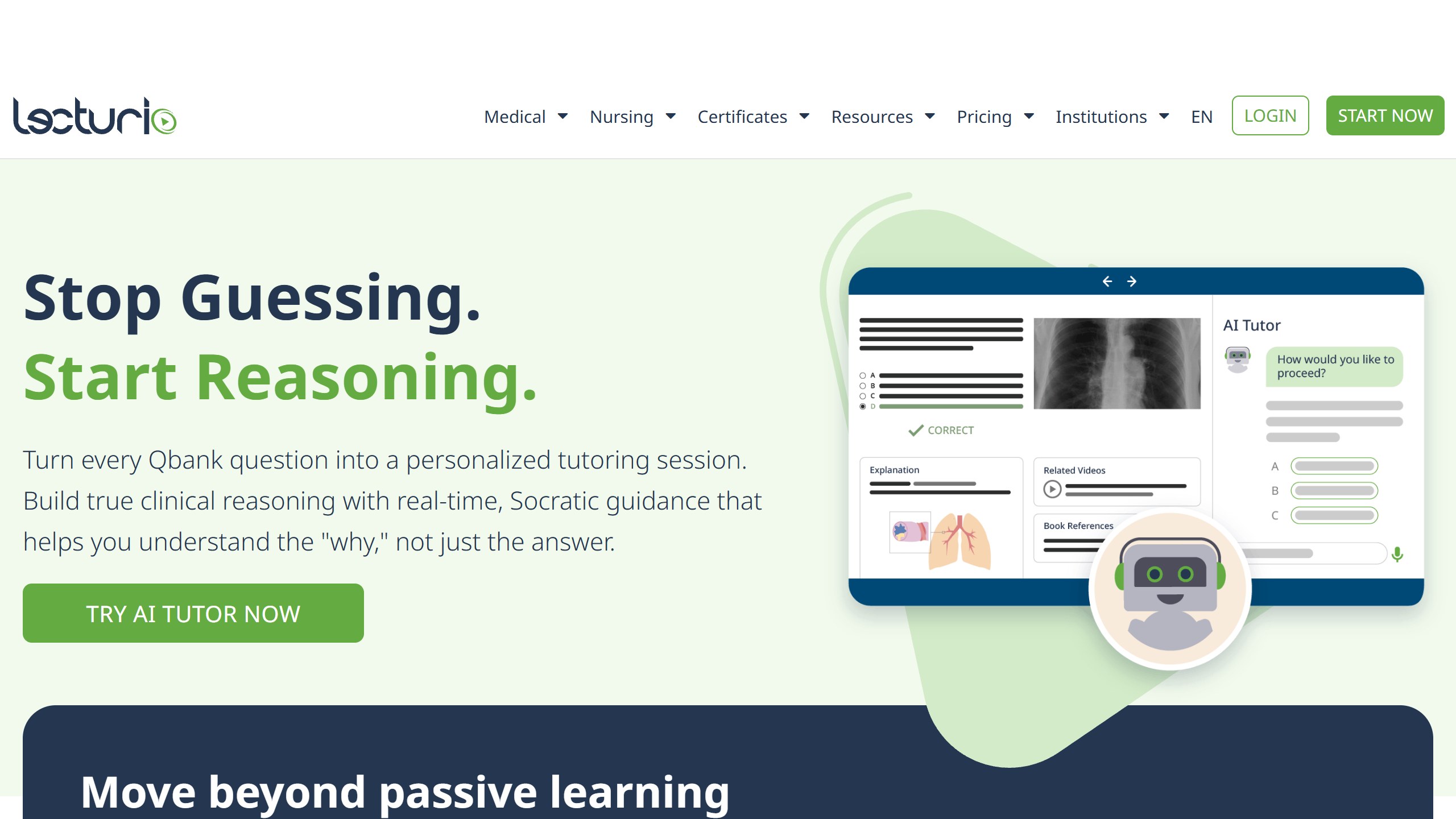
Lecturio is also direct about limits. Its pricing page says AI Assistant answers “are not reviewed by a medical professional, and as such, minor errors may occur.” That warning applies to every AI tutor on this list, and Lecturio prints it on its pricing page.
From our Mumbai connection the pricing page showed rupees: MCAT Premium, the plan with the AI tutor, at Rs 1,049.30 a month billed as Rs 12,591.60 a year during a 30% sale, and MCAT Basic, without the Qbank, at Rs 734.30 a month. US prices may differ. Both plans have a 7-day trial and renew automatically unless you turn renewal off. The MCAT Android app had 100+ installs and no rating yet, while the Lecturio Medical iPhone app had 4.8 from 4,277 ratings, for an app built mainly for medical school.
Choose it if you like being questioned rather than told, and may stay on for medical school. Skip it if you want official AAMC exams bundled in.
6. King of the Curve: free app with AI study tools
King of the Curve is a free app that calls itself “the all-in-one AI-powered learning platform for MCAT, NCLEX, USMLE, and beyond”. Its App Store listing describes an “AI Tutor & Homework Solver (24/7)” for photographed or typed questions, an AI that turns your own notes, slides and PDFs into flashcards, summaries and multiple choice questions, and “over 5,000 MCAT-style practice questions”. It also says its adaptive engine predicts your future MCAT score.
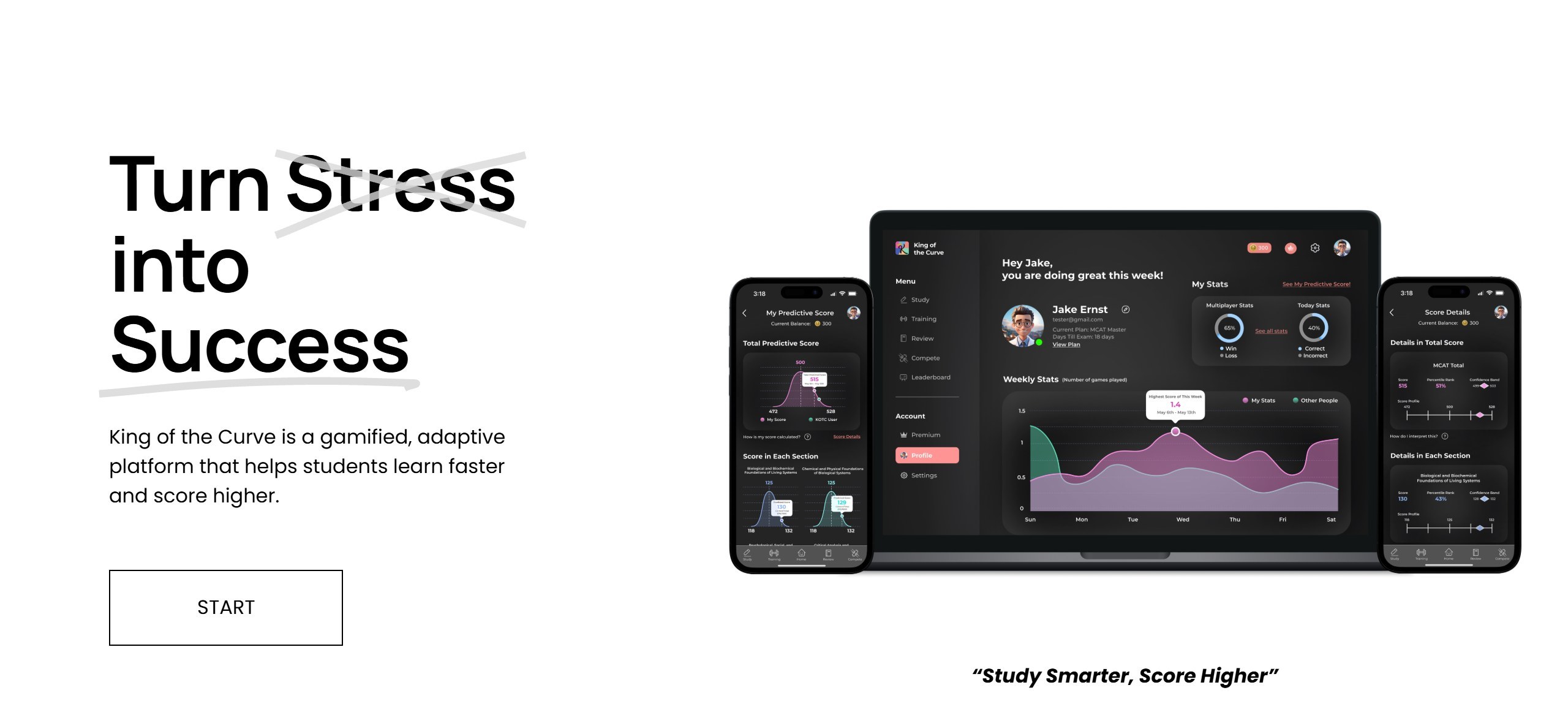
It had 4.5 from 1,528 US ratings and was updated on 21 October 2026. The Android app had 4.1 from 139 ratings and 10K+ installs, last updated 16 June 2026. The download is free; the US in-app purchase list ran from $9.99 for a student month to $199.99 for a year, with several monthly prices listed, so check the plan shown in the app before paying. Its score claims (users average 515+, predictions within 3 percentiles at 91% accuracy) come with no published method. AAMC exams are not included.
Choose it if you want a free, phone-first way to practise and to turn class notes into flashcards. Skip it if you want a structured course.
What we left out, and why
Jack Westin sells MCAT courses, but its homepage did not mention any AI feature on 22 October 2026, so it does not fit an AI roundup. MCAT Prep by Health Admissions IQ, from MedSchoolCoach, is a well-rated iPhone app (4.8 from 1,181 ratings) with videos, flashcards and questions, but its description makes no AI claim, and its Android listing was last updated in August 2023. Magoosh’s MCAT app was last updated in 2019 and The Princeton Review’s MCAT flashcards app in 2020. AiMCAT was free in early access with a founder-run site that says its content is AI-generated, and several other AI MCAT tutor startups in search results had too little public information to verify.
How to choose an AI MCAT prep tool
Anchor everything to AAMC material
Buy or download the official AAMC exams first. They are the closest thing to the real test, and at $35 each they cost less than a month of most AI tutors here. Use them to set your baseline and to check progress, and use AI tools for the practice in between.
Pick by how you study
If you mainly need questions with explanations, an AI Qbank like Blueprint’s or UWorld’s covers it. If you need structure and video teaching, Kaplan and The Princeton Review add an AI tutor on top of a full course. If you want to quiz yourself from class notes, King of the Curve’s note-to-flashcard AI is aimed at that; our guide to AI flashcard apps covers more options.
Ask what the AI is grounded in
An AI tutor that answers from the vendor’s own reviewed content is easier to trust than a general chatbot. UWorld, The Princeton Review and Lecturio say their tutors are trained on or grounded in their own material; Blueprint says Blue was built on GPT-4 and trained by its experts. Even so, Lecturio warns that minor errors may occur. Check anything that surprises you against a textbook or the AAMC explanation.
Read the fine print on score promises
A 15-point average measured from first to best practice exam, among students who finished thousands of questions, is a different thing from a guaranteed real MCAT score. If a guarantee matters to you, read its conditions before paying.
Watch sales and renewals
Course prices on 22 October 2026 were mostly sale prices with countdown timers and promo codes. Monthly plans, like Blueprint’s $99 a month or Lecturio’s, keep billing until you cancel. Put a reminder in your calendar for your test date.
Keep test day content private
The MCAT Essentials bind you to keep exam content confidential indefinitely. Never paste what you remember from your test into an AI tool.
Planning further ahead? Our guide to AI tools for medical students covers what comes after the MCAT, and if you have younger siblings, see our comparisons of AI SAT prep apps and AI AP exam prep apps.
Sources
- AAMC: Prepare for the MCAT exam, free planning and study resources, MCAT Official Prep product comparison, Use of AI in AAMC service programs, Examinee Agreement, MCAT Essentials.
- Blueprint: MCAT home and pricing, practice exams and AI Qbank, Self-Paced course, Meet Blue (23 October 2023), US App Store listing.
- UWorld: MCAT plans, UAsk press release (5 May 2026), US App Store listing, Google Play listing.
- Kaplan: MCAT courses, MCAT press release (10 August 2026), US App Store listing, Google Play listing.
- The Princeton Review: MCAT prep options, Self-Paced course.
- Lecturio: MCAT pricing, AI tutor, US App Store listing, Google Play listing.
- King of the Curve: website, US App Store listing, Google Play listing.
- Left out: Jack Westin, Health Admissions IQ on the App Store, Magoosh MCAT, MCAT Flashcards by TPR, AiMCAT.
- All store listings and web pages read 22 October 2026.

Written by
FazFaz is the founder of AIToolsBakery. Some tools here are tested hands on. Others are assessed from vendor documentation and pricing verified on the live page, and every review says which one it is. Sponsors can buy a position in a guide. They cannot buy the score, the criticism, or silence about a better option.
How we test and how we make money →