One tool does one thing better than anything else. The other does 80 things pretty well. Both are free.
Diffit is a differentiation specialist that generates reading materials at multiple levels from any topic. MagicSchool AI is an all-in-one platform with 80+ teacher tools including lesson planning, grading, IEPs, and more. Diffit wins for differentiated instruction. MagicSchool wins for everything else. Both have generous free plans. Most teachers with mixed-ability classrooms use both: MagicSchool for planning and admin, Diffit for leveled materials.
Faz says: This comparison comes down to a simple question: is your biggest challenge creating materials at different reading levels for different students? If yes, Diffit. If your challenges are spread across lesson planning, grading, IEPs, and everything else, MagicSchool. Here’s the detailed breakdown.
Head-to-Head Comparison
| Feature | Diffit AI | MagicSchool AI |
|---|---|---|
| Type | Differentiation specialist | All-in-one platform |
| Tools | 1 core tool (multi-level readings) | 80+ teacher tools, 50+ student tools |
| Rating | 4.5/5 | 4/5 |
| Free plan | Unlimited readings, PDF download | Full access, no expiration |
| FERPA | Yes | Yes |
| COPPA | Verify | Yes |
| SOC 2 | Verify | Yes |
| Google Classroom | Paid only | Yes (free) |
| Differentiation | Core feature (best in class) | Available but less specialized |
| Lesson planning | No | Yes |
| Quiz generation | No | Yes |
| IEP writing | No | Yes |
| Writing feedback | No | Yes |
| Report cards | No | Yes |
| Student tools | No | 50+ |
| Multi-level readings | Yes (best in class) | Limited |
| YouTube-to-reading | Yes | No |
| Language support | Yes (multilingual) | Yes |
| Input sources | Topics, URLs, PDFs, YouTube | Topics |
Feature-by-Feature Breakdown
Differentiated Instruction
Diffit: This is Diffit’s entire purpose. Enter a topic and instantly generate readings at multiple grade levels. Each version adjusts vocabulary, sentence complexity, and passage length while keeping the same core concepts. Generate the same photosynthesis reading at 3rd-grade and 8th-grade levels simultaneously.
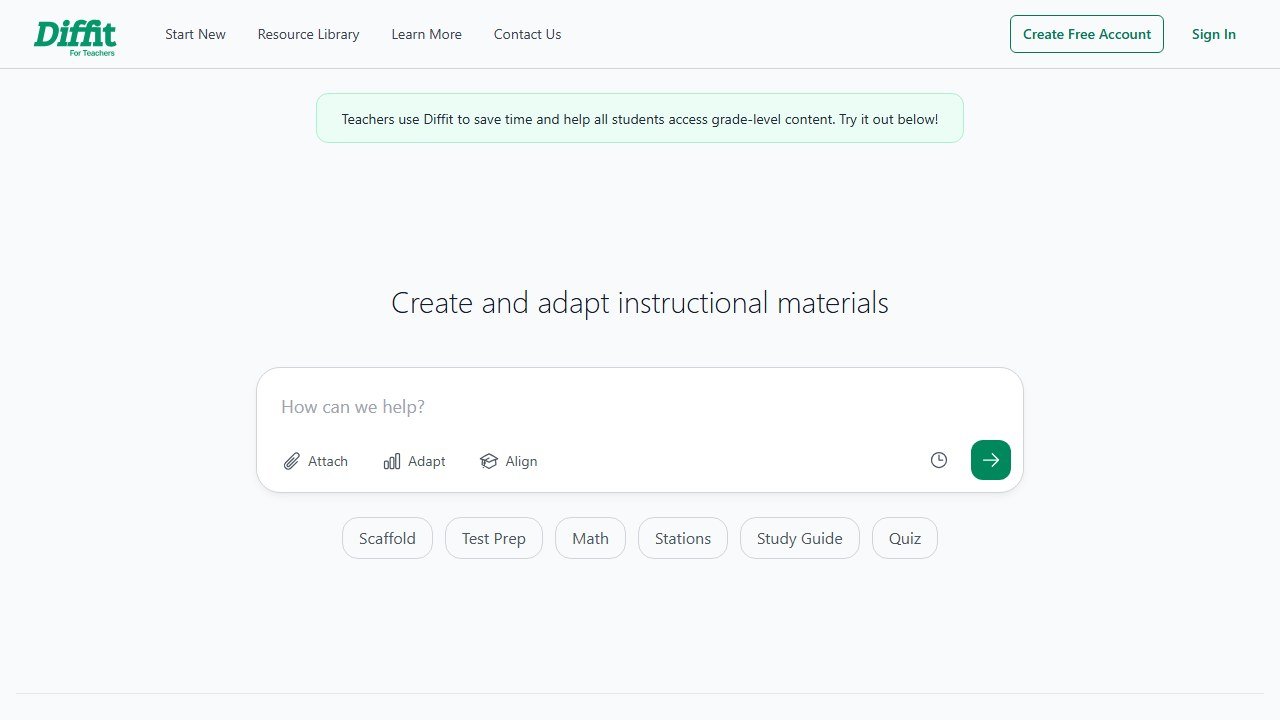
MagicSchool: Has differentiation features within its lesson planning tools. You can request differentiated materials, but the output is less specialized than Diffit’s purpose-built level adjustment.
Winner: Diffit. Not close. Diffit was built for this specific task and does it better than any generalist tool.
Breadth of Teaching Tools
Diffit: Differentiated readings with questions and vocabulary. That’s it.
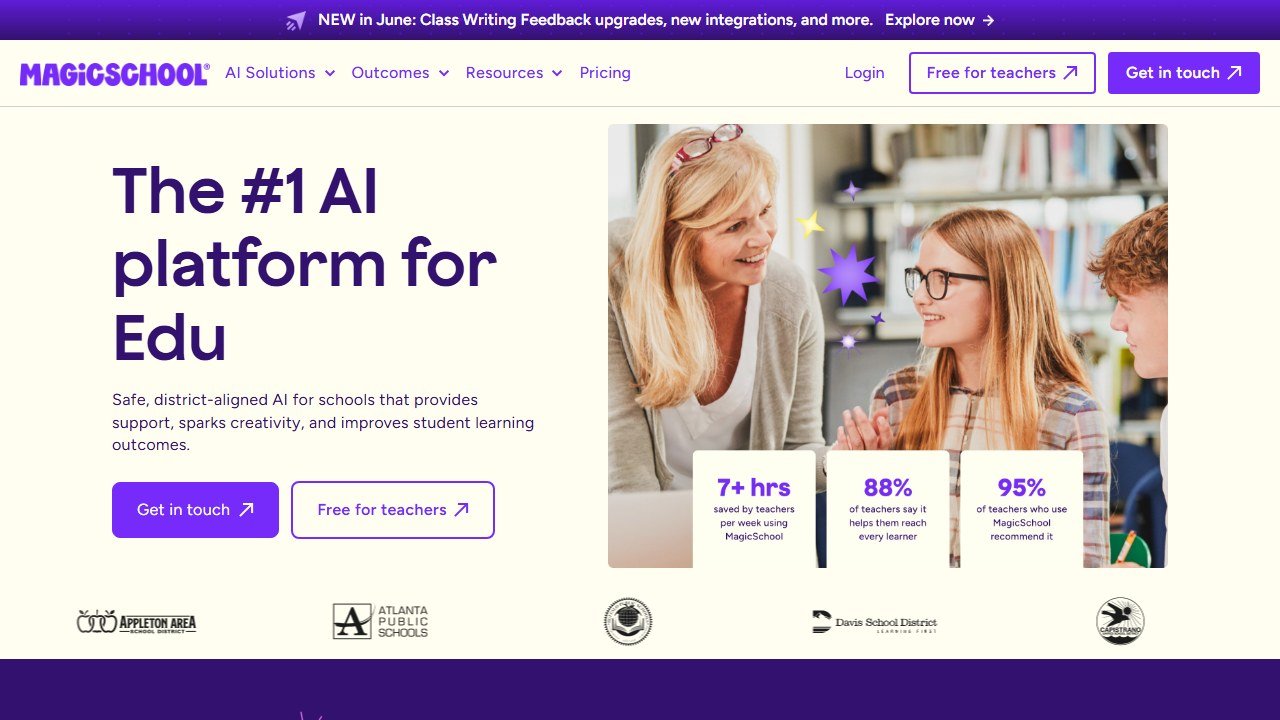
MagicSchool: Lesson plans, rubrics, quizzes, IEPs, report card comments, writing feedback, presentations, vocabulary lists, email drafts, and 70+ more tools.
Winner: MagicSchool. Diffit does one thing. MagicSchool does 80.
Input Flexibility
Diffit: Generate from topics, URLs (paste an article), PDFs, YouTube videos, or Diffit’s content library.
MagicSchool: Generate primarily from topic descriptions.
Winner: Diffit. The ability to differentiate an existing article, PDF, or YouTube video is something MagicSchool can’t match.
Free Plan
Diffit: Unlimited readings, questions, and vocabulary. PDF download, print, and share. No credit card, no expiration. Google Classroom export is paid only.
MagicSchool: Full access to all 80+ tools and 50+ student tools. No credit card, no expiration.
Winner: Tie. Both have exceptionally generous free plans. Diffit is unlimited for its core feature. MagicSchool is unlimited for everything.
Compliance
Diffit: FERPA compliant. COPPA and SOC 2 should be verified directly.
MagicSchool: FERPA, COPPA, SOC 2, GDPR, CCPA, Common Sense Privacy Verified, ESSA Level IV.
Winner: MagicSchool. Stronger and more comprehensive compliance documentation.
Student-Facing Tools
Diffit: Generates materials for students but has no student-facing AI interaction.
MagicSchool: 50+ student tools including an AI tutor, teacher-led activities, and supervised AI environments.
Winner: MagicSchool. Diffit is teacher-facing only.
Real-World Scenarios: Which Tool Wins?
Scenario 1: You Have 5 ELL Students, 3 on IEPs, and 4 Advanced Learners in One Class
Diffit: Enter your lesson topic. Generate the same reading at 3 different levels in under 2 minutes. Each version has the same core concepts but adjusted vocabulary, sentence length, and complexity. Print all three, distribute to the right groups.
MagicSchool: Use the lesson plan generator and request differentiation. The output includes differentiation suggestions (accommodate ELLs, extend for advanced) but doesn’t generate separate leveled readings the way Diffit does.
Better choice: Diffit. This is the exact use case it was built for.
Scenario 2: You Need a Complete Lesson Plan, Quiz, and Rubric by Tomorrow
Diffit: It can generate the reading materials for your lesson, but it won’t create the lesson plan, quiz, or rubric. You’d need a different tool for those.
MagicSchool: Generate a lesson plan, create a quiz with answer key, and build a rubric, all from the same platform in about 10 minutes.
Better choice: MagicSchool. Diffit only covers the reading materials portion.
Scenario 3: You Want to Turn a YouTube Video into a Reading Activity
Diffit: Paste the YouTube URL. Diffit generates a reading passage based on the video content, with comprehension questions and vocabulary, at your chosen grade level. Then adjust the level up or down.
MagicSchool: No YouTube-to-reading feature. You’d need to watch the video, summarize it yourself, then use MagicSchool’s tools to build a worksheet around your summary.
Better choice: Diffit. The YouTube input is a feature MagicSchool can’t replicate.
That video-to-reading workflow is a staple in social studies classrooms. Our guide to the best AI tools for history teachers covers how tools like these handle primary sources and document-based questions.
Scenario 4: You Need to Write IEP Progress Reports and Report Card Comments
Diffit: No IEP or report card features. This is outside its scope entirely.
MagicSchool: IEP generator drafts sections with measurable objectives. Report card comment generator produces personalized comments based on grades and growth areas. Both save hours per student.
Better choice: MagicSchool. These administrative tasks are core MagicSchool strengths.
Scenario 5: You Teach Bilingual or Dual-Language Classes
Diffit: Generate the same reading in English and Spanish (or other languages). Each version is at the appropriate reading level for the target language. This is built into the core workflow.
MagicSchool: Supports multiple languages across its tools, but the differentiation depth for bilingual content doesn’t match Diffit’s dedicated leveling.
Better choice: Diffit for bilingual reading materials specifically. MagicSchool for bilingual lesson planning and other admin tasks.
Pricing Comparison
| Diffit AI | MagicSchool AI | |
|---|---|---|
| Individual teacher | Free (unlimited readings, PDF) | Free (full access, 80+ tools) |
| Google Classroom export | Paid (school plan) | Free |
| Standards alignment | Paid (school plan) | Free |
| School/district | Flat annual rate (contact) | Custom (contact) |
| Credit card required | No | No |
Both tools have genuinely free plans for individual teachers. The key difference: Diffit locks Google Classroom export and standards alignment behind its paid school plan. MagicSchool includes Google Classroom integration for free. If exporting directly to Google Classroom matters to you, MagicSchool’s free plan covers that. If you’re fine with PDF download and manual distribution, Diffit’s free plan has no meaningful limits.
The Real Decision
Faz says: This isn’t really a “pick one” situation. Here’s why:
Pick Diffit if:
• Differentiation is your #1 time sink
• You have ESL, IEP, and gifted students in the same room
• You need the same content at multiple reading levels daily
• You want to turn articles, PDFs, or YouTube videos into leveled readings
Pick MagicSchool if:
• You need AI help across planning, grading, IEPs, and admin tasks
• Differentiation is one challenge among many
• You want student-facing AI tools
• You need the strongest compliance documentation
Pick both if (most teachers with mixed-ability classrooms):
• Use MagicSchool for lesson planning, rubrics, quizzes, and admin tasks
• Use Diffit for creating leveled reading materials
• Both are free. There’s no reason to choose one over the other.
Final Verdict
Saru says: Diffit and MagicSchool are complements, not competitors. Diffit is the best differentiation tool in the market (4.5/5). MagicSchool is the best all-in-one teacher platform (4/5). Teachers with mixed-ability classrooms benefit from both: MagicSchool for the full planning and admin workflow, Diffit for creating leveled materials. Both are free. Use both.
| Diffit AI | MagicSchool AI | |
|---|---|---|
| Rating | 4.5/5 | 4/5 |
| Best for | Differentiated reading materials | Everything else |
Read our full reviews: Diffit AI review | MagicSchool AI review
References & further reading
For deeper research on AI in education and evidence-backed instructional practice:
- Common Sense Education: AI in K-12 classrooms. classroom-tested guidance and tool ratings reviewed by educators
- Edutopia technology integration research. peer-reviewed edtech case studies and classroom implementation practice
- US Department of Education on AI in schools. federal guidance on AI in teaching and learning, including the 2023 Office of Educational Technology report
When to choose Diffit over Magicschool
Picking between Diffit and Magicschool comes down to four factors: team size, budget, integration needs, and how much customization you want. Use the framework below to map your situation to the right tool.
Pick Diffit if:
- You’re an individual operator or a small team and you want the fastest setup path.
- Your budget favors a lower entry tier or a strong free plan over premium features you may never use.
- Your existing stack is light, and you prefer a tool that works well out of the box.
- You value simplicity over feature breadth.
Pick Magicschool if:
- You’re a growing or mid-sized team and you need room to scale without switching platforms.
- You’re willing to pay more upfront for advanced features, integrations, or higher usage limits.
- You already have a mature stack and you need a tool that plugs into it cleanly.
- You’d rather have power and configurability than the simplest possible setup.
What we’d switch for
The most common reasons we see teams move between tools in this category: (1) pricing changes that push the cheaper option out of reach, (2) a missing integration that becomes a daily friction, (3) hitting a usage cap on the lower tier, (4) a feature ship from the alternative that closes a gap users had been working around.
If you can avoid those four switching triggers with your initial pick, you’ve made the right call. If any of them are likely in your first 12 months, plan for them now and pick accordingly.
Student data, and the questions a school has to ask before anything is switched on
This is the part of education technology where getting it wrong has consequences beyond a wasted subscription, and it is mostly answerable in writing before adoption.
Know which law you are under before you evaluate
In the United States, student education records sit under FERPA, and services aimed at under-13s bring COPPA into scope, which requires verifiable parental consent for personal information collected from children. Schools outside the US will have their own regime. The practical effect is the same: the school, not the vendor, carries the obligation, so the vendor questions exist to let you meet it.
Ask whether student work trains the model
This is the single question to get in writing. Ask whether student inputs and outputs are used to train or improve any model, including in aggregated or anonymised form, and whether that binds subprocessors too. “We do not train on your data” and “we do not train foundation models on your data” are different sentences. Get it as a contract term, because a sales assurance does not survive a change of ownership.
Ask who else touches the data
Most tools here are built on a model provider they did not write, so student work reaches a third party. Ask for the current subprocessor list, where each processes data, and how you are notified when it changes. A vendor that cannot produce that list within a day does not have one, which tells you enough about the rest of their programme.
Ask what happens at the end of a school year
Retention and deletion, stated in days rather than described as a process. What is deleted when a student leaves, when a class is archived, when the contract ends. Ask whether deletion means removed from live systems, removed from backups, or flagged. A vendor that will commit to a number in the contract is a different proposition from one that describes an approach.
The one many schools miss: inferences about a child
If a tool generates a reading level, a predicted grade, a behaviour flag or an ability estimate, that is data about a student the student never supplied. Ask whether those inferences are covered by your export, your deletion request and your access request, because a parent asking what the school holds on their child is asking about those too.
Where the figures on this page come from
Every price here was read from the vendor’s own pricing page on 4 September 2026 and carries that date, because education pricing changes with the school year and a claim without a date is not checkable.
The pages we read
Chalkie publishes free, US$6.65 and US$12.99 a month with yearly equivalents. Khanmigo publishes $44 a year. MagicSchool publishes a free plan and Plus at $12.99 a month. Curipod publishes free and from $24 a month with a 21% yearly saving. CoGrader publishes free at 100 submissions a month and $15 a month billed annually. Brisk Teaching publishes a free teacher plan at $0.
The ones we could not read
SchoolAI publishes tier names with no figures. Gradescope now sits on a Turnitin domain and is institution-quoted. We could not read a figure for Diffit, Quizlet, Photomath or Gauth either. That is not evidence they publish nothing, and we do not present it as such. Treat any figure for those six from elsewhere as unverified.
What we do not do
We do not carry a figure we cannot source to the vendor. Where a number circulates and cannot be traced, we say so and withdraw it rather than repeating it with a hedge.
What these tools actually cost, vendor by vendor
Education software prices unlike anything else, because the buyer is often a teacher paying personally while the vendor is really selling to a district. That produces a free tier that is genuinely usable and an enterprise tier with no published figure. Here is each alternative to diffit vs, read at source on 4 September 2026.
Chalkie, the most completely published rate card here
Chalkie publishes a free plan at US$0.00 a month covering five full lessons or activity sheets every seven days, then US$6.65 a month at US$79.80 paid yearly, and US$12.99 a month at US$155.88 yearly. Its annual toggle is marked as three months free and the arithmetic holds. Publishing the free tier’s exact limit, five resources per week rather than a vague “limited”, is rarer than it should be and worth rewarding.
Khanmigo, the cheapest paid option in this guide
Khanmigo publishes $44 a year, saving $4 against monthly billing, which works out around $4 a month. That is an order of magnitude below most of this category and reflects its position as a non-profit-backed product tied to an existing content library rather than a general purpose teacher toolkit. Judge it on whether that library matches your curriculum, because the price is not the deciding factor at that level.
MagicSchool and Curipod, free tiers with paid steps
MagicSchool publishes a free plan and Plus at $12.99 a month billed monthly, with a lower per user rate billed annually and volume-based discounts on district Enterprise licences that are quoted rather than published. Curipod publishes free at $0 a month and paid from $24 a month, with a yearly toggle marked as saving 21% and stated as $60 off against monthly. Both make the teacher tier genuinely usable, which is the commercial model rather than generosity.
CoGrader, where the free tier has a hard number on it
CoGrader publishes a free plan covering 100 student submissions a month with rubric building and FERPA compliance, then $15 a month billed annually. A hundred submissions is roughly three or four class sets, which makes the free tier a real trial for one teacher and clearly insufficient for a department. That is an honest place to draw the line and it lets you test properly before spending anything.
The ones that publish nothing, and what that tells you
Brisk Teaching publishes a free teacher plan at $0 but we could not read figures for its paid tiers. SchoolAI publishes tier names, Free Trial, Pro and Scale, with no figures attached, which is district-quoted pricing by design. Gradescope now sits on a Turnitin domain and its page is headed “Gradescope for Your Institution” with no rates. We also could not read pricing for Diffit, Quizlet, Photomath or Gauth. We are not claiming those publish nothing; a failed read is not evidence of absence.
Bottom line
Diffit is the more accessible starting point. Magicschool is built for the stage after you’ve outgrown a simpler tool. Most teams should start with the tool that matches today’s needs and move when (and if) they hit a real wall, not based on what they think they might need in two years.
Both platforms continue to receive active development and strong teacher adoption in 2026.
Final pick recommendation for 2026 teachers
Teachers focused on reading-level differentiation and ELL classrooms: pick Diffit. The depth of leveling and language support outperforms MagicSchool’s similar features. Teachers focused on broad classroom AI (lesson planning, IEPs, parent communication): pick MagicSchool. The breadth of 80+ tools earns its slot in any general teacher AI stack. Many teachers use both because the strengths do not overlap; Diffit for content adaptation, MagicSchool for everything else around the lesson.
Cost comparison: Diffit’s free tier covers most individual teachers; MagicSchool’s free tier is similarly generous. Paid tiers run $9 to $20 a month for either, with school licenses at lower per-teacher costs. The price gap between them is small; pick by feature fit, not by cost.

Written by
FazFaz is the founder of AIToolsBakery. Some tools here are tested hands on. Others are assessed from vendor documentation and pricing verified on the live page, and every review says which one it is. Sponsors can buy a position in a guide. They cannot buy the score, the criticism, or silence about a better option.
How we test and how we make money →