Many of the big names in USMLE prep now advertise AI. UWorld has UAsk, AMBOSS has AI Mode Learning, Bootcamp has Ask Bootcamp AI, Lecturio has an AI Tutor, Osmosis has Osmosis AI and Sketchy has AI patient cases. The “best AI for USMLE” pages we read were mostly written by those same companies, or by AI study startups ranking themselves first.
Three things get left out. First, the AI is nearly always a chat layer on the vendor’s own question bank, and the vendors describe its accuracy in very different words, from “may occasionally make mistakes” to a “Hallucination-free guarantee”. Second, the AI comes with limits: UWorld caps UAsk prompts on its shorter plans, and the AMBOSS base membership allows 50 Qbank questions a month. Third, the USMLE itself changed format on 14 May 2026, and some prep pages still describe the old one. This guide compares six AI USMLE prep tools on those points, using prices listed on 28 October 2026.
How we put this together. We have not used these tools ourselves; this is a research-based comparison. Every price, rating, limit and feature below comes from the vendor’s own website, the official USMLE and NBME websites, or the app’s US App Store and Google Play listing, read on 28 October 2026, and each source is linked. Some sites blocked automated reading or loaded prices with scripts, so we read them in a normal browser. Osmosis and Lecturio showed us prices in Indian rupees because we read them from India; we report those as shown and do not convert them. Pass guarantees and accuracy claims are the vendors’ own, and we quote the fine print. This page is about exam preparation, not medical advice. None of these companies paid to appear here.
What the USMLE looks like in 2026
The USMLE is run by the Federation of State Medical Boards (FSMB) and the National Board of Medical Examiners (NBME), so their pages are the reference point for everything else here.
Step 1 is pass/fail, Step 2 CK and Step 3 are scored
The USMLE results and scoring page says “All Step 1 exam score outcomes are reported as pass/fail for exams administered on or after January 26, 2022.” Step 2 CK and Step 3 are still reported on a three-digit scale. The current minimum passing score is 218 for Step 2 CK (for exams on or after 1 July 2025) and 200 for Step 3 (on or after 1 January 2024). The Bulletin of Information adds that examinees “typically must answer approximately 60% of questions correctly to achieve a passing score”, though the figure varies by Step and by form.
Since May 2026, more and shorter blocks
This is the change many prep pages have not caught up with. The Step 1 page says that from 14 May 2026, “Step 1 is a one-day examination. It is divided into fourteen 30-minute blocks”, all in a single 8-hour session. No block has more than 20 questions, and break time is at least 55 minutes. Before that date, Step 1 was seven 60-minute blocks of up to 40 questions. The Step 2 CK page describes the same shift for exams from 7 May 2026: sixteen 30-minute blocks in a 9-hour session, with no more than 20 questions per block.
The USMLE announcement posted on 14 May 2026 says the new test software was in place for all three Steps from that date, and that “The exam content, total number of items, and overall length of the tests remain unchanged. However, the exams have more blocks, and the blocks are shorter in length.” The new interface adds a settings menu and image contrast controls. If you practise timed blocks, 20 questions in 30 minutes now matches test day better than 40 in 60.
Two more changes to know about
Step 2 CS, the clinical skills exam, was discontinued in January 2021, so any product still selling Step 2 CS prep is selling prep for an exam that does not exist. Looking ahead, the USMLE program says its Designated Testing Dates model starts in January 2029 and “will reduce the number of Step exam administrations each year”. That matters for planning, not for which tool you buy.
What NBME and the USMLE sell or give away
Neither NBME nor the USMLE program offers an AI tutor. The USMLE website has free sample questions: “More than 100 sample Step 1 test questions are available in both PDF format and as an interactive testing experience”, including a new interactive version built for the 30-minute blocks. NBME sells self-assessments written by the same organisation that co-sponsors the exam. Its Comprehensive Basic Science Self-Assessment for Step 1 and its Comprehensive Clinical Science Self-Assessment for Step 2 CK each list “seven available” forms, with a “Price starts at $62”. The Step 3 self-assessment is “available for $62”, with 200 questions in four sections of 50.
AI USMLE prep tools compared
| Product | What the AI does | Entry price (28 October 2026) | AI limits we found | Free trial or refund | Pass guarantee |
|---|---|---|---|---|---|
| NBME self-assessments (benchmark) | No AI; official practice exams with score reports | From $62 per form | Not applicable | Not stated on the pages we read | None |
| UWorld | UAsk chat inside the QBank and Medical Library | $349 for 30 days (Step 1 QBank) | Up to 100 prompts on 30 days, 250 on 90 days, 1,000 on 180 days or more | Refunds case by case | None found |
| AMBOSS | AI Mode Learning copilot, reads uploads and score reports | $19.99 a month membership (50 Qbank questions a month) | Included in all subscriptions “currently” | 5-day free trial, 30-day money-back | None found |
| Med School Bootcamp | Ask Bootcamp AI inside every question | $59 a month | “Unlimited” | Free account to start | Step 1 refund on 1 and 2 year plans, with conditions |
| Lecturio | AI Tutor in the Qbank, AI Assistant across content | Premium ₹12591.60 a year (regional price) | None stated | 7-day free trial | None found |
| Osmosis | Osmosis AI chat linked to videos | ₹11663 for 3 months (regional price) | None stated | Free trial offered | None found |
| Sketchy Medical | AI virtual patients and attendings in case simulations | $349.99 for 6 months (All access) | None stated | 7-day free trial | Refund of last payment for Step 1 or 2, with conditions |
Prices read on 28 October 2026, before promo codes. Several vendors showed a higher crossed-out price, and Halloween or seasonal discounts were running at Lecturio, Osmosis and Sketchy. Rupee prices are what Lecturio and Osmosis showed to a reader in India; US prices may differ, so check them from your own location.
How we chose and ordered these
Every product had to describe a real AI feature for USMLE study in its own words, show a price, and cover Step 1 or Step 2 CK. We ordered them by how directly the AI helps with board questions, how clearly the vendor explains what the AI is built on and what its limits are, how much USMLE-style practice comes with it, and how honest the fine print is. Companies with no AI claim on their own pages, or an AI feature with no description, are listed further down with the reason they were left out.
The six AI USMLE prep tools in detail
1. UWorld: UAsk inside the QBank, with prompt limits
UWorld calls UAsk “a medical AI assistant built directly into the UWorld USMLE QBank and Medical Library”. It says UAsk “isn’t a generic chatbot. It’s trained to answer your questions based on UWorld’s trusted medical content”, and that it is context-aware: “it will identify the specific practice question or library article you’re viewing”. You can turn its answers into notebook entries and flashcards, and UWorld says it works for Step 1, Step 2 CK and Step 3.
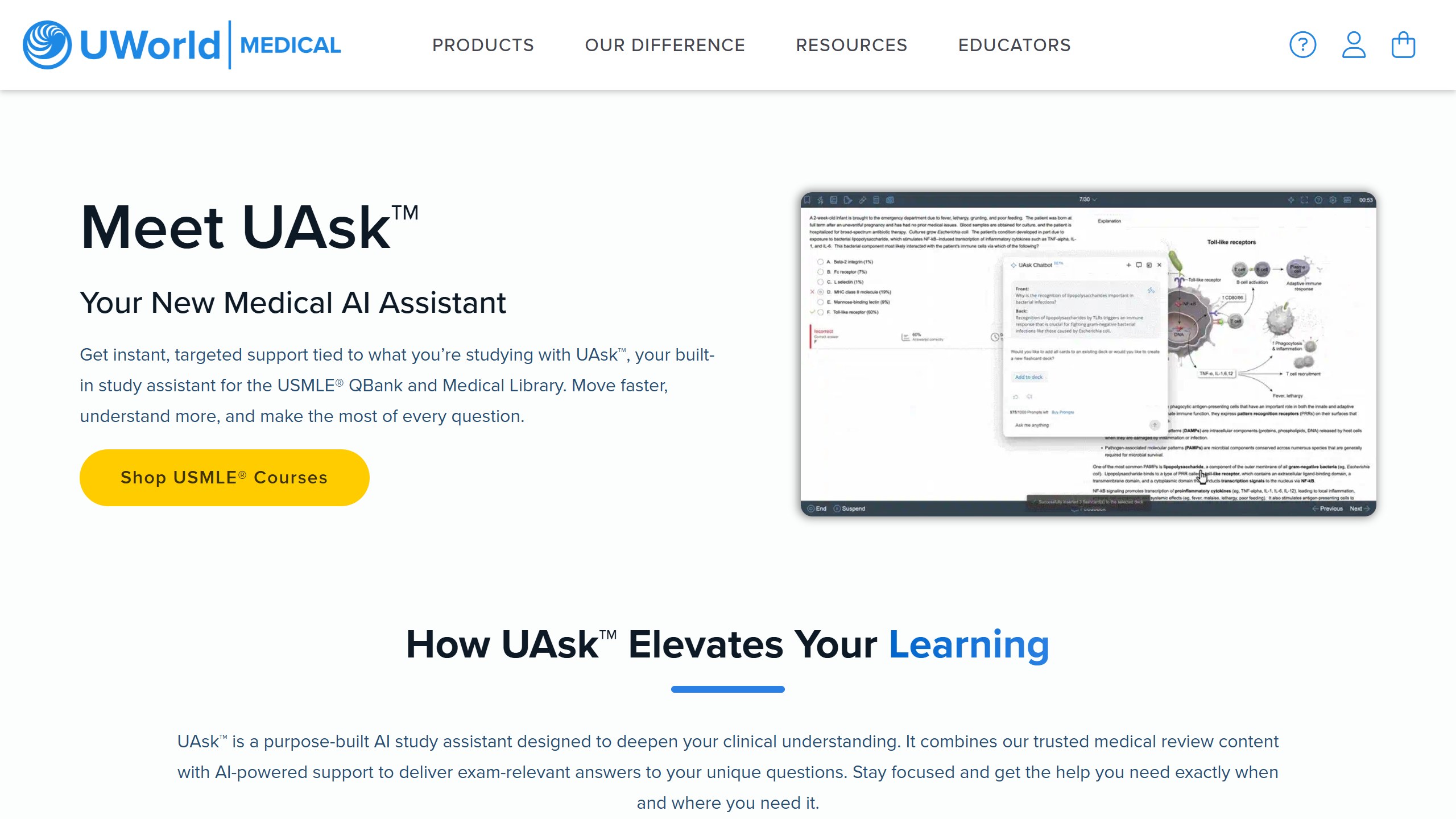
UWorld is direct about accuracy. Its FAQ says UAsk “is powered by AI and may occasionally make mistakes, so responses should be used thoughtfully within your UWorld study experience.” It also says UAsk “does not replace” traditional studying.
The detail other reviews miss is the prompt cap. On the Step 1 QBank page, the 30-day plan at $349 says “Access includes up to 100 prompts”. The 90-day plan at $459 includes up to 250 prompts and one self-assessment, and the 180-day plan at $519, the 360-day plan at $579 and the 730-day plan at $749 each include up to 1,000 prompts. QBank Plus adds medical videos for $99 more, from $448 for 30 days. UWorld’s own self-assessments cost $50 each or $120 for three, and each is “8 blocks of 20 questions”, which matches the new block length. The Step 2 CK page lists the same QBank prices and prompt caps.
Read the refund terms before buying. UWorld says “All refunds are evaluated on a case-by-case basis”, self-assessments are “non-refundable, non-transferable”, and it cannot refund in-app purchases made through Apple. One more oddity: UWorld’s menu still lists Step 2 CS, and its Step 2 CS page was still live with a “Buy Now” button on 28 October 2026, more than five years after the exam was discontinued.
The UWorld Medical iPhone app had 4.7 stars from 4,136 ratings and was updated on 28 September 2026. The Android app had 4.2 stars from 3.38K reviews, 500K+ downloads, and was updated on 3 October 2026.
Choose it if UWorld is already your main QBank and you want an AI that can see the question you are on. Skip it if you plan to lean on AI heavily during a short 30-day plan, because 100 prompts runs out fast.
2. AMBOSS: AI Mode Learning, on a library plus Qbank
AMBOSS describes AI Mode Learning as its “AI study copilot, designed to help learners turn questions and uploaded materials into trusted explanations, targeted practice, and clear next steps”. You can upload notes or slides, and AMBOSS says you can “upload a score report or missed questions from other sources and have AI Mode Learning explain what went wrong”, then get pointed to AMBOSS questions, articles and Anki cards. It says the AI “gets its information directly from AMBOSS content”. On price, the FAQ says “AI Mode is currently included in all AMBOSS subscriptions. We reserve the right to offer it within a Premium subscription in the future.”
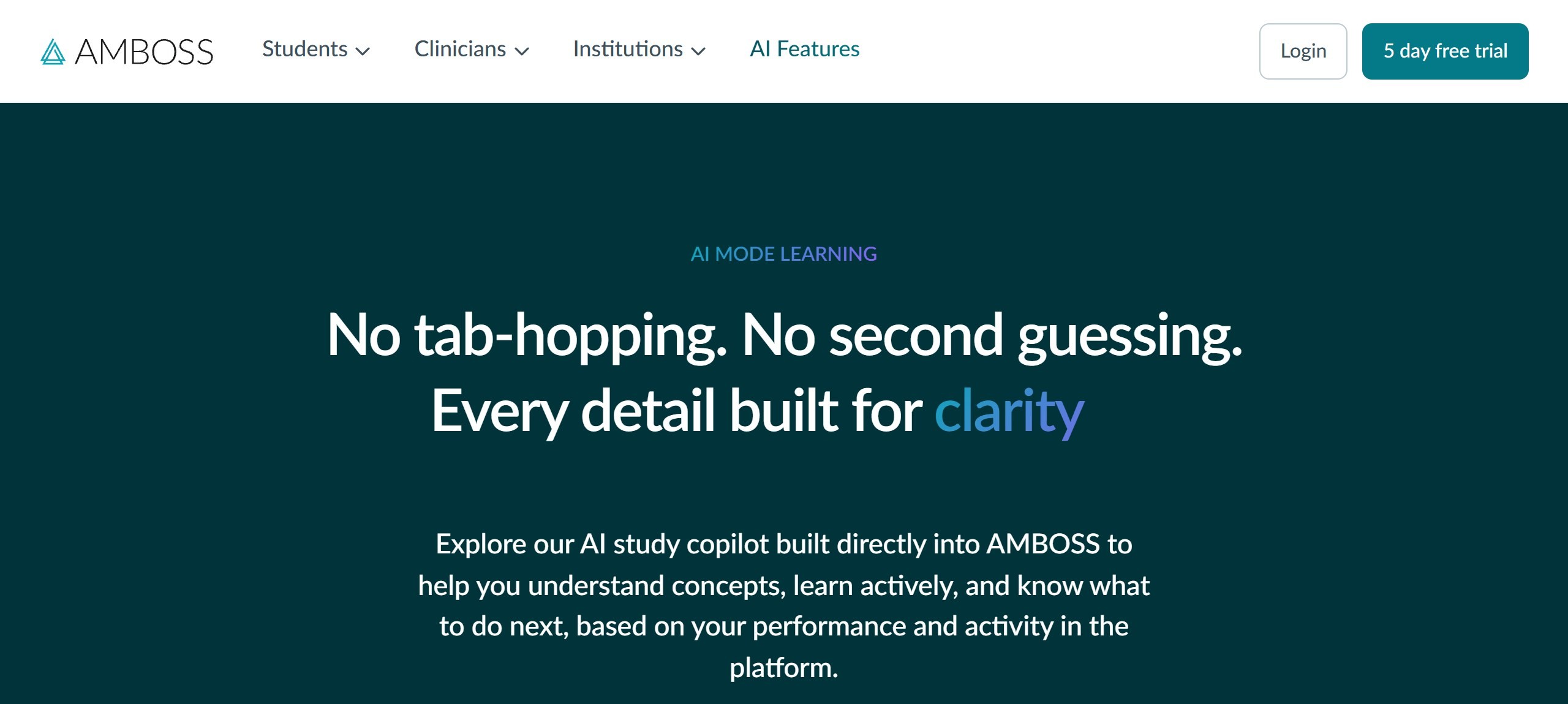
On accuracy, AMBOSS goes further than the other vendors here. Its AI principles page lists a “Hallucination-free guarantee”, saying it uses “continuous feedback loops and testing to prevent hallucinations and exclude misinformation”. We found no terms explaining what that guarantee covers or what happens if an answer is wrong, so treat it as a design goal and still check answers against the linked articles.
The pricing needs care. On the pricing page, the basic membership costs $19.99 a month or $12.50 a month billed yearly, and both include “50 Qbank questions a month”. Full Qbank access is extra. The USMLE page sells $298 for a 1-month Qbank plus a 1-year membership and $378 for a 6-month Qbank plus a 1-year membership, and both say “Membership renews yearly at $149 unless canceled.” Student Life costs $1,199 once and runs through the end of PGY-1, including the AMBOSS Step 1 and Step 2 CK self-assessments, which otherwise cost $49.99 each and have “160 timed questions in the NBME format”. There is a 5-day free trial and a 30-day money-back guarantee for purchases made directly from AMBOSS. The pricing page gives the question count as 13,900+ in one place and 13,000+ in another.
The AMBOSS iPhone app had 4.9 stars from 13,909 ratings and was updated on 13 October 2026, and the Android app had 4.9 stars from 8.56K reviews and 500K+ downloads.
Choose it if you want an AI that can take your NBME score report or another bank’s missed questions and turn them into a study plan. Skip it if you will forget to cancel; the packages renew at $149 a year.
3. Med School Bootcamp: unlimited AI prompts for Step 1
Med School Bootcamp from Bootcamp.com puts its AI inside each question: “Ask Bootcamp AI™ anything right inside the question.” Its FAQ takes a clear swipe at prompt caps: “Unlimited Ask AI prompts: Ask Bootcamp AI anything, without worrying about how many prompts you have left.” It has more than 2,500 Step 1 questions, each linked to a short video, and says it added “New question formats including SOAP-style, nutrition content, and longer stems”. Bootcamp calls itself “the only Qbank built for the updated Step 1”; that is the vendor’s claim, not something we can check.
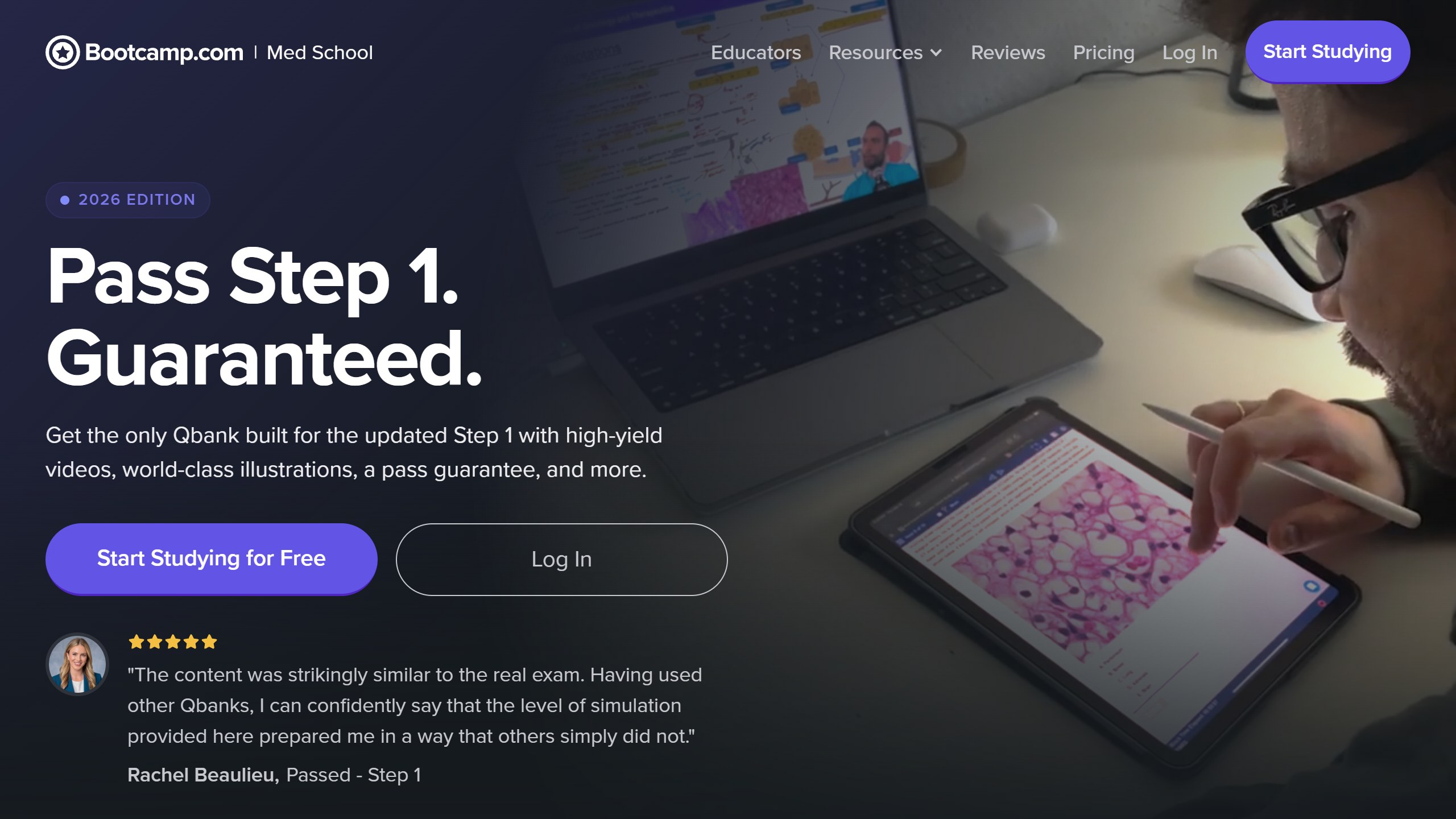
On the pricing page, Monthly Access cost $59 a month (shown against $79), one year $299 (against $349) and two years $449 (against $649). All three list “Ask Bootcamp AI™ Unlimited”, Step 2 Qbank questions and Step 2 crash course videos, though the main page describes Step 2 content as a preview that is still being rolled out. Treat it as a Step 1 product first.
The pass guarantee covers Step 1 on the one and two year plans only. Bootcamp says “If you fail Step 1 after meeting both of your Pass Targets”, it will “refund your entire payment”. You must buy at least 30 days before the exam, hit both Pass Targets on your Performance page, and be at an accredited medical program in the US or Canada, so students outside US or Canadian programs, including many international medical graduates, do not qualify.
The Bootcamp.com iPhone app, which covers all Bootcamp courses, had 4.9 stars from 17,943 ratings and was updated on 26 May 2026. The Android app had 4.8 stars from 3.36K reviews and was updated on 21 May 2026.
Choose it if you are studying for Step 1 and expect to ask the AI a lot of follow-up questions. Skip it if you need a mature Step 2 CK or Step 3 bank today.
4. Lecturio: an AI Tutor in the Qbank, and a frank warning
Lecturio sells a “Qbank with AI-tutor” with “2,200+ USMLE Step 1 questions, detailed explanations, and First Aid ® references”, and says “An AI-tutor will be at your side, assisting you in reaching the correct answer.” Premium plans also include an AI Assistant. Its pricing FAQ explains that the AI Assistant “is powered by all of Lecturio’s content”, that “AI is used to extract an answer, but doesn’t add or change anything to the content”, and then says plainly that “the answers provided by the AI Assistant are not reviewed by a medical professional, and as such, minor errors may occur.” It tells you to check the source materials.
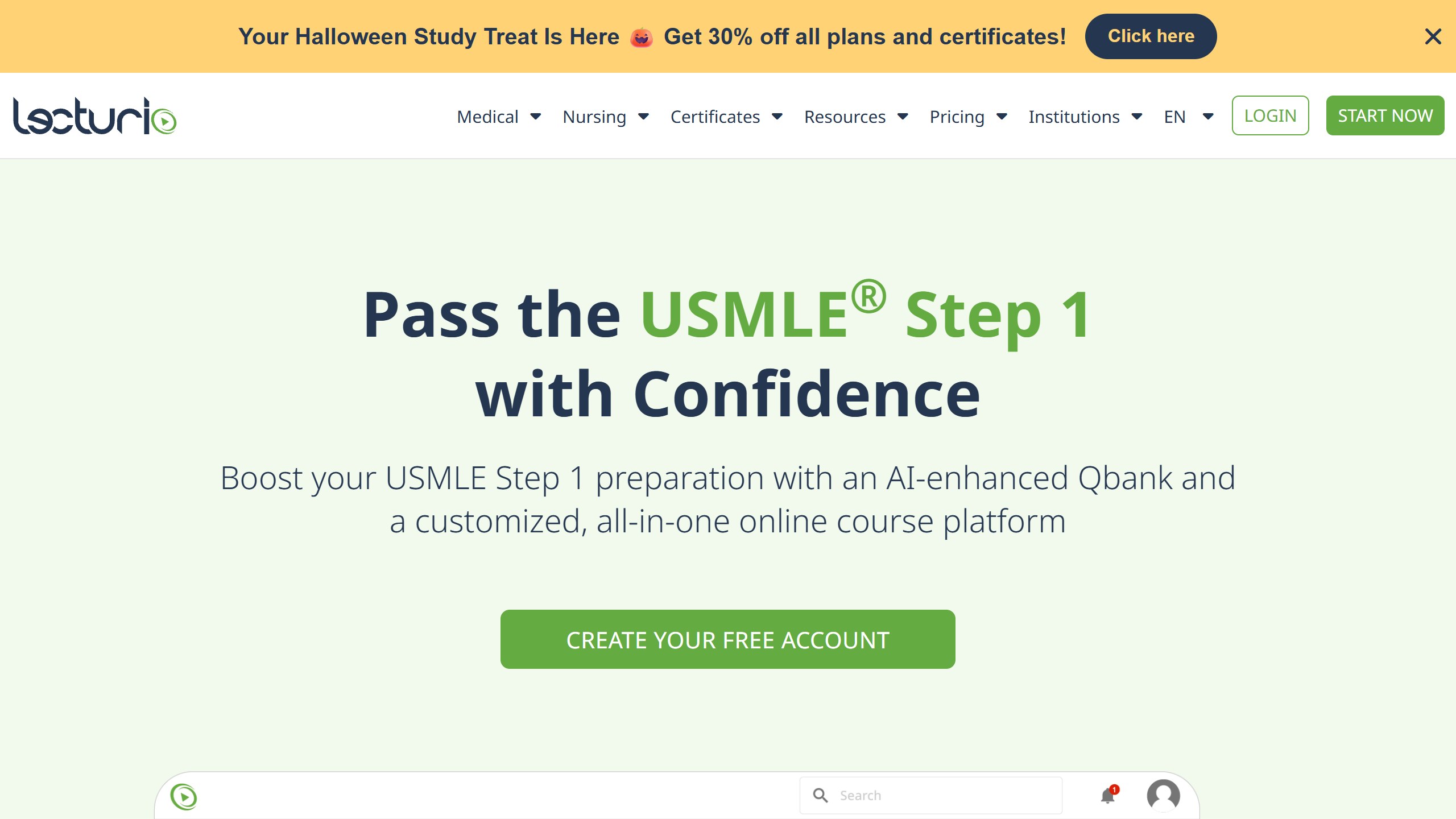
Prices were shown to us in rupees. Medical Premium, the plan with the Qbank and AI Tutor, was listed at ₹1049.30 a month, charged as ₹12591.60 a year, during a 30% Halloween offer (shown against ₹1499.00 a month). Plans come in 3, 12 and 24 month lengths, there is a 7-day free trial, and Lecturio says memberships “automatically renew at the end of each billing period” unless you switch it off.
Lecturio’s own Step 1 page also shows how fast the exam moved. Its FAQ still says Step 1 “is administered in seven 60-minute testing blocks with a maximum of 40 questions per block, with a total of 45 minutes of break time”, which was the format before 14 May 2026. Check that the timed-block settings you practise with match the 30-minute, 20-question format.
The Lecturio iPhone app had 4.8 stars from 4,280 ratings and was updated on 19 October 2026, and the Android app had 4.9 stars from 6.74K reviews and 500K+ downloads, updated on 21 October 2026.
Choose it if you learn from video lectures and want an AI tutor that nudges you toward the answer rather than giving it away. Skip it if you want AI answers that a clinician has reviewed.
5. Osmosis: AI chat grounded in Elsevier content
Osmosis says “Osmosis AI is now available with all student subscriptions! Ask a question and get an instant, clear explanation, grounded in trusted Elsevier content and reinforced by the Osmosis videos you already love.” Its plans page says Osmosis AI uses “conversational chat linked to trusted Osmosis videos & content”. The medical plan lists more than 1,700 videos, “2,700+ USMLE® Step 1-style practice questions” and an “Additional 2,900+ USMLE® Step 2-style practice questions”, plus high-yield notes and decision-making trees.
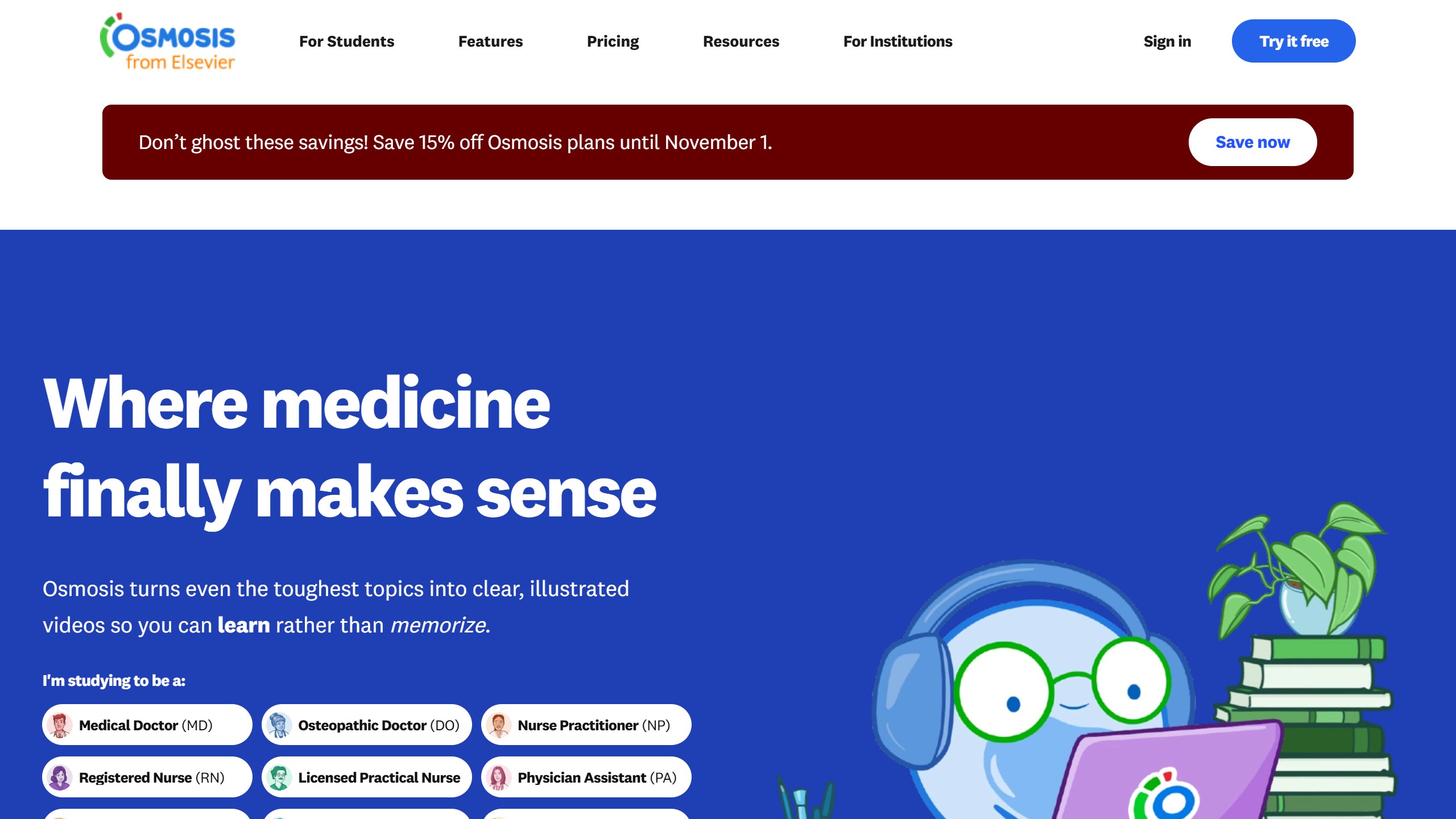
The pricing link sent us to a deal page priced in rupees: ₹11663 for 3 months, ₹18719 for 12 months (shown against ₹20799) and ₹29969 for 24 months (against ₹33299). We could not see US dollar prices from India. Osmosis says its app is available on iOS and Android, and the iPhone app had 4.8 stars from 3,884 ratings, updated on 15 October 2026.
Choose it if you are early in preclinical study and want short videos with an AI that explains them. Skip it if your dedicated period is close and you need a question bank as your main tool.
6. Sketchy Medical: AI patients for clinical reasoning
Sketchy is known for its visual mnemonic lessons, and its AI sits in a different place. Its Patient Case Simulations are “Clinician-created, powered by AI”: you “Chat with virtual patients and attendings” and “get questions and feedback from an attending”. The cases cover imaging and lab interpretation, differential drills and board-style vignettes. Sketchy’s homepage says 500+ cases, and its medical page says 405+. We found no AI claim for the lessons or the QBank themselves.
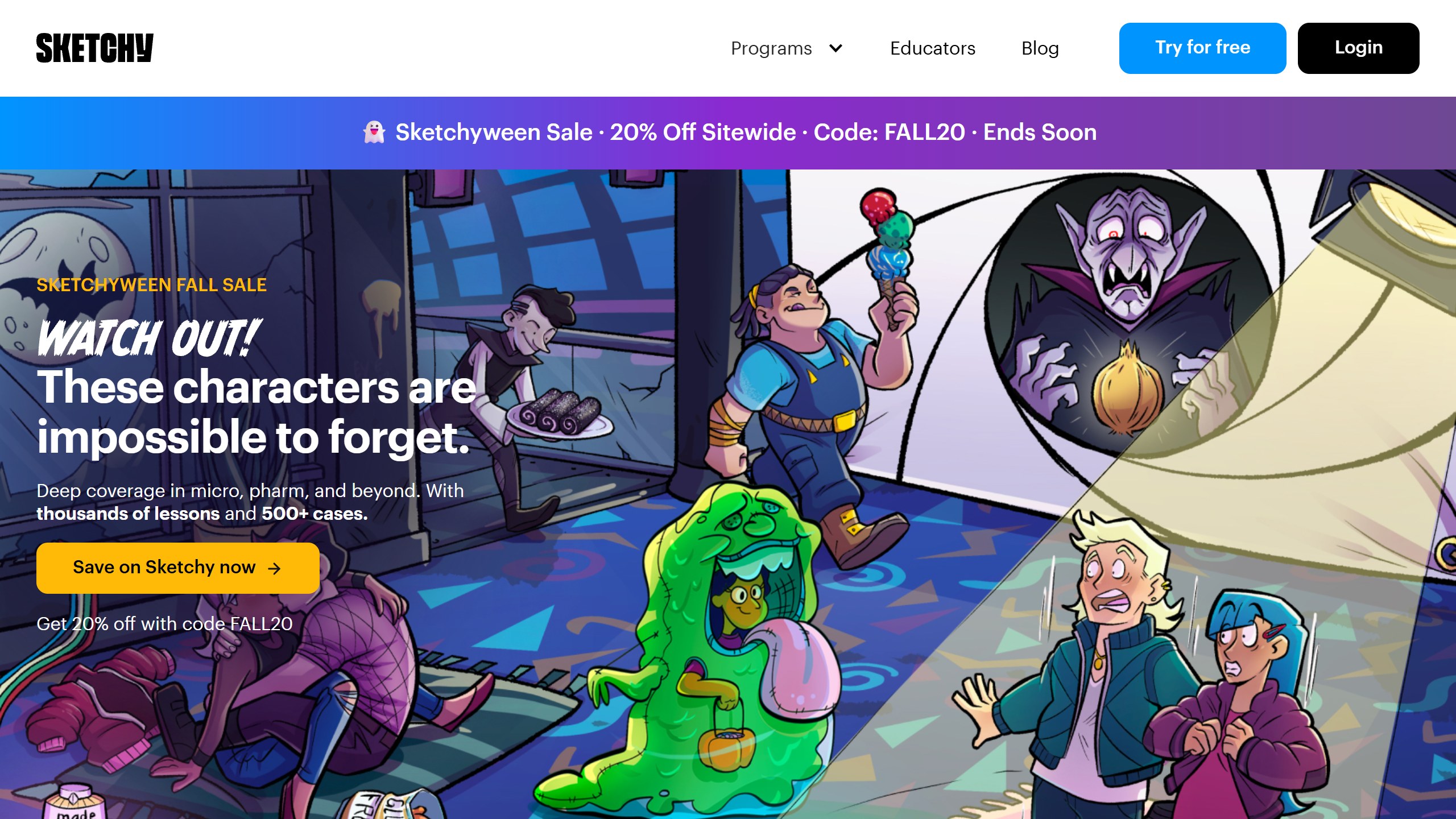
On the pricing page, Medical All access cost $349.99 for 6 months, $449.99 for 12 and $649.99 for 24, and a Cases only plan cost $19.99 a month or $119.99 a year. Every plan starts with a 7-day free trial.
The USMLE Step Pass Guarantee refunds “your last purchase payment”, not everything you paid, so if you bought six months and renewed for three, you get the three-month payment back. You need a 6, 12 or 24 month plan bought on the website, “At least 150 completed lessons across 2 or more months of usage”, enrolment in a US accredited medical or osteopathic program, and a claim within 60 days of your test date. It covers Step 1 or Step 2.
The Sketchy Learning iPhone app had 4.9 stars from 836 ratings and was updated on 3 April 2026.
Choose it if you want AI practice at talking through a case, alongside a separate main QBank. Skip it if you want an AI tutor on your board questions.
What we left out, and why
TrueLearn announces SmartInsights, which it calls “Your New AI Study Partner”, on its Step 1 page but gives no description of what it does, so we could not compare it; its SmartBank cost $149 for 30 days up to $419 for 545 days. USMLE-Rx sells Qmax for $299 for 12 months and an all-in-one bundle for $399 for 12 months, but we found no AI claim on its homepage or pricing page. Kaplan’s USMLE page made no AI claim, though it advertises “Pass the first time, or get your money back.” Boards and Beyond is now sold by McGraw Hill, and we found no AI claim for it on its product page. Anki has no AI of its own; AMBOSS and Bootcamp connect to it, and the paid AnkiMobile iPhone app had not been updated since 8 September 2025, while the free AnkiDroid app was updated on 18 October 2026. AI tutor startups such as iatroX publish their own rankings but had too few US App Store ratings to assess.
How to choose an AI USMLE prep tool
Start from your main question bank
Every vendor here that explains its AI says it answers from its own content: UAsk from UWorld, AI Mode from AMBOSS, Lecturio’s AI Assistant from Lecturio, Osmosis AI from Elsevier and Osmosis. So choose the question bank first and treat the AI as part of it. Our wider guide to AI tools for medical students covers the tools that help outside board prep.
Read the accuracy wording
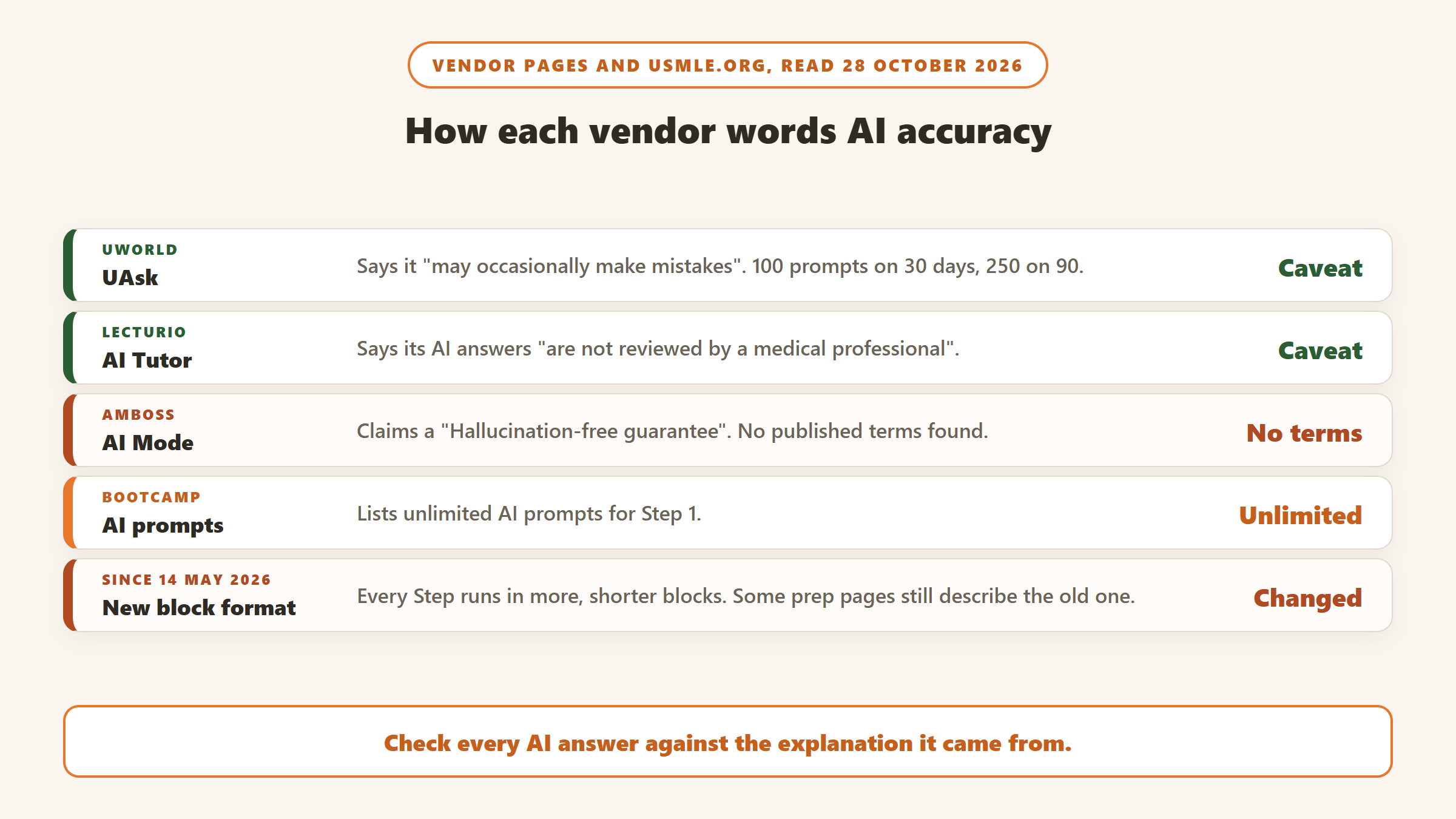
UWorld says UAsk “may occasionally make mistakes”. Lecturio says its AI answers “are not reviewed by a medical professional”. AMBOSS claims a “Hallucination-free guarantee” without published terms. Whichever you pick, check AI answers against the explanation or article they come from, and never take a drug dose, cut-off or guideline from a chat answer alone.
Check the AI limits and renewals
UWorld caps UAsk at 100 prompts on 30 days and 250 on 90 days. AMBOSS’s basic membership allows 50 Qbank questions a month, and its USMLE packages renew at $149 a year. Lecturio renews automatically. Bootcamp lists unlimited prompts. If you expect to use AI on most questions, the cheapest headline price may not be the cheapest plan.
Practise in the new block format
Since May 2026, Step 1 and Step 2 CK run in 30-minute blocks of up to 20 questions. Set your timed blocks to match, use the USMLE’s free interactive sample questions to learn the new interface, and be wary of any page that still talks about 40-question blocks or Step 2 CS.
Benchmark with NBME
Vendor self-assessments and score predictors are useful, but NBME’s forms are written by the exam’s co-sponsor. At $62 each, three spaced through your dedicated period cost $186, less than UWorld’s 30-day QBank plan at $349.
Use general chatbots carefully
A general chatbot does not know the USMLE content outline or your performance data, and it can be confidently wrong on medical facts. If you use one, use it to explain a concept you then check in your QBank or textbook. For flashcards made from your own notes, see our comparison of AI flashcard apps, and if you are still before medical school, our guide to AI MCAT prep tools covers the MCAT.
Sources
- USMLE: examination results and scoring, Bulletin of Information, scoring, Step 1, Step 2 CK, test delivery software update (14 May 2026), Designated Testing Dates timeline, Step 1 sample questions, Step 2 CS discontinued.
- NBME: self-assessments, CBSSA, CCSSA, CCMSA.
- UWorld: USMLE home, UAsk, Step 1 QBank, Step 2 CK QBank, Step 2 CS page, App Store, Google Play.
- AMBOSS: AI Mode Learning, AI principles, pricing, USMLE, App Store, Google Play.
- Bootcamp.com: Med School Bootcamp, pricing, App Store, Google Play.
- Lecturio: USMLE Step 1, pricing and FAQ, App Store, Google Play.
- Osmosis: homepage, plans, App Store. Sketchy: homepage, pricing, Step pass guarantee, App Store.
- Left out: TrueLearn, USMLE-Rx, Kaplan, Boards and Beyond, Anki.
- All store listings and web pages read 28 October 2026.

Written by
FazFaz is the founder of AIToolsBakery. Some tools here are tested hands on. Others are assessed from vendor documentation and pricing verified on the live page, and every review says which one it is. Sponsors can buy a position in a guide. They cannot buy the score, the criticism, or silence about a better option.
How we test and how we make money →