Search for AI help with the CPC exam and almost every result is written by someone selling the answer. App makers describe their own apps, course companies rank their own courses, and free study sites explain why their AI makes paid prep unnecessary. None of them starts where the exam starts. The Certified Professional Coder exam from AAPC is an open-book test. You sit it with your CPT, ICD-10-CM and HCPCS Level II code books beside you, and the skill it measures is whether you can find the right code, guideline or modifier in those books quickly and read the record correctly while the clock runs.
That changes what an AI study tool can do for you. A chatbot cannot sit the exam with you, and memorising codes matters far less than knowing your way around the manuals. So this guide starts with the exam facts from AAPC, including a change in 2025 that lets you choose between printed books and on-screen eBooks with search, then sets AAPC’s own practice exams and course as the benchmark. It covers AAPC’s own AI assistant, which is real but is not an exam tool. It then compares two third-party products that describe an AI study feature in their own words, and finishes with the well-known courses and question banks that make no AI claim.
How we put this together. We have not used these tools ourselves. Every price and feature below comes from the vendor’s own website or its App Store and Google Play listings, and the exam facts come from AAPC’s own pages and help centre, all read on 12 November 2026 and linked in the text. None of these companies paid to appear on this page, there are no affiliate links, and we are not affiliated with AAPC.
The CPC exam in 2026: what AAPC says
Read these facts before you spend anything. They decide which kind of practice is worth paying for.
Format and scoring
AAPC’s exam page says the CPC has 100 multiple-choice questions, taken in one sitting, with four hours to finish, which it works out as about 2.4 minutes a question. You can sit it at home with a live remote proctor or on a computer at a testing centre. Most questions are coding scenarios, and the exam ends with 10 cases that ask you to read a medical record and code it.
AAPC also publishes how the 100 questions split. Medical terminology and anatomy get 4 each, compliance and regulatory 3, coding guidelines 7, ICD-10-CM 5 and HCPCS Level II 3. Each of the six CPT surgery ranges, from the 10000 series to the 60000 series, gets 6 questions, so surgery accounts for 36 in total. Radiology, pathology and laboratory, medicine, and evaluation and management (E/M) get 6 each, anesthesia 4, and the cases 10. To pass you need 70% overall, which means at least 70 questions right. If you fail, AAPC tells you which areas scored 65% or less, and results arrive in your AAPC account in 7 to 10 business days.
The books you may use, and the choice you make since 2025
The approved books are the AMA’s CPT Professional Edition, plus an ICD-10-CM and a HCPCS Level II book from any publisher. AAPC says these are the only code books you are allowed to use. You may take the current year’s books, the previous year’s, or a mix, but only one copy of each. An online calculator is built into the exam platform, and physical calculators are not allowed.
Since January 2025, AAPC’s books for exams page says members can choose to take the exam with printed books or with eBooks, and its eBook page says you can change your mind up to 48 hours before the exam. The two formats behave very differently. AAPC’s help centre says you must choose one, not both. The exam eBooks are a standard set supplied by the exam platform rather than your own copies, they include a search feature, and they do not carry your personal notes, highlights or annotations. AAPC’s eBook page says search finds a code everywhere it appears, including the guidelines and the index, and that in its own study of members, 71% said they would rather use eBooks for a future exam. Printed books keep everything you have written in them, within AAPC’s rules.
Those rules are worth reading closely. The exam page allows handwritten notes in print books if they relate to day-to-day coding, but no long passages, nothing copied from study guides or practice exams, and no altering or printing over pages. On tabs, the exam page says they may be inserted, taped, pasted, glued or stapled as long as they only mark a page. AAPC’s own study tips page says taping, gluing or stapling anything into your code books is prohibited, including sticky notes. The two AAPC pages disagree, so follow the current exam page and confirm with AAPC before you tab your books.
Which code year, and the January blackout
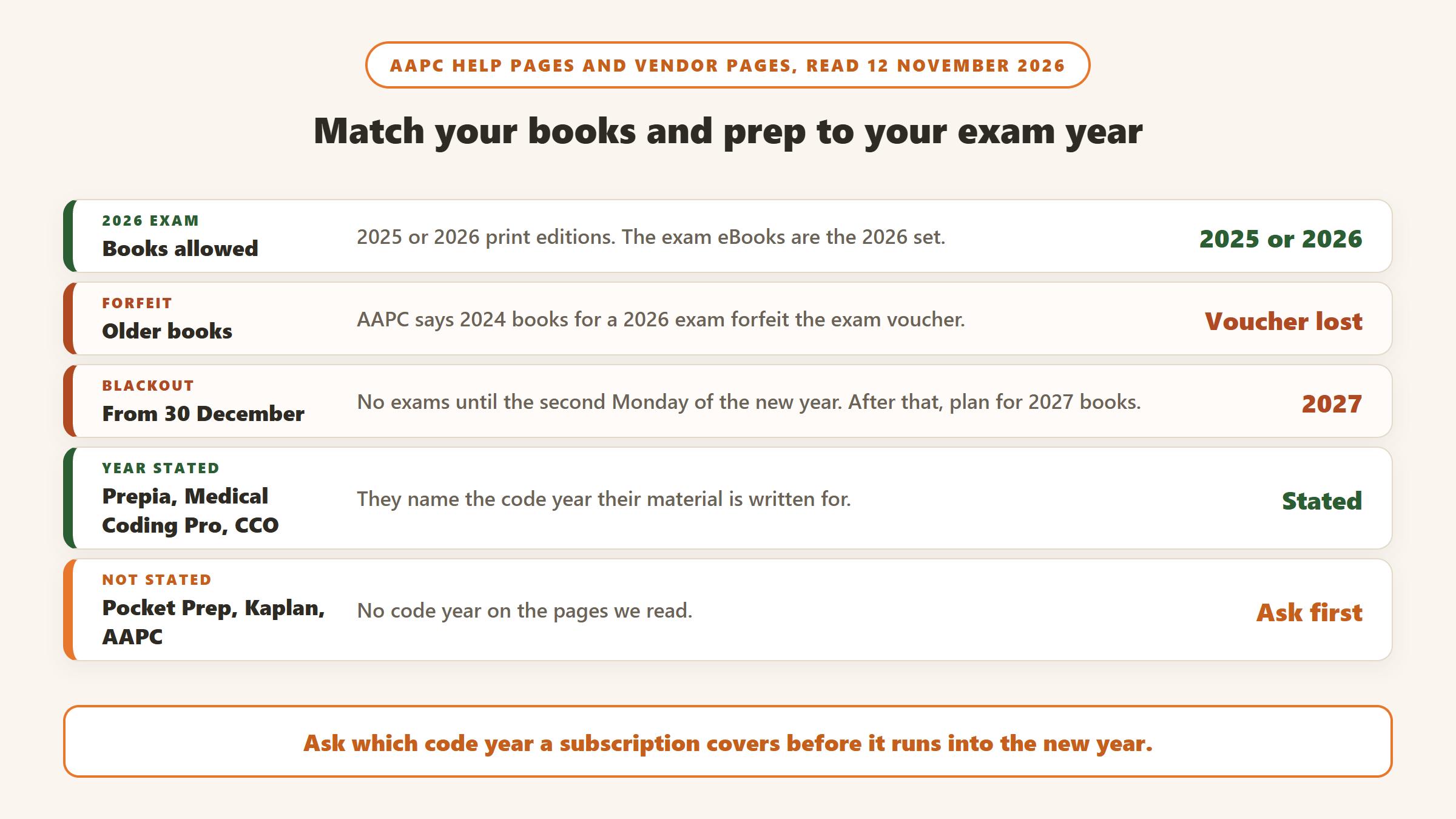
Code sets change every year, so the year your study material was written for matters. AAPC’s code book help article says that for the 2026 exam, 2025 and 2026 print editions are allowed, that only current-year eBooks are provided in the testing platform, and that older editions, such as 2024 books for a 2026 exam, would result in a forfeited exam voucher. AAPC also has an annual blackout period starting on 30 December, when no exams are given while the next year’s updates go in, and exams resume on the second Monday of the new year. If you plan to sit in early 2027, your material and your books need to match the 2027 code year, not the one you studied in this autumn.
Cost, attempts and the “A”
AAPC’s exam cost page lists the CPC at $425 for one attempt or $499 for two, with student pricing of $400 or $475. A voucher is valid for one year from purchase, and exam fees are non-refundable. The CPC overview page says you must register three weeks before your exam date, and that keeping the credential means holding an annual AAPC membership and earning 36 continuing education units every two years.
Passing does not make you a full CPC straight away if you are new to coding. AAPC’s apprentice page says that if you pass without two years of coding experience, your credential carries an “A” for apprentice: CPC-A. Its removal page lists the ways to drop the A: two years of verified coding employment, or one year of employment plus AAPC’s Practicode program or an 80-hour coding course. Practicode completion means at least 600 cases with an overall score of 70% or higher.
Why an open-book exam changes what AI can do for you
Many AI study tools are built to help you remember facts. The CPC does not ask you to remember codes; it asks you to find them and apply the guidelines under time pressure. AAPC’s study tips put it plainly: everything you need is in your code books, and the more familiar you are with them, the kinder the clock will be. That leaves three jobs where AI can genuinely help, and one where it cannot.
The first job is explaining why. When you miss a question about a modifier, a global surgery rule or an E/M level, an assistant that walks you through the reasoning, and points you to where the rule sits, saves you from repeating the mistake. The second is targeting. With 36 questions spread across the surgery ranges and 10 cases at the end, a tool that notices you keep missing the 60000 series or the cases can steer your practice there. The third is terminology and anatomy, 8 questions between them, where a chatbot is a quick way to check what a procedure involves.
The job AI cannot do is the one the exam is about: moving through your own books fast. No AI goes into the testing room, and nothing on a phone teaches your hands where the integumentary guidelines sit in your CPT book. Timed practice with your actual books open, in the format you will use on the day, is the part no app replaces.
The benchmark: what AAPC sells, and where its AI sits
AAPC writes the exam and sells its own preparation, so its products are the yardstick for everything else on this page. We treat them as the benchmark, not as a numbered entry.
AAPC practice exams and the CPC course
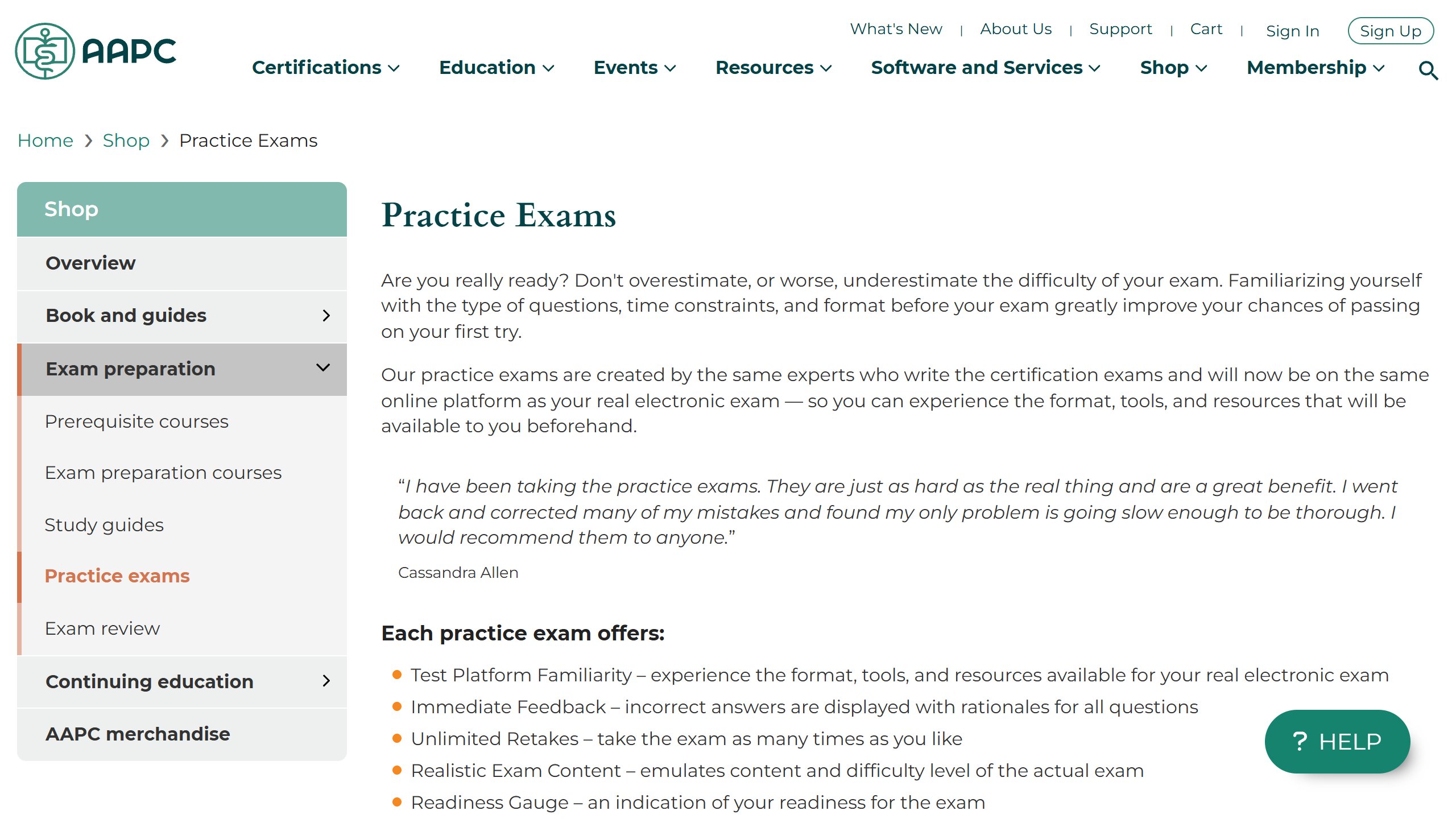
AAPC’s practice exams page sells six CPC practice exams, labelled A to F, each with 50 unique questions, in two bundles: A, B and C, or D, E and F. Each bundle costs $209.85, or $79.95 for AAPC members. AAPC says they are written by the same experts who write the real exam and now run on the same online platform as the electronic exam, with rationales for every question, unlimited retakes and a readiness gauge. AAPC’s help centre says access lasts one year from purchase, cannot be extended and is non-refundable.
The CPC online training course costs $2,299 for the self-paced course on its own. The Self-paced Career Package was shown at $2,799 and the Instructor-led Career Package at $3,499, under a 50% off offer with free books that the page says expires on 30 November. The packages add a year of AAPC membership, the Practicode virtual internship for removing the A, a one-year Codify subscription, three 50-question practice tests and one exam attempt. The self-paced course gives six months of access with options to extend, and the instructor-led course runs for 16 weeks. The page says AAPC’s pass rates are the highest in the industry but does not give a figure. Neither the practice exams page nor the course page describes an AI tutor.
Codie: AAPC’s AI, which stays outside the exam
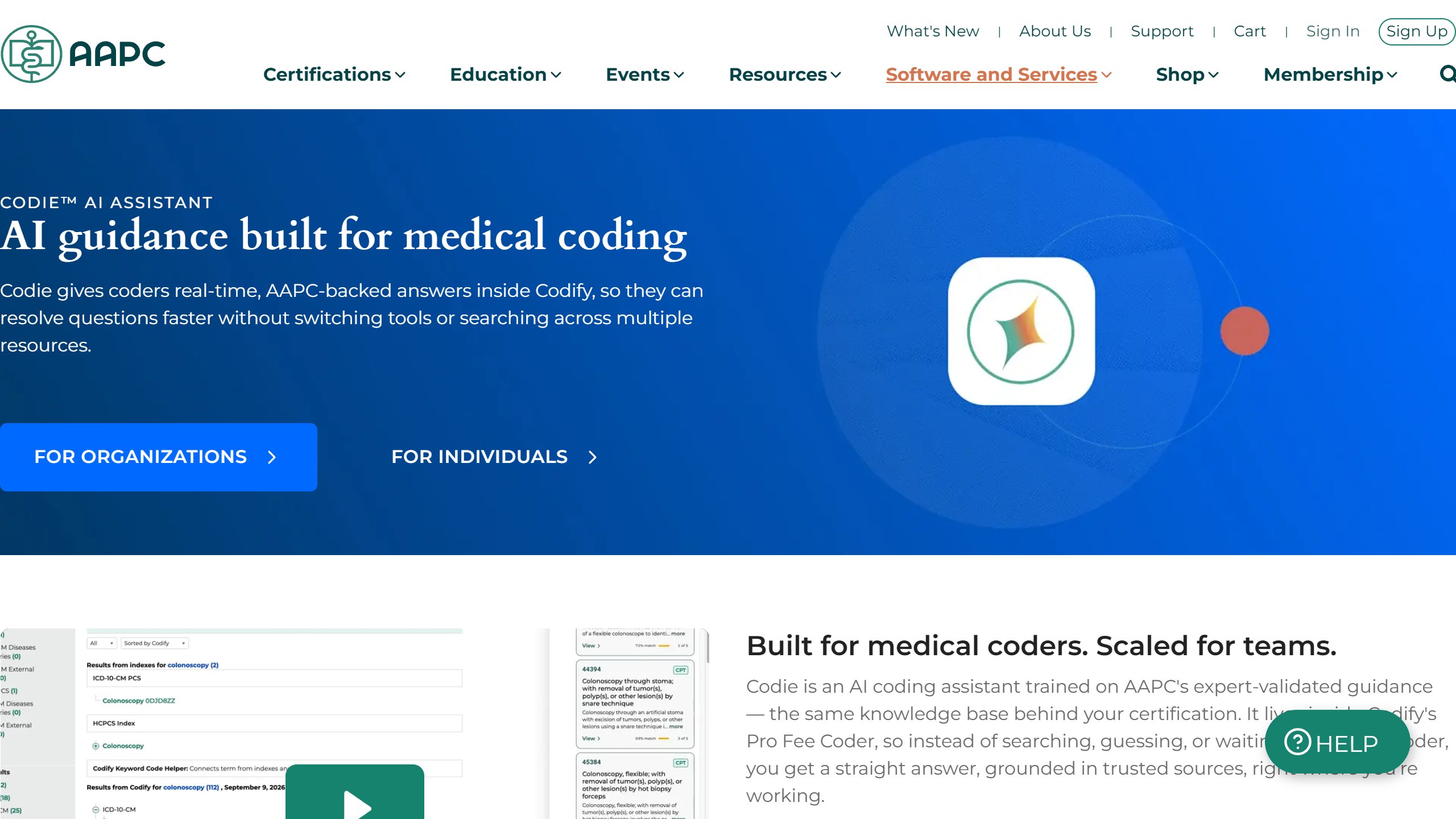
AAPC does have an AI product. Codie is an AI coding assistant inside Codify, AAPC’s online code lookup platform. AAPC says it is trained on AAPC’s expert-validated guidance and draws its answers from the data in Codify: code sets and guidelines, NCCI edits, coverage policies, fee schedules, crosswalks and six years of code history. In AAPC’s launch webinar, its staff said Codie is available in the Pro Fee and Complete Codify licences and gives citations to AAPC sources so you can see where an answer comes from.
Codie is built for working coders, not for exam practice, and it cannot come into the exam with you, since the approved code books are the only references allowed. It can still help a student who already has Codify understand a guideline while studying. AAPC’s career packages include a one-year Codify subscription, but the course page does not say which Codify tier that is, or whether Codie is part of it, so ask before you count on it.
That is the yardstick for the two tools below. Each has to offer something AAPC’s own material does not: a lower price, practice on a phone, or AI help on the questions you miss.
AI tools for CPC prep compared
| Product | What the AI does | Where the AI sits | Prices (12 November 2026) | Code year stated | Catch to check |
|---|---|---|---|---|---|
| Benchmark: AAPC practice exams and course | No AI tutor; AAPC’s Codie AI is a separate workplace tool in Codify | Codie: Pro Fee and Complete Codify licences | Practice bundles $209.85 (members $79.95); course $2,299; packages $2,799 or $3,499 until 30 November | Not stated on the pages | Practice access ends a year after purchase |
| Pocket Prep (Medical bundle) | Tutor chatbot coaches you through a quiz question without giving the answer | Quiz modes, not Mock Exams or Assignments | $15.99 a month, $39.99 for 3 months, $95.99 a year | Not stated | 1,050 CPC questions on the web, 750 in the App Store text |
| Prepia Medical Exam Prep | “AI targets YOUR weak spots” | Not stated; premium unlocks the full app | US App Store: weekly $6.99 to $11.99, monthly $16.99 to $24.99, 6 months $39.99 or $49.99 | “2025/2026-aligned” | Weekly plans; tracking identifiers on the privacy label |
How we chose and ordered these
AAPC’s own products are the benchmark, not numbered entries. Every numbered product had to describe an AI study feature in its own words, cover the AAPC CPC, be on sale or free to new users on 12 November 2026, and have been updated during 2026. We ordered them by how clearly the vendor explains what the AI does and where it sits, how closely the practice material follows AAPC’s published breakdown, and how plainly the price and limits are stated. The order says nothing about pass rates. AAPC does not rate third-party prep, and none of these vendors publishes an audited pass figure.
The two AI tools
1. Pocket Prep: an AI Tutor inside a question bank weighted like the exam
The AI. Pocket Prep’s Medical app introduced Tutor in its latest App Store release notes as an AI-powered learning partner that helps you reach the answer without simply handing it over. Its help article says Tutor is a chatbot available on the web and in the mobile apps, in every quiz mode except Mock Exams and Assignments. Each chat is tied to the question you are on, it may ask what you already know or why you picked an answer, and it can point you to textbook references. Pocket Prep says it draws on the same exam prep content used in its apps. For a CPC candidate, that is the “explain why” job: working through a missed modifier or E/M question until the rule makes sense.
Plans and price. The CPC exam page lists Premium at $15.99 billed monthly, $39.99 every 3 months or $95.99 billed annually, and you can try 30 questions free. Premium covers Pocket Prep’s whole medical catalog, which the web page counts as 20 exams. The pass guarantee is three extra months of Premium free if you do not pass, not a refund.
Fine print. The web page lists 1,050 CPC questions across 18 subjects, and the split tracks AAPC’s own breakdown closely: 63 questions for each CPT surgery range, radiology, pathology, medicine and E/M, 105 for cases, 42 each for anatomy, anesthesia and terminology, 75 for coding guidelines, 52 for ICD-10-CM and 31 each for HCPCS and compliance. That is roughly ten and a half times AAPC’s 100-question split. The App Store description says 750 CPC questions, so the two counts disagree. Neither page says which code year the questions follow, and the help article does not say whether Tutor is in the free tier. The app had 4.9 stars from 6,563 ratings on the US App Store, updated 30 October 2026, and 4.5 stars on Google Play from about 1,320 reviews, updated 6 November 2026.
Choose it if you want short phone sessions on a bank that mirrors the exam’s weighting, with a coach on the questions you miss. Skip it if you want AI help during full mock exams, because Tutor is switched off there by design.
2. Prepia Medical Exam Prep: weak-spot targeting on weekly plans
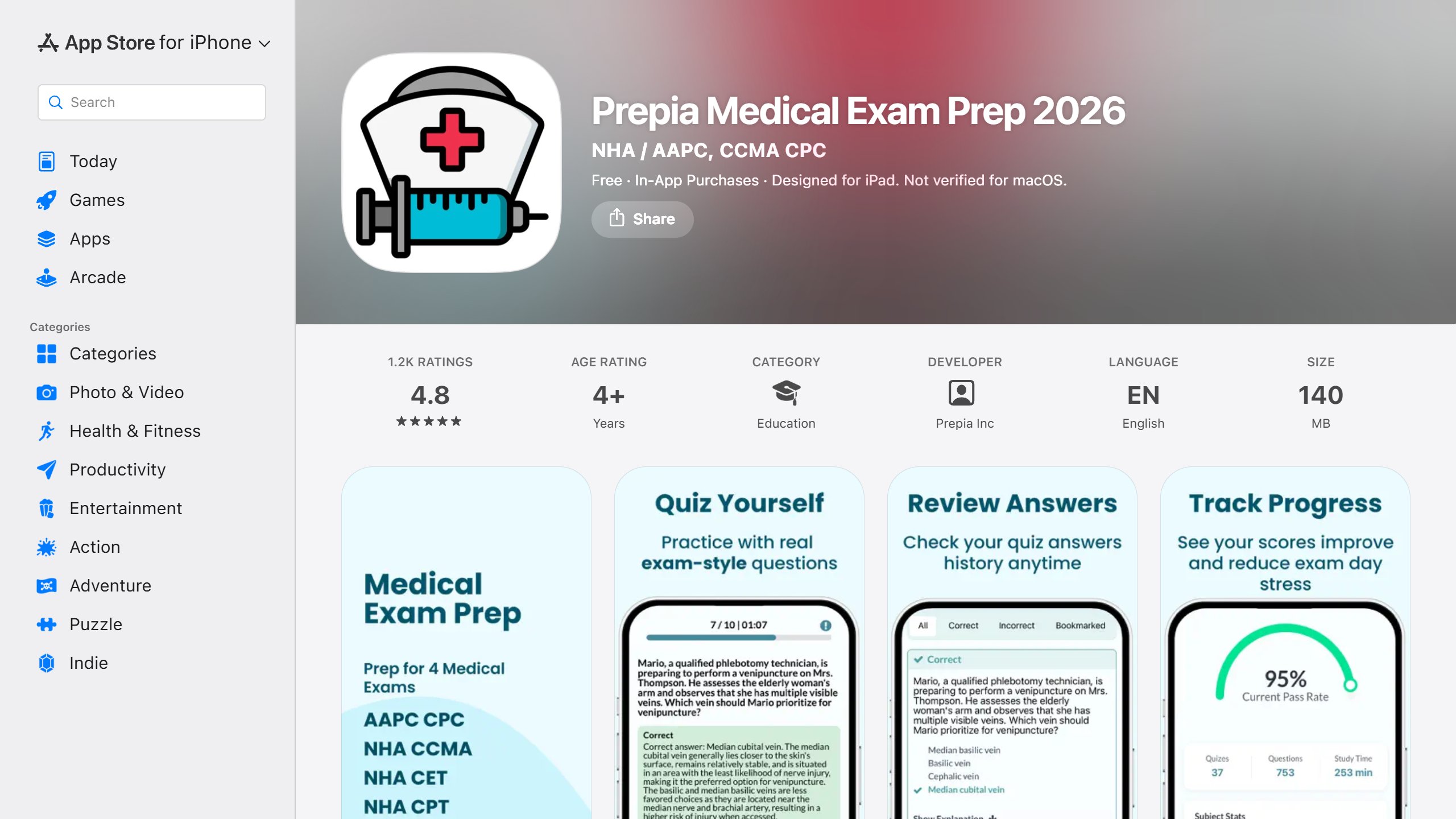
The AI. Prepia Medical Exam Prep 2026, sold by Prepia Inc, covers the AAPC CPC alongside three NHA exams for medical assistants, EKG technicians and phlebotomists. Its only AI wording is one line: “AI targets YOUR weak spots”. The rest of the listing describes a smart dashboard that finds weak areas, personalised study plans, real-exam simulations, CPT flashcards and more than 1,500 questions it calls 2025/2026-aligned. The listing does not describe a chatbot or explain what the AI does beyond targeting.
Plans and price. The US App Store listed ten subscription entries: weekly plans at $6.99, $7.99 and $11.99, monthly plans at $16.99, $19.99 and $24.99, and six-month plans at $39.99 and $49.99. Which one you see depends on the offer shown in the app, so check the renewal period before you tap. A weekly plan is the expensive way to buy it over a few months of study.
Fine print. The description opens with a “90% REPORTED PASS RATE” and “4.8 from 12K+ reviews” without saying how either was measured. On the day we read it, the app showed 4.8 stars from 1,201 ratings on the US App Store and 4.8 stars from 218 reviews on Google Play, so the 12,000 figure may count other Prepia apps. Its App Store privacy label lists identifiers under data used to track you. Prepia also sells a CPC-only app with 4.7 stars from 173 ratings and similar weekly and monthly plans, but that listing makes no AI claim. Prepia’s website lists dozens of exams, from nursing to ServSafe, so this is a catalog publisher rather than a coding specialist.
Choose it if you are also preparing for an NHA exam and want one app that steers you toward weak areas. Skip it if you want a clear explanation of what its AI does, or a plan you will not forget to cancel.
Courses and question banks that do not claim AI, and still matter
Many CPC candidates build their study around these. None describes an AI tutor on the pages we read, so they are not in the numbered list, but they pair well with one of the AI tools above.
Kaplan CertPrep. Kaplan’s CPC exam prep costs $29 and includes a 1,306-question bank, three practice tests that Kaplan says simulate real exam timing and format, and 340 flashcards, with a 3-day satisfaction guarantee.
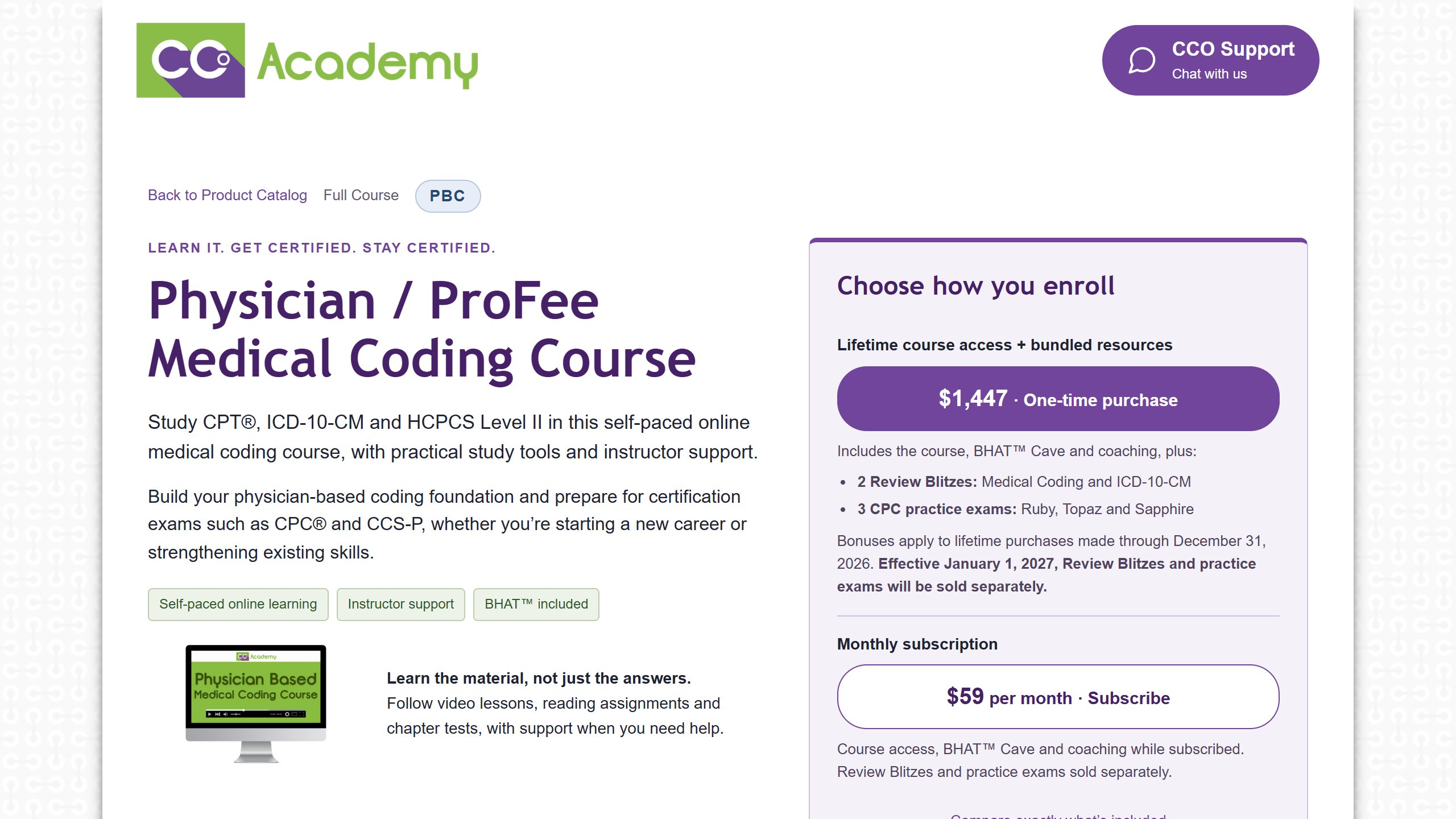
CCO (Certification Coaching Organization). CCO’s physician-based coding course, from the company founded by Laureen Jandroep, costs $1,447 as a one-time purchase with lifetime course access, or $59 a month while you subscribe. Its method, which it calls BHAT, for Bubble, Highlight and Annotate Technique, is about organising your code manuals so you can find guidance faster, which fits the open-book format. Note the date: CCO says its Review Blitzes and practice exams are bundled with lifetime purchases made through 31 December 2026, and sold separately from 1 January 2027. CCO’s CodeDrill question platform is listed as coming soon, with no launch date, and says its questions are current to FY 2026 ICD-10-CM and CY 2026 CPT.
Medical Coding Pro. The CPC Exam Study Guide is labelled the 2025 to 2026 edition and includes three full 100-question practice exams with rationales, 180 coding tips and bonus eBooks, with an online system that times and scores each test. The guide page says 300 questions while the homepage says more than 425, and the guide page did not show a price.
EZ Prep. The Medical Coding CPC Test 2026 app from EZ Test Prep had 4.9 stars from 119 ratings and was updated on 18 September 2026. It describes adaptive questions and an exam simulator, and a pass guarantee that refunds your money with terms to check. Its in-app purchases ranged from $9.99 to $64.99 and were still named 2025.
What about ChatGPT or another general chatbot?
A general chatbot is the baseline every reader already has, and for CPC study it can explain what a procedure involves, define a term or describe the general idea of a modifier as many ways as you ask. That helps with terminology and anatomy. For codes, it is risky. A chatbot can state a CPT or ICD-10-CM code that does not exist, attach the wrong descriptor to a real one, or apply last year’s guideline with full confidence, and it does not know which code year you are sitting. AAPC makes the same point about general AI in its Codie webinar. Use a chatbot to explain a concept, then check the code and the guideline in your own book every time. For working on medical terms and anatomy, our guide to AI tools for medical students covers tools that explain clinical concepts, and our guide to AI flashcard apps covers spaced repetition decks for the terminology questions.
What we left out, and why
We did not number AAPC’s practice exams, course or Codie, because AAPC writes the exam and they are the benchmark set out above. We did not number Kaplan, CCO, Medical Coding Pro or EZ Prep because none describes an AI feature on the pages we read. Several App Store apps with AI wording were too small to judge, with between 0 and 2 ratings. One app that claims artificial intelligence for tracking had not been updated since November 2025, before the 2026 code year, and one CPC app with 17 ratings reuses another company’s feature wording almost word for word. Two other CPC apps with about 100 and 190 ratings had also not been updated since late 2025. A CPC specialization on Coursera had 7 reviews and named no AI tutor. OpenExamPrep advertises a free AI tutor with a daily limit, but, as with our TEAS and HESI guides, we could not establish who runs it. We could not find an ABC Elearning CPC app on the US App Store. AHIMA’s CCA exam, a different coding credential with 105 questions in two hours and a fee of $199 for members or $299 for non-members, needs its own guide. If you are choosing compliance training for a coding team rather than preparing for the CPC, our guide to AI tools for healthcare compliance training covers that.
How to choose an AI tool for CPC prep
Pick your book format first
Decide between printed books and AAPC’s exam eBooks before you build a study plan, since you can change your choice up to 48 hours before the exam. Exam eBooks give you search but none of your notes or highlights. Print gives you your tabs and notes but no search. Whichever you choose, do your timed practice that way, and if you choose print, check AAPC’s current rules on notes and tabs, since two of its pages disagree on tabs.
Match the code year to your exam date
If you sit in 2026, 2025 or 2026 print books are allowed and the exam eBooks are the 2026 set. If you sit after the January blackout, plan for 2027 books. Pocket Prep, Kaplan and AAPC’s own practice exams do not state a code year on the pages we read; Prepia says 2025/2026, Medical Coding Pro says 2025 to 2026 and CCO’s upcoming CodeDrill says 2026. Ask before you buy a subscription that runs into the new year.
Find where the AI actually sits
At Pocket Prep, Tutor works in quizzes but not in mock exams. At Prepia, the AI wording is one line about weak spots, on plans that can bill weekly. At AAPC, the AI is Codie inside Codify, a workplace tool rather than an exam tool. If AI help is the reason you are paying, read the help pages, not the headline.
Practise the cases and the surgery ranges
Thirty-six questions come from the six CPT surgery ranges and ten from the cases, which together make up nearly half the exam. Use the AI to work through the ones you miss, and make sure your practice includes full medical record cases, not only one-line questions.
Budget for the whole path
Add the exam fee of $425 or $499 for two attempts, the code books, and an AAPC membership, which AAPC says you must keep to maintain the credential. AAPC’s practice exams cost far less for members, so weigh the membership fee against that saving. Watch subscription renewals on apps, and remember that a voucher and AAPC practice exams both expire a year after purchase.
Verdict
Start with the exam owner. AAPC’s practice exams run on the same platform as the real electronic exam, and at $79.95 a bundle for members they make a close rehearsal for the real thing. For AI help, Pocket Prep is our first pick: its Tutor coaches you through missed questions on a bank weighted like AAPC’s breakdown, for $95.99 a year, though it stays switched off in mock exams. Prepia makes sense mainly if you are also sitting an NHA exam, and only on a plan you will remember to cancel. If you want more questions without AI, Kaplan’s $29 bank is a cheap extra set, and CCO’s course suits someone who wants a full course built around marking up the manuals. A general chatbot is fine for terminology and anatomy, never for the final code. Whatever you choose, decide on print or exam eBooks first, practise with those books open and the clock running, and check every code an AI gives you against the book you will have on exam day.
Sources
- AAPC: taking the CPC exam, CPC overview, study tips, apprenticeship status, removing the A, exam cost, voucher validity, refunds, blackout period, books for exams, eBooks in exams, eBooks vs printed books, code book requirements, practice exams, practice exam access, CPC course, Codie, Codie webinar.
- Pocket Prep: CPC page, Tutor help article, App Store listing, Google Play listing. Prepia: Medical Exam Prep listing, CPC app listing, Google Play listing.
- Non-AI products: Kaplan CertPrep CPC, CCO course, CCO CodeDrill, Medical Coding Pro, EZ Prep app. AHIMA: CCA.
- All pages read 12 November 2026, except that dates in the text are those shown on each page.

Written by
FazFaz is the founder of AIToolsBakery. Some tools here are tested hands on. Others are assessed from vendor documentation and pricing verified on the live page, and every review says which one it is. Sponsors can buy a position in a guide. They cannot buy the score, the criticism, or silence about a better option.
How we test and how we make money →