If you want to fly a drone for pay in the US, you need a Remote Pilot Certificate, and for most people that means passing one FAA knowledge test: 60 multiple-choice questions in two hours at a testing centre, with about $175 riding on each attempt. Search for AI Part 107 test prep and the first page is mostly prep companies comparing themselves with each other, plus app-tracking sites that repeat App Store blurbs. Several apps now promise an AI tutor. Very few of those pages mention two changes to the test itself.
The first came on 29 September 2025, when the test moved to a new blueprint that puts nearly half the questions on regulations and only 5% on weather. The second came on 26 October 2026, when the FAA started adding questions with images from current sectional charts that are not in the printed testing supplement candidates are handed at the test centre. Both matter more than any AI feature, because they decide whether the questions you practise look like the ones you will see. This guide sets out what the FAA and its testing contractor PSI publish, which free official material covers what, and then compares the prep products that describe an AI feature on what the AI does, which plan it sits on, what it costs and what the guarantee asks of you. There is a short section at the end for private pilot students facing the written test.
How we put this together. We have not used these tools ourselves. Every price and feature below comes from the vendor’s own website or its US App Store listing, and the test facts come from faa.gov, FAA testing documents and PSI’s candidate bulletins, all read on 19 November 2026 and linked in the text. Prices are US dollars as listed that day, and some prices were seasonal Black Friday offers, so treat every figure as a dated snapshot. None of these companies paid to appear on this page, and nothing here is legal or flight safety advice.
What the Part 107 knowledge test is, according to the FAA
Prep sites restate the FAA’s rules with small differences, and some of them still quote the pre-2025 blueprint, so these facts come straight from the FAA and PSI.
Format, score and fee
The test is called Unmanned Aircraft General, Small, or UAG. The FAA’s Become a Drone Pilot page says you must be at least 16, able to read, speak, write and understand English, and in a condition to fly safely, and you must pass the UAG. The FAA’s testing matrix, revised on 25 September 2026, lists the UAG at 60 questions, two hours and a passing score of 70, with a minimum age of 14 to sit the test, so you can pass it before you are old enough to hold the certificate. No instructor endorsement is needed, which sets it apart from the private pilot written test.
PSI’s UAG applicant bulletin, effective 29 September 2025, adds detail. You get 60 scored questions plus 5 unscored validation questions that the FAA uses to try out new items, and the 120 minutes covers all 65. You need 70% of the scored questions correct, which is 42 of 60. The test centre supplies the testing supplement book, scratch paper and a pen, and the testing software has a built-in four-function calculator. If you fail, you wait 14 days and bring your failed test report to retest. The FAA’s cost FAQ says testing centres charge approximately $175 for the initial test, and that fee is paid again for every retake.
The September 2025 blueprint
| Content area | ACS area | Share of questions |
|---|---|---|
| Regulations | UA.I | 48% |
| Airspace Classification and Operating Requirements | UA.II | 20% |
| Weather | UA.III | 5% |
| Loading and Performance | UA.IV | 2% |
| Operations | UA.V | 25% |
These weights come from PSI’s bulletin, which says they were set by an industry-wide job task analysis completed in 2025. The FAA’s August 2025 Airman Testing Community Advisory explained the change: PSI’s assessment of the UAG was put into effect on 29 September 2025, the topics themselves did not change, the time allowed did not shrink, and the blueprint in the Remote Pilot Airman Certification Standards (ACS) became obsolete until the ACS is updated. In practice that means regulations questions, such as operating limits, waivers, operations over people and Remote ID, now make up nearly half the test, and weather is about three questions out of 60. Airspace, which is where sectional charts come in, is one question in five.
That is worth knowing before you choose a prep product. Many Part 107 guides spend pages on decoding weather reports, which is useful, but on the current blueprint it is a small slice of your score. A bank that spreads its questions evenly across the five areas is not weighted like the test.
The October 2026 change: chart images not in the supplement
For years the airspace questions pointed you to a figure in the printed testing supplement, FAA-CT-8080-2H, which the FAA’s supplements page lists for sport, recreational, remote and private pilots, and which the matrix dates to 2018. Because the figures were public, many prep apps built their chart practice around them. The FAA’s October 2026 Airman Testing Community Advisory says that is changing. Under what it calls the Graphics Conversion Project, images are being embedded directly in test questions, and as of 26 October 2026 the UAG and Instrument Rating Airplane tests “began featuring image-based questions not included in the test supplements”, using clearer, up-to-date images from the latest sectional charts.
The same advisory says the embedded images cannot be previewed, that candidates will keep their supplement until the FAA sets and announces a removal date, and that candidates should use the sample questions on PSI’s site to get used to the new format. It also notes that PSI will move FAA testing to a new scheduling and check-in platform in the first quarter of 2027. The practical point: practising only on supplement figures is no longer enough. You need to be able to read a current sectional chart you have never seen before, and any app that says its chart questions are up to date should be able to tell you which charts they use.
What people miss, and how many pass
The FAA publishes knowledge test statistics. Its calendar year 2025 report counts 73,914 UAG tests with a pass rate of 82.96% and an average score of 79.31%, so roughly one attempt in six failed. The FAA’s frequently missed ACS codes report for July 2024 to June 2025 lists codes that test takers missed more than 70% of the time. The one UAG code on it is UA.I.E.K13, which the Remote Pilot ACS defines as the Declaration of Compliance, part of the operations over people rules, missed 78.58% of the time. Those rules arrived on the test on 6 April 2021, according to the FAA’s 2021 testing notice, along with Remote ID and night operations, so older prep material is weakest exactly where test takers struggle.
After the test: IACRA, the TSA check and recurrent training
The FAA’s steps run in a fixed order. Before you book, create a profile in IACRA, the FAA’s online application system, to get an FAA Tracking Number. Book the test with PSI and bring a government photo ID. After you pass, complete Form 8710-13 in IACRA using the 17-digit Knowledge Test Exam ID from your report, which the FAA says can take up to 48 hours to appear. Once the TSA security background check is done, you get an email with instructions to print a temporary certificate, and the permanent card follows by post.
The certificate does not expire, but to keep flying under Part 107 you must complete recurrent training within the previous 24 calendar months. The FAA’s recurrent course, ALC-677 on FAASafety.gov, is online and its course page lists the cost as No. Nobody needs to pay for recurrent prep, whatever a prep app’s listing implies.
The official benchmark: free FAA and PSI material
PSI’s free sample test
What it is. The FAA does not publish live test questions, but PSI’s bulletin says a free sample test is available on PSI’s FAA site under Exam Resources, in the Unmanned Aircraft Systems category. The FAA’s advisories say PSI has added enhanced sample content and point candidates there for the new image-based format.
Price. Free.
Fine print. PSI says the sample questions do not represent the full range of content or difficulty of the real test, so treat it as a look at the format, not a readiness score.
Choose it if you want to see how questions and images appear on the PSI screen before test day. Skip it if you need volume; it is a sample, not a bank.
The ACS, the testing supplement and the FAA study guide

What it is. The Remote Pilot ACS (effective 6 April 2021) lists every knowledge element the test can draw on, coded the same way as the missed-topic codes on your test report, so a failed report tells you exactly which ACS lines to reread. The supplement, FAA-CT-8080-2H, holds the charts and figures the test still references. The FAA’s Remote Pilot Study Guide, FAA-G-8082-22, is a free 88-page PDF that explains the rules, airspace, weather and charts.
Price. All free on faa.gov.
Fine print. The study guide is dated August 2016. It predates the 2021 rule changes on operations over people, Remote ID and night flight, which now sit inside the 48% regulations area, so pair it with the current rule text and AC 107-2A, the FAA’s small UAS advisory circular, which the FAA’s 2021 notice lists among its references. The ACS blueprint percentages are the ones the FAA has called obsolete; use PSI’s bulletin for the weights.
Choose it if you want the source material every paid product is built from, at no cost. Skip it if you need timed practice and explanations; none of this quizzes you.
AI Part 107 test prep compared
| Product | What the AI does | Plan that includes the AI | Price (19 November 2026) | Current-test claims | Guarantee |
|---|---|---|---|---|---|
| FAA and PSI official material | No AI | n/a | Free; test fee about $175 | The source | n/a |
| Rotate Pilot Part 107 Pass | AI tutor on every question; “Explain it back” | The $69 Pass | $69 once, lifetime access | Exams weighted like the 2025 test; 87 questions on current sectionals | Refund plus $175 retest, with conditions |
| ABC Elearning FAA PART 107 Practice Test | Mentora AI tutor explains rules and concepts | Pro subscription | $9.99 a week, $19.99 a month, $39.99 a quarter, $69.99 a year | None stated | None found |
| AprentisAi FAA Part 107 Pilot Prep | AI instructor avatars present lessons; adaptive path | The course | No public price | None stated | “Guaranteed Success” line, no terms found |
How we chose and ordered these
Every product had to sell Part 107 test prep to US candidates on 19 November 2026 and describe an AI feature on its own pages or App Store listing. Apps also needed enough US ratings to judge, which ruled out a long tail of recent clones. The FAA and PSI material sits first as the benchmark because it is what the test is built from. The numbered list is ordered by how clearly the vendor explains its AI, how plainly it prices access to it, and whether it says it has caught up with the September 2025 blueprint and the October 2026 chart change. Rotate Pilot states all three. ABC Elearning has nearly 2,000 App Store ratings but says nothing about either change and bills weekly. AprentisAi describes its AI but shows no price. Pilot Institute, Drone Pilot Ground School and Aeroapps show no AI, so they have their own section. The order says nothing about pass rates, because every pass rate a vendor quotes is its own figure.
The AI tools
1. Rotate Pilot Part 107 Pass: an AI tutor and current chart questions for $69

The AI. Rotate Pilot’s Part 107 Pass page lists an AI tutor on every question that answers why an answer is right in plain English, and an “Explain it back” mode where you put an answer in your own words and the tutor points out gaps. It does not name the model behind the tutor. Around it are 32 written lessons of 10 to 20 minutes each, with no videos, 470+ practice questions with explanations, 543 spaced-repetition flashcards, a METAR decoder and full timed exams of 60 scored and 5 unscored questions on a 120-minute clock, which Rotate says are weighted like the 2025 test. It also lists 87 chart questions on current sectionals for the image questions the FAA added on 26 October 2026, and offers 13 chart questions free. Of the three AI products here, it is the one that addresses both recent changes.
Plans and price. $69 once, with lifetime access and no subscription, and a 30-day refund as long as you have not finished the course. It includes a drone business template kit that Rotate also sells for $49. Rotate also runs a wider subscription platform for pilot exams, and its pricing page is a different picture: a free tier, First Officer at $14.99 a month, and Captain at $29.99 a month, which is the tier where the grid lists the AI tutor, at 100 questions a day. A $9.99 single-exam pass for 30 days also lists the AI tutor. If you only want Part 107, the $69 Pass is the simpler buy; check which product you are paying for at checkout.
Fine print. The Part 107 guarantee asks you to finish every lesson and score 85% or more on three full 60-question practice exams in the 30 days before your test. If you then fail on your first attempt and send your test report within 30 days, Rotate refunds what you paid and adds $175 toward the retest, one claim per purchase. The subscription plans have a separate, smaller guarantee with different conditions. Rotate is a young operation: the Pass page names a Part 107 instructor, Max Bennedeto, the About page names the founder as Renzo Madueño, a former Airbus A320 first officer, and the subscription pricing page showed “Join 35+ student pilots”. Rotate also writes many of the Part 107 comparison pages you will find in search, including ones about the other courses on this page, so read those as a competitor’s view. It says it is not affiliated with the FAA or PSI.
Choose it if you want an AI tutor, a bank built for the current blueprint and practice on current sectional charts, for one payment. Skip it if you learn better from video, or want a provider with a longer track record.
2. ABC Elearning FAA PART 107 Practice Test: the Mentora tutor on a weekly subscription
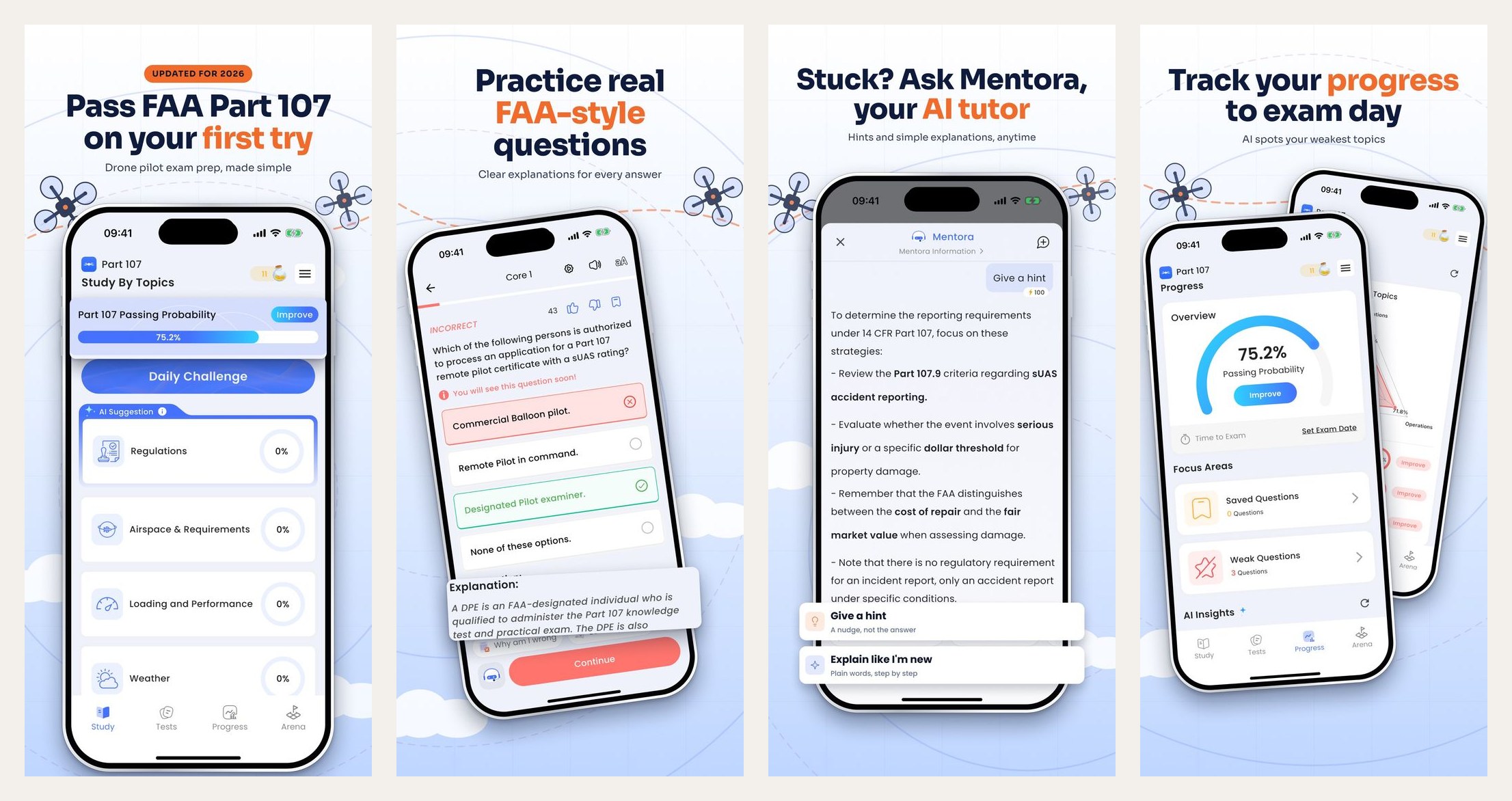
The AI. This iPhone and iPad app, sold on the US App Store by EASY PASS COMPANY LIMITED under the ABC Elearning name, describes an AI tutor called Mentora that explains FAA rules, clarifies tricky concepts and helps you retain knowledge with interactive explanations. It also offers a diagnostic test, custom tests by topic, explanations with FAA reference codes, a passing probability score and topic heatmaps, across regulations, airspace, weather, loading and performance, and operations. The listing does not say what Mentora draws on, and it gives no blueprint weights and no mention of the October 2026 chart images. It is an independent app with no connection to the FAA.
Plans and price. The free download unlocks Pro through a subscription. The US listing showed $9.99 a week, $19.99 a month, $39.99 a quarter and $69.99 a year. Four weeks on the weekly plan cost $39.96, about twice the monthly price, so if you choose this app, skip the weekly option. Subscriptions renew automatically unless you turn renewal off at least 24 hours before the period ends.
Fine print. The app had 4.8 stars from about 1,990 US ratings and was last updated on 16 November 2026. Its privacy label lists identifiers, usage data and diagnostics used to track you, and third-party advertising. The reviews shown first on the listing date from November 2023 to December 2024: one says Pro moved from a one-time purchase to a subscription, which the developer’s reply confirms, and one says the content had gaps on night flight, operations over people and Remote ID, to which the developer replied that its team would review the content. That was before the current blueprint, so judge today’s questions on the free part before you subscribe. The same developer sells apps for other licence tests, including the CDL; our guide to AI CDL practice test apps covers that one.
Choose it if you want a phone-first question bank with an AI explainer and will take the monthly or yearly plan. Skip it if you want proof the bank matches the September 2025 weights and the new chart questions, or you object to tracking data.
3. AprentisAi FAA Part 107 Pilot Prep: AI instructor avatars, price on request

The AI. AprentisAi, LLC, a Cape Coral, Florida company, announced its Part 107 course on 11 August 2026 in a press release that describes AI-driven instructor avatars that present the material and reinforce key concepts, alongside adaptive learning and multi-modal lessons. Its How Our Courses Work page adds short video lessons on one topic at a time and AI-driven dashboards that let schools and organisations follow learner progress. The homepage says three of its staff had full FAA careers. It does not name the AI behind the avatars.
Plans and price. We found no price on the pages we read; enrolment runs through the site’s sign-up for individuals, and schools and organisations are asked to get in touch. The press release says the course was beta tested with educational programs in Georgia and Virginia, and the site leans towards high school and workforce programs.
Fine print. The homepage carries the line “Great Instructors. Guaranteed Success.” but we found no guarantee terms. Nothing on the pages read mentions the September 2025 blueprint or the October 2026 chart images. With no price and no terms, ask both questions before you enrol.
Choose it if you are a school or program that wants an instructor dashboard and avatar-led lessons. Skip it if you are buying alone and want to see the price and the guarantee before you sign up.
What about ChatGPT or another general chatbot?
A general chatbot is a reasonable free baseline, and this page gives no price for one because plans change often. It can explain the difference between Class B and Class C airspace, walk you through the operations over people categories, quiz you on the five content areas in the blueprint’s proportions, or decode a METAR you paste in. Ask it to question you before it explains, so you do the recall. If you like turning notes into cards, our guide to AI flashcard apps covers tools that do that, and our guide to AI tutoring apps covers general tutors.
Two cautions. First, chart reading: the new questions show a piece of a current sectional chart, and a chatbot describing a chart image can misread an altitude, a boundary or a symbol with full confidence. Learn the chart legend yourself and check every chart answer against it. Second, rule versions: the small UAS rules changed in 2021, so a chatbot may mix older text with current limits on night flight, operations over people or Remote ID. Check anything that matters against 14 CFR part 107 and AC 107-2A. And never try to use any tool to recall live test questions; PSI’s bulletin says copying or communicating test content can void your result.
The non-AI options
These show no AI feature on their Part 107 pages today, so they sit outside the numbered list. They are common choices and set the price range for paid prep.
Pilot Institute Part 107 Made Easy: video course with a $175 guarantee
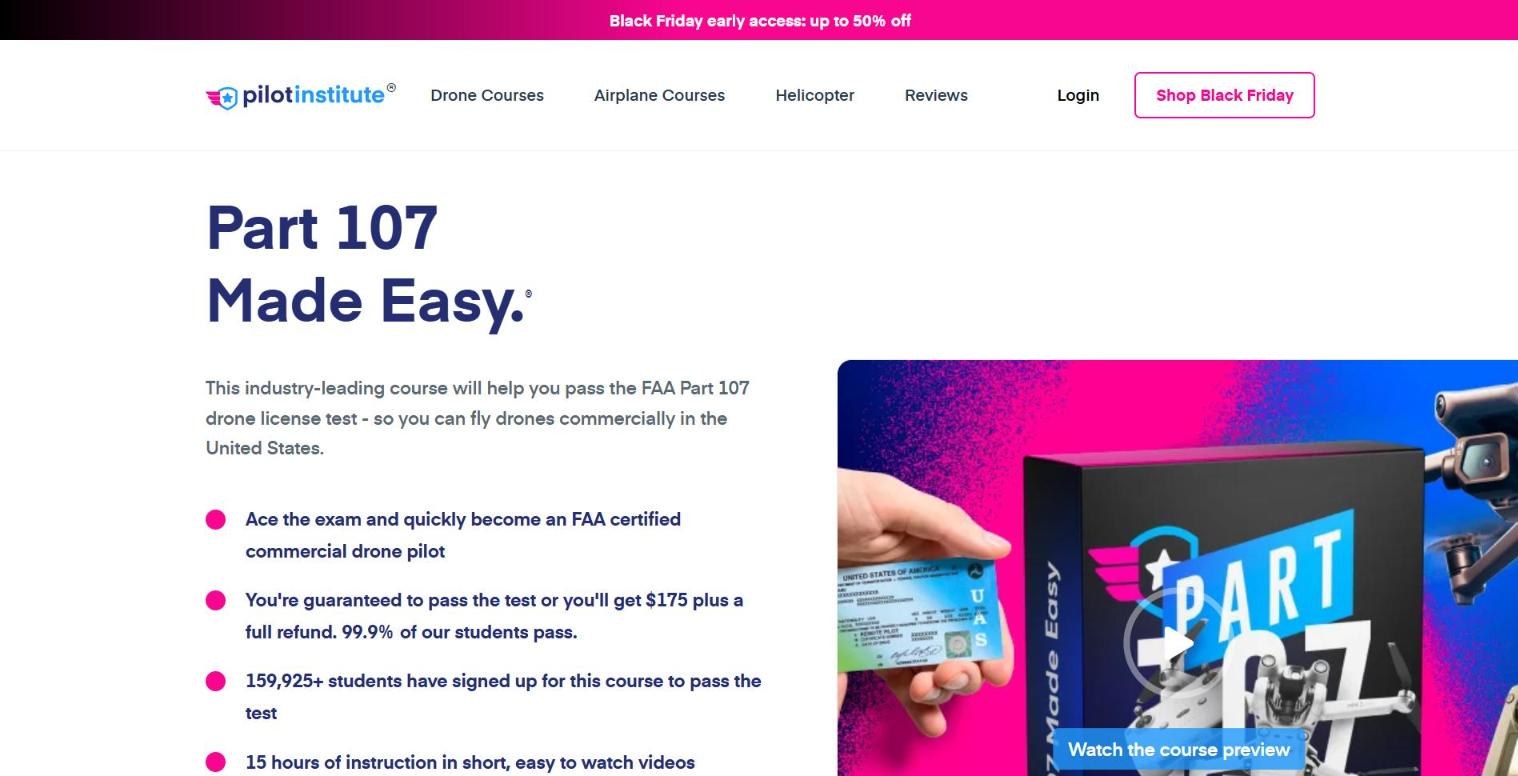
The AI. None listed on Pilot Institute’s course page.
Plans and price. The page showed $159 struck through and $111, under a Black Friday early access banner of up to 50% off; the end date was not shown in the page text we could read, so treat $159 as the regular price. It lists 15 hours of video, unlimited practice exams and 20 quizzes with more than 750 questions, a 14-page cheat sheet and lifetime access.
Fine print. Pilot Institute says it will send $175 and refund the course if you do not pass on your first try, and offers a 30-day money-back guarantee. Its 99.9% pass figure and 159,925+ sign-ups are its own claims.
Choose it if you learn best from video and want a guarantee that covers the test fee. Skip it if you want an AI tutor or a written course you can skim.
Drone Pilot Ground School: lifetime access and live support
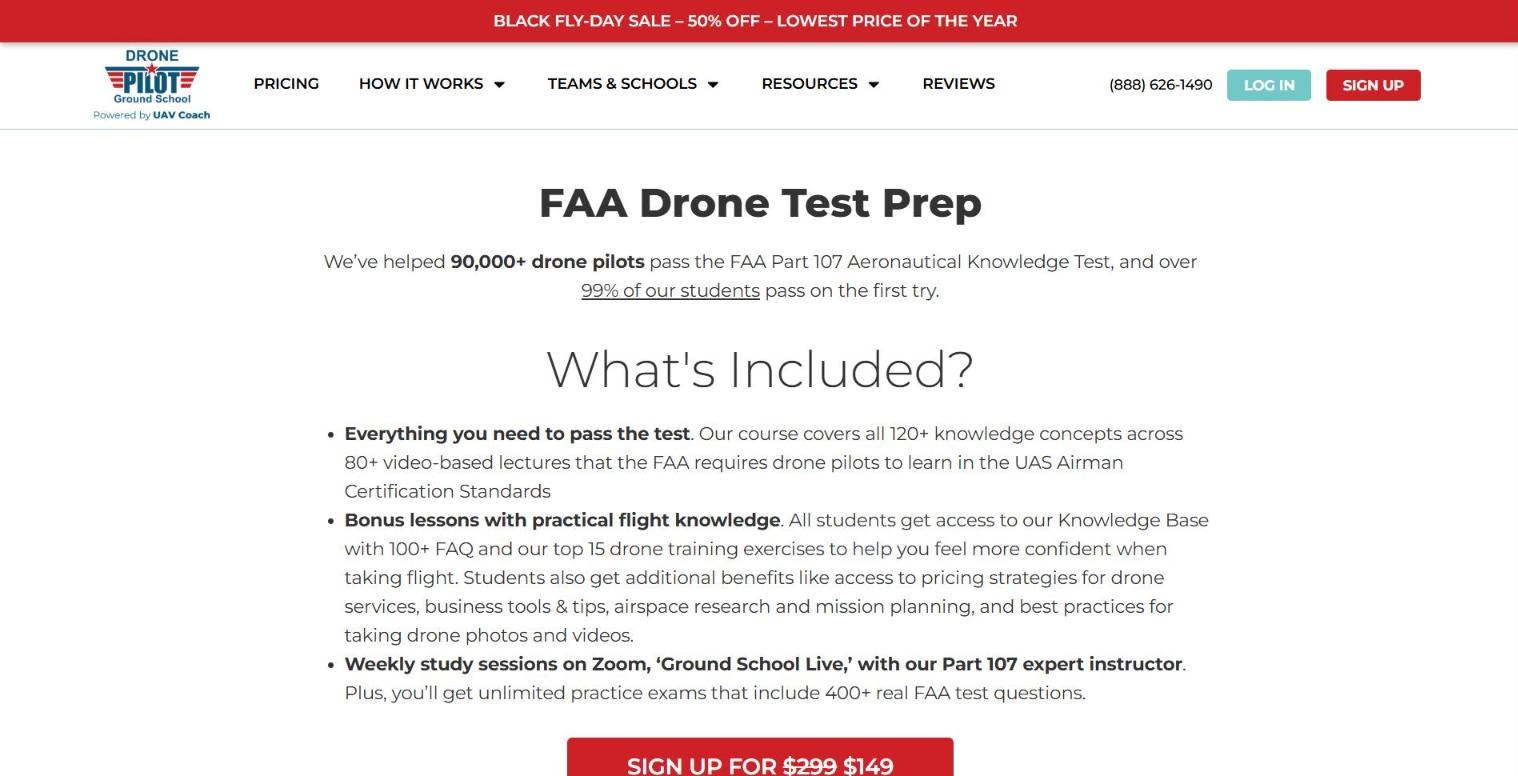
The AI. None listed on the test prep page or the pricing page.
Plans and price. The pricing page lists $299 for one person and $249 per person for groups of two to four, and also showed $149 for individuals and small groups with no end date, which looks like a seasonal price. It is pay once for lifetime access, with 400+ practice questions, unlimited full-length practice tests, lesson summaries and support by phone, email and weekly webinars.
Fine print. Its 99%+ first-attempt success rate and 90,000+ students are its own figures. The guarantee terms sit behind a page we did not read, so check them before you rely on them.
Choose it if you want a structured course with people to ask. Skip it if you only need a question bank.
Aeroapps Remote Pilot Test Prep: a paid question bank with no subscription
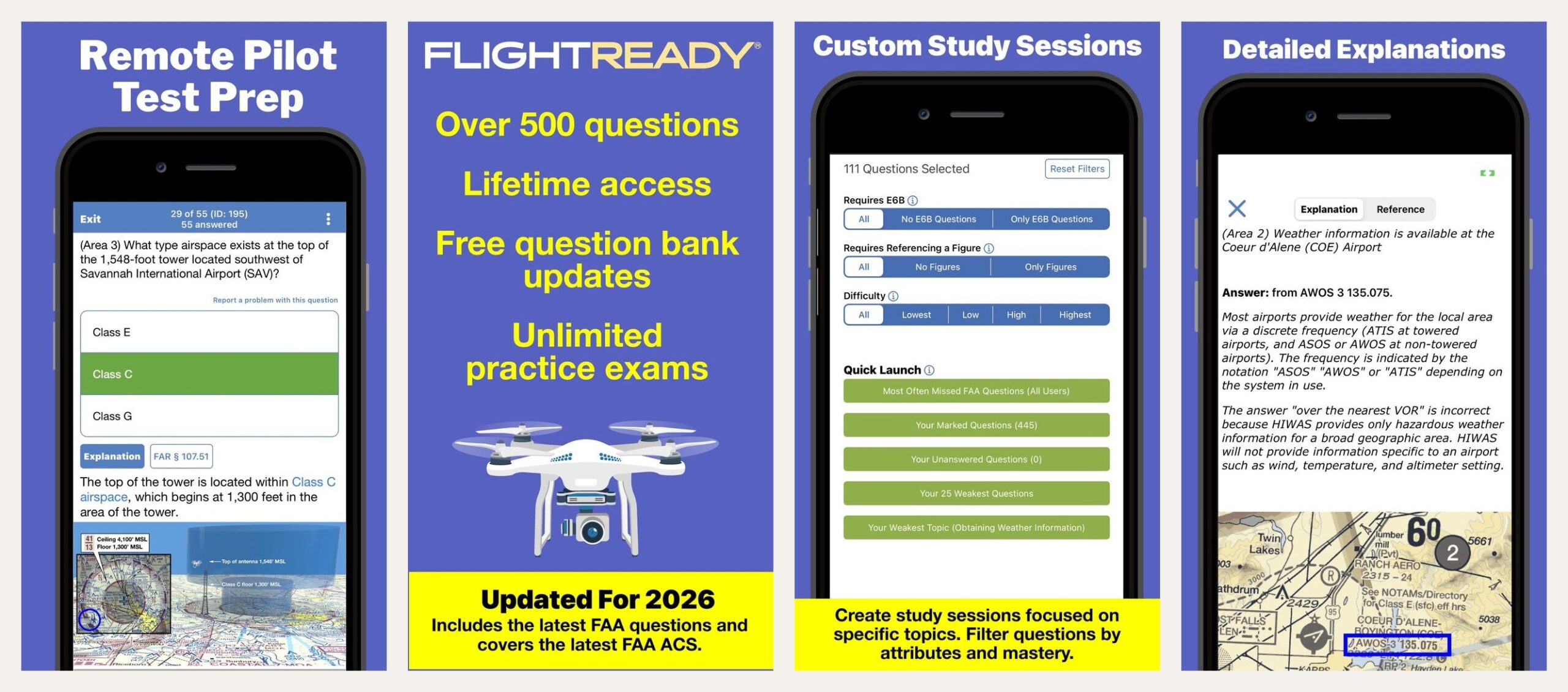
The AI. None described on the App Store listing.
Plans and price. $49.99 to download, with web access included, and an in-app upgrade to the full Drone Ground School course at $89.99. The listing says it has more than 500 questions, including actual FAA questions, updated for 2026 and covering night operations, Remote ID and operations over people, with explanations but no training content.
Fine print. The app had 4.8 stars from about 790 US ratings and was updated on 17 November 2026. For contrast, the popular free Part 107 FAA Practice test app by Aleksandr Alekseev, with about 1,080 ratings, sells weekly plans from $2.99 to $8.99 alongside monthly and yearly ones, and its privacy label lists data used to track you; it describes no AI.
Choose it if you want one payment for a question bank. Skip it if you need lessons, unless you add the course.
Studying for the private pilot written test (PAR) instead
Some readers are heading for a private pilot certificate rather than, or as well as, a drone certificate. The Private Pilot Airplane test (PAR) shares the same testing supplement and the same format on paper: the matrix lists 60 questions, two hours and a passing score of 70, minimum age 15, and PSI’s PAR bulletin adds 5 unscored validation questions. The big difference is authorization. The PAR needs a graduation certificate from an FAA-certificated pilot school or an endorsement from an authorized instructor saying you completed a ground training or home study course, and a retest after failure needs an instructor endorsement after more training. In 2025 the FAA counted 44,657 PAR tests with an 89.56% pass rate.
Sporty’s Learn to Fly with ChatCFI
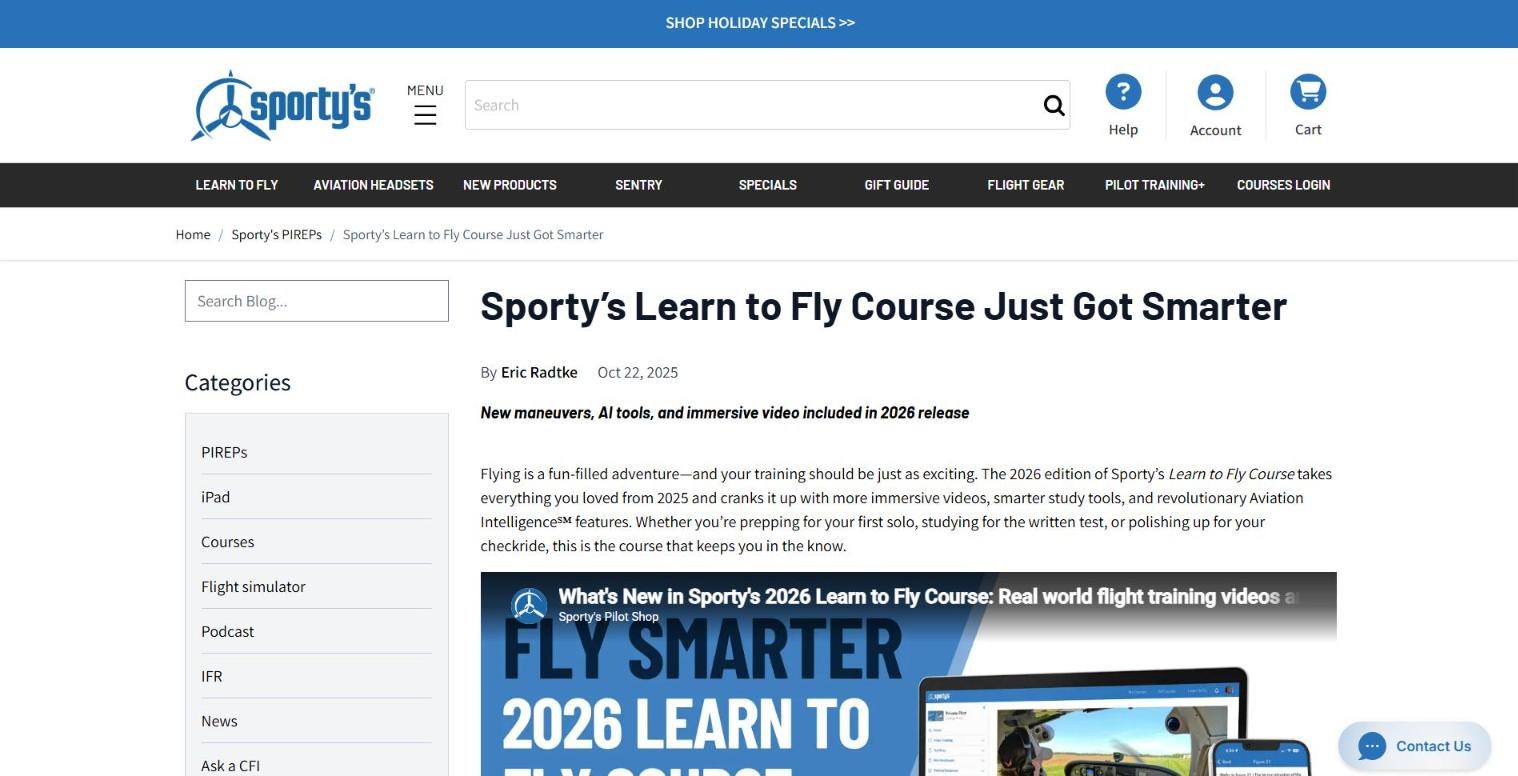
Sporty’s October 2025 announcement of its 2026 Learn to Fly course describes ChatCFI as a flight-tested, aviation-specific AI engine that gives answers, guidance and custom study plans with course links, plus a test analysis tool where you upload your knowledge test results and get a breakdown of missed questions by ACS task. The announcement gave the price as $299 with lifetime access; Sporty’s product pages were blocked to our reader on 19 November, so confirm today’s price. The Sporty’s Pilot Training app listing says completing the course earns you the FAA knowledge test endorsement the PAR requires, which a question bank alone does not give you.
Rotate Pilot Private Pilot Pass
Rotate’s Private Pilot Pass costs $69 once, or Rotate Premium is $14.99 a month (first month $7.49 with a code, cancel anytime, 30-day money-back), and lists 560+ questions, 60-question mock exams on a 120-minute timer and an AI tutor for aerodynamics, weather, navigation and FAR parts 61 and 91, with the same guarantee structure as its Part 107 Pass. Its page does not mention a knowledge test endorsement, so you will still need one from your instructor or school.
Gleim’s AI, a generative AI examiner called Otto described by AvWeb in July 2025, is aimed at checkride oral questions, not the written test. King Schools’ homepage showed no AI feature when we read it.
What we left out, and why
Open Exam Prep, run by Bayview Global LLC, offers Part 107 material and shows up in search; we have kept it out of this lineup while we look at it across all our exam guides. VECTOR, an iPhone app that lists an AI tutor and sectional chart drills at $9.99 a month, had no US ratings after its July 2026 release, and Drone Study Guide also had none, so both are too new to judge. A long list of recent AI-labelled Part 107 apps on the US App Store had between 0 and 53 ratings and generic 2026 names, so none made the list. Pocket Prep lists 157 exams on its site and Part 107 is not one of them. ASA’s Prepware Remote Pilot app describes no AI, and Sporty’s Remote Pilot Test Prep page was blocked to our reader, so neither is covered.
How to choose AI Part 107 test prep
Start with what is free
Open the PSI sample test to see the screen, keep the ACS beside you as the list of what can be asked, and read the FAA study guide with the 2021 rule changes added. If that is enough for you, the only cost is the $175 test fee.
Check the blueprint weights
Ask whether the bank and its mock exams follow the September 2025 weights: Regulations 48%, Operations 25%, Airspace 20%, Weather 5%, Loading and Performance 2%. A bank heavy on weather and light on operations over people and Remote ID is preparing you for an older test.
Ask about current sectional charts
Since 26 October 2026 the UAG includes chart images that are not in the supplement. Prefer prep that practises on current sectionals, and learn to read an unfamiliar chart, not just the figures you have memorised.
Find out which plan the AI is on
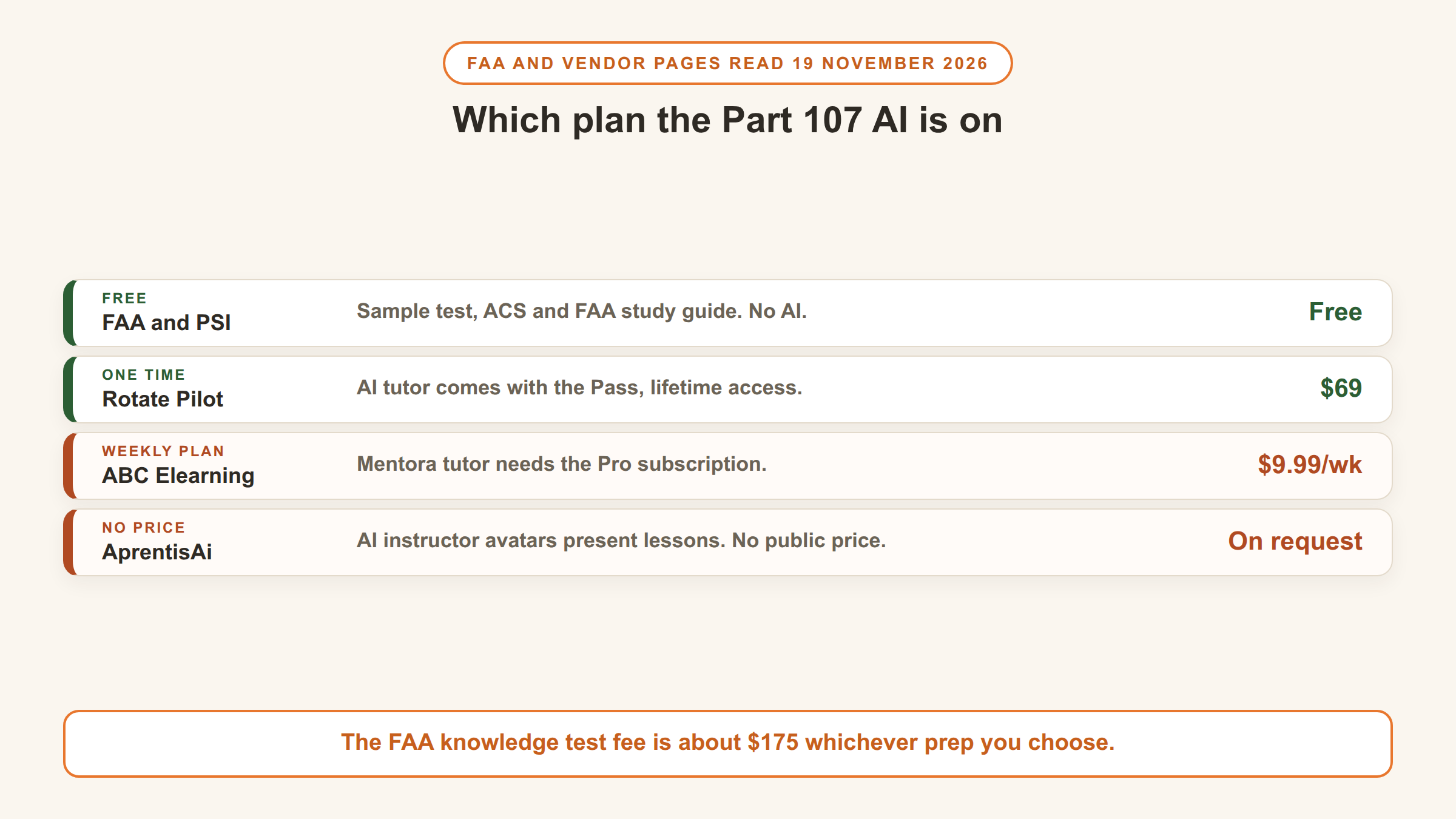
Rotate’s AI tutor comes with the $69 Pass, while its subscription grid puts it on the $29.99 Captain tier. ABC Elearning’s Mentora needs Pro, from $9.99 a week. AprentisAi shows no price. Price the cheapest plan that includes the AI you want, and avoid weekly billing.
Read the guarantee before you rely on it
Rotate’s refund plus $175 needs every lesson finished and three 85% mock scores in the 30 days before the test. Pilot Institute offers $175 plus a refund if you fail on your first try. Check whether a guarantee refunds the course only or the test fee too, and what proof you must send.
Verdict
Start with the free FAA and PSI material, because the test is built from it and the sample test shows you the real screen. If you want an AI tutor on top, Rotate Pilot’s $69 Part 107 Pass is the clearest offer here: one price, a tutor on every question, exams weighted like the current blueprint and practice on current sectional charts for the October 2026 change, with a guarantee whose conditions are written out. It is a young company that also writes many of the comparisons you will read, so weigh that. ABC Elearning’s app has far more ratings and an AI explainer, but it says nothing about the 2025 blueprint or the new chart questions, and its weekly plan is poor value. AprentisAi suits schools more than individuals until it shows a price. If you would rather learn from video and do not need AI, Pilot Institute and Drone Pilot Ground School remain solid. Whatever you choose, practise on a current sectional chart and the rules as they stand after 2021.
Sources
- FAA: Become a Drone Pilot, Remote pilot certificate cost FAQ, Airman Testing, Airman Testing Community Advisory, October 2026, Airman Testing Community Advisory, August 2025, Airman Knowledge Testing Matrix (25 September 2026), Testing supplements.
- FAA: Airman Certification Standards, Remote Pilot ACS, Changes to testing for a Remote Pilot Certificate (2021), Remote Pilot Study Guide (2016), Airman knowledge test statistics, CY2025 test volume report, Frequently missed ACS codes, Q2 CY25. FAA Safety Team: ALC-677 recurrent course.
- PSI: UAG applicant information bulletin, PAR applicant information bulletin, FAA testing portal.
- Rotate Pilot: Part 107 Pass, Part 107 guarantee, Pricing, About, Private Pilot Pass. ABC Elearning: FAA PART 107 Practice Test. AprentisAi: Home, How our courses work, Launch announcement.
- Pilot Institute: Part 107 course. Drone Pilot Ground School: Pricing, Test prep. Aeroapps: Remote Pilot Test Prep. Aleksandr Alekseev: Part 107 FAA Practice test. Sporty’s: Learn to Fly 2026 announcement, Pilot Training app. AvWeb: Gleim AI and data tools.
- All pages read 19 November 2026.

Written by
FazFaz is the founder of AIToolsBakery. Some tools here are tested hands on. Others are assessed from vendor documentation and pricing verified on the live page, and every review says which one it is. Sponsors can buy a position in a guide. They cannot buy the score, the criticism, or silence about a better option.
How we test and how we make money →