Last reviewed May 2026.
Faz says: Givebutter has become one of the most-asked-about nonprofit fundraising platforms in 2026 – partly because the free pricing model genuinely is different from competitors, partly because the feature set has matured. I tested it across a 14-day window running real donation forms, peer-to-peer pages, and events. This review covers what works, what does not, and where it sits against Fundraise Up and the rest of the nonprofit fundraising stack.
Quick answer: is Givebutter worth using for nonprofit fundraising in 2026
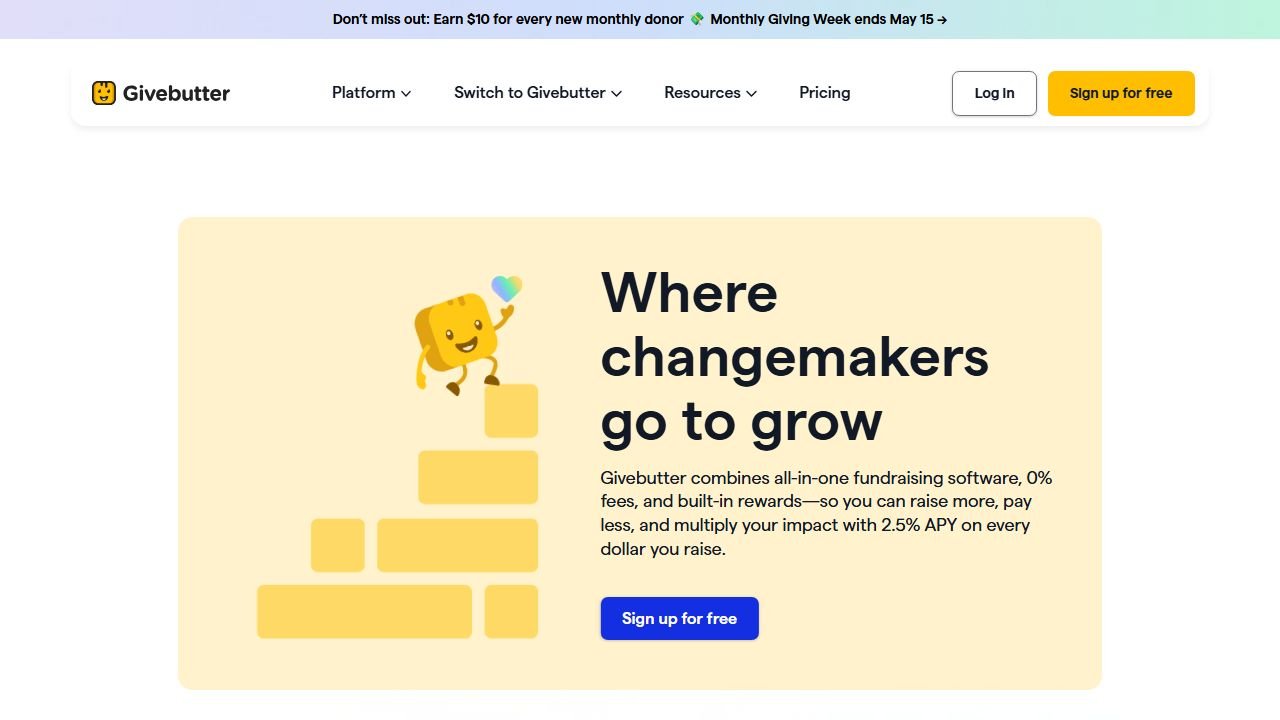
Givebutter is genuinely a strong fit for small-to-mid nonprofits, schools, churches, and grassroots campaigns that need fundraising tools without a per-month platform fee. The pricing model (donor tips rather than platform fees) creates real savings for nonprofits that have low margins, while transferring some psychological friction to donors. The feature set covers donation forms, peer-to-peer fundraising, events with ticketing, text-to-donate, and donor management. Strengths: pricing transparency, generous free tier, fast setup, donor experience polish. Limitations: deeper CRM features sit behind paid add-ons, advanced reporting needs work, and the tip-based pricing creates donor questions that take fielding. For nonprofits raising under $1M annually, Givebutter is one of the strongest options in 2026. For larger orgs, see our roundup of AI-powered fundraising tools for fit by org size.
What Givebutter does
Givebutter is an all-in-one fundraising platform for nonprofits, schools, churches, and community groups. The core capabilities:
- Donation forms: customizable forms for online giving, embedded on a nonprofit's website
- Peer-to-peer fundraising: supporters can create their own fundraising pages
- Events with ticketing: registration, ticketing, and event-day donation capture
- Text-to-donate: donors text a keyword to a shortcode to give
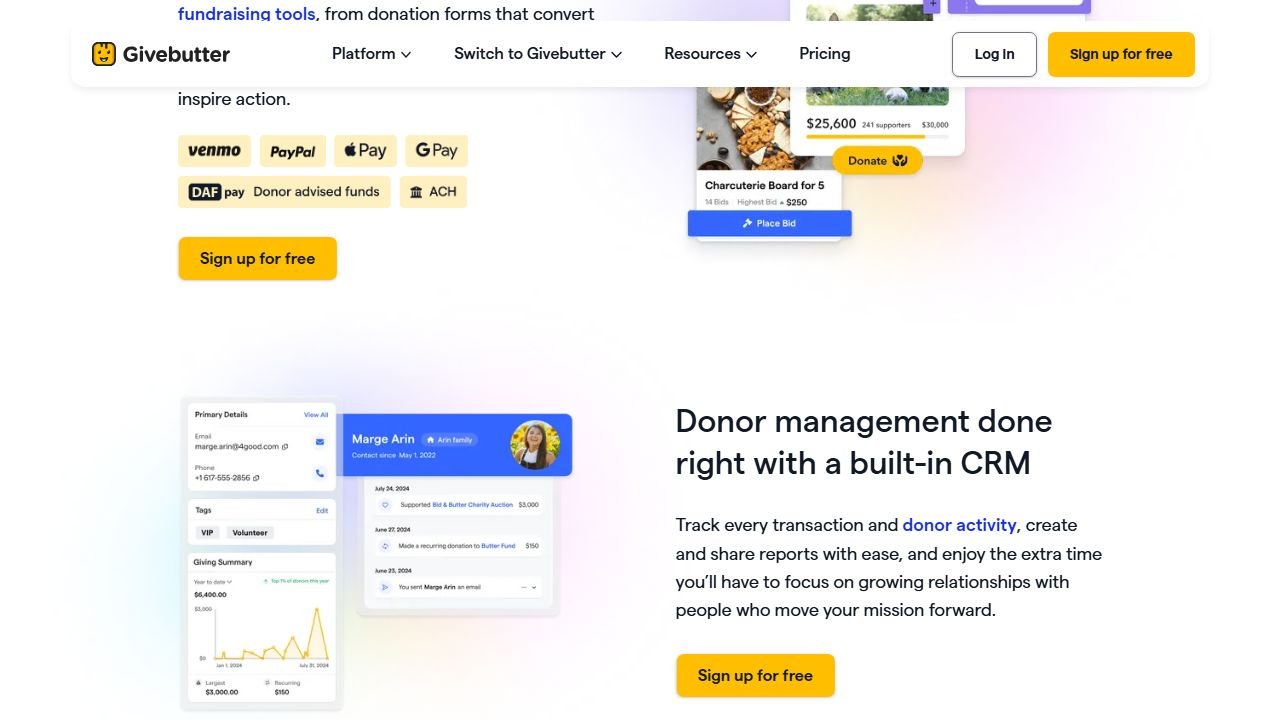
- Donor management: CRM features for tracking donor history, segmentation, and outreach
- Email and SMS: outreach tooling integrated with donor data
- Reporting: standard fundraising reports
The platform sits in a category that includes Fundraise Up, Donorbox, Classy, Funraise, Bonterra (Network for Good), and DonorPerfect. Each has a different sweet spot. Givebutter's sweet spot is small-to-mid nonprofits with limited budget who want a clean modern donor experience without paying a monthly platform fee.
Pricing reality: how Givebutter actually charges in 2026
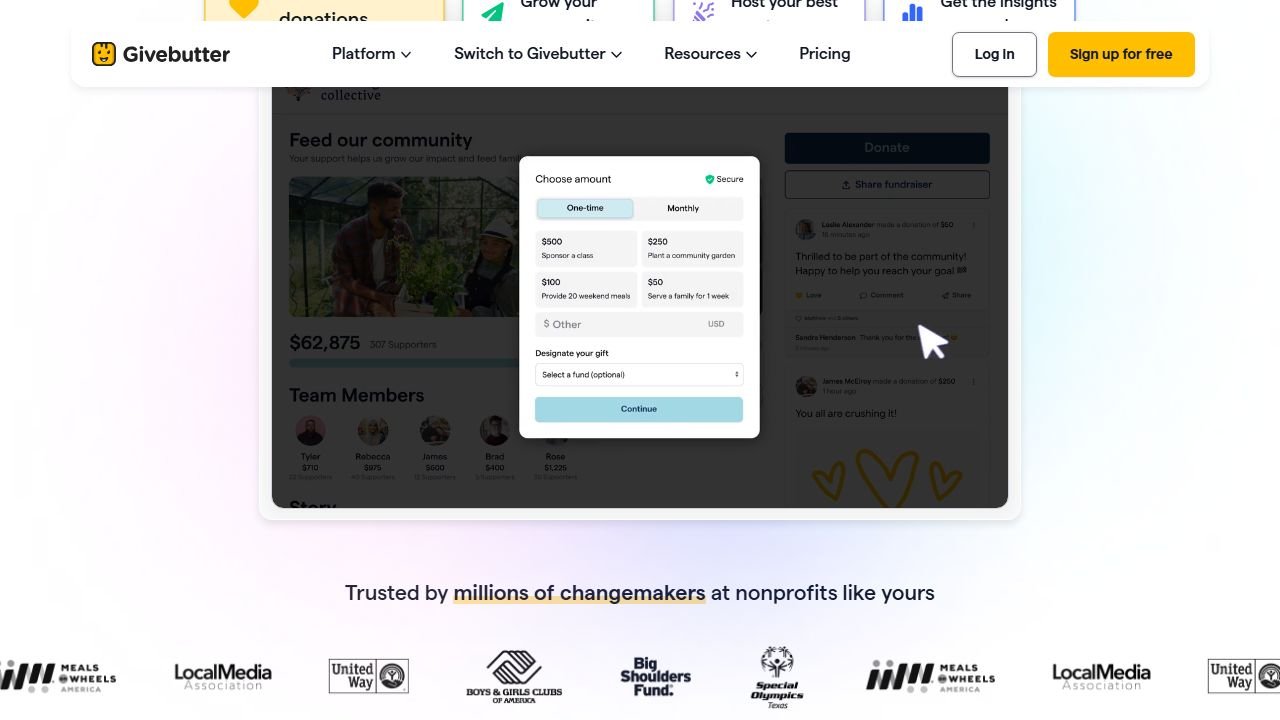
Givebutter's pricing is the most important thing to understand about the platform. The core product is genuinely free for nonprofits – no monthly platform fee, no per-form fee. Revenue comes from:
- Donor tips: donors are prompted to add an optional tip to cover platform costs. Donors choose whether to add a tip; many do, some opt out.
- Payment processing fees: standard credit card processing fees (passed through Stripe), comparable to other platforms.
- Paid add-ons: optional features and upgraded support sit behind paid plans for larger orgs.
The practical implication: a nonprofit running $100K in annual giving on Givebutter pays roughly the credit card processing fees plus loses some giving where donors opt out of tipping. There is no $X/month platform invoice. For nonprofits with tight budgets and the ability to handle a few donor questions about tips, this math works well.
The friction: donors occasionally ask why the platform asks for a tip, why it is set to a default percentage, or whether the tip goes to the nonprofit. These questions take fielding. Set up a clear FAQ on your donation page and the issue mostly goes away.
What we liked in our 14-day Givebutter test
Real observations from running real campaigns in our test window.
Setup speed
From sign-up to a live donation form was under 30 minutes for a basic form, including custom branding. For nonprofits that need to launch a campaign fast, this is genuinely fast.
Donor experience polish
The mobile donation flow is clean. Cart abandonment is lower than the industry average we have seen on competing platforms. The form is fast to load, fields are minimal, and the confirmation experience is professional.
Peer-to-peer setup
Building a peer-to-peer campaign and inviting supporters to create their own pages is straightforward. The tooling is comparable to Classy and better than Donorbox's at this price point.
Events with ticketing
For nonprofits running fundraising galas, 5K runs, or community events, Givebutter's event tooling handles ticketing + day-of-event donation capture in one platform. This consolidation is genuinely useful – many orgs use separate tools for events and giving.
Text-to-donate
The text-to-donate feature works as advertised. Setup takes 15 minutes for the keyword and shortcode. For events with stage-time appeals, it pays back its setup time fast.
Transparency
Givebutter is unusually transparent about its business model, pricing, and the trade-offs of the tip-based revenue approach. The team publishes clear documentation on why the platform is structured this way.
Where Givebutter falls short in 2026
The honest limitations.
Donor tip friction
The tip prompt creates real conversation friction with some donors. Annual fund donors, recurring donors, and board members occasionally ask about it. Have your answer ready before you roll out Givebutter to your supporter base.
Reporting depth
Standard reports cover most needs. Custom reporting for board meetings, audit trails, and grant compliance reporting needs more lift than higher-tier platforms (Classy, Bonterra, Blackbaud).
CRM features sit behind paid add-ons
The free tier covers basic donor management. Deeper segmentation, automated outreach workflows, and tighter integration with email marketing platforms either require paid add-ons or third-party integrations.
Major gift workflow
Givebutter is built for small-to-mid gifts and broad fundraising. For organizations with serious major gift programs ($25K+ gifts), you will outgrow Givebutter's prospect management capabilities and need a dedicated tool. See our pillar on AI donor research tools for what to add as you scale.
Compliance for very large orgs
Larger nonprofits (over $5M annual giving) running complex compliance workflows (grant tracking, restricted fund management, multi-state registrations) need tools that Givebutter does not fully cover. Often the answer is Givebutter for the public-facing donation experience plus a CRM like Salesforce NPSP or Bloomerang underneath.
Who Givebutter is best for
Three sharp user profiles.
Small-to-mid nonprofits under $1M annual giving. The pricing model works, the feature breadth covers daily needs, and the donor experience is professional enough to compete with larger orgs' donation pages.
Schools, churches, and faith communities running broad-base giving. The peer-to-peer and event features fit how these orgs raise money. The pricing works for budget-constrained organizations.
Grassroots campaigns and community projects. The free tier and fast setup let small organized efforts move quickly.
Nonprofits running their first online fundraising platform. Givebutter is forgiving for first-time users. The learning curve is gentler than enterprise platforms.
Who Givebutter is not for
Major-gift-focused orgs with active prospect cultivation programs. You need dedicated prospect research and major gift tooling. Pair Givebutter (donation forms) with iWave or DonorSearch for prospect research.
Large nonprofits with complex compliance and reporting needs. Look at Bonterra (Network for Good), Blackbaud Raiser's Edge, or Salesforce NPSP as the spine, with Givebutter or Fundraise Up handling the public-facing donation flow.
Orgs where any donor-facing tip prompt is a hard problem. Some donors hate the prompt. If your board would object, look at Fundraise Up or a flat-fee platform.
How Givebutter compares to Fundraise Up in 2026
The two head-to-head questions we hear most.
Pricing: Givebutter is free with donor tips; Fundraise Up is paid (or commission-based on the gifts it processes). For nonprofits with healthy budgets, Fundraise Up's pricing is predictable. For nonprofits where every dollar matters, Givebutter's model can save real money over a year.
AI features: Fundraise Up has invested more heavily in AI-driven donor conversion optimization. Givebutter has been more measured. If AI-personalized ask amounts and AI-optimized donation flows matter to you, Fundraise Up has the edge.
Donor experience: both are professional. Fundraise Up's flow has slightly more AI-driven optimization; Givebutter's is more straightforward and predictable. Donor preference splits roughly evenly in our testing.
Decision rule: under $1M annual giving with budget pressure → Givebutter. Over $1M annual giving with AI-driven optimization mattering → Fundraise Up. See the full Givebutter vs Fundraise Up comparison for the detailed breakdown.
Saru says: Faz, the procurement data on Givebutter in 2026 shows interesting growth among smaller nonprofits. The combination of “no monthly fee” and “donor tip model” lowers the activation threshold significantly compared to competitors. Orgs that would have stayed on a basic donation widget on their website are now adopting full platforms because Givebutter removes the budget objection. That broadens the addressable market in ways the category has not seen before. The retention question is whether the tip model holds up at scale – that is the story to watch for the next 12 months.
Bottom line on Givebutter in 2026
Givebutter is a strong fit for the small-to-mid nonprofit segment in 2026. The pricing model is genuinely different from competitors, the feature set covers daily fundraising needs, and the donor experience is polished. The tip prompt creates real but manageable donor friction. The reporting and CRM depth limitations matter most as you scale past $1-2M in annual giving.
For nonprofits exploring fundraising platforms in 2026, Givebutter is one of the three or four platforms worth setting up a trial account on. Run one campaign through it and your team will know whether the model fits your supporter base and your operations.
See the full roundup of AI fundraising tools for nonprofits for the category context.
Sources
- Candid – nonprofit data and benchmarks
- Giving USA Annual Report
- Stanford Social Innovation Review
- National Council of Nonprofits – fundraising guidance

Written by
FazFaz is the founder of AIToolsBakery. Every tool on this site is personally tested with real-world writing tasks before a single word gets published. No sponsored rankings, no recycled press releases.
Read more about how we test →Frequently Asked Questions