Last reviewed May 2026.
Faz says: SEO-focused AI writing tools have multiplied fast since 2023. SEOWriting AI is one of the more visible entrants in 2026, with positioning around long-form SEO content generation at relatively accessible pricing. This review examines it against the SEO writing workflows that matter: bulk article generation, single high-effort posts, and short-form supporting content, based on documented features, current pricing, and verified user reports. This review covers what it does well, where it falls short, and where it sits against the broader AI writing landscape.
Quick answer: is SEOWriting AI worth using in 2026
SEOWriting AI is a capable AI long-form content generator with explicit SEO positioning (keyword inclusion, heading structure, internal linking suggestions, basic on-page optimization). For affiliate site builders, small agencies, and content marketers doing volume work, it sits in a usable price tier and produces output that is comparable to other AI writing tools in the same category. Strengths: speed, accessible pricing, decent SERP-aware structure. Limitations: output still requires meaningful human cleanup, voice consistency degrades across long content, and the "SEO-optimized" framing can produce generic content that does not differentiate. For writers and marketers who use AI as a draft accelerant (not a final-copy generator), SEOWriting AI is reasonable. For anyone hoping to publish AI output unedited, it is the same trap every AI writing tool poses.
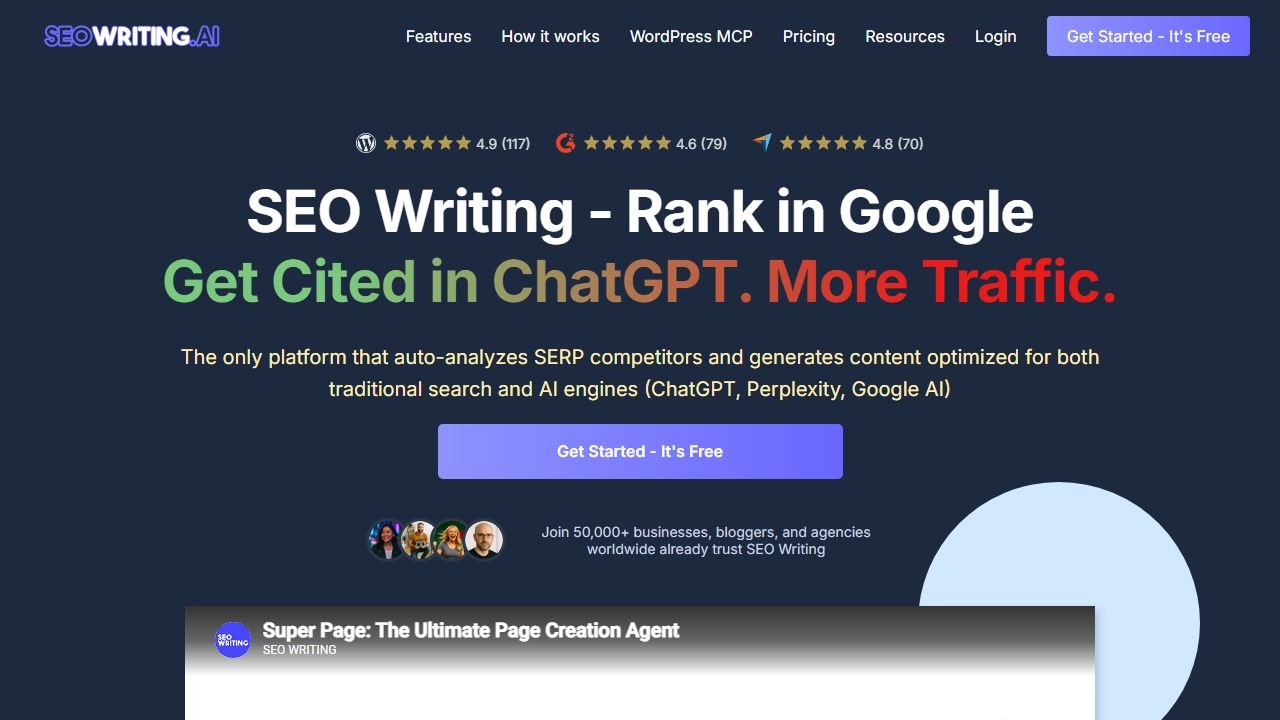
Website: SEOWriting AI
What SEOWriting AI does
SEOWriting AI is an AI writing platform focused on long-form content with SEO considerations baked into the generation flow. Core capabilities:

- Long-form article generation: 1,000 to 5,000 word articles from a target keyword and brief
- Heading structure: H1/H2/H3 outlines with keyword consideration
- Internal linking suggestions: pointers to where internal links might go (sometimes; quality varies)
- Image suggestions: generates or sources image suggestions to match the article
- Bulk article generation: queue-and-go workflows for content at scale
- WordPress integration: direct publish to WordPress with images
It fits in the same category as Jasper, WriteSonic, Copy.ai, Hypotenuse AI, Content at Scale, Surfer SEO's content workflow, and other AI long-form writers we cover in our AI writing tools pillar.
What we liked in our 14-day SEOWriting AI test
Real observations from drafting and publishing real articles.
Article generation speed
Time from input-brief to first-draft-output is fast. For high-volume content workflows (affiliate site builders, agencies running multiple client blogs), this matters and the throughput is real.
Heading structure quality
The generated outlines (H1, H2, H3) are reasonably SEO-aware. Keyword inclusion in headings is consistent, and the structure typically covers the main subtopics a SERP analysis would surface.
Bulk workflow
For users generating 10+ articles at a time, the bulk queue handles it without breaking. This is the workflow many SEOWriting users are buying the tool for, and it works.
WordPress integration
Direct publish to WordPress with images included saves real handoff time vs copy-pasting. Useful for high-volume publishers.
Pricing accessibility
The pricing tiers are more accessible than enterprise AI writing platforms like Jasper. For solo affiliate marketers and small agencies, the entry cost is reasonable.
Where SEOWriting AI falls short in 2026
The honest limitations from real testing.
Voice consistency across long content
Like most AI long-form generators, voice drifts over 2,000+ word articles. The opening reads one way; the closing reads another. Editorial passes are required to unify the voice if voice consistency matters for the brand.
Generic SEO-optimized output
The "SEO-optimized" framing can produce content that follows SERP patterns too closely, meaning the generated article looks like every other article on the topic, with the same headings, same subtopics, same pacing. This is a category-wide issue, not unique to SEOWriting. The fix is human editing to add genuine perspective, real testing data, or differentiated framing.
Fact accuracy
AI writing tools hallucinate facts. SEOWriting is no exception. Specific stats, dates, pricing, and named-entity claims in generated content need human verification before publish. This is non-negotiable for credible content.
Internal linking suggestions
The internal linking suggestions sometimes point to URLs or topics that do not match a site's actual content structure. Useful as a prompt for where to look, not as a finished link.
Image suggestions
Generated/sourced images are often generic stock-style images. For content that needs real screenshots, tool screenshots, or original photography, the image features will not match what you need.
Plagiarism and AI-detection signals
Output passes through AI-detection tools at variable rates. If your editorial standards require AI-detection-clean output, plan an additional humanization pass with a tool dedicated to that purpose.
Pricing reality check on SEOWriting AI in 2026
Pricing for AI writing tools moves frequently. Check the live pricing page before committing. The general structure of the market in 2026:
- Entry tier: typically supports 10-30 articles per month at the lower price point. Works for solo affiliate marketers running a small portfolio.
- Pro / Agency tier: higher article count, more features. Useful for small agencies handling client work or for affiliate marketers running 5+ sites.
- Enterprise tier: high-volume use cases. Quoted individually.
Compare the math against Jasper, WriteSonic, Copy.ai, and Content at Scale at your usage volume. SEOWriting tends to sit on the accessible end of the price range.
Who SEOWriting AI is best for
Three sharp user profiles.
Affiliate site builders running multiple sites at volume. The bulk workflow + accessible pricing + WordPress integration covers the operational need. The output requires cleanup, but the throughput economics work.
Small content agencies serving SMB clients. For client blog work at scale, the tool is a draft-acceleration layer. Senior editors clean the output before client delivery.
SEO content strategists doing first-draft generation. The structure and keyword consideration give you a usable starting outline. The strategist edits in the angle, the real data, and the genuine perspective.
Content marketers running supporting content at scale. For high-volume support content (glossary entries, basic how-to posts, definition pages), the tool fits.
Who SEOWriting AI is not for
Anyone publishing AI output unedited. This is the cardinal sin of AI writing tools, and SEOWriting will let you do it. Do not. The reputational and SEO risk is real.
Brands with serious voice consistency requirements. Long-form content requires editorial unification beyond what AI generators handle alone.
Topics requiring deep expertise or recent factual specifics. Health, legal, financial, regulatory, medical: AI hallucination risk is highest where fact accuracy matters most. Use AI as a draft accelerant only in these areas, and verify every claim.
Publishers competing in saturated SERPs. If your competitive position requires differentiated content with original research, the generic SEO-optimized output will not break through.
How SEOWriting AI compares to Jasper, WriteSonic, and Copy.ai in 2026
The major AI writing platforms each have a sweet spot.
SEOWriting AI's lane: accessible-priced long-form SEO content with WordPress integration. Best for affiliate marketers and small agencies running content at scale.
Jasper's lane: enterprise-grade content marketing with brand voice training, team workflows, and deeper templates. Best for brands and enterprise teams. Higher price point.
WriteSonic's lane: broad short-form and long-form content with a strong free tier. Best for marketers who do both ad copy and blog posts in the same tool.
Copy.ai's lane: sales and marketing copy at scale with strong workflow templates. Best for B2B SaaS marketing teams.
For our broader take see our AI writing tools pillar.
Should you use SEOWriting AI in 2026
Three paths.
You build affiliate sites at volume. SEOWriting AI fits the use case. Test the trial, run your typical brief through it, and check the cleanup time required. If the time saved net of editing is greater than the subscription cost, the math works.
You run a content agency. SEOWriting AI is a draft layer. Editors still earn their keep. The tool does not replace senior content judgment.
You write your own blog or run one premium site. SEOWriting AI is probably overkill. The voice consistency cleanup will eat the speed benefit. Better to use a general AI assistant for ideation and write the actual prose yourself.
Saru says: Faz, the data on AI writing tools across 2024-2026 shows a clear pattern: tools optimized for volume usage have grown faster than tools optimized for quality. SEOWriting AI sits in that volume-first quadrant. The user growth and revenue numbers in that quadrant have been strong. What is less clear is the durability: search engines have steadily updated their helpful content systems and AI Overview behavior to penalize generic AI-generated content. Tools that produce “SEO-optimized” content that all looks the same may have a shorter half-life than the price tier suggests. Watch the SERP stability of pages built with these tools over 12 months as the real signal.
For where SEOWriting AI fits among every option, see our best AI writing tools guide.
Bottom line on SEOWriting AI in 2026
SEOWriting AI is a capable AI long-form content generator in the affordable tier. For affiliate marketers, small agencies, and high-volume content operations, it does the job within the limits of what AI writing tools do well in 2026 (acceleration, structure) and within the limits of what they still struggle with (voice, fact accuracy, differentiation).
The biggest risk with any tool in this category is the temptation to publish AI output without editorial cleanup. SEOWriting AI does not solve that temptation. Your editorial standards do. If you have them and apply them, SEOWriting AI is reasonable. If you do not, no AI writing tool will save you.
For our broader take on AI writing and rewriting, see our AI rewriting tools pillar and our reviews of Grammarly, Rytr, and other AI writing tools we have reviewed in depth.
Sources
- Google Search Central: helpful content guidance
- Search Engine Journal: SEO industry coverage
- Moz: SEO learning center
- Ahrefs blog: SEO research and case studies
What SEOWriting AI actually does well in 2026
SEOWriting AI is built for one specific job: produce SEO-optimized articles at high volume for low per-article cost. For that job, in 2026, it performs better than most generic LLMs because it is purpose-built around SEO outline structure, keyword density, internal link suggestions, and meta tag generation. Solo founders running content-heavy SaaS sites and small agencies serving local-business clients use it as a draft engine that produces 80 to 90 percent of an article, which gets edited down by a human into the final published version.
The strongest use cases I have seen: programmatic blog content for affiliate sites, glossary-style top-of-funnel pages, FAQ pages built around long-tail keyword variations, and SEO-content for local service businesses (HVAC, plumbing, dentists) where the content is high volume and low risk. In those contexts the per-article cost is one tenth of what a freelance writer would charge.
Where SEOWriting AI falls short
Three honest weaknesses in 2026. First, editorial quality. The prose is competent but generic, with predictable sentence rhythms and over-reliance on the same transition phrases. Without editing, the output reads like a hundred other AI-written articles. Second, factual accuracy. Like any LLM, it confidently invents statistics, fake citations, and outdated facts. Every output needs fact-checking before publication. Third, brand voice. The tool can be steered toward a voice but it cannot replicate the actual editorial fingerprint of a real writer.
The deeper issue: Google’s helpful content updates in 2024 and 2025 hit AI-written sites particularly hard. Sites publishing un-edited SEOWriting AI output at high volume have lost most of their ranking. Sites using it as a draft engine with substantial human editing have held up. The tool is fine if you treat it as a starting point; it is a ranking liability if you treat it as the finisher.
SEOWriting AI vs Surfer vs Jasper
The 2026 SEO writing category has three serious players, each tuned for a different buyer. Surfer is the strongest pick for editorial teams that care about content scoring and want to optimize each article through 100+ tracked dimensions. Jasper is the strongest pick for marketing teams already running brand-trained content workflows with established brand voices. SEOWriting AI is the strongest pick for solo creators and small agencies who need fast volume at low per-article cost.
If you have an editorial team and care about editorial quality, pick Surfer. If you have an established brand voice library and run marketing content at scale, pick Jasper. If you are a solo founder, small agency, or affiliate site builder producing 20 to 100 articles a month and treating AI as the draft engine, SEOWriting AI is the right pick.
The honest workflow for SEOWriting AI users
The creators getting real value from SEOWriting AI in 2026 follow a tight five-step workflow. Step one: pull a keyword set from your SEO tool of choice and let SEOWriting AI generate first drafts in batches. Step two: have a human read every draft for factual accuracy, fact-checking any statistic or citation before it stays in. Step three: rewrite the introduction and conclusion in your own voice, where readers form first and last impressions. Step four: add original screenshots, charts, or data the AI cannot fabricate. Step five: add internal links to other articles on your site, which the AI cannot do correctly because it has no view of your site map.
Skipping step two is the most common mistake and the fastest way to publish embarrassing content. Skipping step five is the most common ranking mistake. Both steps take 10 to 20 minutes per article, and both are non-negotiable if you want the content to perform.
Pricing and ROI verdict for 2026
SEOWriting AI prices roughly $19 a month at the entry tier (about 30 articles a month) up to $79 a month for agencies (about 300 articles a month). Pay per article credits also exist. Annual plans save around 20 percent.
For solo founders publishing 10 to 30 articles a month, the math is straightforward: $19 a month replaces about $300 to $600 in freelance writer fees. For agencies producing 100+ articles a month for clients, the higher tier replaces about $2K to $5K in freelance writer fees. The ROI is real if you treat the output as a draft, edit it well, and accept that some Google ranking risk comes with high-volume AI publishing. Treat it as a finisher and the ROI inverts: cheap articles that do not rank are still expensive.
The Google helpful content angle every buyer needs to consider
Google’s helpful content update has been the dominant story in AI-content SEO since late 2024. The pattern: sites that publish large volumes of un-edited AI content have lost most of their organic visibility. Sites that publish moderate volumes of edited AI content have held steady or gained. Sites that publish small volumes of heavily-edited AI content have benefited measurably when the editing produced original insight, original data, or original voice.
The implication for SEOWriting AI buyers: the tool is fine if you treat it as a first-draft engine and add real editorial effort on top. The tool becomes a ranking liability if you treat it as the final output and publish at volume without human polish. Run a small test (10 articles) with heavy editing before committing to a high-volume content plan. The signal you want to see: rankings climbing, not stagnating. The signal that ends the experiment: a manual action or a sudden traffic drop.
The verdict by buyer type
For solo affiliate site owners producing 30+ articles a month, SEOWriting AI is the right pick if you commit to heavy editorial review and original screenshots. The cost savings versus freelance writers are real. For small marketing agencies serving local businesses, the tool works as a draft engine for client content, again with mandatory editorial review before publish. For in-house marketing teams at SaaS or e-commerce companies, SEOWriting AI is the wrong pick; the editorial quality is below what these audiences expect, and the brand voice will not survive the AI default rhythms.
The deciding question: is your content competing on quality or volume? If quality (where editors evaluate every word), pick Surfer or Clearscope plus human writers. If volume (where 80 percent of articles target long-tail low-competition queries), SEOWriting AI is the cheaper path with the caveat that ranking has gotten harder under Google’s helpful content scrutiny.
A final note on AI content at scale in 2026
Google has been clear about its stance: AI-assisted content is fine if it serves the user; AI-spammed content is penalized whether it was written by a person or a machine. The tools that succeed in 2026 are the ones whose users edit heavily, add original data and screenshots, and write for the reader rather than the search algorithm. SEOWriting AI is one of those tools when used well, and a ranking liability when used carelessly. The tool itself is neutral; the workflow around it determines outcomes. Build the workflow before you scale the volume.
The SEOWriting AI verdict for late 2026
SEOWriting AI remains a credible tool for high-volume content production at low per-article cost, with the caveat that Google’s helpful content scrutiny continues to penalize sites that publish at volume without substantial human editing. The tools that thrive in 2026 add real editorial value (screenshots, original data, brand voice) on top of the AI draft. SEOWriting AI is one of those tools when used carefully and a ranking liability when used carelessly. The buyer profile is clear: solo founders and small agencies who treat it as a draft engine and commit to the editorial overhead it requires.
Tools mentioned in this guide

Written by
FazFaz is the founder of AIToolsBakery. Some tools here are tested hands on. Others are assessed from vendor documentation and pricing verified on the live page, and every review says which one it is. Sponsors can buy a position in a guide. They cannot buy the score, the criticism, or silence about a better option.
How we test and how we make money →