The short answer
If your ABM programme is built around finding one contact at a target account, it is built around a buyer that no longer exists. Gartner puts the buying group for a complex B2B solution at six to ten decision makers, each independently gathering their own information before anyone speaks to a supplier.
Here is the committee you actually have to reach, and what each member needs from you.
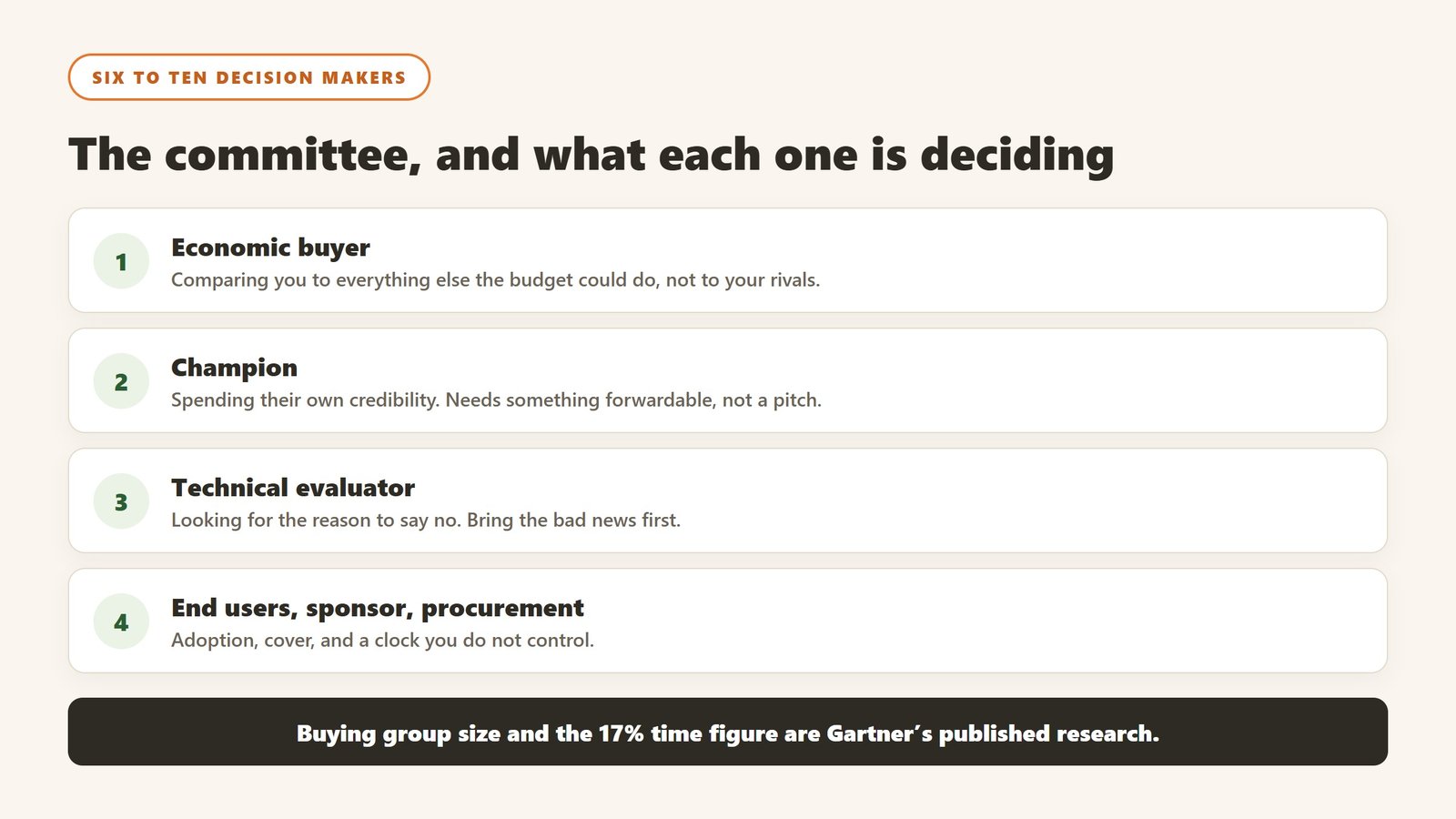
| Role | What they are deciding | What convinces them |
|---|---|---|
| Economic buyer | Whether this is worth the money against everything else it could be spent on | A defensible cost case and what happens if nothing changes |
| Champion | Whether to spend their own credibility on you internally | Material they can forward without editing. This is the one thing most teams never produce |
| Technical evaluator | Whether it works with what they already run | Integration specifics, data handling, an architecture conversation with someone competent |
| End users | Whether their working day gets better or worse | Seeing the actual product doing their actual job |
| Executive sponsor | Whether this is defensible if it goes wrong | Peer evidence and a credible reference |
| Procurement and legal | Whether the paper is acceptable | Early answers on security, data residency and contract terms |
For which category of ABM software to buy and what each type costs, see our companion guide to AI ABM tools and their pricing. This page is about the outreach itself.
The number that reframes the whole problem
Gartner’s finding is not that buying groups are large. It is how little of their time you get.
17%, and it is shared
B2B buyers spend about 17% of their total buying time meeting potential suppliers. When several suppliers are competing, that falls to roughly 5% to 6% each. Everything else is happening without you: internal discussion, independent research, and building consensus among people you may never meet.
What that means practically
You are not being evaluated in your meetings. You are being evaluated in the conversations between them, by people quoting you second-hand, from material they half remember. That single observation changes what good outreach looks like more than any targeting technology does.
So the job is not persuasion, it is equipping
If 83% of the decision happens in rooms you are not in, your objective is to make sure an accurate version of your argument is in those rooms. That means material designed to be forwarded, not material designed to be presented. The most valuable asset in most ABM programmes is a single page a champion can paste into Slack without having to explain it.
Faz says: The test we use: could someone who has never spoken to you read this in ninety seconds and correctly describe what you do to a colleague? Almost no vendor one-pager passes that. Most are written to impress the person who already likes you.
The six roles, one at a time
The table above is the summary. The detail is where programmes actually go wrong, because each of these people is running a different risk and almost all outreach is written for only one of them.
The economic buyer is comparing you to everything, not to your competitors
The mistake is assuming they are choosing between you and a rival. They are usually choosing between your category and three unrelated things the same budget could do. Competitive differentiation is close to useless to this person. What they need is the cost of the current situation continuing, stated in their units, and an honest account of what they give up by spending here instead of elsewhere. If you cannot describe the cost of doing nothing, you have not got an economic case, you have a feature list.
The champion is spending something they cannot get back
A champion puts their own standing behind you. If it goes badly, they carry that for years, and they know it. This is why champions go quiet: not lost interest, but a private calculation that the risk is not yet worth it. What reduces the risk is evidence they can hold up if challenged, a reference from somebody comparable, and your willingness to be specific about what your product does not do. Volunteering a limitation is worth more to a champion than any proof point, because it is the thing they can repeat to a sceptic without being ambushed later.
The technical evaluator is looking for the reason to say no
That is their job and it is a reasonable one, since they will own the consequences. They are looking for the integration that does not exist, the data-handling answer that is vague, the migration nobody has costed. The winning move is to bring the bad news yourself, early. A vendor who says “we do not integrate with that, here is how people usually handle it” is enormously more credible than one who discovers the gap in week eight, and this is the cheapest credibility available anywhere in the process.
End users decide adoption, which decides renewal
End users rarely have a veto and almost always determine whether the thing survives contract year two. They are not interested in strategy, they want to know whether their Tuesday gets better or worse. Nothing substitutes for showing the product doing their actual job with their actual data. A generic demo tells them nothing, and a roadmap tells them less.
The executive sponsor needs cover, not information
This person is not going to read your documentation. They need to know that if this fails, the decision still looks reasonable in hindsight. That is what peer evidence is for: a comparable organisation that made the same call. It is also why a named, callable reference outperforms a case study, and why the reference has to be genuinely comparable rather than merely impressive.
Procurement and legal are on a clock you do not control
Security review, data residency, insurance and contract terms take the time they take, and that time is frequently longer than the rest of the evaluation combined. The mistake is treating this as a formality at the end. Ask in week two which reviews apply and roughly how long they run, and the close date stops being a guess. It feels like inviting friction. It is actually the only way to find out whether your timeline was ever real.
Where AI genuinely helps here, and where it does not
The query that brings people to this page usually mentions AI sales tools, so it is worth being straight about which parts of this the technology actually changes.
It is good at finding the committee
Working out who sits in a buying group at a target account, keeping that current as people move, and spotting which accounts are showing activity is genuinely hard manual work, and it is the part these tools do well. Job-change detection is the clearest example: it is a real signal, it is time-sensitive, and no human process catches it reliably.
It is worse than you at what to say
Generated outreach converges on the same register, and a committee of six receiving six variations of the same competent, characterless message notices immediately. The differentiated part of this work, understanding what a particular technical evaluator is worried about, is exactly the part a model has no access to. Use it for the research and the routing, not for the argument.
The failure mode to avoid
The tools make it cheap to contact more people, and cheap contact is what turns multi-threading into spam with better targeting. If adopting a tool increases your contacts per account without increasing your roles covered per account, it has made the problem worse and your dashboard will show it as progress.
Why single-threaded outreach fails, mechanically
Single-threading is not merely riskier. It fails for a specific structural reason worth naming.
Your champion has to do your selling for you
If you reach one person, everyone else in that group of six to ten hears about you through them. Your champion has to reconstruct your argument for five different audiences with five different concerns, none of which they are equipped to answer, in meetings where you cannot correct anything. They will do this badly, not through any fault of their own, but because you have handed them a job that is genuinely hard.
And a single thread breaks
People change jobs. If your one relationship leaves, the deal does not slow down, it disappears, because nobody else at the account has any reason to defend it. This is common enough that at least one vendor has built an entire product around detecting it, which we come to below.
The fix is unglamorous
Multi-threading is not a technology problem. It is deciding, per account, which of the six roles you have covered and which you have not, and then treating each gap as a named piece of work. Most teams that believe they multi-thread are actually running the same message at more people, which is a different and much weaker thing.
What the committee-targeting tools actually cost
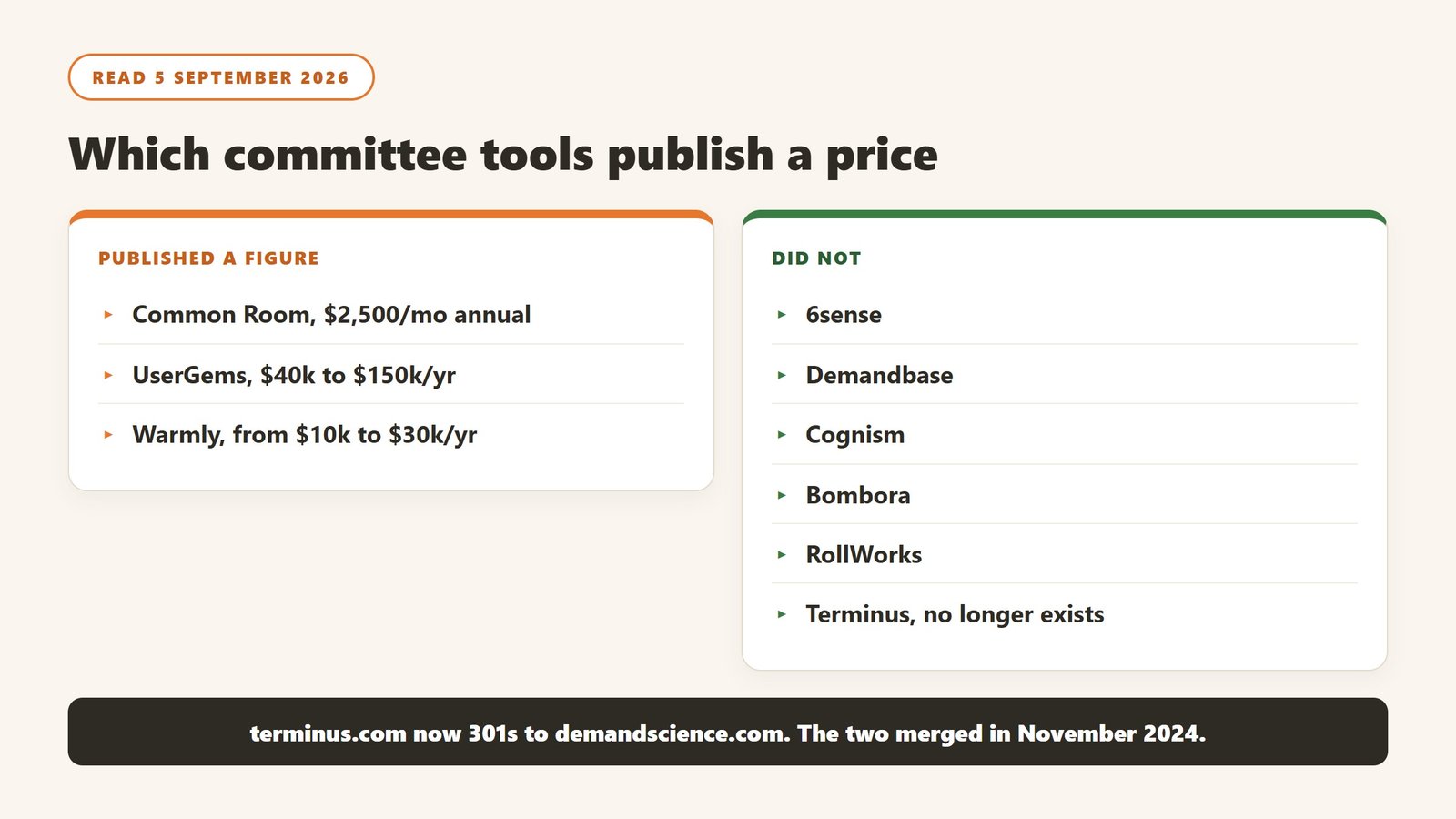
This is where the category gets expensive and opaque. We read ten vendors’ own pricing pages on 5 September 2026. Three published a figure. Six did not. One no longer exists.
| Vendor | What it does for committee reach | Published price, read 5 September 2026 |
|---|---|---|
| Common Room | Identifies people at target accounts across channels | $2,500 a month billed annually, 5 seats, up to 100k contacts |
| UserGems | Tracks job changes so a departed champion becomes a new lead | $40,000, $75,000 and $150,000 a year across three tiers |
| Warmly | Identifies accounts on your site and routes outreach | From $10,000, $20,000 and $30,000 a year by product |
| 6sense | Intent and account identification | Pricing page, no figure on it |
| Demandbase | Account intelligence and orchestration | Pricing page, no figure on it |
| Cognism | Contact data across the committee | Standard and Pro tiers named, no figure |
| Bombora | Intent data co-op | /pricing redirects to its Data Co-op page, no figure |
| RollWorks | Account-based advertising | Packages sit on AdRoll’s site, no figure read |
| Terminus | Account-based advertising | No longer exists. See below |
The one published term worth copying into your evaluation
UserGems publishes something almost nobody in B2B software does: a money-back revenue guarantee, stated on its own pricing page as 1x, 2x and 3x ROI across its three tiers, refundable if you do not see the return in closed-won revenue. It also publishes its one-time implementation fees at $3,000, $5,000 and $10,000, which is the cost line most vendors leave for the contract. Whether or not you buy it, ask every other vendor on your shortlist why they will not offer the same thing.
What “quoted” costs you in practice
Six of these nine will not show you a number, which means your first real datapoint arrives after a discovery call and a demo. Price a published alternative at your seat and account count first, and make that the figure every quote has to justify itself against. Common Room at $2,500 a month is $30,000 a year, and it is a real, checkable number both sides can see.
Terminus no longer exists, and most articles have not noticed
This is the sort of thing that makes a shortlist embarrassing, so it is worth stating plainly.
What we found
Checking on 5 September 2026, terminus.com returns a 301 permanent redirect to demandscience.com. Terminus and DemandScience announced their merger in November 2024, and the combined company operates under the DemandScience brand. Terminus is not a product you can buy under that name.
Why it matters beyond one vendor
Terminus appears in a great many current ABM roundups, including an earlier version of our own, because roundups get updated by refreshing the prices rather than by checking the vendors are still there. A price check will not catch a company that has been absorbed, because there is no price to be wrong.
The check that catches it
Before shortlisting anything, load the vendor’s own domain and look at where you land. If it redirects to another company, that is your answer in five seconds. We now record the final URL for every vendor we check, having previously recommended a tool that had been acquired nine months before we published.
Sequencing: who to reach, and in what order
Reaching everyone at once is not multi-threading, it is spam with better targeting. Order matters.
Start with the end user, not the executive
The instinct is to go top down, and it is usually wrong for a first touch. Executives delegate evaluation. If you land at the top, the most common outcome is a forwarded email to the person you should have contacted first, arriving with the implicit message that you tried to go over their head.
Earn the champion before you ask for anything
A champion is not someone who replied. It is someone willing to spend internal credibility on you. That is earned by being useful before there is a deal, and it is the reason the forwardable one-pager matters more than the pitch deck.
Bring the technical evaluator in early, deliberately
The technical evaluator is the most common late-stage killer and the easiest to disarm early. A short, honest conversation about what does not integrate, held in week two, is worth more than a flawless demo in week eight. Volunteering a genuine limitation is the fastest credibility you can buy.
Procurement is a schedule, not an obstacle
Security review, data residency and contract terms take the time they take. Asking in week two which of those apply and how long they run is the single most effective thing you can do about close dates, and almost nobody does it because it feels like inviting friction.
How to tell whether any of this worked
Committee coverage is measurable, and almost nobody measures it, which is why programmes run for a year without anyone being able to say whether they worked.
| Measure | How to take it | Why this one |
|---|---|---|
| Roles covered per account | Count how many of the six you have a named, engaged contact for | The only metric that describes multi-threading rather than activity |
| Contacts engaged per opportunity | Distinct people with a meaningful interaction, not an open | Catches the “same message, more people” failure |
| Champion continuity | How many open deals lost their main contact this quarter | Quantifies the risk single-threading creates |
| Time to first technical conversation | Days from first contact | Predicts late-stage failure better than stage progression |
Take the baseline first
Count roles covered on your current open pipeline before you change anything. It takes an afternoon and it is unrecoverable afterwards. Teams that cannot say whether their ABM programme worked almost always simply never wrote down where they started.
The number not to manage to
Meetings booked. It rewards volume at the top and tells you nothing about whether the committee is covered. A quarter with fewer meetings across more roles per account is a better quarter, and it will look worse on the dashboard most teams have built.
Where the figures on this page come from
The buying group size, the 17% figure and the per-supplier share are Gartner’s published research on the B2B buying journey. Every vendor price was read from that vendor’s own pricing page on 5 September 2026 and carries that date, because these move: we recorded the final URL in each case, which is how the Terminus redirect surfaced.
Where a vendor publishes no figure we say so rather than estimating, and we do not repeat figures for those vendors that we cannot trace to the vendor. Six of the nine here publish nothing, and an unsourced range would be worse than the gap it filled.
Related reading
For the software categories and what each type costs, AI ABM tools and pricing. For contact data specifically, AI lead enrichment tools. For the outreach tooling itself, the best AI sales tools.

Written by
FazFaz is the founder of AIToolsBakery. Some tools here are tested hands on. Others are assessed from vendor documentation and pricing verified on the live page, and every review says which one it is. Sponsors can buy a position in a guide. They cannot buy the score, the criticism, or silence about a better option.
How we test and how we make money →