The short answer
Outreach does not publish a price. Unlike most quote-only vendors, though, there is solid public evidence of what people actually pay.
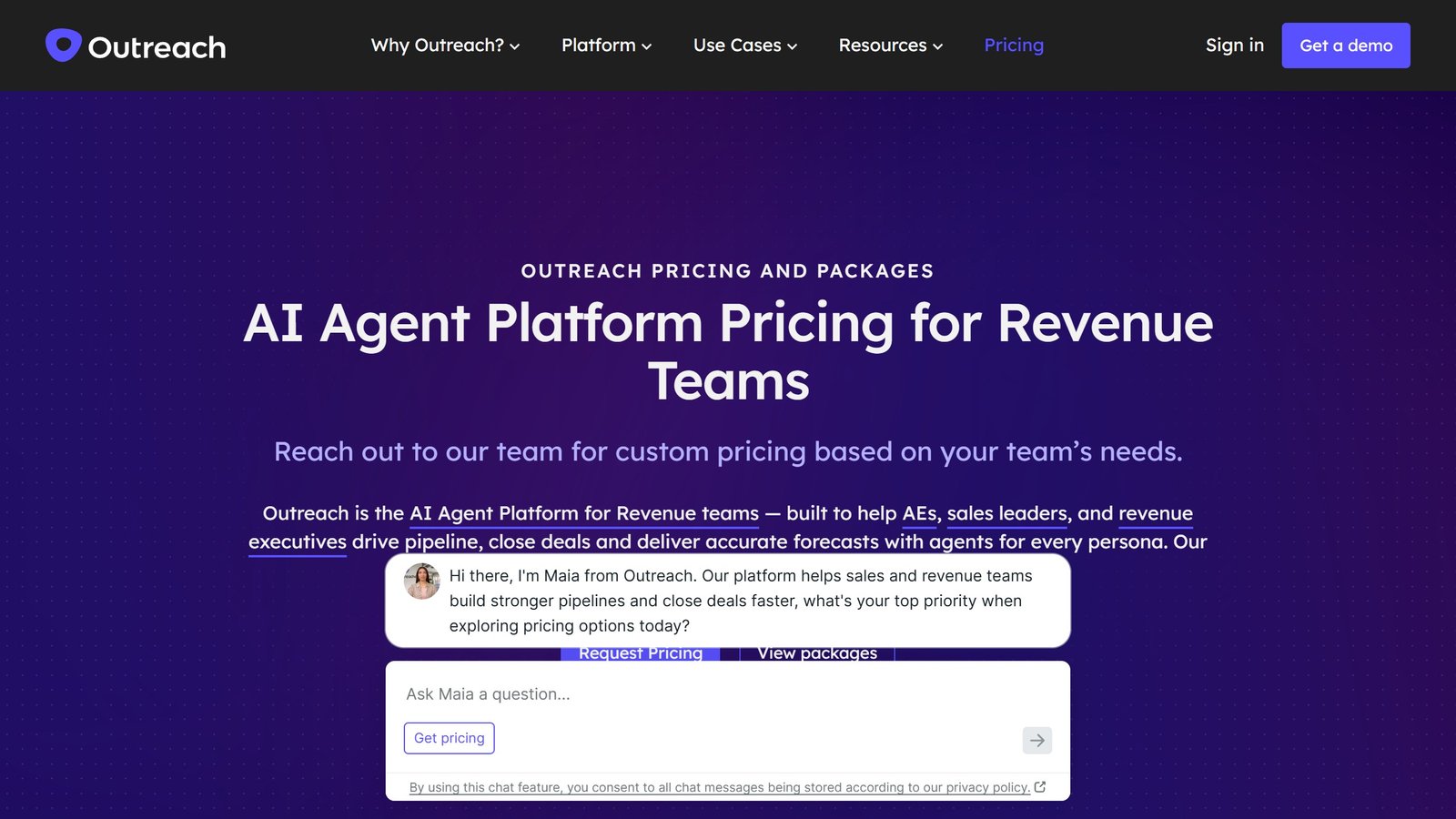
We loaded the pricing page in a browser on 1 September 2026. Four plans are listed, Essentials, Core, Amplify Plus and Enterprise, and the phrase “Request pricing” appears eleven times. There is no currency figure on the page.
The useful number comes from elsewhere. Vendr, which brokers software contracts and publishes aggregates from its own transaction data, reports that the median Outreach buyer pays $45,600 a year, drawn from 914 anonymised purchases.
First, note that the company moved
Outreach now trades at outreach.ai. The old outreach.io redirects there, and the packaging changed with the domain.
If you are reading a comparison that discusses Engage and Engage Plus tiers, it is describing the previous line-up. Those names are not what Outreach sells today, and a quote built on them is a quote for a product that has been repackaged. This catches out a lot of otherwise current-looking coverage.
What the contract data actually shows
| Metric | Value |
|---|---|
| Median annual contract | $45,600 |
| Contracts in the sample | 914 |
| Lowest observed | $8,560 a year |
| Highest observed | $213,832 a year |
| Average buyer saving vs opening quote | 12% |
| Implementation / professional services | $5,000 to $25,000+ |
| Premium support | Often 10-15% of annual contract value |
| Add-on modules | Can add 20-40% to total contract value |
The spread matters more than the median. A factor of twenty-five separates the smallest contract from the largest, which is precisely why any single per-seat figure for Outreach misleads. The bottom of that range is a small team on a narrow configuration with no add-ons. The top is a large enterprise with conversation intelligence, several modules and a long term.
The 12% average saving is the other number to hold onto. Treat the first figure you are shown as an opening position rather than a rate.
The new meter: AI credits
The most important 2026 change for budgeting is that Outreach now sizes plans partly in AI credits, quoted separately from seats. The Amplify Plus tier is listed with 50,000 of them.
This is the line item most likely to produce an unbudgeted bill, because it does not scale with headcount. Two teams of the same size can consume wildly different amounts. A team leaning hard on the agent layer, the research and personalisation features and the meeting prep tooling burns credits at a completely different rate from a team using Outreach mainly as a sequencer.
Get the credit allowance, the consumption rate and the overage price written into the contract. Seats are easy to forecast. Credits are not, and an overage rate you never agreed is not a negotiation you want to have mid-year.
What sits on top of the subscription
The subscription is not the bill. Three things stack on top, and only one of them is a one-off.
Implementation. Setup, CRM integration and training run $5,000 to $25,000 or more depending on complexity. Year one only.
Premium support. Often 10 to 15% of annual contract value. Recurring.
Add-on modules. Can add 20 to 40% to the total if they are not negotiated up front. Recurring.
Stack those and year one sits materially above the median while the steady state sits below it. Budget the two separately, or the second-year invoice will look like a saving that was never real.
What the tiers cover
Outreach does not attach prices to its tiers, but it does describe them.
The entry packaging covers the cadence engine, email and phone sequencing, standard CRM sync and reporting. The mid packaging adds conversation intelligence with real-time transcription, deal and pipeline management, account planning, and the agent layer: research, personalisation, meeting prep and coaching cards. Enterprise adds scale, controls and rollout support.
The coaching layer is where the value case for the higher tiers rests, and it is also the easiest thing to buy and never use. If your managers do not run weekly call reviews, that upcharge buys an expensive recording tool. Vendors across this category quote win-rate lifts from coaching, and none of them publish a methodology you can audit, so test any such figure against your own closed-won data rather than accepting it.
The questions to ask on the call
What is the AI credit allowance, the consumption rate, and the overage price? The 2026-specific question, and the one most likely to save you money.
What is the seat minimum on this tier? Outreach has historically applied one, and it is what rules small teams out rather than the per-seat rate.
What is implementation, itemised? Ask for setup, CRM integration and training as separate lines.
Is premium support in this number or on top? At 10 to 15% of contract value it is not a rounding error.
Which modules are in the quote and which are add-ons? Price them in the first negotiation, not the second.
How it compares to Salesloft
The direct competitor publishes no price either, and the same contract data covers both.
| Outreach | Salesloft | |
|---|---|---|
| Median annual contract | $45,600 | $30,740 |
| Contracts in sample | 914 | 704 |
| Range | $8,560 to $213,832 | $5,160 to $145,903 |
| Average buyer saving | 12% | 18% |
Outreach carries a meaningful premium at the median. Whether it is worth paying comes down to sequence depth and Salesforce integration, which is the argument we make in the Outreach review. The Salesloft review makes the other side of it.
The twenty-five-fold spread is the real story
The median is the headline, but it is the least interesting number in the Vendr data. The range is $8,560 to $213,832. The same product, sold to different buyers, at a spread of roughly twenty-five to one.
No amount of seat-count difference explains that alone. A spread like this is what quote-only pricing produces: the number is set by what the buyer will bear and how well they negotiate, not by a rate card. Understanding which end you are heading for is worth more than knowing the median.
What pushes a buyer toward the top of the range
- Arriving with a deadline. Quarter-end urgency is the seller’s strongest asset and your weakest position.
- Buying the whole platform at once rather than the module you can justify today.
- No competing quote in hand, so nothing anchors the conversation but their opening number.
- Multi-year commitments signed before you know whether reps will adopt it.
What pulls a buyer toward the bottom
- A live, credible alternative being evaluated in parallel, and the seller knowing it.
- Starting with a smaller seat count and a written expansion price agreed up front.
- Buying outside the vendor’s quarter end rather than into it.
- Separating implementation from subscription so each is negotiated on its own merits.
Vendr also publishes an average buyer saving of 12% on Outreach against 18% on Salesloft, which is itself a signal: the smaller average discount suggests Outreach holds its pricing harder in negotiation.
What a published rate card looks like, for contrast
It is worth seeing what the transparent end of this market does, because it changes what you can reasonably ask for. We read apollo.io/pricing in both billing states on 4 September 2026.
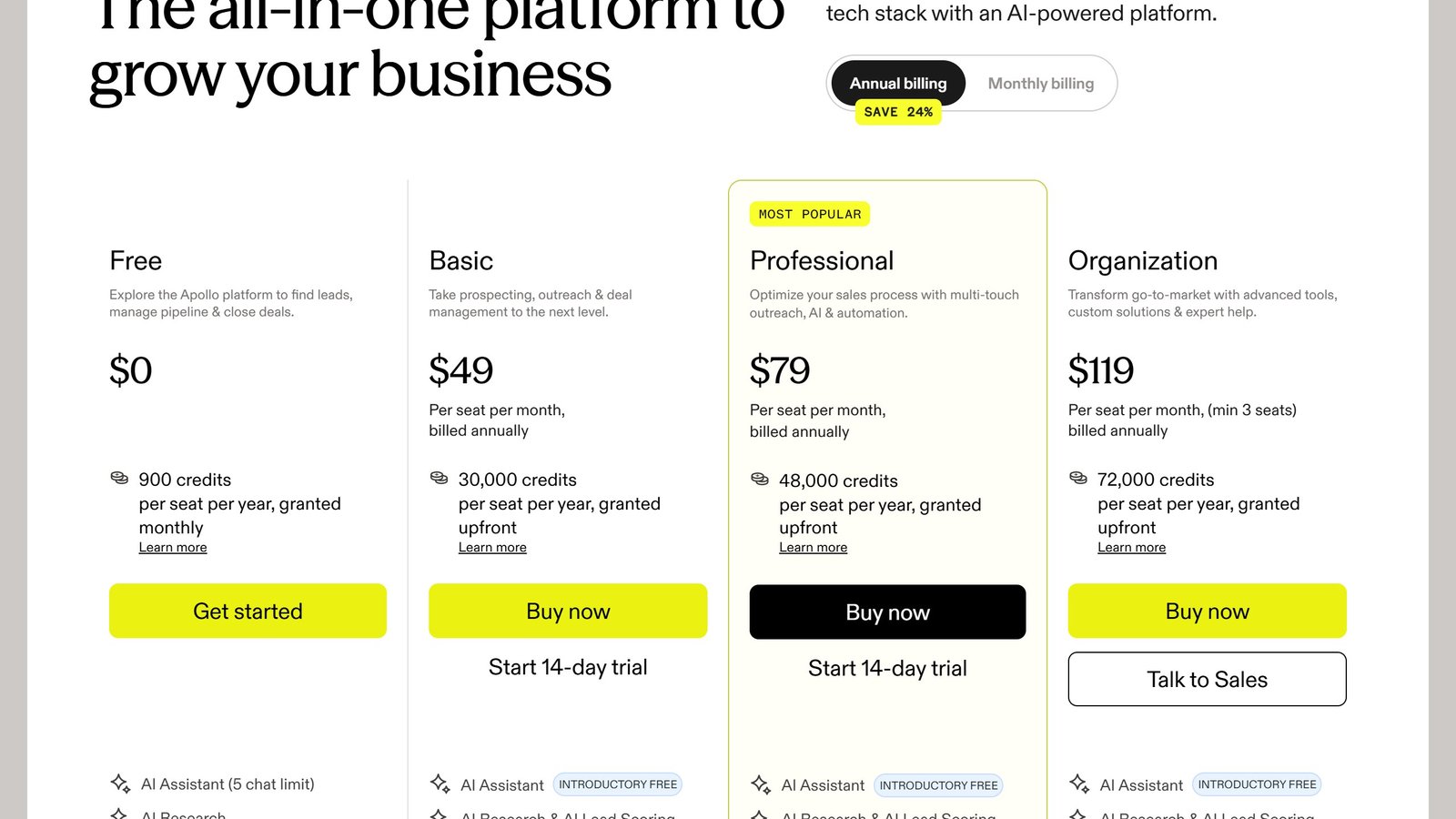
| Apollo plan | Billed annually | Billed monthly | Notes |
|---|---|---|---|
| Free | $0 | $0 | 900 credits per seat per year |
| Basic | $49 per seat/mo | $65 | 30,000 credits per seat per year |
| Professional | $79 per seat/mo | $99 | |
| Organization | $119 per seat/mo | $149 | Minimum 3 seats |
These are not competing products at the same tier, and we are not suggesting Apollo replaces Outreach for an enterprise sales org. The point is narrower: a buyer can model an Apollo deployment on a spreadsheet in five minutes and cannot model an Outreach one at all. That difference is a real cost, paid in procurement time, and it belongs in the comparison. Our Apollo pricing guide has the full breakdown.
Who this price makes sense for
A median of $45,600 a year is not a tooling decision, it is a headcount-scale commitment, and it only makes sense for a specific shape of team.
It makes sense with a real outbound motion and managers to run it
Outreach is built for a team where sequencing, cadence discipline and pipeline hygiene are the daily job of several people. If you have a defined SDR function, a manager who owns process adherence and enough volume that inconsistency is costing you deals, the spend has something to attach to.
It does not make sense as a first outbound tool
If you are proving whether outbound works at all, this is the wrong end of the market to prove it in. A published-price tool lets you test the motion for a few hundred dollars a month and walk away cleanly. Committing five figures a year to find out is an expensive way to run an experiment.
It does not make sense without CRM discipline already in place
Every serious claim made for this category depends on the CRM being accurate enough to act on. If opportunities are stale, stages are inconsistent and nobody trusts the forecast today, a sequencing platform layered on top inherits all of that and adds a bill. Fix the underlying data practice first; it is cheaper and it is a prerequisite either way.
Salesloft has gone further than Outreach, and not in a good way
The obvious alternative is worth checking at source rather than assuming, and the position has moved. On 4 September 2026 we loaded salesloft.com/pricing and it does not resolve to a pricing page at all. It redirects to /see-it-live, a page titled “Talk to Sales”.
So the comparison is not “two vendors who both hide their prices”. Outreach maintains a pricing and packaging page that at least sets out tiers and what sits in them. Salesloft no longer maintains a pricing URL at all.
What that means when you are comparing the two
Practically, it means neither vendor will give you a number without a call, so the only comparative data available is third-party. Vendr’s aggregates put the Salesloft median at $30,740 against Outreach’s $45,600, across 704 and 914 contracts respectively, with a larger average buyer saving on Salesloft at 18% against 12%.
Read carefully, that says two things at once. Salesloft is cheaper at the median and discounts harder, which usually indicates the weaker negotiating position of the two. That is useful leverage in an Outreach conversation, and it is the sort of thing worth saying out loud on the call.
The AI credit meter is the line that changes the maths
The subscription is no longer the whole bill. AI credits are a consumption meter on top, and consumption meters behave differently from seats: they scale with activity rather than headcount, which means the cost can rise in a quarter where you have hired nobody.
Why a usage meter is harder to budget than a seat count
A seat-based line is predictable because you control the input. A credit-based line is driven by how much your reps actually use the AI features, which is precisely the behaviour you are hoping to increase. Success at adoption raises this line. That is an uncomfortable structure to budget against and it deserves an explicit conversation rather than a footnote in the order form.
What to pin down before signing
- How many credits are included per seat, and does the allocation pool across the team or sit per user?
- What happens when the allocation runs out: does it hard stop, soft throttle, or auto-purchase?
- What does an additional credit block cost, and is that price fixed for the contract term?
- Do unused credits roll over, or expire at period end?
- Which specific features draw credits, and can any be disabled per user?
Ask for the answers in the contract, not the demo. A meter whose top-up rate is set at the vendor’s discretion mid-term is an open-ended commitment dressed as a subscription.
Modelling the cost before you have a quote
Work from the median, not the entry point
Because there is no published entry price, the safest planning assumption for a mid-size team is the median rather than the bottom of the range. Vendr’s $45,600 is the number to put in a draft budget, then treat anything below it as a negotiating win rather than an expectation.
Budget implementation separately and early
Implementation, integration and admin time are not in the subscription figure and are the most commonly underestimated line in this category. Ask for it quoted separately, and ask specifically whether CRM integration work is included or scoped as a professional services engagement.
Price the second year, not just the first
First-year discounts are the norm and renewal uplifts are where quote-only vendors recover them. A capped renewal percentage, written into the contract, is worth more than a larger year-one discount and is the single most valuable thing to negotiate for.
What the rest of this market charges, vendor by vendor
A table gives you the number. What decides your bill is the meter behind it and the limit that binds first. Here is each comparable vendor to Outreach, read from their own pricing page on 4 September 2026.
Apollo.io, from $49 per seat, and it publishes the allowances too
Apollo is the transparency benchmark in this category. Basic is $49 per seat per month billed annually and $65 billed monthly, Professional $79 and $99, Organization $119 and $149 with a three-seat minimum, plus a free tier at $0. Crucially it also publishes the credit allowance, 30,000 per seat per year on Basic, which almost nobody else does. That means you can divide the allowance by your real monthly reveal volume and know whether the plan fits before speaking to anyone.
Lavender, from free to $89 a seat, and free for students and jobseekers
Lavender publishes every tier: Basic free forever but capped at five emails analysed a month, Starter $27, Individual Pro $45 and Team $89 per seat, all billed annually. Note the URL, because lavender.ai/pricing now returns a 404 after the company split into two products. It also gives the Email Coach away free to students, jobseekers and bootstrapped founders, which is unusually generous and worth knowing if you hire from a graduate pipeline.
Instantly and Smartlead, published, and metered on sending
Instantly and Smartlead both publish figures openly. For cold email tooling the binding constraint is usually monthly sending or active-lead volume rather than seats, so a plan can look generous per user and still stop you at the volume your campaign needs. Smartlead runs a working monthly and annual toggle that changes every figure, so check which state you are reading.
Clay, published but on a slider
Clay publishes real numbers, but they sit on a credit slider with a monthly and annual toggle marked “Save 10%”, so the figure changes as you move the credit volume. Any article quoting a single flat Clay price has taken one position on that slider and presented it as the price. Always pair a Clay figure with the credit volume it assumes, or it cannot be compared to anything.
Cognism, no price, but it publishes the packaging
Cognism publishes no figure in any currency. It does publish that Standard and Pro both include five seats, which is a floor worth knowing, and that its credits model only spends a credit again if a contact changes jobs. A two-person team should expect to be quoted for five.
Gong, no price, but it publishes the formula
Gong publishes no figure either, but it does publish the model: licences priced per user plus a separate platform fee based on the number of users supported. Two components, both scaling with headcount, which at least lets you model the shape of the bill.
ZoomInfo, Outreach and Salesloft publish nothing at all
ZoomInfo renders over 12,000 characters of pricing page with no currency figure anywhere. Outreach sets out packaging but no numbers, and note the domain moved from outreach.io. Salesloft has gone furthest: its pricing URL now redirects to a page titled “Talk to Sales”, so there is no pricing page at all. Artisan has also removed its figures, its cards now reading “Pricing scoped on your plan”.
How we checked this
We loaded the Outreach pricing page in a real browser on 1 September 2026, confirmed the redirect from outreach.io to outreach.ai, waited for full render, and recorded the tier names, the AI credit allowance and the absence of any currency figure. The contract figures are Vendr’s published aggregates, read on the same date, and are attributed to Vendr rather than to Outreach. We hold no private contract data of our own and quote none. This is a pricing page rather than a review of the product, and we did not run a hands-on trial for it.

Written by
FazFaz is the founder of AIToolsBakery. Some tools here are tested hands on. Others are assessed from vendor documentation and pricing verified on the live page, and every review says which one it is. Sponsors can buy a position in a guide. They cannot buy the score, the criticism, or silence about a better option.
How we test and how we make money →