Compliance training used to mean one thing: assign the annual course, chase the stragglers, and export a completion report before the audit. That model still ships in most legacy systems, but it does almost nothing to reduce actual risk. People click through, forget the content, and the organization stays exposed.
AI changes the job description. The newer platforms behave less like a course catalog and more like a risk control system. They turn your policies into structured lessons in minutes, assign the right training the moment someone changes roles, adjust difficulty based on how a person actually performs, and keep a versioned, timestamped record that holds up when a regulator asks. Below are the platforms doing this well in 2026, ordered by how much real compliance value they deliver, not by marketing volume.
| Platform | Best for | Standout AI feature | Pricing model |
|---|---|---|---|
| KnowBe4 | Security and phishing awareness | AIDA agents personalize training per user risk | Per seat, tiered, quote based |
| Docebo | Automated compliance assignment | AI rules engine for role based enrollment | Per user, quote based |
| Skillsoft | Enterprise regulated libraries | Percipio AI coach and adaptive paths | Per user or per course, quote based |
| iSpring Learn | Author your own compliance courses | AI content creation and task automation | Active user, low starting cost |
| Litmos | Fast extended enterprise coverage | Large off the shelf library plus automation | Per user, tiered |
| Traliant | Harassment, ethics, HR compliance | Dynamic course profiling by role and location | Per learner, quote based |
| Cornerstone Galaxy | Enterprise talent plus compliance | AI governance framework and readiness agents | Per user, quote based |
| Absorb LMS | Microlearning and recertification | AI authoring and automated recert workflows | Per user, quote based |
If you want the wider view across every training use case, our best AI corporate training tools pillar covers onboarding, sales, and soft skills alongside compliance.
KnowBe4
KnowBe4 is the clearest AI native pick when your compliance risk is human behavior around security. Its platform pairs the largest security awareness content library in the category, spanning 35 plus languages, with a suite of AI agents branded AIDA. In 2026 the standout is AIDA Orchestration, which the company describes as an autonomous agent that independently creates, schedules, and manages personalized training and phishing simulations at the individual user level, adapting to each person’s risk profile without manual administration.
Who it is for: security, IT, and risk teams that need to prove they are actively reducing human risk, not just running an annual module. It is a strong fit for organizations under frameworks like SOC 2, ISO 27001, HIPAA security rules, or PCI where phishing resilience is a real audit line.
The standout feature is risk based personalization. Rather than blasting the same simulation to everyone, AIDA targets the right difficulty and reinforcement to the people who need it. KnowBe4 reports that AIDA customers reduce their risk score close to three times more than non AIDA users, though as with any vendor stat you should validate it against your own baseline.
The honest limitation is scope. KnowBe4 is superb at security and phishing but is not the tool for harassment prevention, code of conduct, or industry specific regulatory training. Many buyers run it alongside a broader compliance LMS. Pricing is per seat and tiered by feature level, quoted based on headcount. If security awareness is your primary need, see our deeper best AI cybersecurity awareness training platforms guide.
Docebo
Docebo earns its spot on the strength of its AI rules engine, which automates the part of compliance that quietly eats admin hours: getting the right training to the right person at the right time. When an employee changes roles, Docebo can automatically assign the compliance courses tied to the new role, set the renewal schedule, and push a notification to that person’s dashboard. That role driven logic is exactly what regulated organizations need to avoid coverage gaps.
Who it is for: mid market and enterprise learning teams that want automation and reporting depth without buying a full talent suite. It suits companies with complex org structures where compliance requirements shift by role, location, or department.
The standout feature is audit reporting. Docebo offers drill down by department, location, regulation, or individual, and can generate compliance matrices and heat maps so you can see coverage at a glance and defend it later. That reporting layer is what turns a training tool into an audit asset.
The honest limitation is that Docebo is a platform, not a content library. You bring or build the compliance content, or integrate a third party library. Teams looking for turnkey OSHA or HIPAA courses out of the box will need to pair it with a content provider. Pricing is per user and quote based, and Docebo generally targets organizations above the small business tier.
Skillsoft
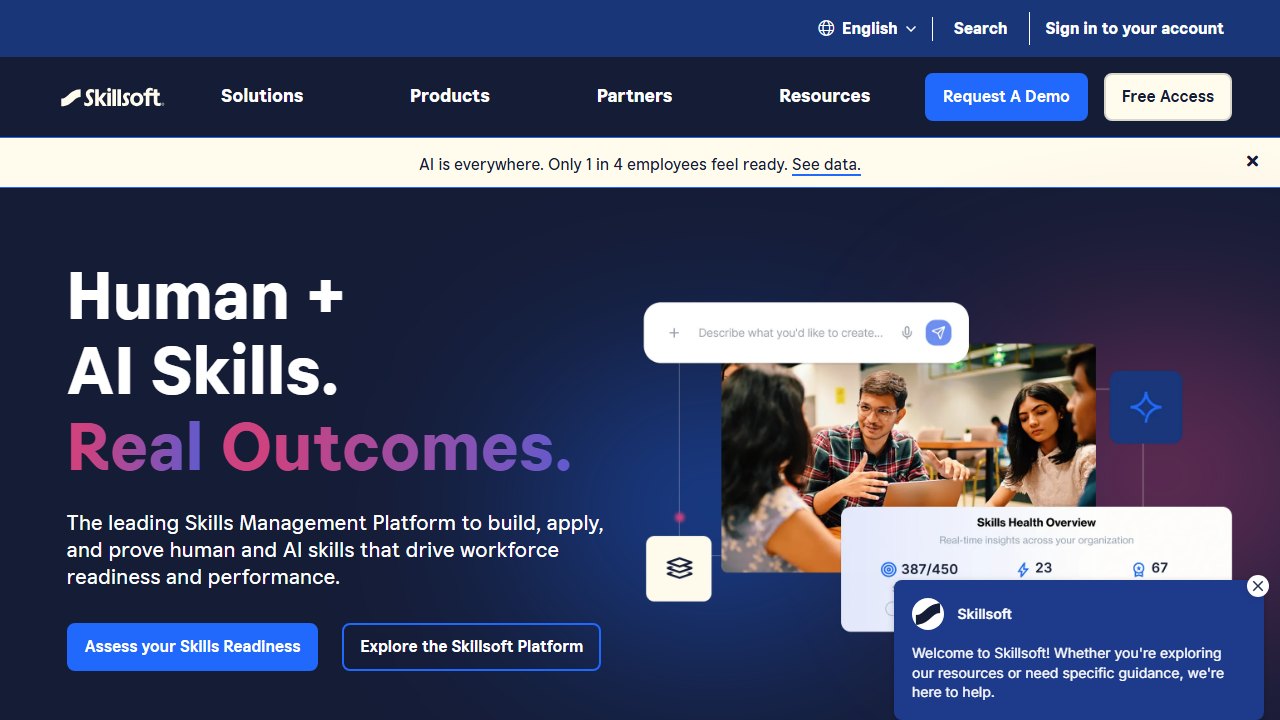
Skillsoft is the enterprise breadth choice. Its compliance library is deep and genuinely regulated grade, covering OSHA, HIPAA, harassment prevention, anti bribery, and cybersecurity, delivered through the Percipio platform. For a large, multi regulation organization that wants one vendor to cover most mandatory training, Skillsoft is hard to beat on catalog alone.
Who it is for: large enterprises and regulated industries that need broad, maintained course coverage across many compliance domains and jurisdictions, with the content upkeep handled by the vendor.
The standout AI element is inside Percipio: AI driven recommendations, an AI powered coach, and adaptive learning that personalizes paths based on role and prior performance. For compliance specifically, the value is less about flashy generation and more about keeping learners on the right, current version of a course and surfacing the next required item automatically.
The honest limitation is that Skillsoft is built for scale, and smaller teams can find it heavier and pricier than they need. Pricing is quote based, subscription per user or per course, and implementation is an enterprise engagement rather than a self serve signup. If your compliance need is narrow, a lighter tool will move faster. If it is broad and regulated, this is the safe library backbone.
iSpring Learn
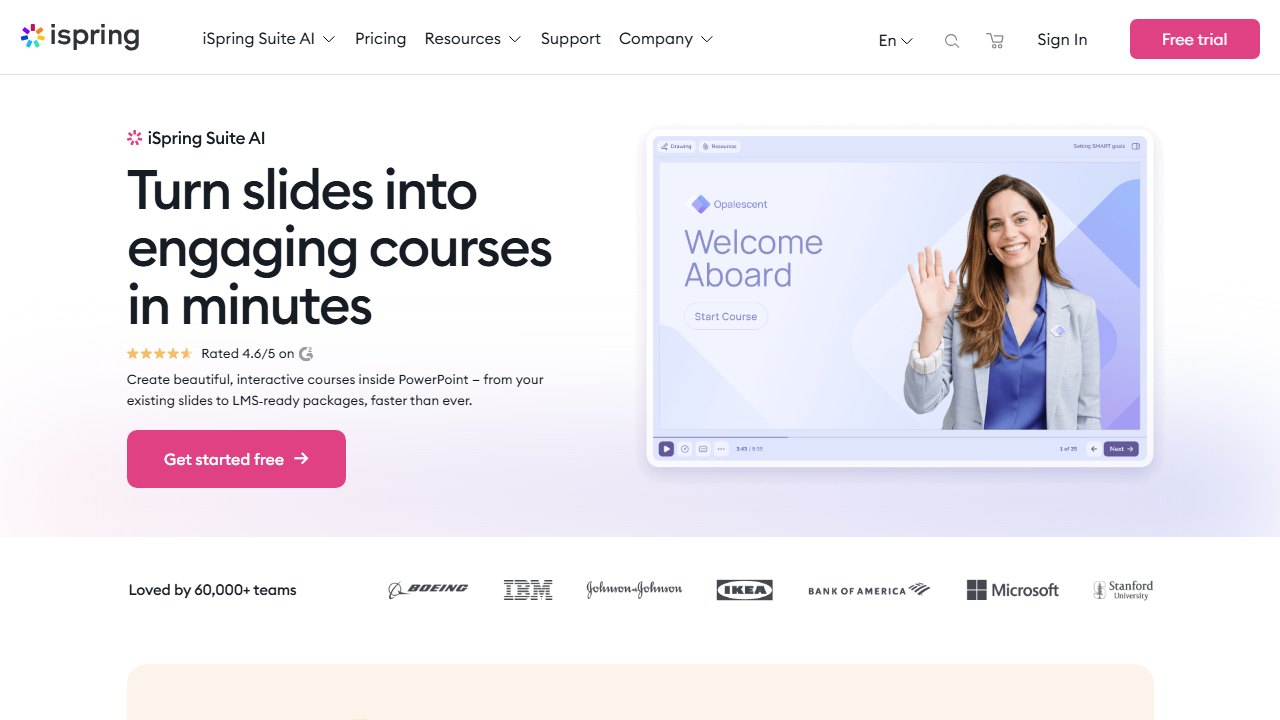
iSpring Learn is the pick for teams whose compliance content is proprietary and internal rather than off the shelf. Paired with the iSpring Suite authoring tool, it turns PowerPoint, SCORM, and existing documents into trackable courses, and recent AI enhancements help admins create content faster and automate repetitive setup tasks. If your regulators care about your specific SOPs, not a generic module, author first is the right model.
Who it is for: small and mid sized teams, and any organization that wants to build and host its own compliance courses cost effectively rather than license a fixed library.
The standout feature is the pricing and authoring combination. iSpring Learn uses an active user model that bills only for people who actually log in, and pricing starts in the low single digits per user per month at volume when billed annually. For a manufacturer or clinic that needs to train on internal procedures, that is a fraction of enterprise suite cost.
The honest limitation is that you supply the compliance expertise. iSpring gives you the authoring and delivery engine, but there is no deep pre built OSHA or AML catalog waiting for you. It is a build tool, not a buy tool. For teams that want to level up how they produce that content, our best AI instructional design tools roundup pairs well here.
Litmos
Litmos is the fastest route to broad compliance coverage. It bundles a large off the shelf course library, reported in the tens of thousands of titles, with the automation that mid market and enterprise teams need for assignments and recertification. For compliance heavy industries that need training live within days rather than months, that speed to coverage is the whole pitch.
Who it is for: extended enterprise scenarios where you must train not only employees but also contractors, partners, and customers from one system, all with their own compliance requirements.
The standout feature is the combination of a ready library plus recertification automation. You can assign a required course, set the renewal cadence, and let the system re enroll learners automatically when certifications expire, which keeps continuous compliance obligations from slipping.
The honest limitation is that a very large library can feel generic, and heavy compliance customization or highly specific regulatory content may still require your own authoring or a specialist provider. Pricing is per user and tiered by active learner bands, generally decreasing per seat as your learner count rises. Litmos rewards scale, so it is less economical for very small teams.
Traliant
Traliant is the specialist for the HR side of compliance: harassment prevention, code of conduct, DEI, workplace violence, ethics, and increasingly responsible AI use. Its 2026 flagship, The Conference, reimagines harassment training as a TV style episodic course that follows colleagues through realistic scenarios, which is a real step up from the click through modules most employees dread.
Who it is for: HR, legal, and people teams that need modern, defensible, and genuinely engaging training on workplace conduct across multiple states and roles.
The standout feature is dynamic course profiling. A single unified course automatically adapts based on a learner’s role and location, so a manager in California and an individual contributor in Texas each get the correct version without you maintaining separate courses. Built in behavioral analytics with pre and post training questions produce the defensible insight auditors and investigators actually want.
The honest limitation is focus. Traliant is excellent for HR and conduct compliance but is not your OSHA safety or cybersecurity phishing engine. Its AI Ethics course on responsible generative AI use is a smart, current addition, but the catalog centers on people and conduct topics. Pricing is per learner and quote based. Many organizations run Traliant for HR compliance alongside KnowBe4 for security.
Cornerstone Galaxy
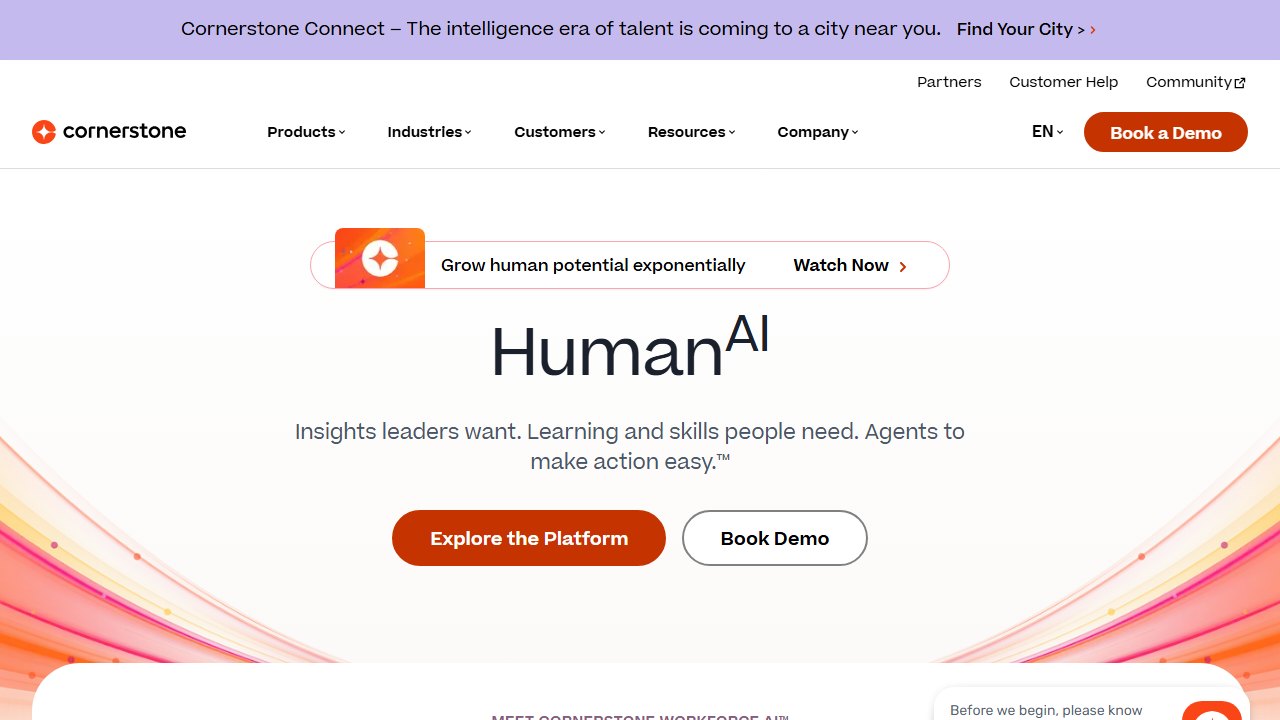
Cornerstone now operates as Cornerstone Galaxy, unifying learning, performance, succession, recruiting, and workforce intelligence in one system. For compliance, the value is that mandatory training lives inside the same platform that manages the rest of the employee lifecycle, so role changes, new hires, and skill gaps can trigger the right compliance actions automatically.
Who it is for: large enterprises that want compliance training embedded in a broader talent platform rather than run as a standalone tool, especially those already invested in Cornerstone for HR.
The standout feature in 2026 is Cornerstone’s AI governance posture combined with its readiness agents. The company is ISO 42001 certified for responsible AI management and embeds an AI governance framework with a dedicated committee and risk based implementation. For organizations that must justify their own AI use to regulators, buying compliance training from a vendor with mature AI governance is a meaningful signal. Its AI powered coaching for practicing high stakes conversations extends beyond pure compliance into behavior.
The honest limitation is weight and cost. Galaxy is a full enterprise suite, and adopting it purely for compliance training is overkill. It shines when compliance is one workload inside a larger talent transformation. Pricing is per user and quote based, with an enterprise implementation cycle.
Absorb LMS
Absorb LMS rounds out the list as a well balanced AI powered LMS with a specific compliance strength: bite sized microlearning plus automated certification and recertification workflows. For organizations that want compliance to fit into a busy schedule rather than block out a half day, the microlearning approach improves both completion and retention.
Who it is for: mid market teams that want a clean, modern LMS with solid compliance automation and AI authoring, without the full enterprise suite footprint of Cornerstone or Skillsoft.
The standout feature is the recertification automation paired with AI assisted authoring. Absorb can automate enrollment into certification and recertification courses so ongoing obligations are handled by the system, and its AI tools speed up building the courses in the first place. A newer mentoring and coaching capability with intelligent matching adds a human reinforcement layer on top of formal training.
The honest limitation is that Absorb, like Docebo, is primarily a platform. Its off the shelf regulated content is lighter than a dedicated library vendor, so heavily regulated buyers may still license OSHA or HIPAA content separately or author their own. Pricing is per user and quote based. Absorb is a strong middle ground when you want automation and a good learner experience without enterprise complexity.
Rolling this out so people actually use it
The failure mode in corporate training software is not a bad product, it is a deployment that reaches week six with impressive licence numbers and no behaviour change.
Pick one team and one behaviour, not one platform
The instinct is to roll out to everyone because the licence covers it. The better move is one team, one measurable behaviour, and a fixed period. A discovery call structure, an objection, a specific product pitch. Narrow scope means you can tell whether it worked, and a result from one team persuades the rest far more effectively than a mandate.
Managers have to use it before reps do
Roleplay and coaching platforms live or die on whether managers review the output. If a rep completes a scenario and nobody ever mentions it, completion becomes a compliance task within a fortnight. Before launch, agree which existing meeting will use the output, ideally the one-to-one that already happens, and make somebody responsible for opening it there.
Mandatory completion produces completion, not skill
If the only metric is completion percentage, you will get a high completion percentage and learn nothing. Pair it with something qualitative from the start: a manager rating on a rubric, a before-and-after recording, or a call outcome. Otherwise the dashboard will look excellent while the sales floor is unchanged.
Plan for the second wave, which is where it usually dies
The first cohort is volunteers and enthusiasts and it always goes well. The second is everyone else, and their experience decides whether best ai becomes part of how the team works. Budget real time for the second wave, expect more resistance, and do not read the first cohort’s enthusiasm as evidence the rollout is done.
Name the owner and the stop condition
One person whose job includes this, with the hours to do it, and a written statement of what twelve months would have to look like for you not to renew. Both are unglamorous and both are the difference between a platform that survives a budget review and one that quietly does not.
How to choose the right AI compliance platform
Start from your regulations, not the feature list. The mistake buyers make is shopping for AI capabilities in the abstract, then discovering the platform does not cover the specific rules that put them at risk. Map your mandatory training obligations first, then match the tool.
If your top risk is security and phishing, KnowBe4 is the default. If it is harassment, ethics, and conduct, Traliant leads. If you need a broad regulated library maintained for you, Skillsoft or Litmos give you the fastest coverage. If your compliance content is proprietary and internal, an author first platform like iSpring Learn will be far more cost effective. And if you want automated assignment logic and audit grade reporting on top of your own content, Docebo is the engine.
Whatever you choose, keep a human compliance owner in the approval loop for any AI generated content, insist on version control and timestamped records, and confirm the platform retains data for your required audit period. AI is a powerful drafting and personalization accelerator, but it is not the final authority on regulatory language. For a structured rollout, our how to build an AI training program guide walks through piloting and scaling without breaking your audit trail, and if healthcare is your world, the best AI tools for healthcare compliance training roundup goes deeper on HIPAA specifics.

Written by
FazFaz is the founder of AIToolsBakery. Some tools here are tested hands on. Others are assessed from vendor documentation and pricing verified on the live page, and every review says which one it is. Sponsors can buy a position in a guide. They cannot buy the score, the criticism, or silence about a better option.
How we test and how we make money →