Search for AI NBDHE exam prep and the first page is mostly prep companies describing their own products, app listing sites and general articles about AI study tools that never mention dental hygiene. Few of them start with the two facts that should shape every choice. First, 150 of the 350 questions on the National Board Dental Hygiene Examination are case-based: you read a patient history, look at a dental chart, radiographs and clinical photos, and answer a run of questions about that one patient. Second, the Joint Commission on National Dental Examinations (JCNDE) put new test specifications into effect on 1 November 2026, and none of the AI tools’ pages we read for this guide mentions them.
Both facts matter for AI prep in a specific way. An AI tutor explains the question in front of you, so it is only as useful as the questions it sits beside. A bank that is mostly one-line recall questions can make you fast at facts and still leave you slow on a 15-question patient case. So this guide asks three questions of every product: how much case-based practice does it have, what exactly does its AI do, and what do you pay and on what terms? It starts with the exam as JCNDE describes it and with JCNDE’s own practice material, then compares three prep products that describe an AI feature, followed by banks and courses with little or no AI, a section on general chatbots, a note on look-alike apps, the products we left out, and a guide to choosing. It is written for dental hygiene students preparing for boards. If friends in other programs are preparing too, our guides to AI NPTE exam prep and AI PANCE exam prep cover their exams.
How we put this together. We have not used these tools ourselves. Every price, rating and feature below comes from the vendor’s own website, terms or US App Store listing, and the exam facts come from JCNDE’s own pages and PDFs and its practice test page at Pearson VUE, all read on 19 November 2026 and linked in the text. None of these companies paid to appear on this page, and there are no affiliate links. Nothing here is clinical advice; for anything about patient care, follow your program, current guidelines and your state board.
The NBDHE in 2026: what JCNDE actually sets
Every product below says it prepares you for “the NBDHE”, so it is worth being exact about the exam. All of the figures in this section come from JCNDE’s NBDHE page, its 2026 candidate guide (updated 17 September 2026) and its other documents.
| Item | What JCNDE says |
|---|---|
| Questions | 350 multiple choice: 200 discipline-based, 150 case-based |
| Case-based component | 12 to 15 patient cases with histories, dental charts, radiographs and photos |
| Testing time | 7 hours 30 minutes in two sessions (3.5 hours and 4 hours); 9 hours in total with tutorial, breaks and survey |
| Where | Pearson VUE test centres |
| Fee | $600, including reports to three licensing jurisdictions and your program |
| Scoring | Pass or fail; scale of 49 to 99, with 75 the minimum passing score |
| Retakes | Wait 60 days; no more than four attempts in any 12 months |
| 2025 first attempts, accredited programs | 7,893 candidates, 10.1% failed |
Two components and two sessions
The NBDHE has 350 multiple-choice items, and the candidate guide splits them into two components. The discipline-based component has 200 items across three areas: the scientific basis for dental hygiene practice, the provision of clinical dental hygiene services, and research principles and community health. The case-based component has 150 items built around 12 to 15 patient cases. JCNDE says the cases involve adult and child patients and may include geriatric, adult periodontal, pediatric, special needs and medically compromised patients, with the information presented through patient histories, dental charts, radiographs and clinical photographs. A patient box shows what the clinician would know at the visit, and the guide tells you to assume that anything missing from it is unknown, so if no allergies are listed, assume none.
The schedule follows the two components. Session one gives you 3 hours 30 minutes for the 200 discipline-based questions, with an optional 15-minute break inside the session. After an optional 30-minute break, session two gives you 4 hours for the 150 case-based questions, presented as two blocks of seven or eight patient cases. Testing time adds up to 7 hours 30 minutes, and the whole appointment runs to 9 hours with the optional tutorial, breaks and post-exam survey. That makes case-based questions 43% of the exam and more than half of the time on the clock, which is why this guide keeps coming back to them.
The research and community health questions use a third format worth practising on purpose. JCNDE calls it a testlet: a short scenario about a community or a study, followed by a set of questions. The candidate guide’s sample testlet is a rural county planning a preventive program, with caries index scores, a school fluoride rinse program and a question about which group is underserved.
New test specifications from 1 November 2026
JCNDE’s Recent and Forthcoming Updates document, updated 22 October 2026, says updated NBDHE test specifications were scheduled for 1 November 2026, and that the changes are not expected to substantially alter exam preparation but add clarity and refinements to several areas. The candidate guide prints both versions side by side. The 200 discipline-based items move from 61, 115 and 24 across the three areas to 56, 124 and 20, so the scientific basis and the research and community health areas shrink a little and clinical services grows. The third area is renamed Research Principles and Community Health. Local anesthesia now appears by name under both the scientific basis and care planning, alongside occlusal evaluation, nonsurgical periodontal therapy, documentation and risk management, and emerging technologies in radiography and supportive treatment. The case-based component stays at 150 items, with its areas renamed to match.
The same document lists the clinical guidelines the exam follows, which is useful when you check an explanation from any source: the 2017 periodontal classification from the American Academy of Periodontology, the 2017 American Heart Association blood pressure guidelines, the 2021 AHA statement on antibiotic prophylaxis, the 2020 trauma guidelines from the International Association of Dental Traumatology, and the current American Society of Anesthesiologists physical status classification. It also notes that the exam no longer asks about film processing.
Scoring, retakes and fees
JCNDE reports results as pass or fail. Behind that sits a scale from 49 to 99, with 75 the minimum passing score, and the guide stresses that a 74 does not mean one more correct answer would have passed you. JCNDE’s scoring FAQ says it does not release how many correct answers you need, because that varies by exam form. There is no penalty for guessing. Some questions are unscored pretest items that look the same as the rest, and JCNDE does not say how many. If you fail, your report shows your overall scale score plus performance information for 13 discipline areas and for the case area. Results usually arrive within three to four weeks.
After a failed attempt you must wait at least 60 days, and you can sit no more than four times in any 12-month period. Under the Five Years/Five Attempts rule, you have to pass within five years of your first attempt or within five attempts, whichever comes first; after that you can test once every six months. The exam fee is $600, and each attempt needs a new application and fee. Once your application is processed you have six months to test, and a 45-day extension costs $150. Rescheduling costs $25 through Pearson VUE.
Pass rates and what they tell you
JCNDE’s 2025 technical report shows that 7,893 candidates from accredited programs took the NBDHE for the first time in 2025 and 10.1% failed. Retakers from accredited programs did much worse: 54.9% of 1,560 failed. Across all 9,876 attempts, 18.7% failed. Failure rates for first-time candidates from accredited programs ran between 5.1% and 7.9% from 2016 to 2019, rose to 14.3% in 2022, and have fallen each year since. The lesson for prep is simple: most first-time candidates pass, but a failed first attempt is hard to recover from, so it pays to prepare once and properly.
The NBDHE is the written exam. Most states also require a clinical exam, which is separate; JCNDE launched its own clinical exam for hygienists, the DHLOSCE, in fall 2025, and acceptance varies by state. Check your state board for which clinical exam it accepts.
The benchmark: JCNDE’s own practice material

JCNDE writes the exam, so its practice material is the yardstick for every product below. None of it has an AI feature.
Free sample questions
JCNDE’s NBDHE sample questions, linked from its prepare page, are free. The PDF has 17 single discipline-based questions, a testlet with three questions, and a full patient box case followed by 15 questions, each with the key marked. That case is a valuable free resource for the case-based part of the exam, because it shows exactly how much information a case gives you and how the questions lean on it. The prepare page also links a list of acronyms and abbreviations used on the exam, the reference texts the question writers use, and Pearson VUE’s software tutorial.
Official practice tests at Pearson VUE: $20 to $100
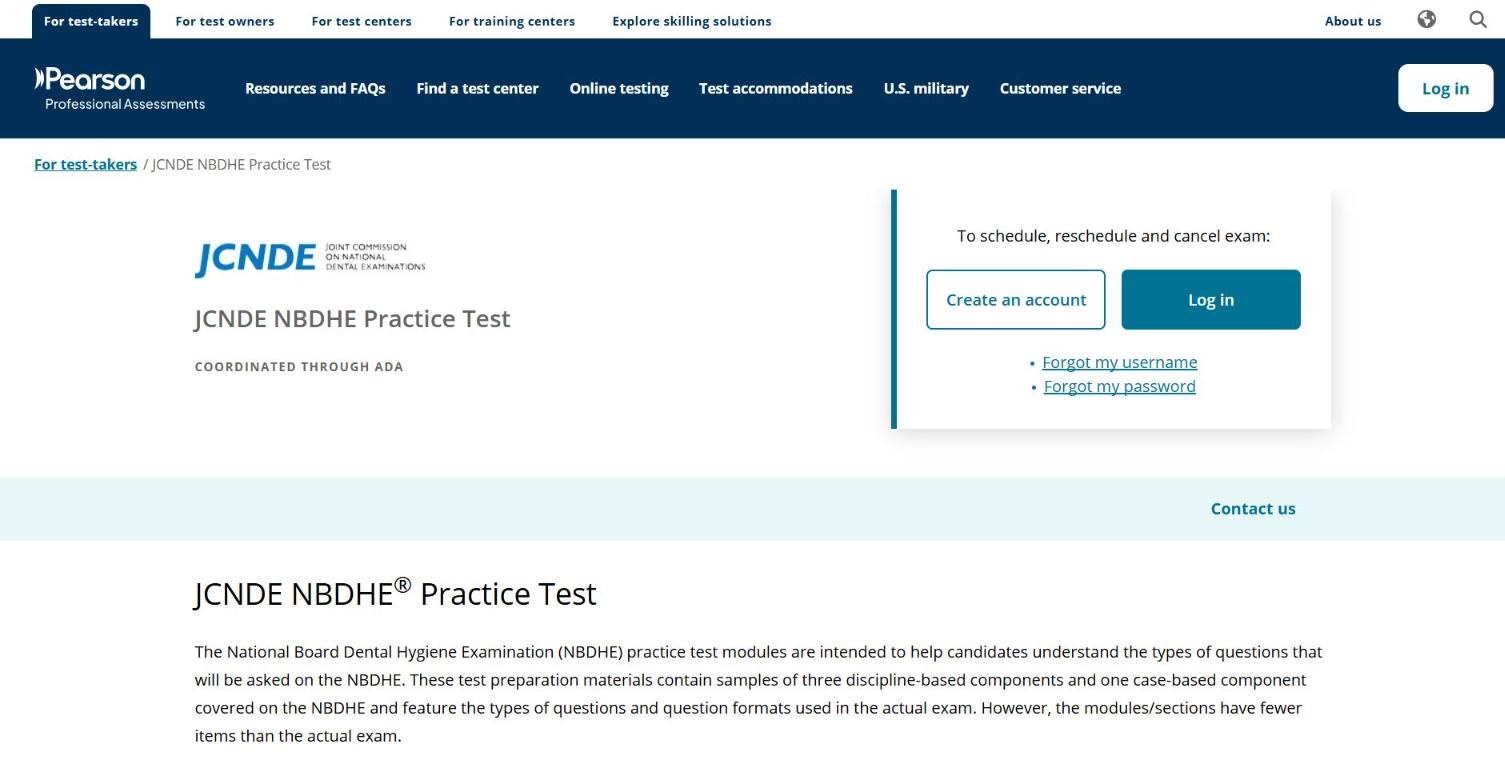
JCNDE sells practice tests through Pearson VUE. Each module comes in two forms. The scientific basis module has 30 items in 30 minutes for $20, clinical services has 65 items in 65 minutes for $60, community health and research principles has 15 items in 20 minutes for $20, and the case-based module has 70 items in 125 minutes for $75. The full practice test has 180 items in 240 minutes for $100 per form, which Pearson VUE says saves $75 against buying that form’s modules separately. You have 30 days from payment to finish. The candidate guide warns that results do not predict how you will do on the real exam, and that practice content may or may not reflect the questions currently on the exam. The Pearson VUE page was last updated in March 2026 and still uses the old area names, so treat it as a rehearsal of format and pace, not of the new split.
Reference texts and guidelines
The reference text list and the guideline notes above are what the exam writers work from. They are also the right place to check anything an AI tool tells you, because none of the tools below names a source for each AI answer.
AI NBDHE exam prep tools compared
| Product | What the AI does | Case-based practice | Price (19 November 2026) | Renewal and guarantee |
|---|---|---|---|---|
| NBDHEBooster | Booster AI tutor answers your NBDHE questions | 230+ case-based and 105+ community testlet questions in 1,200+ | $299 for 90 days or $349 for 180 days, one-time | Does not renew; refund or extension if you meet three targets and fail |
| TrueLearn | SmartInsights chat answers questions about your own performance data | Not mentioned; 800+ questions mapped to the blueprint | $49 for 30 days up to $99 for 180 days, one-time | Pass Guarantee on 90 and 180-day plans; terms not on the page |
| AndyRDH Dental Hygiene Academy | An AI-Powered Studying System, not explained | 40 case studies and three mock exams | Packages from $199.99 to $499.99; app $14.99 a month or $144.99 a year | Packages do not expire; money back on Premium only, four conditions |
How we chose and ordered these
Each product had to describe an AI feature in its own words, offer NBDHE preparation, and be live and updated in 2026. We ordered them by three things: how much case-based and testlet practice the vendor says it includes, since that is 43% of the exam; how clearly it explains what its AI does and which plan includes it; and how clear its price, renewal and refund terms are. This order says nothing about pass rates, and we found no independent study comparing these tools. None of the three names the 1 November 2026 test specifications on the pages we read.
The three AI tools
1. NBDHEBooster: a stated count of case and testlet questions, an AI tutor on both plans, and prices that do not renew
The AI. NBDHEBooster is the dental hygiene product from Booster Prep, which also sells Booster-branded INBDE and DAT prep. Its upgrade page lists a Booster AI Tutor on both paid plans and describes it as tutor-like guidance that answers your NBDHE questions at any time. The NBDHE page goes further and promises instant, accurate answers to any NBDHE question, which is a vendor claim rather than something anyone outside the company has checked. Booster does not say which model powers it, what sources it answers from, or whether it can see the case or question you are working on.
The questions. Both plans list more than 1,200 NBDHE questions, of which more than 230 are case-based and more than 105 are community testlet questions. That is the clearest case and testlet count among the AI tools here, though at about a fifth of the bank it is still a smaller share than the 43% case-based share on the exam. The FAQ says the questions include patient box and case-based scenarios with detailed explanations, and that membership includes simulated NBDHE tests and patient cases. The site also lists videos, study notes, cheat sheets, games, a study schedule builder and a pass-probability prediction. Booster labels everything Updated for 2027 and says its questions are based on the real 2027 NBDHE; it does not mention JCNDE’s November 2026 specifications by name. Its expert team on the page is made up of dentists, and none is listed as a dental hygienist.
Plans and price. Premium costs $299 for 90 days or $349 for 180 days, and both say in plain words that the membership will not auto-renew. You can ask support to pause a membership until you are ready. The pass guarantee in Booster’s terms of use (last modified 5 September 2026) applies if you bought a qualifying membership, met all three targets on your performance page before your test date, and email Booster within 15 days of your result with the official failure notice; you then choose a full refund or an extension as long as your original membership. Booster says 98% of students who meet all three targets pass. Outside the guarantee, refunds are at Booster’s discretion, only within 24 hours of purchase, and carry a 7% processing fee. The Booster Prep iPhone app, one app for all Booster products, had a 4.85 rating from 745 ratings and was updated on 19 November 2026.
Choose it if you want a bank that says how many case and testlet questions it has, an AI tutor in the price, and a fixed cost with nothing to cancel. Skip it if you want to know where the AI’s answers come from before you rely on them, or $299 is more than you want to spend before trying the free sample case.
2. TrueLearn: a low-cost bank written by hygienists, with AI that reads your results rather than the question
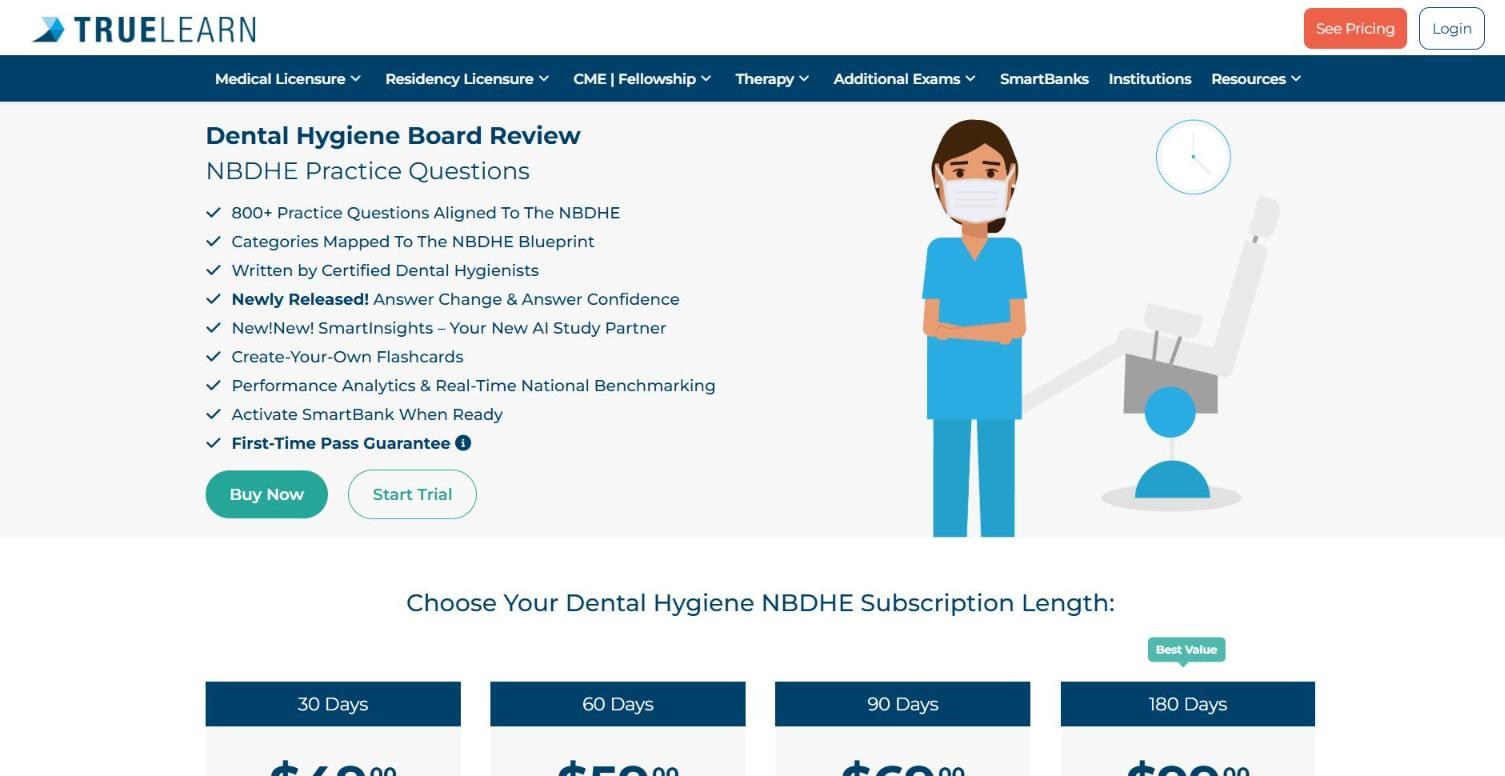
The AI. TrueLearn’s Dental Hygiene NBDHE page introduces SmartInsights as your new AI study partner. TrueLearn describes it as a conversational AI study partner that knows your entire question history, your weak spots and your behaviour patterns, and that gives specific answers from your performance data in plain language. That is a different job from a tutor: it is built to tell you what to study next and how you are answering, not to explain why option C is right on a radiograph question. The page lists SmartInsights at the top of its features, but the individual plan cards do not mention it, so confirm it is included before you buy. TrueLearn does not name the model.
The questions. The bank has more than 800 questions that TrueLearn says are written by certified dental hygienists, with categories mapped to the NBDHE blueprint. The page does not mention case-based questions, patient boxes or testlets anywhere, so you cannot tell from it how much of the bank looks like session two of the exam. TrueLearn adds custom quizzes, flashcards you build from questions, national benchmarking, and new answer-change and answer-confidence reports that show whether your second guesses help or hurt.
Plans and price. Each plan is a single payment for a set number of days: $49 for 30 days, $59 for 60, $69 for 90 and $99 for 180. You can wait up to 365 days after buying before you activate it, and there is a five-day free trial. The 90 and 180-day plans carry a Pass Guarantee and the page header mentions a First-Time Pass Guarantee, but we found no guarantee terms linked from the page, so ask TrueLearn for the conditions before relying on it.
Choose it if you want a hygienist-written bank at the lowest price here and like seeing your performance explained. Skip it if you want an AI that explains individual questions, or you need proof of case-based practice before you pay.
3. AndyRDH Dental Hygiene Academy: seminars, 40 cases and a big question count, with an AI claim it does not explain

The AI. AndyRDH’s main product is its three-day board review seminars, with dates listed on its home page from Atlanta on 14 to 16 December 2026 through Raleigh on 15 to 17 January 2027, plus a live stream from Dallas. Every package on its packages page lists an AI-Powered Studying System for smarter learning, and the home page says it uses artificial intelligence among its digital learning technologies. Neither page says what the AI does. The AndyRDH #1 NBDHE App describes an artificial intelligence system for a smarter, adaptive learning experience, which suggests the AI chooses or orders your questions rather than answering them, but that is as far as the vendor goes.
The questions. Every package lists 40 case studies and three simulated NBDHE mock exams, two short-form and one full-length. The Premium and Gold packages list more than 6,000 practice questions and the 2027 printed textbook, Premium also lists 140 mini-video lessons, and the Premium packages and the streamed Gold package include more than 26 hours of recorded seminar lectures. Forty cases is roughly three full exams’ worth of patient cases, which is a strong count, though the page does not say how many questions sit under each case. The app’s own walk-through shows 25 cases inside the app.
Plans and price. Packages run from Bronze at $199.99 (online material, no textbook, no guarantee) and Silver at $349.99, to Gold at $369.99 streamed or $399.99 in person, and Premium at $469.99 streamed or $499.99 in person. A payment plan starts at $199.99 and upgrades in steps. The money-back policy covers Premium packages only and needs four things before your exam: 100% completion of the online system with 80% or higher on every end-of-course quiz, every seminar video played in the app, 80% or higher on all app quizzes and mocks, and one website mock at 70% raw or better. It applies to your first attempt only. Refunds outside the guarantee mostly end once you log in or your book ships. Packages do not expire until you pass. The app, by contrast, sells its own subscriptions at $14.99 a month or $144.99 a year that renew automatically; it had a 3.0 rating from four ratings and was last updated on 7 July 2026.
Choose it if you learn best from live teaching and want lots of cases and questions with access that lasts until you pass. Skip it if the AI is the reason you are buying, since the vendor never says what it does, or you want a low-cost bank.
NBDHE banks and courses with little or no AI
These products describe no AI tutor for the NBDHE, or use AI only for analytics, so they are not in the numbered list. They are the fair comparison for anyone deciding whether an AI feature is worth paying for.
BoardVitals

BoardVitals’ NBDHE bank lists more than 850 questions, including questions in the testlet and case-based format, and says it follows the exam content outline. The only AI on the page is AI-powered risk assessment data that flags your most at-risk subjects, alongside adaptive quizzes and an Ask a Clinician feature. Plans cost $89 for one month, $109 for three months and $139 for six months, with a 100% Pass Guarantee on the three and six-month plans and a free trial; a banner offered 25% off with a code until 1 December. The page has not kept up with the exam: it cites the 2025 guide and the old area names, lists question formats such as paired true-false, cause-effect, matching and ordering that the current guide does not show, and quotes a 2021 pass rate.
Dental Hygiene Mastery (HLT)

Higher Learning Technologies’ Dental Hygiene Mastery uses an adaptive engine that serves harder questions after right answers and easier ones after wrong answers, and neither the website nor its App Store description calls this AI. The website lists 1,600+ questions at $24.99 a month or $149.99 a year; the iPhone app description says 1,300+ questions at $24.99 a month, $49.99 for three months or $109.99 a year, all renewing automatically, and the app had a 4.81 rating from 1,956 ratings. The page says its questions are based on past NBDHE exams without explaining what that means; JCNDE treats its exam questions as confidential. It advertises a triple refund if you fail after following its study plan, and claims a 99.7% pass rate in one place and 99.6% in another. Its FAQ still shows Lorem ipsum placeholder text under “Who writes your practice questions and explanations?” and carries a question about an NCLEX predictor.
StudentRDH

StudentRDH is a course built by hygienists: the VIP package costs $497 with a printed review book, and On-Demand costs $397, each with six months of access, more than 5,000 practice questions, a mock exam and on-demand case studies, plus free extensions until you pass. Its home page makes the same point as this guide, that 43% of the exam is case studies. There is no AI feature. StudentRDH says the guidelines change from October 2026; JCNDE gives 1 November 2026.
DHS Board Review
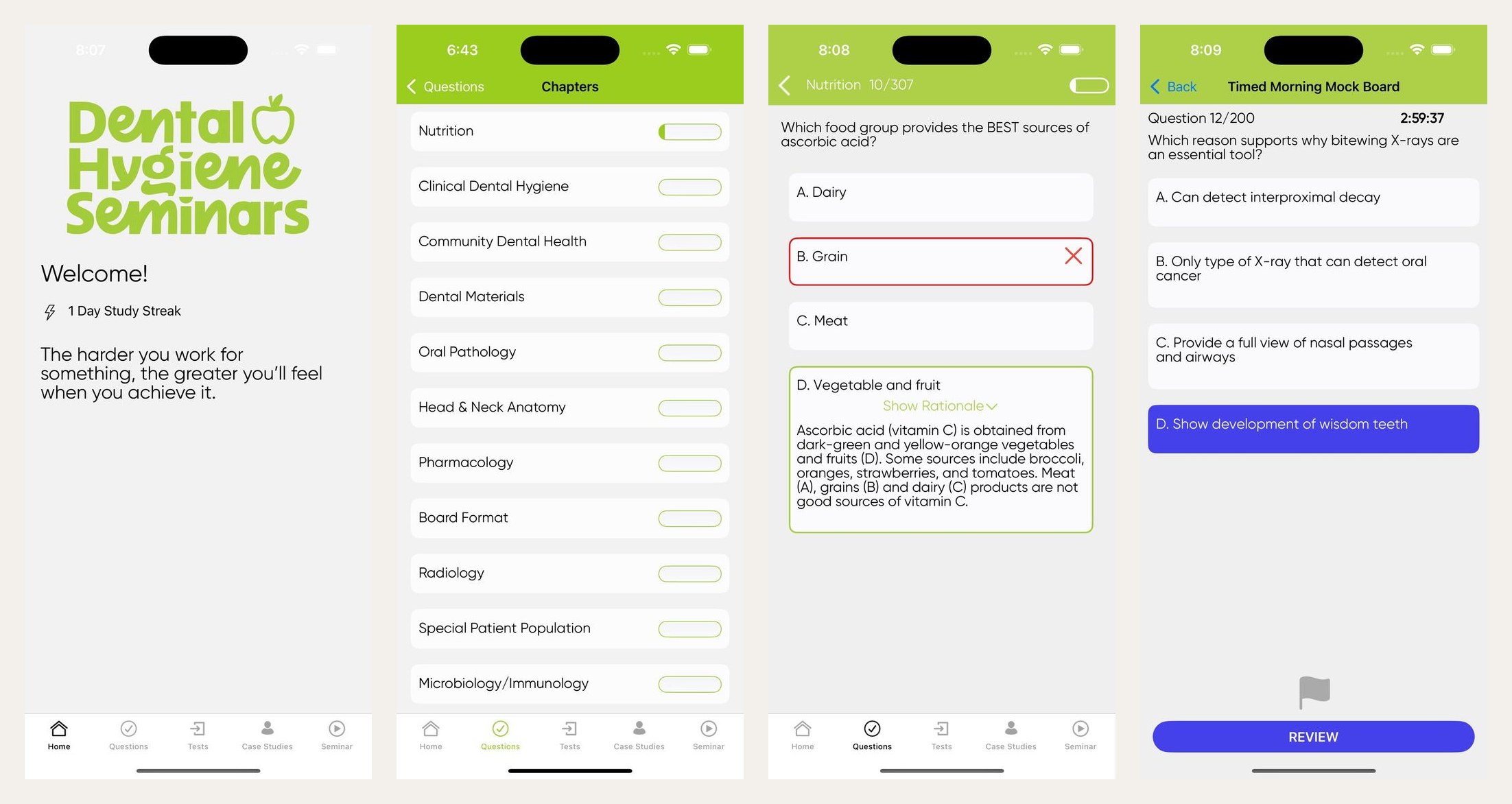
Dental Hygiene Seminars’ DHS Board Review app lists more than 4,000 practice questions and 12 case studies, and was redesigned in an update on 6 November 2026. It had a 3.2 rating from 35 ratings. There is no AI feature.
What about ChatGPT or another general chatbot?
A general chatbot can explain how fluoride works, walk through the 2017 periodontal staging and grading, or turn your notes into flashcards, and it costs little or nothing. Four limits matter for the NBDHE in particular. First, accuracy: local anesthetic doses, antibiotic prophylaxis rules, blood pressure cut-offs and periodontal classifications all have exact answers that a chatbot can get wrong with full confidence, and the exam follows the specific guideline versions JCNDE lists. Check every clinical fact against your program and those guidelines, and never treat a chatbot answer as clinical advice. Second, cases: a chatbot cannot reliably read a real radiograph or dental chart, which is a large part of session two. Third, JCNDE prohibits obtaining, sharing or posting exam questions, including memorised ones, so do not use a chatbot to collect remembered items. Fourth, never paste real patient details from clinic.
Look-alike apps: check the developer
Search the US App Store for NBDHE and you will find many near-identical titles. NBDHE Dental Hygiene Prep 2026 from Snap Prep OU had a 4.68 rating from 19 ratings and sells weekly plans at $4.99 and $8.99 alongside monthly and quarterly ones. GET EXAM SRL publishes NBDHE Exam Prep 2026 (30 ratings) and Dental Hygiene Exam Prep (92 ratings), and PDG APPS SRL publishes Zen Prep’s Dental Hygiene Exam Prep 2026 (62 ratings). Several others had no ratings at all, one called NBDHE Practice Test had a 1.5 rating and was last updated in 2019, and NBDHE Prep 2024 is still on sale for $19.99 with no ratings. None of these makes an AI claim we could tie to a named feature. Before you subscribe to any NBDHE app, check the seller name under the title, the number of ratings, the last update date, and whether the plan is weekly.
What we left out, and why
Open Exam Prep, run by Bayview Global LLC according to its terms, offers a free NBDHE study guide and practice questions; nothing has changed since our last guides, and we have kept it out while we look at it across all our exam guides. StatPearls sells an NBDHE bank, but its site blocked our requests, so we could not confirm its current price or question count. We found no NBDHE product from Pocket Prep, and no product called TestPrepPal. QuizOdontist and DentAIstudy are AI study tools for dentists that do not list the NBDHE. Peterson’s and Mometrix sell general practice tests with no AI feature.
How to choose AI NBDHE exam prep
Count the case-based questions
Case-based items are 150 of 350 questions and get four hours to themselves. NBDHEBooster lists more than 230 case-based and 105 testlet questions, AndyRDH lists 40 case studies, BoardVitals says it includes case and testlet formats without a count, and TrueLearn’s page does not mention cases. Whatever you buy, add JCNDE’s free sample case and its $75 case-based module.
Ask what the AI actually does
Booster AI answers your questions as a tutor would. TrueLearn’s SmartInsights talks about your own performance. AndyRDH’s AI is not explained beyond adaptive learning. BoardVitals uses AI only for risk analytics. A tutor that explains a question and a tool that tells you what to study next do different jobs, so pick the one that matches where you are stuck.

Check the version
JCNDE’s new specifications took effect on 1 November 2026. JCNDE expects little change to preparation, but the split has moved toward clinical services and local anesthesia is now named. Ask any vendor whether its questions reflect the November 2026 specifications, and use the candidate guide’s new outline as your checklist.
Read the renewal and refund terms
NBDHEBooster and TrueLearn sell one-time access by days, AndyRDH packages do not expire, and app subscriptions, including AndyRDH’s own app and HLT’s, renew through your Apple account until you turn them off. Guarantees run from Booster’s refund or extension after three targets, to AndyRDH’s four conditions on Premium only, to TrueLearn’s terms that are not on the page.
Use the official practice as checkpoints
Work through JCNDE’s free sample questions early to see the format, take the $100 full practice test or the case-based module a few weeks out, and treat the result as a check on pace, since JCNDE says it does not predict your score.
Verdict
Start with JCNDE’s own material: the free sample questions, especially the full patient case, and the $100 practice test at Pearson VUE. For AI help on top, NBDHEBooster is our pick, because it gives the clearest count of case-based and testlet questions, includes its AI tutor on both plans, and charges once with no renewal, though you should check what its AI tells you against your textbooks. TrueLearn is the low-cost choice for a hygienist-written bank, with an AI that coaches you on your results rather than on the questions. AndyRDH suits students who want seminars and lots of cases, but its AI is a label without an explanation. Whichever you choose, count the case questions, ask about the November 2026 specifications, and check who the developer is before you pay.
Sources
- JCNDE: Home, NBDHE, Prepare for the NBDHE, NBDHE results, 2026 NBDHE candidate guide, Recent and Forthcoming Updates, NBDHE technical report 2025, NBDHE sample questions, NBDHE reference texts.
- Pearson VUE: JCNDE NBDHE practice test.
- AI tools: NBDHEBooster, NBDHEBooster plans, Booster Prep terms of use, Booster Prep, App Store, TrueLearn Dental Hygiene NBDHE, AndyRDH home, AndyRDH packages, AndyRDH money-back policy, AndyRDH #1 NBDHE App, App Store.
- Little or no AI, and left out: BoardVitals NBDHE, Dental Hygiene Mastery, Dental Hygiene Mastery, App Store, StudentRDH NBDHE review, DHS Board Review, App Store, Open Exam Prep, Open Exam Prep terms.
- All pages read 19 November 2026, except that dates in the text are those shown on each page.

Written by
FazFaz is the founder of AIToolsBakery. Some tools here are tested hands on. Others are assessed from vendor documentation and pricing verified on the live page, and every review says which one it is. Sponsors can buy a position in a guide. They cannot buy the score, the criticism, or silence about a better option.
How we test and how we make money →