Blend is the rare vendor where “what does it cost” has no page, no PDF, and no leaked rate card, yet the answer is sitting in public, filed with the SEC every quarter. Because Blend (that is Blend Labs, the mortgage technology company at blend.com, NYSE: BLND, not the design tool or the payments startup of the same name) reports a metric called economic value per funded loan in its earnings, we can tell you what lenders effectively pay per funded loan on average, quarter by quarter, with dates attached. No other page ranking for this query prints a dollar figure at all. This one prints five.
We track mortgage point-of-sale economics across the stack, from Floify’s published seat pricing to quote-gated enterprise platforms like Blend, and this post is the fee-math companion to our best AI tools for loan officers roundup, where Blend has a full section. Here we stay on one question only: what a lender should expect to pay, and what to push on before signing.
Blend pricing at a glance
| Product / metric | Price | Official or reported |
|---|---|---|
| Mortgage Suite (Originations, Rapid Home Equity, Rapid Home Refi, Close, Verifications, Lender Tools) | Quote only, no published price | Official: blend.com shows no pricing anywhere (verified 2026-07-19) |
| Consumer Banking Suite | Quote only | Official: no published price |
| Blend Builder (configurable platform) | Quote only | Official: no published price |
| Blend IMB Essentials (lower-cost IMB edition) | Quote only | Official: announced as lower cost, no number published |
| Blend Autopilot (AI loan review) | No public price | Official: commercially available, price demo-gated |
| Economic value per funded loan, Q2 2025 | $90 ($78 core + $2 partnerships + $10 add-ons) | Official: Blend earnings, Q2 2025 |
| Economic value per funded loan, Q3 2025 | $86 | Official: Blend earnings, Q3 2025 |
| Economic value per funded loan, Q4 2025 | $83 | Official: Blend earnings, Q4 FY2025 |
| Economic value per funded loan, Q1 2026 | $84 | Official: Blend Q1 2026 earnings call, May 2026 |
| Economic value per funded loan, Q2 2026 (guided) | $79 to $80 | Official: Blend guidance, May 2026 |
| Blend’s claimed savings: cost per loan cut, eClose savings | $650/loan; over $240/loan on eClose | Vendor claim: Blend’s own ROI math, not independently verified |
The quote-only reality
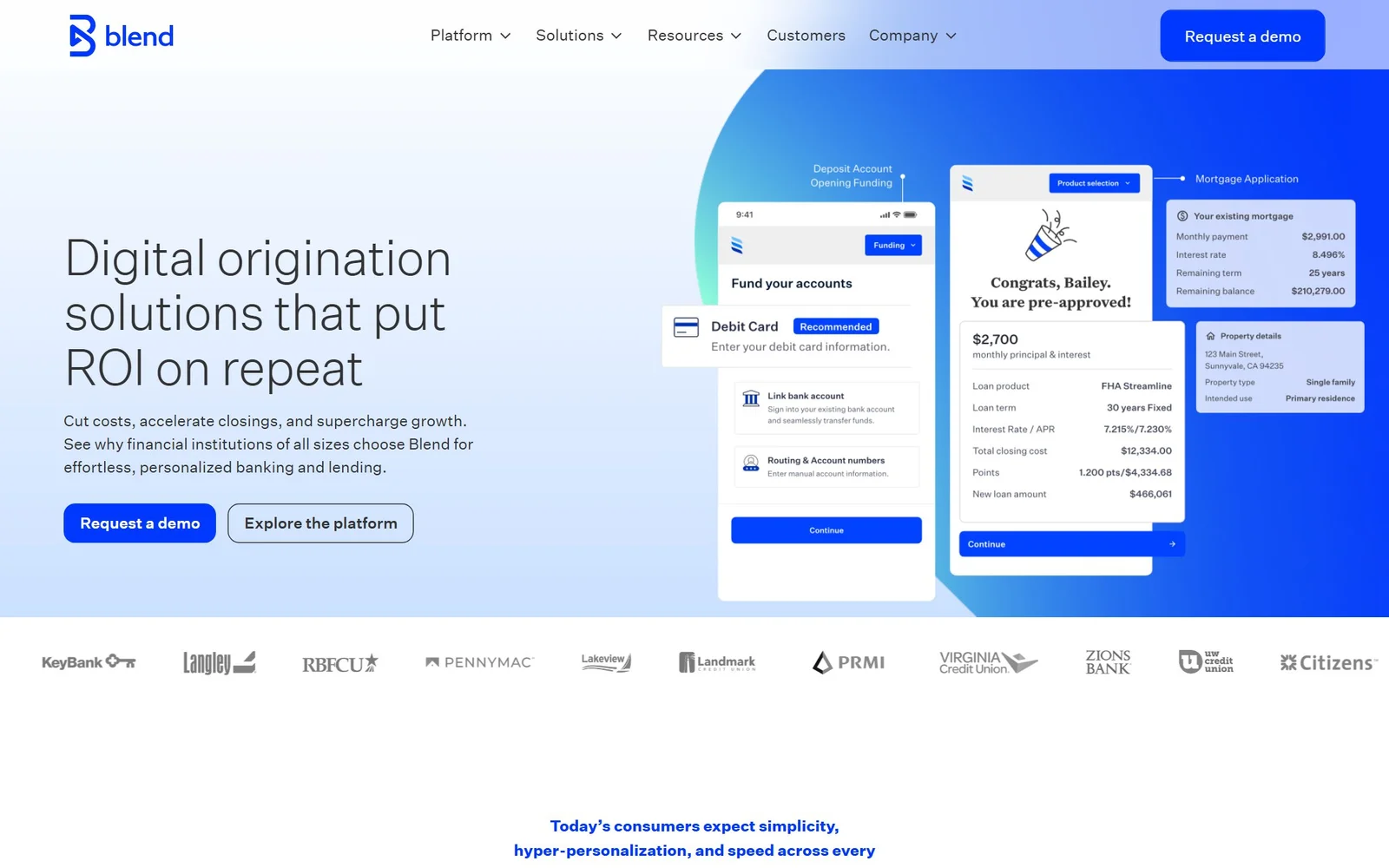
Go to blend.com and try to find a price. You will not. The Home Lending Suite page lists Mortgage Originations, Rapid Home Equity, Rapid Home Refi, Close, Verifications, and Lender Tools, all of it behind “get a demo.” Same for the Consumer Banking Suite and Blend Builder. There is no starter tier, no per-seat number, no published minimum. This is deliberate: Blend sells to banks, credit unions, and independent mortgage banks on multi-year contracts where pricing scales with volume, product mix, and how hard you negotiate.
One product note before we get to numbers: Blend is exiting the title business. It announced the sale of its Title365 insurance business, so if you see title and closing services listed in older coverage of Blend’s product line, treat that as historical. Budget against the software platform, not title fees.
Also worth clearing up, because aggregator pages get it wrong: Blend is a public company, NYSE: BLND, and it has not been acquired. Haveli Investments put in $150 million of convertible preferred stock in April 2024 and has continued buying shares in the open market through June 2026, which is a strategic investor accumulating a position, nothing more. The stock is down roughly 46 percent over the trailing period per third-party reporting (247wallst, March 2026), which matters to you only in one way: a vendor under share-price pressure is a vendor with motivated sales reps. More on that in the negotiation section.
evPFL: the number Blend cannot hide
Every quarter, Blend reports a metric to investors called economic value per funded loan, or evPFL. The definition matters, so here it is plainly: evPFL is Blend’s recognized platform revenue in the quarter divided by the number of loans funded through its platform. It is not a rate card, not a list price, and not what any single lender pays. It is an average across every contract Blend has, and it bundles three components: core platform software fees, partnership revenue, and add-on products.
With that caveat stated, it is the single most honest pricing signal that exists for this platform, because it is audited, dated, and impossible to spin. Here is the slide:
- Q2 2025: $90 per funded loan, broken out by Blend as $78 core software, $2 partnerships, and $10 add-ons.
- Q3 2025: $86.
- Q4 FY2025: $83, with guidance of roughly $83 to $84.
- Q1 2026: $84, landing at the low end of the guided $84 to $85 range. Blend’s CFO Jason Ream attributed the softness to higher mortgage volumes mechanically lowering the per-loan math on fixed-fee contracts.
- Q2 2026 guidance, issued May 2026: $79 to $80.
Read that as a trend, not noise. From $90 in mid-2025 to a guided $79 to $80 a year later is roughly a 12 percent slide, and Blend has been open that competitive pricing pressure is part of it. The Q1 2026 detail is instructive: some Blend contracts are fixed-fee, so when volume rises, the effective per-loan cost falls. That tells you fixed-fee structures exist and are winnable.
Volume context for the same quarter: about 187,000 loans funded through Blend in Q1 2026, up 29 percent year over year, with Mortgage Suite revenue at $17.2 million (up 18 percent) and Consumer Banking at $10.8 million (up 12 percent). The business is growing on volume while the per-loan take shrinks. That is the exact backdrop you want as a buyer.
What this means when you budget per loan
Here is how we would translate evPFL into a working budget for a lender heading into a Blend sales call.
Use $80 to $90 per funded loan as your anchor range for a full Mortgage Suite deployment, and treat the low end as the current market. If Blend is guiding investors to $79 to $80 for Q2 2026, a new contract signed today at $95 per funded loan means you are paying above the average of Blend’s entire existing book, including its oldest, stickiest enterprise deals. Push back with the number.
Do the annual math on your own volume. A mid-size IMB funding 5,000 loans a year at $85 effective per loan is budgeting about $425,000 annually. At 20,000 loans, you are at roughly $1.7 million. That is the scale of decision this is, and it is why Blend deals get negotiated rather than bought.
Remember the composition. Of the Q2 2025 $90 figure, $10 was add-ons and $2 was partnerships. Add-on products (verifications, closing tools, and now AI) are where the per-loan number grows after signature. Your contract’s base number is the floor of your relationship, not the ceiling.
Then weigh it against Blend’s own ROI story, clearly labeled as Blend’s own math: the company claims its platform cuts about $650 in cost per loan, saves 9.4 days of cycle time, and that digital closings save over $240 per loan. Those are vendor claims, not independent findings, and they come from customer deployments Blend selected. But even if the real numbers were half that, the value case at $85 per funded loan would still clear. The honest question is not whether Blend pays for itself against those claims. It is whether it pays for itself against the cheaper mid-market alternatives; our mortgage brokers roundup covers where a leaner shop can get most of the workflow for a published price.
One durability note: Mr. Cooper, one of Blend’s flagship customers, remains on the platform following the Rocket merger, with a contract reported to run to 2028 (per HousingWire). Enterprise anchor customers staying put is relevant if you are betting a multi-year deployment on the platform’s stability.
Blend IMB Essentials: the smaller-lender door
For years the honest knock on Blend was that it was enterprise software with enterprise onboarding, priced past the reach of small and mid-size independent mortgage banks. Blend IMB Essentials is the answer: a packaged, lower-cost edition of the mortgage platform aimed at IMBs, with a faster path to going live and a slimmer configuration surface than the full Builder-driven deployment.
What it costs: still not published. There is no price on the page, no tier grid, nothing. The positioning is “lower cost,” and the evPFL logic still applies as your sanity check: if the blended average across all of Blend’s customers is $84, an Essentials contract for a smaller lender should land meaningfully under your own back-of-envelope per-loan math for a full enterprise deployment. If the quote you get works out above roughly $90 per funded loan at your projected volume, you are not getting the Essentials discount, you are getting the enterprise price with a smaller feature set.
If you are an IMB doing the tour of this market, it is worth comparing the fully loaded quote against tools that publish their numbers. Floify sells its point-of-sale by the seat with pricing on the page (we break it down in our Floify pricing guide), and Zeitro plays the budget-AI angle for smaller shops (covered in our Zeitro review). On the CRM side of the same desk, Shape publishes a per-user price too, and our Shape Software review shows why the number most aggregators quote for it is stale. Neither is a Blend-scale platform, and that is the point: knowing what the published-price tier of this market charges is how you keep a quote-only vendor honest.
Autopilot: the AI add-on with no sticker
Blend Autopilot is the company’s AI product, and it is the part of the platform most likely to change your per-loan math over the next two years. What it does: automated loan origination reviews, with Blend claiming reviews that once took hours now run in about 15 seconds. It went through a five-lender preview and more than 16 weeks of production testing across 25,500+ loans before Blend declared it commercially available.
Adoption is moving fast by enterprise-software standards. On the Q1 2026 earnings call (May 2026), Blend said 65 lenders had activated Autopilot, 22 were running it live in production, and more than 7,000 applications had been processed since launch, with a reported $10 million pipeline attached to it. CEO Nima Ghamsari cited customers cutting cycle times from 29 days to 21. Those adoption numbers are official statements to investors; the cycle-time improvement is a customer result Blend chose to highlight, so weight it accordingly.
What Autopilot costs: nobody outside a sales call knows. There is no published price, no per-loan rate, no per-review rate. What we can infer from the earnings structure is that Autopilot lands in the add-ons bucket of evPFL, the same bucket that contributed $10 of the $90 in Q2 2025. Blend’s visible strategy is to offset the sliding core per-loan price by attaching AI revenue on top. Which is fine, as long as you price the attachment deliberately instead of absorbing it.
What to negotiate before you sign
Blend deals are bespoke, which cuts both ways: no protection from a list price, but everything is movable. Five things to push on, in order:
- Anchor to evPFL, out loud. Ask your rep directly how your effective per-funded-loan cost compares to the company’s reported $84 (Q1 2026) and guided $79 to $80 (Q2 2026). They know the numbers. Making clear that you do too changes the conversation.
- Push for a fixed-fee structure if your volume is growing. Blend itself told investors that fixed-fee arrangements caused per-loan economics to fall as volumes rose in Q1 2026. If you expect volume growth, a fixed fee means your effective per-loan cost drops every quarter. If your volume is flat or seasonal, per-loan pricing with a low minimum protects you instead.
- Cap the add-ons. Verifications, closing products, and Autopilot will be offered as attachments after go-live. Negotiate the attach rates now, while you still have signature leverage, and get any bundled credits written into the order form.
- Price Autopilot per funded loan, not per seat. An AI review product’s value scales with loan volume. Its price should too. Also ask what happens to the rate as the model automates more of the review; you should not pay 2026 pilot pricing for a 2028 commodity.
- Use the timing. A public company with a stock down roughly 46 percent (reported, March 2026) and per-loan revenue guided lower is a company that needs bookings. Quarter-end and fiscal-year-end are real phenomena in enterprise sales. Blend’s fiscal year is the calendar year; plan your signature window accordingly.
Buying leads honestly: what the conversion numbers actually mean
Every platform in this category quotes conversion figures. Almost none of them mean what a reader assumes, and the differences are large enough to reverse a purchase decision.
Ask what the denominator is
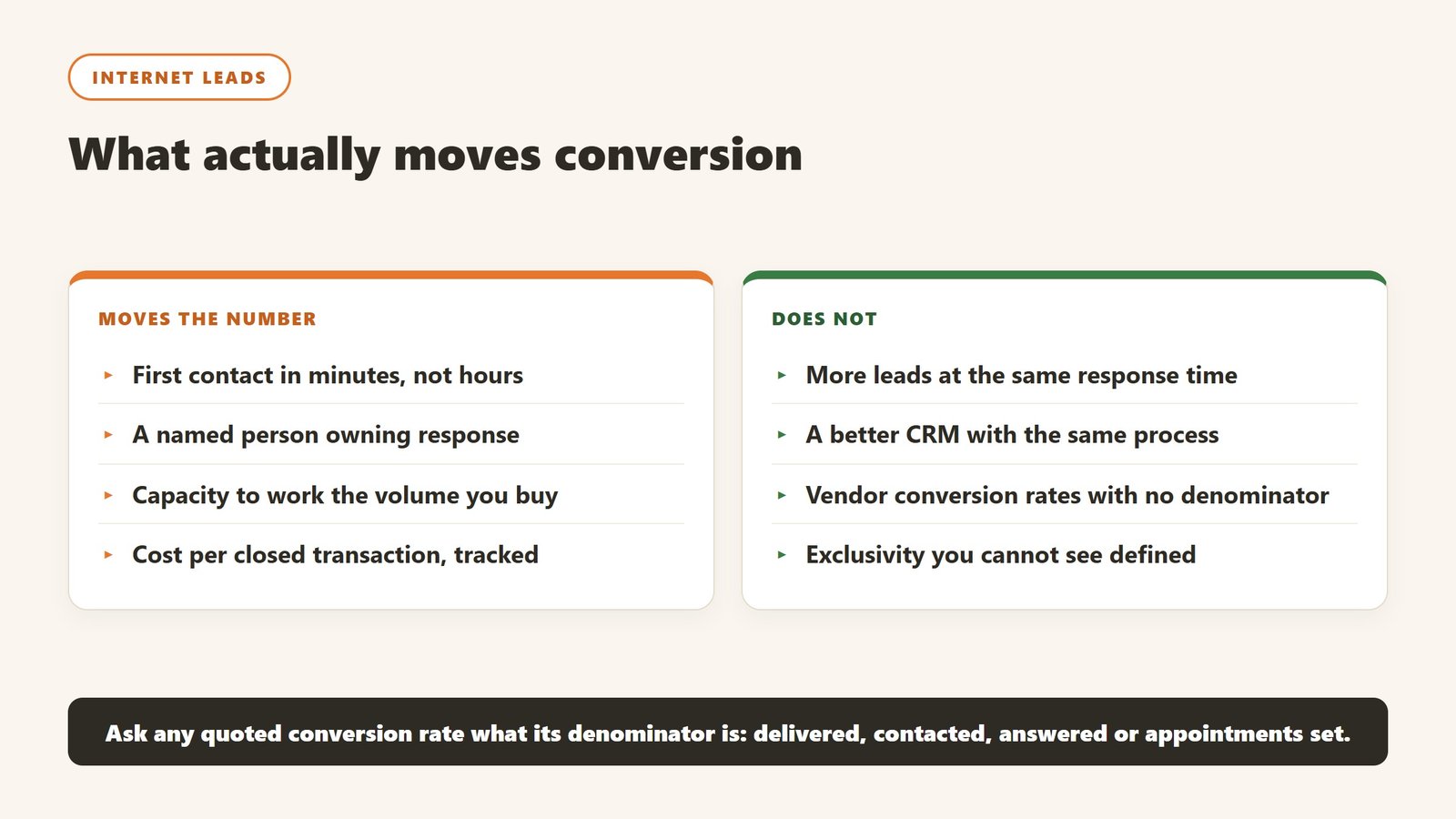
A conversion rate can be measured against leads delivered, leads contacted, leads that answered, or appointments set. Those four produce wildly different percentages from the same underlying performance. When a vendor quotes a rate, ask which one it is, and ask for the number of days over which it was measured. A rate with no denominator and no window is a marketing figure rather than a metric.
Speed to lead is the variable that actually moves conversion
The single largest controllable factor in internet lead conversion is how fast the first contact happens, and it is measured in minutes rather than hours. That is a staffing and process question, not a software one. A platform that routes leads instantly to an agent who checks their phone twice a day will underperform a spreadsheet worked by someone answering in five minutes. Fix the response process before buying anything that increases lead volume.
More leads at the same conversion is not obviously good
Doubling lead volume doubles the work and, unless response times hold, usually reduces conversion. Teams that buy volume without adding capacity get a lower conversion rate on a bigger number and conclude the leads were bad. Before increasing volume, work out how many new leads your current team can genuinely contact within the window that matters.
The contract term is where the risk sits
Lead platforms frequently ask for six or twelve month commitments, sometimes with a territory or exclusivity element. That is defensible, because a pipeline takes time to season. It is also a lock-in on performance you have not seen. Ask for a defined review point in writing, agree in advance what result would end the arrangement, and be sceptical of any exclusivity you are paying a premium for without a written definition of the area it covers.
Verdict: budget $80 to $90 per funded loan, then beat it
Blend will never hand you a price sheet, but its SEC filings are better than one. The platform’s blended revenue per funded loan slid from $90 in Q2 2025 to $83 by Q4 FY2025, ticked to $84 in Q1 2026, and is guided to $79 to $80 for Q2 2026. That is your anchor: budget $80 to $90 per funded loan fully loaded, treat quotes above that range as opening bids, and remember that the direction of travel in this market is down. Get IMB Essentials quoted if you are under enterprise scale, get an Autopilot rate in writing before you need it, and bring the published prices of the mid-market alternatives to the call. For where Blend fits in the broader stack, our loan officer tools roundup ranks it alongside everything else we have reviewed.

Written by
FazFaz is the founder of AIToolsBakery. Some tools here are tested hands on. Others are assessed from vendor documentation and pricing verified on the live page, and every review says which one it is. Sponsors can buy a position in a guide. They cannot buy the score, the criticism, or silence about a better option.
How we test and how we make money →