Search “Floify pricing” and you will find the same two numbers repeated across a dozen review sites: $79 per user per month for the Business plan, $250 per month for Team. Here is the problem. Those numbers stopped being real in December 2023. Floify retired that rate card when it launched Broker Edition, then moved lenders to per-loan pricing in March 2024, and today there is no published Floify price anywhere. Not on the pricing page, not in the help docs, nowhere.
That matters if you are budgeting before a sales call, because walking in anchored to $79 sets you up for sticker shock. We traced the full repricing timeline, archived the legacy evidence, and pulled together what is actually known in 2026 so you can go into that demo with the right questions instead of a stale number.
Floify pricing at a glance: official vs reported
| Plan or product | Price | Official or reported | Status in 2026 |
|---|---|---|---|
| Broker Edition (Dec 2023) | Custom quote | Official: no figure published | Current, quote-only |
| Lender Edition (Mar 2024) | Custom quote, per closed loan | Official: pricing model confirmed, no figure published | Current, quote-only |
| Dynamic AI (Oct 14, 2025) | Not published | Official: no pricing released at launch or since | Current, quote-only |
| Legacy Business plan | $79/user/mo | Legacy, reported: pre-Dec-2023 rate card, archived | Retired |
| Legacy Team plan | $250/mo | Legacy, reported: pre-Dec-2023 rate card, archived | Retired |
Every current row says “custom quote” because that is the honest answer. Any site showing you a specific 2026 dollar figure for Floify is either recycling the retired rate card or guessing.
What Floify actually is, and why the pricing went dark
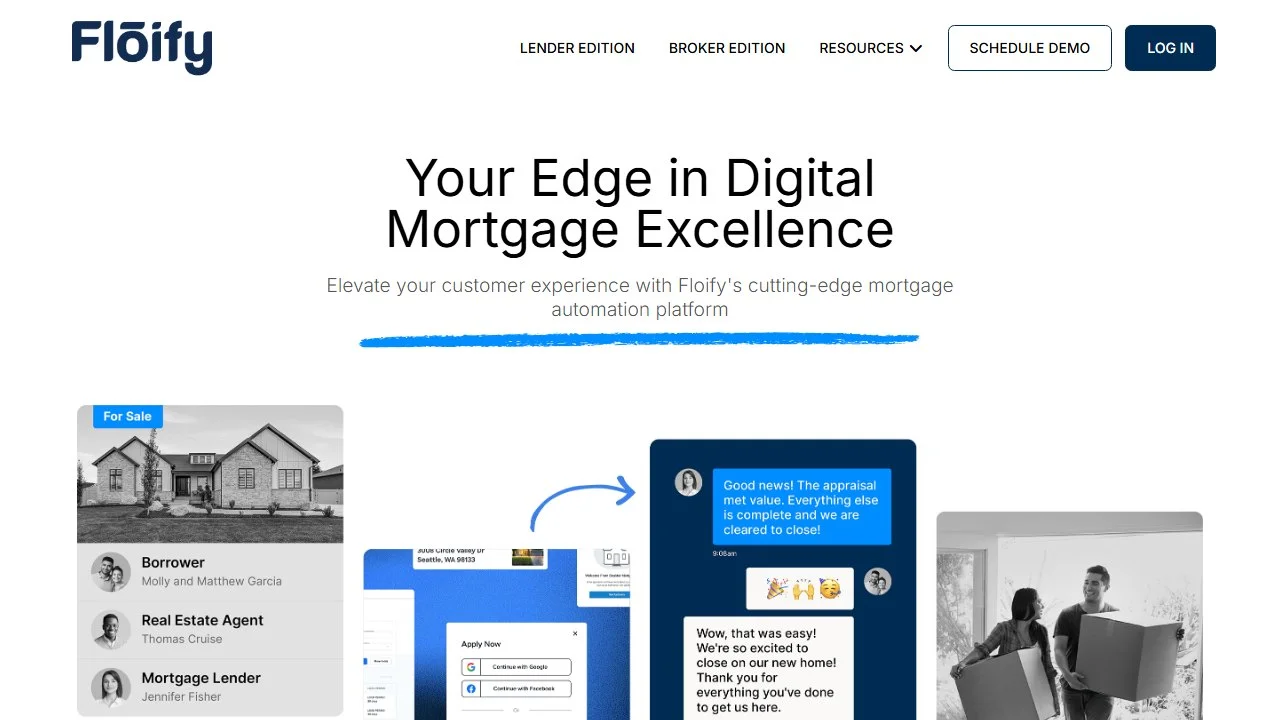
Floify is a mortgage point-of-sale platform: borrower-facing loan applications, document collection portals, milestone updates, and integrations into the LOS stack that loan officers and brokers live in. It has been a fixture in the mortgage tech space for over a decade, and since October 2021 it has been part of Porch Group.
For most of its life, Floify did what we wish every vendor did: it put prices on the website. Then, over roughly 16 months, it executed a full repricing in three moves.
- December 2023: Broker Edition launches. Floify introduced a packaged edition aimed at mortgage broker shops, and the old self-serve rate card came down. From this point forward, broker pricing became a sales conversation.
- March 2024: Lender Edition goes per-loan. For lenders, Floify shifted from seat-based pricing to a per-loan model, where cost scales with closed volume instead of headcount. The model is public. The rate is not.
- October 14, 2025: Dynamic AI ships with no price tag. Floify’s AI layer, which extracts data from borrower documents and prepopulates loan applications, launched with no published pricing at all. It followed Dynamic Apps, the configurable application flow released in March 2025.
The pattern is a familiar one in mortgage tech: as the product moves upmarket and pricing gets tied to volume, the public rate card disappears. Blend went the same direction. It is a rational move for the vendor. It is a headache for anyone trying to budget.
Where the $79 number came from, and why it keeps circulating
The $79 per user per month Business plan and the $250 per month Team plan are real historical prices. They come from Floify’s pre-December-2023 rate card, which we verified through archived captures of the old pricing page rather than trusting secondhand roundups. Label them what they are: legacy, reported, and more than two years stale.
The reason they keep circulating is simple. Review aggregators scrape each other, nobody re-verifies, and a concrete number always outranks “contact sales” in a comparison table. So the $79 figure gets copied forward year after year, and every copy makes it look more authoritative. We see the same staleness problem across the CRM side of this industry, where sites still list products that were absorbed into other platforms years ago.
Could your actual quote land near the old numbers? For a small broker shop, possibly. But per-loan pricing on the Lender Edition means the math is completely different from a seat license: a high-volume branch could pay far more than the old rate card implied, while a low-volume shop might do better. There is no way to know without a quote, which is exactly why the legacy figures are worse than useless as an anchor.
The Lender Edition per-loan model: what it changes for your budget
Per-loan pricing deserves a moment, because it flips the budgeting logic most lenders are used to.
Under the old seat model, Floify was a fixed cost: users times rate, predictable every month regardless of volume. Under per-loan pricing, Floify becomes a variable cost that tracks your closed production. That has three practical consequences we would plan around.
- Slow months cost less. In a rate environment where volume swings hard, paying per closed loan means your POS bill shrinks when pipelines do. For lenders that overbought seats in 2021 and ate the fixed cost through the 2023 downturn, this is genuinely attractive.
- Good months cost more. The flip side: in a refi wave, your Floify bill scales up with your volume. Ask sales whether there are volume tiers or caps, because a flat per-loan rate with no breakpoints gets expensive fast at scale.
- Forecasting requires a loan forecast. Your finance team can no longer budget Floify as a line item. It is now a per-unit cost of production, closer to how you treat credit pulls or verifications.
For broker shops on Broker Edition, we have not seen confirmation that pricing is per-loan, per-seat, or flat-rate packaged. That is question one for your sales call.
Dynamic AI: the newest product with no price
Dynamic AI launched on October 14, 2025, and it is the piece most 2026 buyers will ask about. It reads borrower documents, extracts the data, and prepopulates the loan application, which attacks the most tedious part of the POS workflow: chasing borrowers to type information that already exists on their pay stubs and bank statements.
What it costs is anyone’s guess, because Floify has published no AI pricing at launch or since. Based on how the rest of the market handles AI add-ons, the likely structures are a per-loan surcharge, a bundled premium edition, or usage-based document pricing. But those are possibilities, not facts. Do not let a sales rep leave “Dynamic AI is included” vague: get whether it is included in your edition, at what usage level, and at what price if it ever becomes an add-on, in writing.
If you want to see what transparent AI-forward pricing looks like in this exact category, Zeitro publishes everything: a free tier, $8 per user per month for individuals, $35 per month for a company. It is a far younger and smaller company, and our Zeitro review gets into the viability tradeoffs, but the pricing-page contrast with Floify could not be sharper.
The Porch Group ownership, and the $90M vs $95.4M correction
Floify has been owned by Porch Group since October 2021. Most headlines at the time reported a $90 million acquisition, and that number still gets repeated. The 8-K filing puts total consideration at $95.4 million: the roughly $90 million figure reflected the at-close portion, with the remainder in additional consideration. Small correction, but if we are going to make a living correcting stale pricing, we should get the ownership math right too.
Why ownership matters for a pricing article: Porch is a publicly traded company, and Floify’s repricing into quote-only, volume-tied models fits a portfolio-wide push toward monetizing per transaction. The days of Floify as a scrappy self-serve SaaS with a public rate card ended with this era, and we would not expect the public pricing to come back.
What to ask on the Floify sales call
You cannot avoid the call, so make it count. Here is the list we would bring.
- Which edition fits us, and what is its pricing model? Broker Edition vs Lender Edition, and specifically whether your quote is per-loan, per-seat, or flat.
- The per-loan rate and its tiers. If you are on Lender Edition, get the rate, the volume breakpoints, and whether there is a monthly minimum even in zero-close months.
- Dynamic AI terms, in writing. Included or add-on, any usage caps on document extraction, and what happens to the price if you exceed them.
- Implementation and onboarding fees. Legacy Floify was famously easy to self-start. Quote-only enterprise motions usually come with setup fees. Ask.
- Contract length and exit terms. Quote-only vendors typically want annual or multi-year commitments. Ask what month-to-month costs, if it is offered at all.
- The price protection clause. With no public rate card, your renewal quote is whatever sales says it is. Negotiate a renewal cap now, while you have leverage.
How Floify fits your stack decision
Floify is the borrower-facing front door, not a CRM and not a post-close retention tool, so the pricing question sits inside a bigger stack question.
If you are a loan officer assembling a full toolkit, our best AI tools for loan officers guide maps where a POS like Floify sits next to CRMs, AI assistants, and content tools, anchored by STRATMOR data showing lender AI adoption jumping from 15% to 38% in a single year. If you are on the wholesale side, the best AI tools for mortgage brokers roundup covers the broker-specific stack that Broker Edition competes for. And for the post-close side of the funnel, Homebot handles client-for-life retention with published pricing from $125 per month for loan officers: our Homebot review breaks down its own recently repriced plans, which, in a fun parallel, also killed off a famous legacy price everyone still quotes.
What agent CRMs and lead platforms actually charge
This half of the market divides into CRMs you fill with your own leads and platforms that sell you the leads as well, and the second is several times the price of the first. Here is each alternative to floify pricing, read on 4 September 2026.
Follow Up Boss, $69 per user per month, published plainly
Follow Up Boss publishes $69 per user per month plus tax, with a yearly option giving two months free and calling as a $39 per user add-on. It is a CRM rather than a lead source, which is the important distinction: you are buying the system that works leads you already have. At five agents that is $4,140 a year before the calling add-on, so price it at your real headcount rather than at one seat.
Wise Agent, $49 a month, and the cheapest published option here
Wise Agent publishes $49 a month, falling to $42 billed annually at $499 a year, with a higher tier at $69 and $59. Its annual toggle is marked as saving 15% and the saving holds. For a solo agent or a small team this is the published floor of the category, and the gap to a lead platform is an order of magnitude rather than a percentage.
Placester, from $59 a month, sold around the website
Placester publishes $59, $79 and $129 a month with a 20% annual discount, positioned around IDX websites and marketing rather than lead generation. If your gap is presence rather than pipeline, that is a materially cheaper problem to solve than buying leads, and it is worth being honest with yourself about which one you actually have.
The lead platforms, where almost nobody publishes
The platforms that sell leads alongside software, Lofty, CINC, Ylopo, Zurple, Sierra Interactive, Real Geeks, Market Leader and BoldTrail among them, largely quote rather than publish. We could not read a plan figure from Lofty’s own pricing page on 4 September 2026. That is normal in this corner of the market and it means your only real leverage is a published CRM priced at your team size, plus a clear view of what you currently pay per closed transaction.
Work out your cost per closing before any demo
Take last year: total spend on leads and CRM, divided by transactions closed from those leads. That single number is the benchmark every quote has to beat, and most agents have never calculated it. Without it you are comparing monthly figures against each other rather than against the thing that pays for them, which is how a $2,000 a month platform gets renewed for three years on the strength of a feeling.
Buying leads honestly: what the conversion numbers actually mean
Every platform in this category quotes conversion figures. Almost none of them mean what a reader assumes, and the differences are large enough to reverse a purchase decision.
Ask what the denominator is
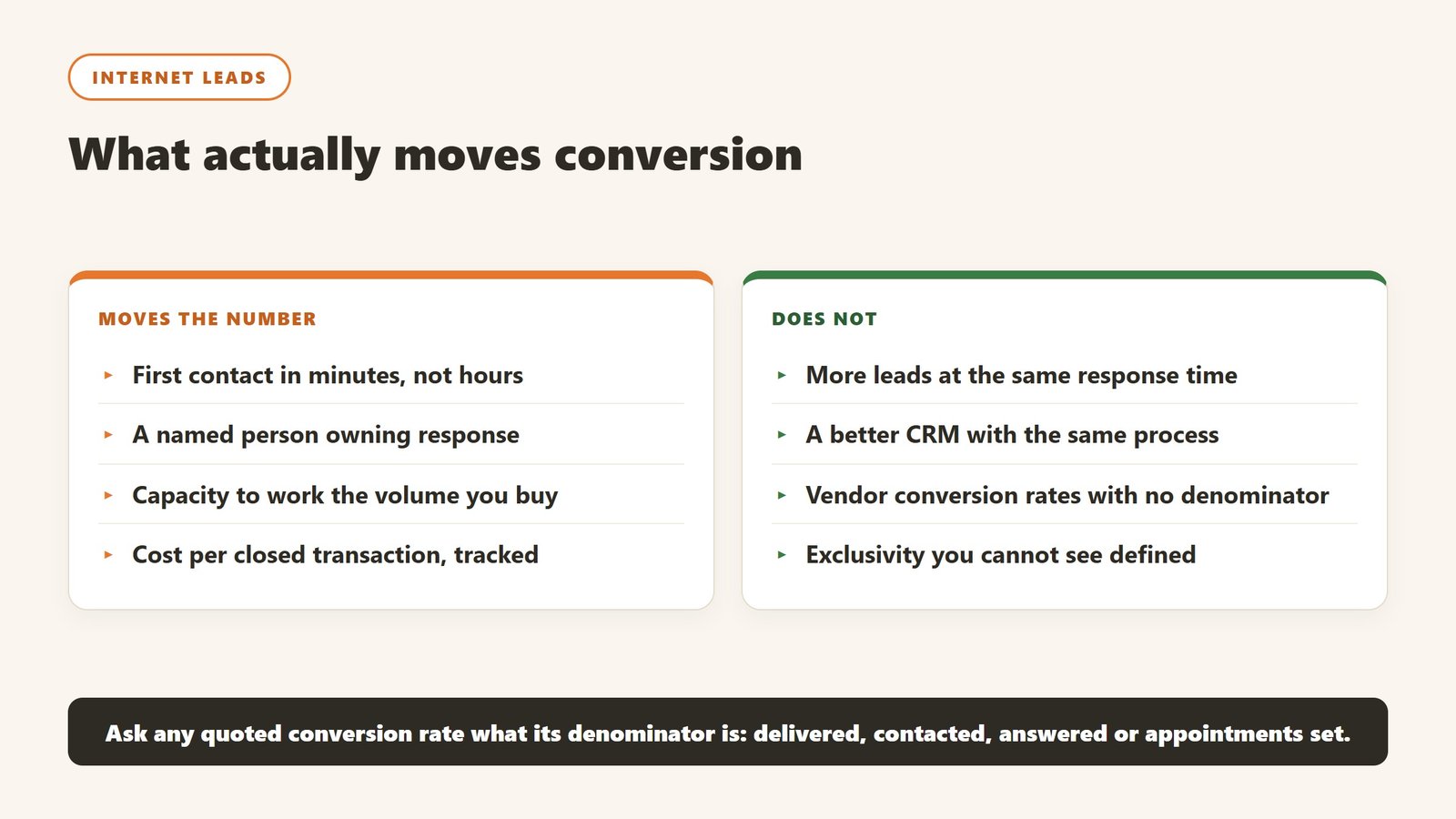
A conversion rate can be measured against leads delivered, leads contacted, leads that answered, or appointments set. Those four produce wildly different percentages from the same underlying performance. When a vendor quotes a rate, ask which one it is, and ask for the number of days over which it was measured. A rate with no denominator and no window is a marketing figure rather than a metric.
Speed to lead is the variable that actually moves conversion
The single largest controllable factor in internet lead conversion is how fast the first contact happens, and it is measured in minutes rather than hours. That is a staffing and process question, not a software one. A platform that routes leads instantly to an agent who checks their phone twice a day will underperform a spreadsheet worked by someone answering in five minutes. Fix the response process before buying anything that increases lead volume.
More leads at the same conversion is not obviously good
Doubling lead volume doubles the work and, unless response times hold, usually reduces conversion. Teams that buy volume without adding capacity get a lower conversion rate on a bigger number and conclude the leads were bad. Before increasing volume, work out how many new leads your current team can genuinely contact within the window that matters.
The contract term is where the risk sits
Lead platforms frequently ask for six or twelve month commitments, sometimes with a territory or exclusivity element. That is defensible, because a pipeline takes time to season. It is also a lock-in on performance you have not seen. Ask for a defined review point in writing, agree in advance what result would end the arrangement, and be sceptical of any exclusivity you are paying a premium for without a written definition of the area it covers.
Verdict: budget for a quote, not for $79
Floify pricing in 2026 comes down to three facts. There is no public price. The $79 per user and $250 per month figures are a retired pre-December-2023 rate card that review sites keep resurrecting. And the current lineup, Broker Edition, per-loan Lender Edition, and Dynamic AI, is priced entirely on the sales call.
Our advice: treat any published Floify number as a carbon-dating tool for the page you found it on, bring the six questions above to your demo, and anchor your negotiation with a competing quote rather than a ghost price from 2023. The product remains one of the most established POS platforms in the industry. Just walk in knowing that the price is whatever you negotiate, because in 2026, that is literally all it is.

Written by
FazFaz is the founder of AIToolsBakery. Some tools here are tested hands on. Others are assessed from vendor documentation and pricing verified on the live page, and every review says which one it is. Sponsors can buy a position in a guide. They cannot buy the score, the criticism, or silence about a better option.
How we test and how we make money →