The thing to know before you evaluate it
Type chorus.ai into a browser today and you do not land on a Chorus website. You land on zoominfo.com/products/chorus, under ZoomInfo branding, with a ZoomInfo navigation bar and a ZoomInfo demo form. We checked again on 4 September 2026 and the redirect still holds.
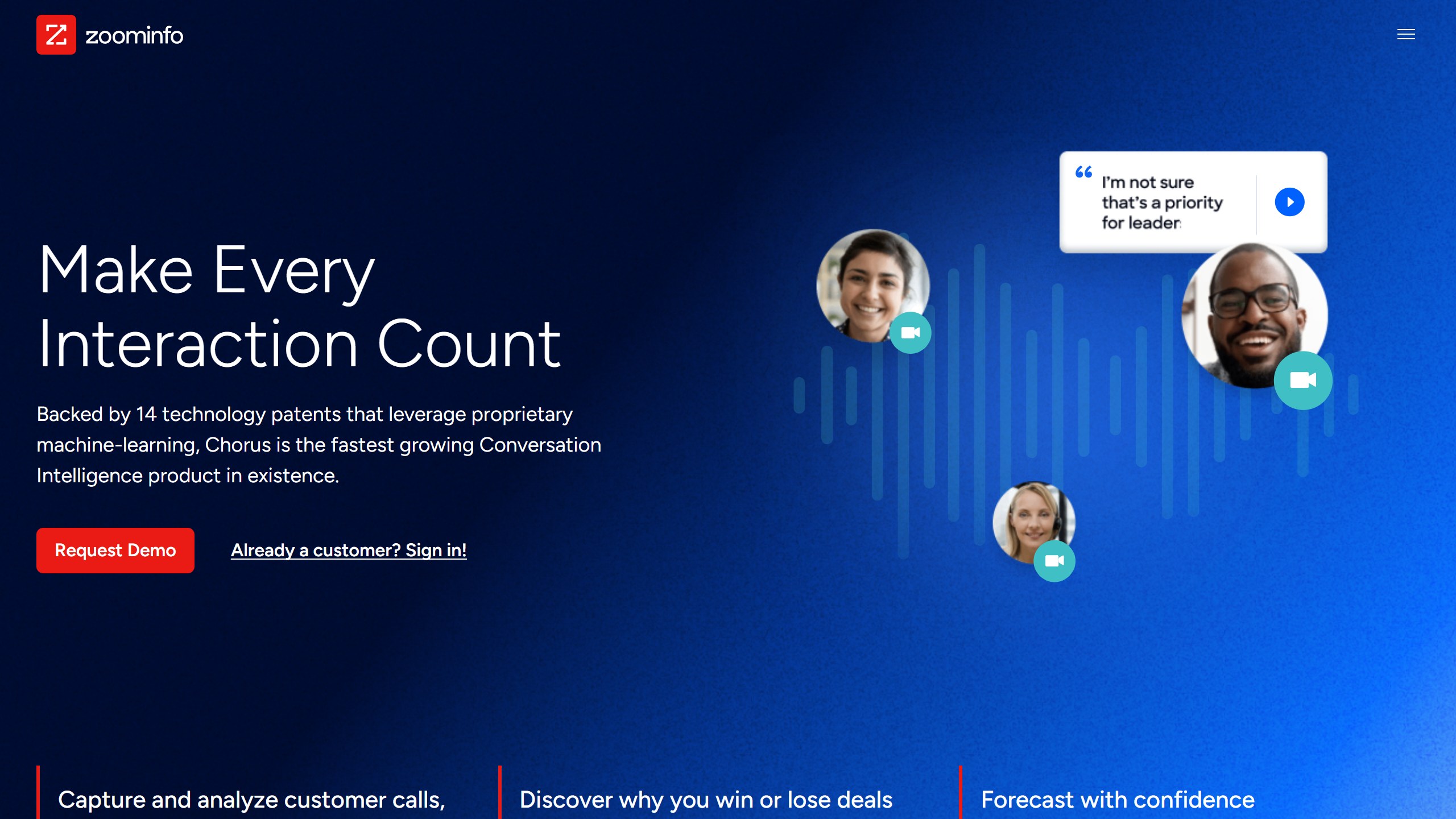
That is not trivia. It changes what you are actually buying in three ways, and every one of them matters more than the feature list.
You are buying into ZoomInfo, not alongside it
Chorus is a module. The commercial conversation, the contract, the renewal and the account team are ZoomInfo’s. If your procurement process treats a conversation intelligence purchase as a small departmental tool, it is worth resetting that expectation early: you are opening a relationship with a data platform vendor.
The value case has shifted, and it may not apply to you
Chorus’s strongest argument is no longer “the best conversation intelligence tool”. ZoomInfo makes the new argument explicit on the product page under the heading Connected Intelligence: bringing “contact and company intelligence to your go-to-market teams courtesy of ZoomInfo”, so you can “see the entire relationship history for each contact or company”.
That is a genuinely strong pitch if you already run ZoomInfo. If you do not, it is an argument for a product you are not buying. Strip Connected Intelligence out and you are comparing a conversation intelligence tool on its own merits against competitors who have spent the same period shipping against that single job.
Most Chorus versus Gong content online is stale
The bulk of the comparison content still treats these as two standalone platforms competing feature for feature. That has not been the shape of the decision since the absorption. Any article that does not mention the redirect is describing a market that no longer exists.
What Chorus actually does
ZoomInfo publishes five capability areas for Chorus. The feature set is conventional, competent conversation intelligence, and the honest summary is that nothing here is exotic.
| Published capability | What it covers | Standalone or ZoomInfo-dependent? |
|---|---|---|
| Sales Call Analysis | Capture and analyse calls, meetings and emails, with transcription and insights | Standalone |
| Onboarding and Sales Enablement | Identify winning behaviours, reduce new hire ramp time, methodology adherence | Standalone |
| Deal Intelligence and Relationship Management | Auto-capture contacts and communications to CRM, deal momentum, churn signals | Standalone, CRM dependent |
| Market Intelligence | Voice-of-customer analysis, competitive insight, customer language for messaging | Standalone |
| Connected Intelligence | ZoomInfo contact and company data joined to conversation history | Requires ZoomInfo |
ZoomInfo also states Chorus is “backed by 14 technology patents”. Patent counts are a marketing signal rather than a buying criterion, and we would not weight it in a decision, but it is their published claim and worth recording accurately.
Pricing: nobody in this category publishes a number
What ZoomInfo publishes
Nothing. We loaded zoominfo.com/pricing on 4 September 2026 and read the fully rendered page: 12,111 characters of copy and not one currency figure. Chorus is quoted as part of a ZoomInfo package, which means the price depends on the data licence you are buying alongside it.
What Gong publishes, and why it is better
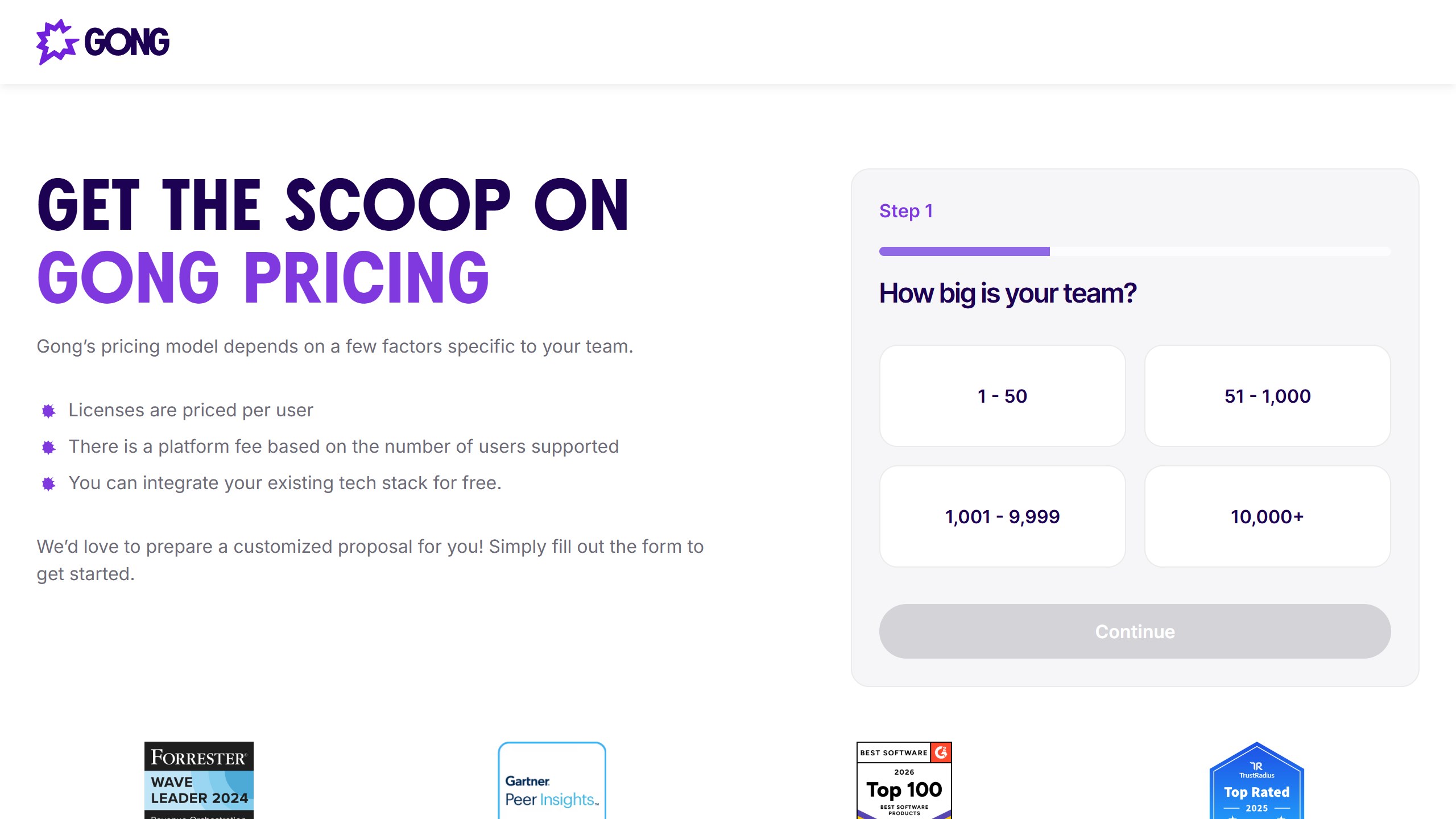
Gong does not publish a figure either, so this is not a transparency scoreboard where one side wins outright. But gong.io/pricing does publish the model, and that is genuinely more useful than nothing: “Licenses are priced per user” plus “There is a platform fee based on the number of users supported”.
Two components, both scaling with headcount. You can build a rough model of how the bill grows before you speak to anyone. ZoomInfo gives you no equivalent, because the answer depends on a data contract as much as on seats.
| Vendor | Publishes a figure? | Publishes the model? | What you can work out in advance |
|---|---|---|---|
| Chorus (ZoomInfo) | No | No | Nothing. Depends on the ZoomInfo package |
| Gong | No | Yes | Per-user licence plus a platform fee scaled by users |
What conversation intelligence actually changes, and what it does not
If this is your first purchase in the category, the vendor pages will tell you what the software does but not what changes in your week. Three things genuinely shift, and one thing that gets sold hard usually does not.
New hire ramp is the reliable win
The most defensible return is onboarding. A new rep can listen to the ten best discovery calls in their segment in an afternoon instead of shadowing for a month, and a manager can point at the exact ninety seconds where a deal turned. ZoomInfo leads with this for Chorus, and it is the claim we would weight most heavily because it does not depend on the AI being clever, only on the recordings being searchable.
Deal review stops running on memory
The second real change is that pipeline reviews stop being a rep describing their own call from memory. Momentum signals, whether next steps were agreed, whether a decision-maker ever appeared, all come from the recording rather than the CRM note. That is a management change as much as a software one, and it only lands if managers actually use it.
The coaching does not happen by itself
The thing that gets oversold across this whole category is automated coaching. Trackers surface moments; they do not change behaviour. Every team we have seen get value from conversation intelligence had a named person whose job included reviewing calls weekly. Teams that bought the tool and expected the scorecards to do the work got an expensive archive. Budget the management time or do not buy the software.
The compliance question buyers forget to ask
Call recording is a legal question before it is a product question, and it is the part of this purchase most likely to be discovered late by someone in legal rather than early by the buyer.
Consent rules vary by where the other person is sitting
Recording consent law differs by jurisdiction, and in some places consent is required from every party to the call rather than just one. In the United States that varies state by state, and the federal wiretap statute sits underneath a patchwork of stricter state rules. In the EU and UK, recorded calls carry personal data obligations under GDPR regardless of consent mechanics.
None of that makes conversation intelligence unusable, and every serious vendor in this category has customers operating lawfully at scale. It does mean the answer to “can we record this call” is a decision your organisation has to make deliberately, with disclosure built into the call opening, rather than a checkbox in a settings panel.
Questions worth putting to legal before procurement, not after
- Which jurisdictions do our reps and prospects actually sit in?
- Is disclosure automated at the start of the call, or is it a rep behaviour we have to enforce?
- How long are recordings retained, and can we set that ourselves?
- Can a participant request deletion, and what is the process?
- Where is the recording data stored, and does that satisfy our data residency position?
Ask these before you have a preferred vendor. They are much harder to negotiate once the contract is drafted, and they apply equally to Chorus, Gong and everything else in the category.
Chorus or Gong: what the decision actually is now
If you already pay for ZoomInfo
Chorus becomes a genuinely strong option, and possibly the obvious one. Connected Intelligence is real value you cannot buy from a competitor, the commercial relationship already exists, and bundling usually gives you leverage on the overall renewal. Ask for Chorus to be priced as an addition to the existing contract rather than as a new line.
If you do not run ZoomInfo
The calculus inverts. You are being asked to take on a data platform relationship to get a conversation intelligence tool, and the module’s headline differentiator is inert for you. In that position Gong’s published model, single-product focus and clearer upgrade path are easier to defend to a finance team. Our Gong versus Chorus comparison goes through this in more detail, and the conversation intelligence guide covers the wider field.
If you are early and price-sensitive
Neither. Both are enterprise purchases with quote-gated pricing and annual contracts. A team of five doing its first call reviews is better served by something with a published rate card, even if the feature depth is lower.
How to run an evaluation that actually tells you something
Because neither vendor publishes a price, the demo is where all the information lives, and most buyers waste it watching a scripted walkthrough. Three things make an evaluation worth the calendar time.
Bring your own calls, not their demo data
A vendor demo runs on recordings chosen because the product handles them well. Ask to load two or three of your own calls, including one with a bad line, an accent the transcription might struggle with, and a technical product conversation full of jargon. Transcription accuracy on your vocabulary is the single biggest determinant of whether reps trust the tool, and it is invisible in a canned demo.
Test the search, not the dashboard
Dashboards demo beautifully and get used rarely. The feature that decides adoption is whether a manager can find the moment they half-remember from a call three weeks ago in under a minute. Ask to search for a competitor name, a pricing objection and a specific phrase across the loaded calls, and watch how many clicks it takes.
Put a real manager in the room
The buyer for this software is usually a revenue leader; the daily user is a frontline manager. If the manager who will actually review calls is not in the evaluation, you are buying on behalf of someone whose workflow you are guessing at. That is the most common reason conversation intelligence tools end up as expensive archives.
What an absorbed product means for the roadmap
The redirect is a commercial fact, but it also carries a product implication worth naming plainly. When a brand is folded into its parent, engineering priorities usually follow the platform rather than the module.
That is not automatically bad. Chorus gained access to a large data asset it could not have built alone, and Connected Intelligence is a genuine capability that a standalone Chorus could never have shipped. Absorption can be the best thing that happens to a product.
What it does mean is that “on the roadmap” needs a follow-up question. Roadmap items announced for the ZoomInfo platform are not necessarily entitlements for a Chorus module customer, and the gap between those two things is exactly where renewal disappointment comes from. Get the distinction in writing, per feature, for anything you are buying partly on the promise of.
It is also why we date everything on this page. A category where products get absorbed, rebranded and re-bundled is one where a two-year-old comparison article is not slightly stale but actively misleading, and most of what is currently ranking for Chorus comparisons predates the redirect entirely.
What to ask before you sign
Because nothing is published, every one of these has to be answered on a call and put in writing.
- Is Chorus priced per user, per recorded seat, or bundled into the ZoomInfo licence?
- What happens to the price if we reduce ZoomInfo data seats but keep Chorus?
- Which Connected Intelligence features require an active ZoomInfo data licence, and which survive without one?
- What is the renewal uplift, expressed as a capped percentage?
- Do we keep access to historical recordings and transcripts if we do not renew?
- What ships to Chorus as a module versus to the ZoomInfo platform, and which are we entitled to?
That last one matters more than it sounds. When a product’s own domain redirects to its parent, the roadmap has usually been folded in too, and “coming to the platform” is not the same as “coming to your module”.
Who it suits, and who should look elsewhere
It suits existing ZoomInfo customers with a coaching problem
The onboarding and enablement capability is the practical everyday value: reducing ramp time for new hires and identifying what your best reps do differently. Joined to ZoomInfo data, that is a coherent product.
It does not suit anyone buying conversation intelligence in isolation
The published differentiator is the integration. Buying the module without the platform means paying for a relationship you do not need in order to access a feature set that is, on its own, conventional.
It does not suit a team that needs to budget before a call
There is no published figure and no published model. If you need a number for a plan this quarter, that is a scheduling problem before it is a product decision.
The verdict, stated plainly
Chorus is a competent conversation intelligence product whose defining characteristic is no longer its feature set. It is that the product now exists inside ZoomInfo, and that fact should drive your decision more than any comparison table.
For an existing ZoomInfo customer, it is the sensible default. Connected Intelligence is real, the commercial relationship exists, and adding a module to a live contract is usually cheaper and faster than opening a new vendor relationship. We would shortlist it first and make a competitor prove it is worth the extra procurement cycle.
For everyone else, the burden of proof is high. You would be acquiring a data platform relationship in order to buy a coaching tool, and the module’s headline advantage does not apply to you. That is a defensible choice only if the standalone capabilities beat the alternatives on their own, and on the published evidence they are conventional rather than exceptional.
We are not scoring this one. We have not run the product, and a score implies a hands-on judgement we have not earned. What we can tell you with confidence is what you are actually buying, which is the thing most of the comparison content still gets wrong.
How we researched this
We did not run Chorus. This is a research-based review built from ZoomInfo’s own published pages, read on 4 September 2026, and it carries no score because we have not used the product. Everything attributed to ZoomInfo comes from its Chorus product page or its pricing page. The Gong comparison comes from Gong’s own pricing page the same day.
We hold no commercial relationship with ZoomInfo, Chorus or Gong. If any detail here no longer matches the vendor pages, tell us and we will correct it.

Written by
FazFaz is the founder of AIToolsBakery. Some tools here are tested hands on. Others are assessed from vendor documentation and pricing verified on the live page, and every review says which one it is. Sponsors can buy a position in a guide. They cannot buy the score, the criticism, or silence about a better option.
How we test and how we make money →