ZoomInfo is the 800-pound gorilla of B2B data. If you sell into US enterprise accounts, you have almost certainly heard a sales rep, a RevOps lead, or a CMO swear by it, and just as likely heard another one curse the renewal invoice. It is the deepest, most-cited US business database on the market, the one every competitor benchmarks against, and the one with the most colorful reputation for what it costs once you are inside the contract.
That reputation is exactly why an honest review is hard to find. Search “ZoomInfo review” and the results split into two camps that both have an agenda. On one side, cheaper rivals review ZoomInfo to scare you toward their tool. On the other, lead-gen affiliates publish glowing roundups stuffed with referral links. Almost nobody talks plainly about the number that actually decides this purchase: the verified total cost, including the add-ons that quietly stack on top of the base license. The price is the story here, and most pages bury it.
We bought into this category as analysts, not resellers, and we wanted a verdict grounded in what real buyers pay rather than the sticker the website never shows you. So here it is, scored on our usual 0 to 5 scale, with cost and contract terms treated as first-class concerns rather than footnotes.
A note on our independence. We are AIToolsBakery, an independent AI-tools review site. We do not sell ZoomInfo, we are not a ZoomInfo partner or reseller, and we earn nothing if you buy it. We have no affiliate deal with any tool in this category. When a post on this site is sponsored, it is labelled as sponsored at the top, and a sponsorship never changes a score or a recommendation. This review is not sponsored. Nobody paid for it, nobody reviewed it before publication, and the only agenda here is helping you decide where to spend a real budget.
The verdict in 30 seconds: ZoomInfo (3.8/5) has the deepest US B2B data plus genuinely strong intent and ABM signals, and for a 50-plus seat enterprise team it earns its place. The catch: aggregated contract data puts the median buyer at $33,500 a year across a range from $7,200 to $156,000, with annual contracts, no real self-serve option, and an auto-renewal motion that catches buyers off guard. Powerful for enterprise, overkill and overpriced for almost everyone smaller.
What ZoomInfo is
Website: ZoomInfo
ZoomInfo is a B2B data and go-to-market intelligence platform. Its core job is to give your sales and marketing teams accurate contact and company data: who works where, their direct dials and verified emails, company firmographics, technographics, org charts, and the buying signals that tell you when an account is in-market. It then layers workflow tooling on top, so reps can build lists, enrich CRM records, and trigger outreach without leaving the platform.
The company has been at this longer than most of the newer AI-native players, and it shows in the depth of the US dataset. ZoomInfo’s pitch is not that it is the cheapest or the most modern interface. The pitch is coverage and signal: more contacts, more accurate phone numbers, and richer intent data for North American accounts than anyone else can credibly claim. If your total addressable market is US enterprise, that depth is the entire reason to consider it.
If you want the wider landscape before committing, our roundup of the best AI lead enrichment tools for 2026 maps the field, and the head-to-head in our Apollo vs ZoomInfo breakdown is the comparison most buyers actually need.
What ZoomInfo does well
The data is the product, and the data is genuinely good for the US market. A few pillars stand out:
- US contact depth. Direct dials and verified business emails at a scale and accuracy level that newer tools struggle to match for North American accounts. Reps who live and die by connect rates notice the difference.
- Intent data. ZoomInfo aggregates buying-intent signals across a large publisher network, so you can see which accounts are researching topics in your category before they raise a hand. This is one of the strongest intent datasets commercially available.
- ABM and scoops. “Scoops” surface human-sourced intelligence (leadership changes, initiatives, budget moves) that pure web-scraped tools miss. Paired with intent, this is a real account-based-marketing engine, not just a contact list.
- Workflow and integrations. Native enrichment for Salesforce and HubSpot, list-building, and an engagement layer mean the data does not just sit in a CSV. It flows into the systems your team already uses.
For an enterprise team running account-based plays across hundreds or thousands of target accounts, that combination of depth plus signal plus workflow is where ZoomInfo justifies a premium. The breadth is real, and the intent signals are a meaningful edge.
How good is the data
Strong, with honest caveats. US coverage is the best in class, and verified emails and direct dials hold up better than most rivals in independent testing. That is the headline, and it is earned.
The qualifiers matter though. International coverage is weaker than US coverage, and notably thinner on European data than a compliance-first specialist. Data decays constantly (people change jobs roughly every couple of years), so even the best database carries a steady error rate, and ZoomInfo is no exception. And the more you rely on a single source, the more its blind spots become yours. None of this undermines the core advantage for US selling, but a platform at this price should be held to a high bar, and it is not flawless.
The pricing question, honestly
Here is the part the vendor pages and most affiliate roundups carefully avoid. ZoomInfo does not publish transparent pricing, and the pricing model is the single biggest reason this review lands at 3.8 rather than higher.
We will describe the model rather than pretend any single figure is eternal, because ZoomInfo is sales-led and the numbers move per deal. The shape of it, drawn from verified buyer data rather than the marketing site, looks like this:
- No real self-serve. There is no meaningful month-to-month option for serious use. You sign an annual contract, and you sign it after a sales motion, not a checkout page.
- A base license, then add-on stacking. The base platform is only the start. Features many teams assume are included are sold separately: intent data, Chorus for conversation intelligence, website visitor identification, advanced API access, and higher credit ceilings. Get the list of what is in the base contract in writing, because the assumption that these are included is where the surprise lives.
- Median contract $33,500 a year, but the spread is the story. Vendr, which brokers software contracts and publishes aggregates from its own transaction data, puts the median ZoomInfo buyer at $33,500 a year across 1,571 purchases, with observed contracts running from $7,200 to $156,000. A factor of more than twenty separates the ends, which is why no single ZoomInfo figure describes your deal. Read 1 September 2026. Full breakdown on the ZoomInfo pricing page.
- Aggressive auto-renewal. Buyers repeatedly report contracts that auto-renew on tight notice windows, so missing a cancellation date can lock you in for another year. Read the renewal clause before you sign, not after.
What this means in practice: ZoomInfo is a budget-line decision, not a tool you quietly expense. For a funded enterprise team that will use the depth, the math can work. For an SMB, a startup, or a team that just wants clean contact data, the all-in cost is hard to justify when capable alternatives sell self-serve at a fraction of the price.
How ZoomInfo compares
| Tool | Data strength | Pricing model | Best for | Entry friction |
|---|---|---|---|---|
| ZoomInfo | Deepest US data, top-tier intent + ABM | Annual contract, add-on stacking, $33,500/yr median across 1,571 contracts | 50+ seat US enterprise / ABM teams | High: sales-led, no self-serve |
| Apollo | Large database, decent accuracy, all-in-one outreach | Transparent, self-serve, low entry | SMB and mid-market sales teams | Low: free tier, instant signup |
| Cognism | Strong EU/UK data, phone-verified mobiles, compliance-first | Annual contract, transparent-ish | Teams selling into Europe | Medium: sales-led |
| Lusha | Good contact data, lighter on intent | Self-serve tiers, credit-based | SMB prospecting, quick lookups | Low: free tier |
The pattern is clear. ZoomInfo wins on US depth and signal. It loses on price, contract flexibility, and European coverage. Apollo and Lusha win on accessibility and cost. Cognism wins for Europe. Which trade-off is right depends entirely on your market and your motion.
Pros and cons
Pros
- Deepest, most accurate US B2B contact data on the market
- Best-in-class intent data and ABM signals, including human-sourced scoops
- Mature integrations with Salesforce and HubSpot, plus a real workflow layer
- The platform a serious enterprise GTM motion can genuinely run on
Cons
- Median contract $33,500 a year across 1,571 purchases, with a $7,200 to $156,000 spread
- Add-on stacking: intent, Chorus, visitor identification and API access are all priced separately
- Annual contracts with no real self-serve option and a sales motion to get in
- Aggressive auto-renewal that catches buyers who miss the notice window
- Weaker outside the US, especially on European data
Who should (and should not) buy it
Buy ZoomInfo if you are a 50-plus seat sales or marketing organization selling primarily into US enterprise accounts, you run account-based plays that actually consume intent and ABM signals, and you have the budget to absorb a five-figure annual contract plus add-ons. For that buyer, the depth and signal are worth it, and few tools can match the combination.
Do not buy ZoomInfo if you are an SMB, a startup, a solo founder, or a lean team that mostly needs clean contact data and a way to reach people. The all-in cost is hard to justify, the contract terms are unforgiving, and a self-serve alternative will get you most of the value at a fraction of the spend. If Europe is your main market, a compliance-first specialist will serve you better. Our best AI sales tools for 2026 guide covers the lighter-weight options worth shortlisting first.
Our verdict
ZoomInfo is the most powerful B2B data platform money can buy for the US market, and that is not in dispute. The intent data and ABM signals are a genuine edge, the contact depth is real, and a well-resourced enterprise team can build a serious go-to-market engine on it. If data depth is the whole game for you, nothing else in the category quite matches it.
But this review is about value, not just power, and value is where ZoomInfo loses points. The median contract lands at $33,500 a year and the observed range runs from $7,200 to $156,000, the entry quote is rarely the final number, the contracts are annual with no easy exit, and the auto-renewal motion has burned enough buyers to be a known risk rather than a footnote. The one number worth negotiating against is the 22% average saving in that same dataset, which says the first figure you are shown is an opening position rather than a rate. Go in with eyes open: price the full stack, read the renewal clause, and only sign if your motion genuinely needs the depth you are paying for.
For the right enterprise buyer, it is a confident recommendation. For everyone else, it is an expensive habit dressed up as a necessity. ZoomInfo scores 3.8 out of 5.
undefined
What every B2B data vendor charges, read from their own pages
Contact data is the one category where the sticker price tells you least, because the meter is credits and a credit does not mean the same thing at any two vendors. Here is each alternative to ZoomInfo as published on 4 September 2026.
Apollo, from $49 a seat, and it publishes the allowance too
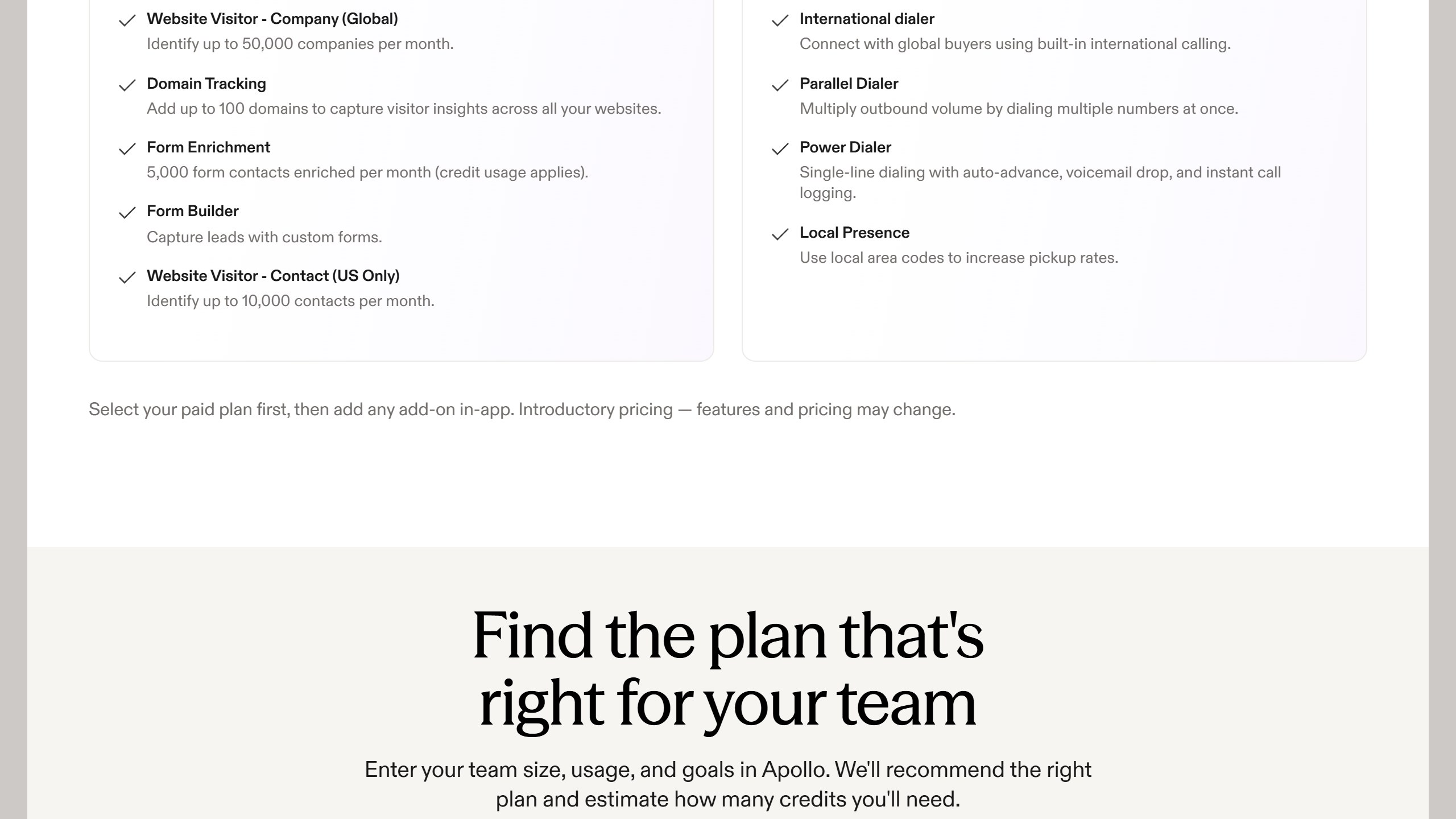
Apollo is the transparency benchmark here. Basic is $49 per seat per month billed annually and $65 billed monthly, Professional $79 and $99, Organization $119 and $149 with a three seat minimum, plus a genuine free tier. What matters more is that it publishes the allowance, 30,000 credits per seat per year on Basic, which almost nobody else does. Divide that by your real monthly reveal volume and you know whether the plan fits before you speak to anyone.
Lusha, from $37.45 a month, but the figure moves with the slider
Lusha publishes a free tier at $0 and paid plans at $37.45, $52.45 and $299.95 per month billed yearly. Read that with care: the figures are tied to a credit volume selector that defaulted to 40,800 credits a year when we read it, so the price you see is one position on a slider. Any article quoting a flat Lusha price has taken a position and presented it as the price. Always pair the figure with the credit volume it assumes.
Cognism, no figure, but it publishes the packaging
Cognism shows no price in any currency. It does publish that Standard and Pro both include five seats, which is a floor worth knowing before you ask about two, and that its credit model only spends again when a contact changes jobs. That second point is a real structural difference and it favours teams working a stable account list.
Seamless.AI, where we could not read a figure
We read seamless.ai/pricing twice on 4 September 2026 and could not extract a currency figure from its Free, Pro and Enterprise cards, even though the page itself states that “the prices shown on this page reflect this annual discount”. We are not going to claim it publishes nothing on that basis, because absence in a scrape is not absence in fact. Treat any Seamless figure you find elsewhere as unverified until the vendor confirms it.
ZoomInfo, the largest and the least forthcoming
ZoomInfo renders over 12,000 characters of pricing page with no currency figure anywhere on it. That is a deliberate commercial choice rather than an oversight, and it means your only leverage is a published alternative priced at your exact seat count. Walk in with Apollo costed for your team and you have a number in the room that both sides can check.
Clay, published, but on a credit slider
Clay publishes real figures that sit on a credit slider with a monthly and annual toggle marked “Save 10%”, so the number changes as you move the volume. Clay is also a different shape of product: it orchestrates other vendors’ data rather than owning a database, so its credits buy enrichment runs across providers. Compare it on cost per enriched record you actually use, not on headline price.
How credit pricing actually works, and the four questions that decide your bill
Credits are the reason two vendors quoting similar monthly figures can differ threefold in practice. Ask ZoomInfo and every competitor the same four questions in writing.
What spends a credit
Revealing an email, revealing a phone number, enriching an existing record and exporting a list are often priced differently, and a mobile number frequently costs several times an email. Ask for the table. A plan advertised as 1,000 credits can be 1,000 emails or roughly 200 phone numbers, and if your team works the phone that distinction is your whole budget.
Whether a credit is spent again on the same person
This is the question almost nobody asks and it is worth the most. Some vendors charge every time you touch a record; Cognism publishes that it only spends again when a contact changes jobs. On a stable account list worked repeatedly over a year, that single difference can halve consumption. Get the answer in the contract rather than from a rep.
Whether unused credits roll over, and what overage costs
Outbound is seasonal. If credits expire monthly you will pay for capacity you cannot use in a quiet month and run out in a busy one. Ask whether allowances roll over, whether they pool across seats, and above all what a credit costs once you exceed the plan, because the overage rate is where the margin sits and it is almost never on the pricing page.
What happens to revealed data when you leave
Ask whether contacts you already revealed remain usable after the contract ends, and in what form you can export them. Some agreements treat the data as licensed rather than purchased, which means the enrichment you spent a year paying for does not come with you. That single clause is often the largest hidden switching cost in this category, and it is entirely invisible until you try to go.
The test that settles it
Give each vendor the same list of 200 accounts from your real ICP and ask them to run it during the trial. Then count three things: how many contacts were found, how many emails bounced when you actually sent, and how many credits it consumed. Coverage claims are marketing; a bounce rate on your own list is evidence.
Running the evaluation so the quote means something
Normalise every quote before you compare
Ask each vendor, ZoomInfo included, for the same seat count, the same term, implementation quoted separately, every add-on itemised, and any usage meter stated with its included allowance and top-up rate. A blended annual figure is not comparable to anything and vendors know it.
Bring your own data to the demo
Vendor demos run on datasets chosen because the product handles them well. Ask to load your own: a messy account list, a call on a poor line, a technical conversation full of your product jargon. How a tool performs on your actual data is what decides whether reps adopt it, and it is invisible in a scripted walkthrough.
Test the thing people will do fifty times a day
Dashboards demo beautifully and get opened rarely. The feature that decides adoption is the one used constantly: finding a contact, building a list, locating a moment in a call. Time that specific task during the evaluation and count the clicks.
Agree the expansion price before you need it
Seat creep is the standard overrun in this category. Agree in writing what an additional seat costs, and whether the discount you negotiated applies to seats added mid-term. Discovering it does not is how a good first-year deal becomes an expensive second year.
Cap the renewal in the first contract
At renewal the vendor knows your usage, your dependency and your switching cost, and with no public rate card you have nothing to anchor against. A capped uplift stated as a percentage is worth more than a larger first-year discount, and it is only negotiable while you still have a choice.

Written by
FazFaz is the founder of AIToolsBakery. Some tools here are tested hands on. Others are assessed from vendor documentation and pricing verified on the live page, and every review says which one it is. Sponsors can buy a position in a guide. They cannot buy the score, the criticism, or silence about a better option.
How we test and how we make money →