Quick answer: Lusha is the best lightweight B2B data tool for SMB and prosumer prospecting in 2026. We compared it against documented capabilities, current pricing, and verified user reviews. Independent accuracy reports place its email accuracy below the big-database vendors, and the Chrome extension is the fastest in the category for one-off lookups. The catch: smaller database and lower accuracy than ZoomInfo or Cognism, making it better for individual reps than enterprise data operations.
At a glance:
- Score: 4.0/5
- Best for: Individual reps, SMB teams, and prosumers doing lightweight prospecting
- Starting price: Free tier, paid from $49/month
- Free trial: Generous free tier (5 credits/month)
- Killer feature: Fastest Chrome extension for one-off contact lookups
- Research current to: March 2026
What Lusha does well

Website: Lusha
The Chrome extension is the fastest in the category. Click a LinkedIn profile, hit the Lusha extension, and get the contact’s email and phone in under 2 seconds. For reps doing one-off prospecting inside LinkedIn, Lusha’s speed and simplicity beat the heavier interfaces of ZoomInfo and Cognism.
The freemium model is genuinely generous. The free tier (5 credits per month) is enough for solo founders and light prospectors to validate the tool and run small campaigns without paying. This low-friction entry is why Lusha has such broad adoption among individual reps.
The UI is clean and learnable in minutes. No enterprise onboarding, no sales process, no annual contract for the entry tiers. Sign up, install the extension, start prospecting. For SMB teams that want to avoid procurement overhead, this matters.
User reports describe direct-dial phone accuracy as middling: competitive with algorithm-only providers (below the rate Cognism advertises for its Diamond-verified numbers).
What Lusha falls short on
The database is smaller than ZoomInfo, Apollo, and Cognism. For serious enterprise prospecting where you need deep coverage of a large account universe, Lusha’s database runs out faster. It is built for breadth of individual lookups, not depth of bulk data operations.
Email accuracy, per independent user reports, trails ZoomInfo and Cognism EMEA. For high-volume cold email where bounce rates matter, the lower accuracy means more wasted sends and higher bounce risk. Fine for low-volume targeted outreach, weaker for scale.
The credit model gets expensive at scale. Lusha’s per-credit pricing is friendly for light usage but adds up fast for teams doing bulk enrichment. At high volume, Apollo’s flat pricing or Cognism’s enterprise plans are more cost-effective.
Bulk enrichment and list-building features are weaker than dedicated platforms. Lusha shines at one-off lookups; for building and enriching lists of thousands of accounts, Clay or Apollo are far better suited.
How we assessed Lusha
We have not run a controlled accuracy test of Lusha against other providers, so this page carries no hit-rate percentages. Contact-data accuracy varies so sharply by region, seniority and industry that a single headline percentage would be misleading even if we had measured one.
What is verifiable is the shape of the product: Lusha is built for quick individual lookups from a browser extension rather than for bulk list building, its free tier is genuinely usable for low volume, and its database is smaller than ZoomInfo, Apollo or Cognism by those vendors’ own published figures. If accuracy on your ICP is the deciding factor, run a 50-account trial on your own target list before signing anything.
Lusha pricing breakdown 2026
Free: 5 credits per month, Chrome extension, basic contact reveals. Genuinely usable for solo founders.
Pro (~$49/month per user): More credits, bulk reveals, basic CRM integration. The common starting paid tier for individual reps.
Premium (~$79/month per user): Higher credit allocation, advanced filters, team features.
Scale (custom): Bulk credits, API access, advanced integrations, dedicated support. For larger teams.
The credit model is friendly for light usage but scales in cost faster than flat-rate alternatives at high volume.
Lusha vs ZoomInfo vs Apollo vs Cognism
ZoomInfo is the enterprise heavyweight, far deeper database and higher accuracy, far higher cost. Lusha is the lightweight alternative for individuals and SMBs. ZoomInfo for enterprise data ops; Lusha for individual rep prospecting.
Apollo is the better value for teams that need a database plus sequencing. Apollo at $59-99/month covers more ground than Lusha for serious outbound. Lusha is better purely for fast one-off Chrome-extension lookups.
Cognism is the EMEA and phone-verification specialist with far higher accuracy and far higher cost. Lusha is lighter and cheaper but less accurate. Cognism for serious European outbound; Lusha for quick lightweight lookups.
Who should use Lusha
Individual sales reps doing targeted LinkedIn prospecting. SMB teams (1-5 people) running low-volume outbound. Solo founders validating outbound before investing in heavier tools. Recruiters and business development professionals who need fast one-off contact lookups. Anyone who values speed and simplicity over database depth.
Who should NOT use Lusha
Enterprise data operations needing deep database coverage (ZoomInfo or Cognism). High-volume cold email teams where accuracy and bounce rates matter (Cognism or ZoomInfo). Teams doing bulk list-building and enrichment (Clay or Apollo). European-focused teams needing GDPR-compliant verified data (Cognism). Teams that have outgrown per-credit pricing (Apollo flat rate).
Common Lusha setup mistakes
Using it for bulk enrichment. Lusha is built for one-off lookups. Bulk enrichment burns credits fast and underperforms Clay or Apollo. Use the right tool for bulk.
Not monitoring credit burn. The per-credit model can surprise teams. Track credit usage so you do not hit limits mid-month or overpay.
Relying on it for high-volume cold email. The 68% email accuracy means meaningful bounce risk at scale. For high-volume sending, verify Lusha data through a separate email verification tool first.
Skipping the free tier validation. The free tier is generous enough to validate fit before paying. Use it to test accuracy on your specific ICP before committing to a paid plan.
What every B2B data vendor charges, read from their own pages
Contact data is the one category where the sticker price tells you least, because the meter is credits and a credit does not mean the same thing at any two vendors. Here is each alternative to Lusha as published on 4 September 2026.
Apollo, from $49 a seat, and it publishes the allowance too
Apollo is the transparency benchmark here. Basic is $49 per seat per month billed annually and $65 billed monthly, Professional $79 and $99, Organization $119 and $149 with a three seat minimum, plus a genuine free tier. What matters more is that it publishes the allowance, 30,000 credits per seat per year on Basic, which almost nobody else does. Divide that by your real monthly reveal volume and you know whether the plan fits before you speak to anyone.
Lusha, from $37.45 a month, but the figure moves with the slider
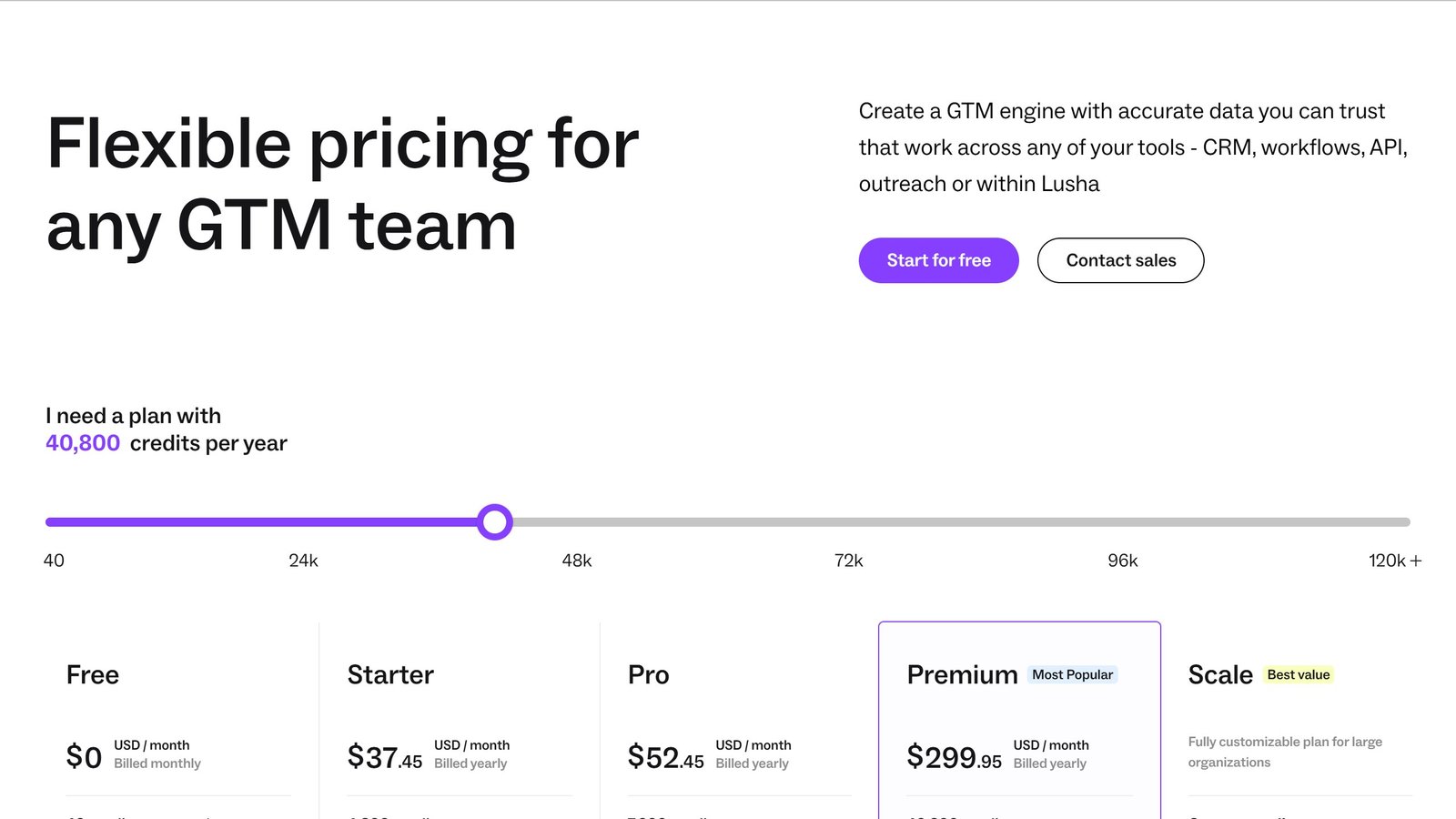
Lusha publishes a free tier at $0 and paid plans at $37.45, $52.45 and $299.95 per month billed yearly. Read that with care: the figures are tied to a credit volume selector that defaulted to 40,800 credits a year when we read it, so the price you see is one position on a slider. Any article quoting a flat Lusha price has taken a position and presented it as the price. Always pair the figure with the credit volume it assumes.
Cognism, no figure, but it publishes the packaging
Cognism shows no price in any currency. It does publish that Standard and Pro both include five seats, which is a floor worth knowing before you ask about two, and that its credit model only spends again when a contact changes jobs. That second point is a real structural difference and it favours teams working a stable account list.
Seamless.AI, where we could not read a figure
We read seamless.ai/pricing twice on 4 September 2026 and could not extract a currency figure from its Free, Pro and Enterprise cards, even though the page itself states that “the prices shown on this page reflect this annual discount”. We are not going to claim it publishes nothing on that basis, because absence in a scrape is not absence in fact. Treat any Seamless figure you find elsewhere as unverified until the vendor confirms it.
ZoomInfo, the largest and the least forthcoming
ZoomInfo renders over 12,000 characters of pricing page with no currency figure anywhere on it. That is a deliberate commercial choice rather than an oversight, and it means your only leverage is a published alternative priced at your exact seat count. Walk in with Apollo costed for your team and you have a number in the room that both sides can check.
Clay, published, but on a credit slider
Clay publishes real figures that sit on a credit slider with a monthly and annual toggle marked “Save 10%”, so the number changes as you move the volume. Clay is also a different shape of product: it orchestrates other vendors’ data rather than owning a database, so its credits buy enrichment runs across providers. Compare it on cost per enriched record you actually use, not on headline price.
How credit pricing actually works, and the four questions that decide your bill
Credits are the reason two vendors quoting similar monthly figures can differ threefold in practice. Ask Lusha and every competitor the same four questions in writing.
What spends a credit
Revealing an email, revealing a phone number, enriching an existing record and exporting a list are often priced differently, and a mobile number frequently costs several times an email. Ask for the table. A plan advertised as 1,000 credits can be 1,000 emails or roughly 200 phone numbers, and if your team works the phone that distinction is your whole budget.
Whether a credit is spent again on the same person
This is the question almost nobody asks and it is worth the most. Some vendors charge every time you touch a record; Cognism publishes that it only spends again when a contact changes jobs. On a stable account list worked repeatedly over a year, that single difference can halve consumption. Get the answer in the contract rather than from a rep.
Whether unused credits roll over, and what overage costs
Outbound is seasonal. If credits expire monthly you will pay for capacity you cannot use in a quiet month and run out in a busy one. Ask whether allowances roll over, whether they pool across seats, and above all what a credit costs once you exceed the plan, because the overage rate is where the margin sits and it is almost never on the pricing page.
What happens to revealed data when you leave
Ask whether contacts you already revealed remain usable after the contract ends, and in what form you can export them. Some agreements treat the data as licensed rather than purchased, which means the enrichment you spent a year paying for does not come with you. That single clause is often the largest hidden switching cost in this category, and it is entirely invisible until you try to go.
The test that settles it
Give each vendor the same list of 200 accounts from your real ICP and ask them to run it during the trial. Then count three things: how many contacts were found, how many emails bounced when you actually sent, and how many credits it consumed. Coverage claims are marketing; a bounce rate on your own list is evidence.
Where the figures on this page come from
Every price here was read from the vendor’s own pricing page on 4 September 2026, not from an aggregator. That distinction matters in this category, because several vendors changed or withdrew their published figures during the past year and a great deal of what circulates describes packaging that no longer exists.
The pages we read
Apollo publishes $49, $79 and $119 per seat per month on annual billing, plus the credit allowance. Lusha publishes $0, $37.45, $52.45 and $299.95 a month billed yearly, tied to a credit volume selector. lemlist publishes $55 and $87 per user per month annually. Reply.io publishes $29 and $69 per month per account. AiSDR publishes from $250 a month. Warmly publishes $10,000 to $30,000 a year. Lavender publishes free to $89 a seat.
The ones that publish nothing
ZoomInfo renders a long pricing page with no figure on it. Cognism and Gong publish packaging and models but no numbers. Outreach publishes packaging only, and note the domain moved from outreach.io. Salesloft’s pricing URL now redirects to a page titled “Talk to Sales”, so it has no pricing page at all. Artisan removed its figures during 2026.
What we do not do
We do not carry a figure we cannot source to the vendor. Where a number circulates and cannot be traced, we say so and withdraw it rather than repeating it with a hedge, and we have withdrawn our own published figures on that basis more than once. Every price here carries the date we read it, because in this market a claim without a date is not checkable.
undefined
The verdict for 2026
Lusha is the best lightweight B2B data tool for individual reps and SMB teams in 2026. The fastest Chrome extension and generous freemium make it the easiest data tool to start with. The smaller database and 68% email accuracy keep it from serious enterprise use. For one-off lookups and small campaigns, Lusha wins on speed and cost. For bulk depth and accuracy, graduate to Apollo, ZoomInfo, or Cognism.
See our Best AI Lead Enrichment Tools 2026 guide for the full category, and Clay vs Apollo for the enrichment-workflow comparison.
Lusha setup and when to upgrade
Lusha’s strength is low-friction lightweight prospecting. The setup is genuinely simple, but knowing when to upgrade (or migrate) matters for cost efficiency.
Day 1: Chrome extension and free tier. Install the extension, start with the free tier (5 credits per month). Validate accuracy on your specific ICP before paying. The free tier is generous enough for real validation.
Week 1: measure accuracy on your ICP. Run 20-30 lookups on your actual target accounts. Lusha’s 68% average email accuracy varies by industry and geography. If your ICP returns better-than-average accuracy, Lusha is a strong fit. If worse, consider alternatives.
Month 1: monitor credit burn. The per-credit model can surprise teams. Track usage against your plan allocation. If you are consistently hitting limits, either upgrade or evaluate flat-rate alternatives.
The upgrade decision. Lusha’s total cost of ownership flips around 1,000 lookups per month. Below that, Lusha is the cheapest option. Above that, Apollo’s flat pricing or Cognism’s enterprise plans become more cost-effective. Plan the migration before the per-credit costs balloon.
Lusha in the modern prospecting stack
Lusha occupies a specific niche in the 2026 prospecting landscape: the fast, lightweight, individual-rep tool. As enterprise data platforms (ZoomInfo, Cognism) and workflow tools (Clay, Apollo) have grown more powerful and complex, Lusha has doubled down on simplicity and speed.
This positioning is both its strength and its ceiling. For individual reps who need a contact email or phone number in 2 seconds without leaving LinkedIn, nothing beats Lusha’s friction-free experience. For teams building and enriching lists of thousands of accounts, Lusha is the wrong tool, Clay or Apollo handle bulk operations far better.
The smart pattern for growing teams: start with Lusha for individual prospecting and validation, then layer in Apollo or Clay for bulk operations as the motion scales. Lusha remains useful for one-off lookups even after a team adopts heavier tools. The mistake is trying to run a serious high-volume outbound operation on Lusha alone, the database depth and accuracy are not built for that scale.
Lusha bottom line: is it worth it in 2026?
Lusha earns a 4.0/5 as the best lightweight B2B data tool for individual reps and SMB teams. The fastest Chrome extension in the category and a genuinely generous freemium tier make it the easiest data tool to start with, no procurement, no annual contract, no learning curve. The 68% email accuracy is decent for targeted lightweight prospecting, though it trails ZoomInfo and Cognism for serious volume.
The honest buyer profile: individual reps, solo founders, recruiters, and small teams (1-5 people) doing targeted, low-volume prospecting where speed and simplicity matter more than database depth. For that profile, Lusha is the right call and often the cheapest option below 1,000 lookups per month. For bulk enrichment, high-volume cold email, or enterprise data operations, graduate to Clay, Apollo, ZoomInfo, or Cognism. The smart move for growing teams is to start with Lusha for individual prospecting, then layer in heavier tools as the motion scales, Lusha stays useful for one-off lookups even after you adopt a bulk platform.
Deciding between providers? Read our Cognism vs Lusha comparison, and our Seamless.AI review for another budget option.

Written by
FazFaz is the founder of AIToolsBakery. Some tools here are tested hands on. Others are assessed from vendor documentation and pricing verified on the live page, and every review says which one it is. Sponsors can buy a position in a guide. They cannot buy the score, the criticism, or silence about a better option.
How we test and how we make money →