Coohom and Planner 5D solve the same problem, turning a plan into a 3D design, but they aim at different users. One is a deep professional suite; the other is a friendly, affordable planner. The right pick depends on how serious and how frequent your design work is.
Faz says: This comparison is really about how much tool you need. Planner 5D is the one I would hand someone planning their own home or doing light client work: friendly, cheap, and it gets a photo of a floor plan into a 3D model fast. Coohom is the one for a designer who lives in this daily and wants depth, a serious product library, and cloud rendering, and is willing to climb a steeper learning curve to get it. Neither is wrong. They are aimed at different people.
Saru says: This comparison draws on both tools’ official documentation and pricing, our own reviews of each, and aggregated user ratings from G2 and Capterra, current to 2026. Confirm current pricing before subscribing.
The bottom line at a glance
| Coohom | Planner 5D | |
|---|---|---|
| Best at | Professional depth, cloud rendering | Friendly, affordable planning |
| Signature strength | Deep product library, 2D-to-3D | Floor-plan recognition, ease of use |
| Learning curve | Steeper | Gentle |
| Free option | Limited trial, no permanent free plan | Free tier available |
| Pricing | From ~$25/mo (annual) | From ~$10/mo |
| Our score | 4.0 | See review |
Short version: Coohom for professional depth and output. Planner 5D for ease, a free tier, and a lower price.
Depth vs ease
Coohom is the heavier tool. It transforms 2D drawings into 3D renders through an interactive interface, backed by a large furniture and product library and cloud rendering, covering more of the workflow than a simple planner. That depth comes with a steeper learning curve.

Planner 5D leads with approachability. Its AI floor-plan recognition can turn a photo of a plan into an interactive 3D model quickly, and the interface is friendly enough for non-professionals. It trades some of Coohom’s depth for a much gentler on-ramp.
Output and professional use
For a designer producing client-facing work daily, Coohom’s product library and cloud rendering give more professional output and scale. For a homeowner, a light-touch designer, or someone who values speed-to-first-result over maximum control, Planner 5D delivers a workable 3D design with far less effort.
Pricing
This is where Planner 5D pulls ahead for casual and budget-conscious users. It offers a free tier and paid plans from around $10/month. Coohom has no permanent free plan, only a limited, watermarked trial, with paid plans from around $25/month on annual billing. If cost or a genuine free option matters, Planner 5D wins; if you need the depth, Coohom justifies the higher price.
Who each is for
Choose Coohom if you design professionally and often, you want a deep product library and cloud rendering, and you will invest time to learn a more capable tool.
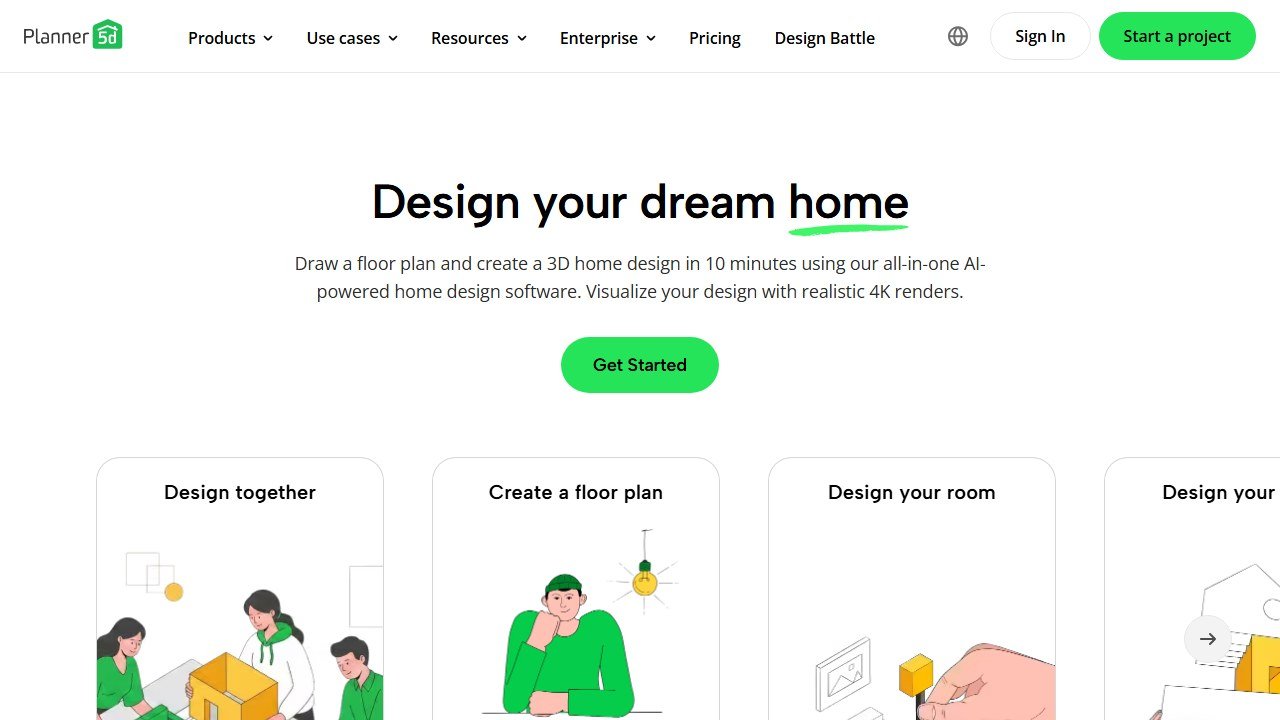
Choose Planner 5D if you want an affordable, friendly tool, you value a free tier, or you are planning your own space or doing lighter client work.
Both sit in the planning-and-layout stage of our AI tools for interior designers guide.
Our verdict
For professionals who want depth and will use it daily, Coohom is the stronger tool despite the price and learning curve. For everyone else, including homeowners and lighter users, Planner 5D is the better-value, friendlier choice with a real free tier. Read the full Coohom review and Planner 5D review for the detail.
The honest decision tree: 10 questions to know which fits you
The Coohom versus Planner 5D decision often comes down to one underlying question: are you a professional or a homeowner? Both tools occupy related but distinct categories. The 10 questions below resolve the decision.
1. Are you a working interior designer or architect, or a homeowner planning your own space? Professional = Coohom. Homeowner = Planner 5D.
2. Will your output be delivered to a client for design approval? Yes = Coohom. No, it is for your own use = Planner 5D.
3. Do you need dimensioned floor plans suitable for a contractor? Yes = Coohom. No = Planner 5D is sufficient.
4. Do you need access to actual furniture catalogs with accurate dimensions for sourcing? Yes = Coohom. No = Planner 5D works for generic furniture symbols.
5. How important is photorealism in your renders? High = Coohom (better real-time render quality). Moderate or hobby-level = Planner 5D is sufficient.
6. What is your willingness to spend? Coohom paid tiers run $30-60/month. Planner 5D is mostly free with paid feature unlocks. Budget-sensitive = Planner 5D.
7. How much time will you invest in learning the tool? Coohom requires 1-2 weeks to reach productive use; Planner 5D is usable within an hour.
8. Do you want AI-generated concept variations? Coohom has AI room-redesign features; Planner 5D is more manual.
9. Do you collaborate with other designers? Coohom supports multi-designer team workflows; Planner 5D is single-user focused.
10. Will you scale this tool across multiple projects per year? Yes (multiple projects) = Coohom’s investment pays back. No (one-off use) = Planner 5D’s simplicity wins.
The actual use case overlap and where each is the wrong tool
The tools genuinely overlap in the middle range of room-planning use cases. A homeowner planning a kitchen renovation could plausibly use either tool. An interior designer producing client renders could also plausibly use either. The decision becomes obvious at the edges, but the middle is where most users hesitate.
Coohom is the wrong tool when: you need a tool for less than 5 hours of total use; your output goes to no professional audience; you find professional-tool complexity demotivating; your budget is under $30/month for tooling. In these cases, Planner 5D delivers the result for less cost and effort.
Planner 5D is the wrong tool when: you need dimensioned outputs for contractors; your output requires presentation-quality photorealism; you are sourcing actual furniture from named brands; you have professional clients who expect a designer-grade deliverable. In these cases, Coohom (or another professional tool) is the better choice.
The honest middle ground: a homeowner with a complex renovation budget over $100,000 should consider hiring a designer who uses Coohom. The cost of professional design service is small relative to the construction budget, and the designer’s tool sophistication translates to better material decisions and contractor coordination. Planner 5D is the right DIY tool for smaller projects where the cost of a designer is hard to justify.
Pricing comparison: what each one actually costs over a project lifetime
Coohom pricing in 2026: free tier with watermark (not viable for client work), paid tier at $30-60/month depending on commitment, team tier for design firms. For a single-project homeowner using Coohom for a 3-month renovation planning phase, total cost is $90-180 for the planning period.
Planner 5D pricing: free tier with limited feature access, paid tier (called “VIP”) at approximately $50/year, lifetime license available at one-time payment around $200. For a homeowner planning a single renovation, the VIP annual tier covers the planning period and the renovation execution at $50 total cost.
For a homeowner who will plan one renovation in their lifetime, Planner 5D’s pricing is materially better: $50 versus $180. For a homeowner planning multiple renovations over years (a flipper, a serial renovator), the lifetime Planner 5D license becomes the right choice at $200.
For an interior designer, the math reverses. Coohom’s higher monthly cost spreads across multiple client projects per year and the productivity gains pay back the subscription many times over. The designer is comparing $360-720/year of Coohom subscription against many tens of thousands of dollars in client revenue.
The third option neither tool fully addresses
A category neither Coohom nor Planner 5D fully serves is the contractor’s workflow. Contractors need dimensioned plans and 3D models but typically receive them from the designer or architect rather than producing them. For contractors who want a self-service tool to communicate with clients about scope and options, neither tool fits cleanly: Coohom is overpowered (too much design depth), Planner 5D is underpowered (limited contractor-credible output).
The contractor’s actual best option in 2026 is to receive Coohom or Revit output from the designer, then communicate with the homeowner using simpler markup tools layered on top of those existing models. This is a workflow gap that the design-tool category has not directly addressed.
For homeowners working directly with a contractor (no designer in between), the practical workflow is to use Planner 5D for initial concept work, share the visual output with the contractor, and let the contractor produce the actual buildable specifications. The contractor’s specifications may be hand-drawn or built in their own tools; the visual concept from Planner 5D anchors the conversation.
Three scenarios that resolve the choice
Scenario 1: Working interior designer with paying clients
Pick Coohom. The professional features (dimensioned plans, accurate furniture catalogs, production-quality renders, multi-project workflow) match client-deliverable requirements. Annual cost $360-720 justified by client revenue.
Scenario 2: Homeowner planning a single renovation under $100K
Pick Planner 5D. The simplicity, low cost ($50 annual VIP or $200 lifetime), and short learning curve match the one-off use case. Coohom’s professional depth is overkill for a single homeowner project.
Scenario 3: Homeowner planning a major renovation over $100K
Hire an interior designer who uses Coohom. The renovation budget easily supports professional design service, and the designer’s tool expertise produces better material and contractor outcomes than DIY in either tool. The cost of design service is small relative to the project scope.
What we still cannot honestly assess
The comparison reflects general market positioning of both tools as of 2026. Your specific best choice depends on your role, project scope, and design ambition. Test the free tiers on both tools before committing; the comparison feels different when you actually use them on a real project versus reading about them.
Migration considerations between the two tools
For users who started with Planner 5D and want to upgrade to Coohom, or vice versa, the migration cost is workflow retraining rather than data migration. Project files do not transfer between the tools cleanly; you would rebuild the project in the new tool from scratch.
Realistic migration timeline from Planner 5D to Coohom: 1-2 weeks to reach Coohom’s basic productive use, with another 4-6 weeks to fully utilize the professional features (AI room redesign, advanced rendering, multi-project management). The investment is meaningful but the productivity gains for professional designers easily justify it.
The reverse migration (Coohom to Planner 5D) is unusual. Designers typically upgrade tools, not downgrade. The exception is a designer leaving professional practice for hobby use; in that case, the simpler Planner 5D may match the post-practice workflow better than the professional Coohom subscription.
When the honest answer is “use a different tool entirely”
For renovations or new construction with structural changes requiring architectural drawings, neither Coohom nor Planner 5D is the right tool. The architectural-grade tools (Revit, ArchiCAD) handle structural elements, MEP coordination, and building-code compliance that interior design tools do not address. For pure interior design without structural changes, Coohom or Planner 5D suffices; for projects with structural scope, hire an architect who works in Revit.
For commercial interior design over 5,000 square feet, Coohom’s capability strains at the edges. Specialized commercial-design tools (CET Designer for office furniture, Mood for hospitality, Vectorworks for theatrical) serve specific commercial niches better than Coohom’s generalist approach.
For purely conceptual exploration without geometric constraint, Midjourney with interior design prompts produces beautiful aesthetic concepts faster than building anything in Coohom or Planner 5D. The trade-off is that Midjourney does not produce buildable or dimensioned output; it is pure concept inspiration.
The honest 30-day evaluation: how to actually compare them
Both tools offer functional free tiers. Run a structured evaluation before committing to either subscription.
Week 1: Build one room (kitchen, living room, or bedroom) in Planner 5D using its free tier. Note the workflow steps, time required, and output quality. Save the project for comparison.
Week 2: Build the same room in Coohom using its free tier. Note the workflow differences, advanced features available, and output quality. Compare directly against Week 1.
Week 3: Push both tools to their limits. Try advanced features in each (lighting variations, material changes, AI room redesign in Coohom). See where each tool excels and where it falls short.
Week 4: Decision time. Based on the evaluation, identify which tool serves your actual use case. For most hobbyists, Planner 5D wins on simplicity. For most working designers, Coohom wins on professional capability. The 30-day evaluation gives you concrete grounding for the choice.
Budget allocation: what each tool typically costs in context
For a homeowner planning a single renovation: Planner 5D’s $50 annual VIP or $200 lifetime is a tiny fraction of a typical $50,000+ renovation budget. Don’t over-think this; if Planner 5D’s features match your needs, the cost is irrelevant to the renovation decision.
For an interior designer doing 10-15 residential projects per year: Coohom Pro at $360-720/year is well under 1 percent of typical professional revenue. The cost is operating expense; the productivity gain from a professional design tool typically delivers 10-20x ROI through faster project completion and better client outcomes.
For an interior design firm with multiple designers: Coohom’s team pricing scales reasonably. The per-designer cost stays under $1,000/year even at the higher tiers. Compare against the alternative cost of maintaining separate tools (SketchUp Pro + a rendering tool + AI concept tool) which often runs $2,000+ per designer per year combined.
The bottom line on Coohom versus Planner 5D in 2026
Pick Coohom if you are a working interior designer with paying clients. The professional features justify the cost; the productivity gain compounds across many projects per year.
Pick Planner 5D if you are a homeowner planning your own renovation or a hobbyist exploring design. The simplicity matches the use case; the cost is appropriate for one-off use.
If you are a homeowner with a renovation budget over $100,000, the genuine recommendation is to hire an interior designer rather than DIY in either tool. The cost of professional service is small relative to the project value, and the designer’s tool expertise produces better outcomes than DIY can match.
The category is mature enough that both tools deliver on their respective use cases reliably. The wrong pick happens when the role mismatch (a homeowner choosing Coohom or a working designer choosing Planner 5D) creates friction the user did not anticipate. Match the tool to your actual role and the decision becomes clear.
Final scorecard: Coohom vs Planner 5D in 2026
Coohom wins on commercial features, rendering quality, and team workflows. Planner 5D wins on ease of use, mobile experience, and price for hobbyists. A retail showroom designer or kitchen and bath professional should pick Coohom. A homeowner planning a renovation or a student learning the basics should pick Planner 5D.
The middle ground
Small interior design firms with one or two designers sit between the two. They can outgrow Planner 5D’s commercial limits within a year, but they may not need Coohom’s full feature set on day one. The honest answer for that buyer is to start with Planner 5D’s paid tier, then migrate to Coohom when client work demands photorealistic renders and team licensing.
Tools mentioned in this guide

Written by
FazFaz is the founder of AIToolsBakery. Some tools here are tested hands on. Others are assessed from vendor documentation and pricing verified on the live page, and every review says which one it is. Sponsors can buy a position in a guide. They cannot buy the score, the criticism, or silence about a better option.
How we test and how we make money →