Quick Answer: TrueCoach is a clean, coach-first platform built around messaging, workout delivery, and habit tracking. From $19/mo. Best for coaches who prioritise the client relationship over complex business automation. Main limitation: no Android app for clients, which rules it out for coaches with a mixed-device client base.
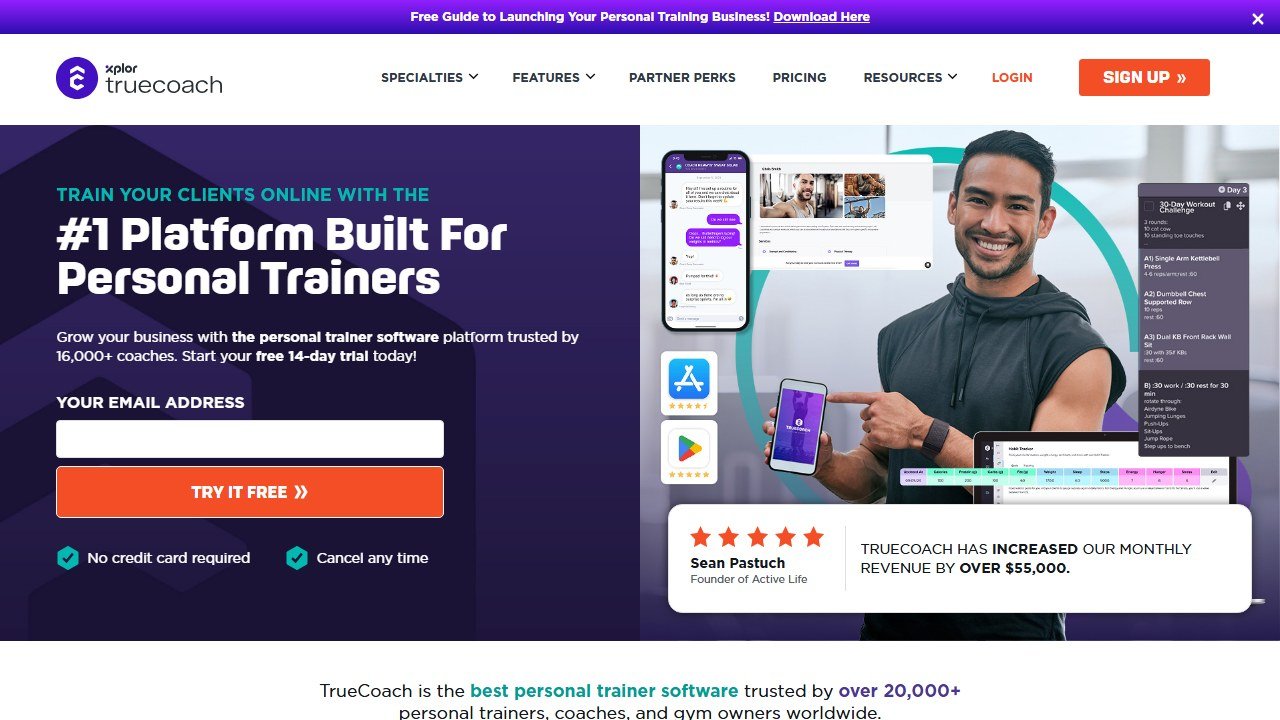
Website: TrueCoach
Last updated: April 22, 2026.
Related: See also: Best AI tools for personal trainers 2026 | TrueCoach vs Trainerize | TrueCoach vs Everfit
What TrueCoach actually is
TrueCoach was built around a specific philosophy: personal training software should be fast, focused, and not try to be everything. Where Trainerize added automation layers and FitBudd added branding tools, TrueCoach optimized the core loop. build a workout, deliver it to a client, track their progress. until it did that better than anyone else.
The product has since been acquired by Xplor Technologies and rebranded under the “xplor truecoach” name. The branding change hasn’t meaningfully altered the product as of 2026. the workflow, pricing structure, and feature set are the same. But worth noting if you see “Xplor” in the interface.
The result is a tool that strength coaches, S&C coaches, and performance coaches reach for when they want to get out of their software and spend more time coaching. The linear feed layout that shows training history alongside the current workout on one screen is genuinely clever. Keyboard shortcuts let power users build programs without touching a mouse. If you build five programs a day, these details matter.
Pricing
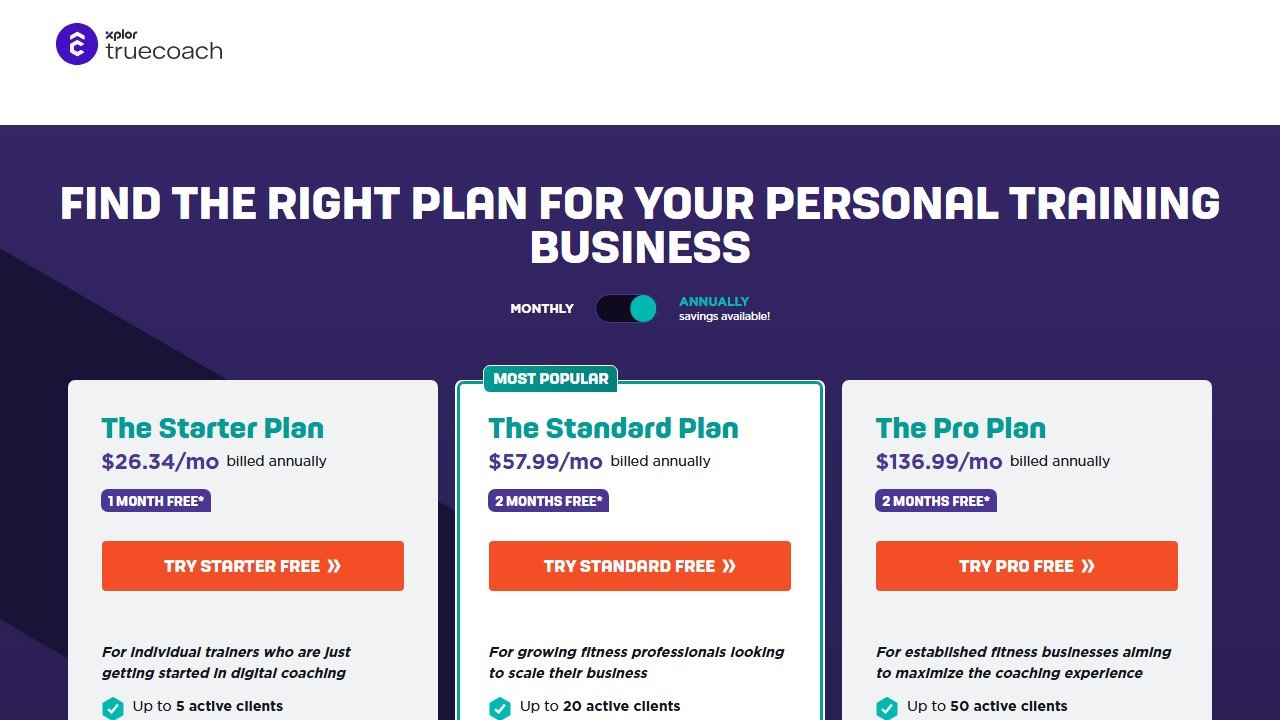
TrueCoach pricing is the most transparent in the category. No add-ons. No upsells. What’s listed is what you pay.
| Plan | Price | Clients |
|---|---|---|
| Starter | $20/mo | 5 |
| Standard | $53/mo | 20 |
| Pro | $107/mo | 50 |
| Enterprise | Custom | Unlimited |
Free trial: Available.
At 50 clients, $107/mo all-in compares very favorably to Trainerize’s $210+/mo at the same scale with nutrition and a branded app. It even undercuts Everfit’s real cost at scale once you add meal plans and automation.
The flip side: that $107/mo doesn’t include a branded client app (not available on any TrueCoach plan), doesn’t include advanced automation, and doesn’t include meaningful nutrition features. You’re paying $107 for the coaching delivery workflow and nothing else. For coaches who specifically need those other things, TrueCoach’s clean pricing starts to look like a clean set of missing features.
The Android problem
This needs to be its own section, not a bullet point in a list of cons.
TrueCoach’s client-facing app is iOS only. There is no Android client app.
Globally, Android holds approximately 72% market share. In the UK, it’s around 52%. In India, it’s over 90%. In Latin America, it’s over 80%.
If you coach clients in any market outside the United States, or if you coach a demographic that skews toward Android devices (which is most demographics), TrueCoach disqualifies itself for a significant portion of your client base. Clients can access workouts through a mobile browser, but the experience is not equivalent to a native app.
Every TrueCoach review mentions this. Most mention it once, in a bullet point, without explaining the stakes. The stakes are: if 40% of your current clients are on Android, TrueCoach will deliver a second-rate experience to 40% of your clients. That’s not a minor limitation.
Before you buy TrueCoach, check the last 10 clients you signed. What devices are they on? If more than one in three is Android, go look at Everfit first.
What TrueCoach does genuinely well
The workout builder is the fastest in the category. The linear feed layout shows a client’s training history alongside their current program. Keyboard shortcuts let you build a program entirely without leaving your keyboard. For coaches who build many programs, this is a real productivity advantage. Everfit’s drag-and-drop is cleaner for individual sessions but TrueCoach is faster for volume.
Pricing is honest. $20, $53, $107, and that’s it. No nutrition add-on, no automation tier, no branded app upsell. What you see is what you pay. After navigating Trainerize’s add-on structure, TrueCoach’s pricing is refreshing.
The interface is genuinely intuitive. New coaches can be onboarded in under an hour. Client onboarding is fast. The learning curve is the flattest of any platform in the category.
3,000+ exercise library with video demonstrations. Larger than most competitors. The videos vary in quality. some are well-coached, some are functional but basic. but the volume means you’ll rarely need to upload your own.
Excellent for strength and performance coaches. The focus on workout delivery without lifestyle coaching features makes it well-matched for S&C coaches, sports performance coaches, and strength specialists who don’t offer nutrition or habit work as part of their program.
What frustrates users
No Android client app. as covered above. This is not a minor friction point. It is a dealbreaker for a significant portion of potential customers.
No branded app on any plan. Clients download the TrueCoach app (or “xplor truecoach” app) with TrueCoach’s branding. For coaches building a personal brand, this means every client interaction reinforces TrueCoach’s brand, not yours. PT Distinction includes a custom branded app from $59.90/mo.
Nutrition features are minimal. MyFitnessPal integration shows macros in client profiles. There’s no meal planning, no food logging, no nutrition programming. For coaches who include nutrition as part of their offer, TrueCoach requires a separate tool.
Coach mobile app is weak. Building and editing programs requires desktop access. The mobile coach experience is functional but not designed for programming on the go.
Exercise library videos have uneven quality. Many coaches end up uploading their own videos regardless of how large the library is, because the demonstrations don’t reflect how they want their clients to move.
Who should use TrueCoach
It’s the right call if:
- Your clients are iOS-dominant (confirm this before buying)
- You’re a strength, S&C, or performance coach whose offer is workout delivery, not lifestyle coaching
- You want the fastest, cleanest workout builder without feature bloat
- You value pricing transparency and hate add-on surprises
- You don’t need a branded app. you’re fine with TrueCoach’s branding on the client side
It’s the wrong call if:
- More than 20-30% of your clients use Android
- You need a branded client app for your business brand
- Nutrition coaching is a significant part of your offer
- You need automation workflows for onboarding and re-engagement
- You coach outside the US, UK, Canada, or Australia (Android market share is much higher elsewhere)
TrueCoach vs the alternatives
| TrueCoach | Everfit | PT Distinction | Trainerize | |
|---|---|---|---|---|
| Price (50 clients) | $107/mo (all-in) | ~$134+/mo | $89.90/mo (all-in) | ~$210+/mo |
| Android client app | No | Yes | Yes | Yes |
| Branded client app | No | No | Yes (from Pro) | Extra ($45/mo) |
| Workout builder | Fastest, cleanest | Best features | Most customizable | Feature-rich |
| Nutrition | Basic MFP sync | Add-on ($33/mo) | Included | Add-on ($45/mo) |
| Automation | Basic | Moderate | Strong | Best in category |
| Learning curve | Lowest | Low | High | Medium |
| Free plan | Trial only | 5 clients free | 3 clients free | 1 client free |
Final verdict
TrueCoach is the cleanest, fastest personal trainer software for 1-on-1 workout delivery. The pricing is the most transparent in the category. The workout builder is the best for speed. The learning curve is the flattest.
The Android issue is the ceiling. It’s not a flaw in the software. it’s a product decision to not support Android that disqualifies TrueCoach for a significant percentage of coaches based on their client demographics. Check your client device breakdown before buying. If you’re iOS-heavy, TrueCoach is excellent. If you’re not, look at Everfit first.
Related personal trainer & fitness AI guides
Other tools and comparisons we have reviewed in this category:
- best AI tools for personal trainers. category overview
- TrueCoach vs Trainerize. side-by-side comparison
- TrueCoach vs Everfit. value comparison at every client scale
References & further reading
For deeper context on programming, periodization, and training science behind the tools we evaluate:
- NSCA: peer-reviewed strength and conditioning research. evidence-backed programming principles from the National Strength and Conditioning Association
- ACSM physical activity guidelines. official exercise prescription standards from the American College of Sports Medicine
- PubMed sports science database. searchable archive of peer-reviewed studies on resistance training, hypertrophy, and recovery
More AI fitness and training guides
More from our AI fitness coverage:
- Best AI Running Coach Apps in 2026.
- Best AI Meal Plan Generators for Fitness Goals in 2026.
- Trainerize Pricing 2026: plans, Costs, and Hidden Fees Explained.
- Best AI Personal Trainer Apps for Beginners in 2026.
More AI tool guides worth reading: Best AI Kettlebell Workout Apps, Best AI Hydration Tracker Apps for Athletes and Best AI Climbing and Bouldering Training Apps.
Client retention, and the small number of things that actually move it
Coaching businesses live and die on retention rather than acquisition, and this is where software genuinely helps, though not in the way the feature lists suggest.
The check-in is the product
Clients renew because they feel seen, and the single highest leverage feature in any of these platforms is whatever makes a consistent, personal check-in easy to deliver at scale. Everything else is secondary. When evaluating, time how long it takes you to review a week of one client’s data and send something meaningful back, then multiply by your roster. That number is your real capacity.
Automation helps until it is noticed
Automated messaging is the standard feature here and it works right up to the moment a client realises the encouraging note arrives every Monday regardless of what they did. Use automation for logistics, reminders and structure. Keep anything that reads as personal actually personal, because the cost of being caught is the relationship rather than the message.
Watch the first six weeks
Most coaching churn happens early, before habit forms and before results arrive. If your platform gives you an activity view, the one report worth opening weekly is the list of clients who have not logged anything in seven days, filtered to those in their first six weeks. Acting on that list is worth more than any feature comparison.
Measure retention before you change anything
Take your current three month and twelve month retention rates from your own records before switching platforms, because you cannot reconstruct them afterwards and every vendor conversation will otherwise be about features. If retention does not move within two full client cycles, the platform was not the constraint.
How to tell whether the tool was worth it
Fitness software is easy to evaluate honestly because the numbers are countable and small. The reason most coaches cannot say whether a platform helped is that nobody wrote down where they started.
Pick the metric the tool is supposed to move
For a coaching platform it is clients per coach and hours spent on programming and admin per client per week. For a consumer app it is sessions completed per week and adherence over eight weeks. For form checking it is whether you are still filming in month three. Each of those is countable and each needs a figure from before.
Record the time cost this month, before anything changes
Ask yourself or your coaches to log how long programming, check-ins and admin take across one normal week. It takes minutes and it is the only way the time saving is ever provable. Most of the honest value in this category is hours rather than revenue, and hours are measurable in advance and unprovable afterwards.
Give it two client cycles
Retention and adherence move slowly and seasonally. A four week read tells you about novelty rather than value. Judge a coaching platform over at least two full client cycles, and say so at the outset so an unremarkable first month is understood as expected.
Name the result that would end it
Write down before you subscribe what twelve months would have to look like for you not to renew. It converts renewal from a default into a decision, which matters more in a category where the monthly figure is small enough to stop noticing.
Where the figures on this page come from
Every price here was read from the vendor’s own pricing page on 4 September 2026 and carries that date, because pricing in this category moves and a claim without a date is not checkable.
The pages we read
PT Distinction publishes $19.90, $59.90 and $89.90 a month with its marginal per client rates. Everfit publishes a rung for every client count from $19 to $290 monthly. TrueCoach publishes $26.34, $57.99 and $136.99 a month billed annually. My PT Hub publishes $25 and $59. FitBudd publishes $15, $79 and $149 with per client add-ons. Trainerize publishes a free tier and plans from $9. JuggernautAI publishes $34.99 a month or $349.99 a year.
The ones we could not read
Fitbod, Dr. Muscle, Hevy, Whoop and Oura did not yield a figure to the same method that read every vendor above, largely because consumer subscriptions are sold inside the app stores rather than on the web. That is not evidence they publish nothing, and we do not present it as such. Check the store listing on your own device, in your own country, before relying on any figure for those five.
One page worth reading twice
Wodify displayed $199 struck through and $99 a month per location, conditional on booking a demo by 31 August. We read it on 4 September 2026, after that deadline, and the discounted price was still shown. Ask which figure actually applies before budgeting on it.
Tools mentioned in this guide

Written by
FazFaz is the founder of AIToolsBakery. Some tools here are tested hands on. Others are assessed from vendor documentation and pricing verified on the live page, and every review says which one it is. Sponsors can buy a position in a guide. They cannot buy the score, the criticism, or silence about a better option.
How we test and how we make money →