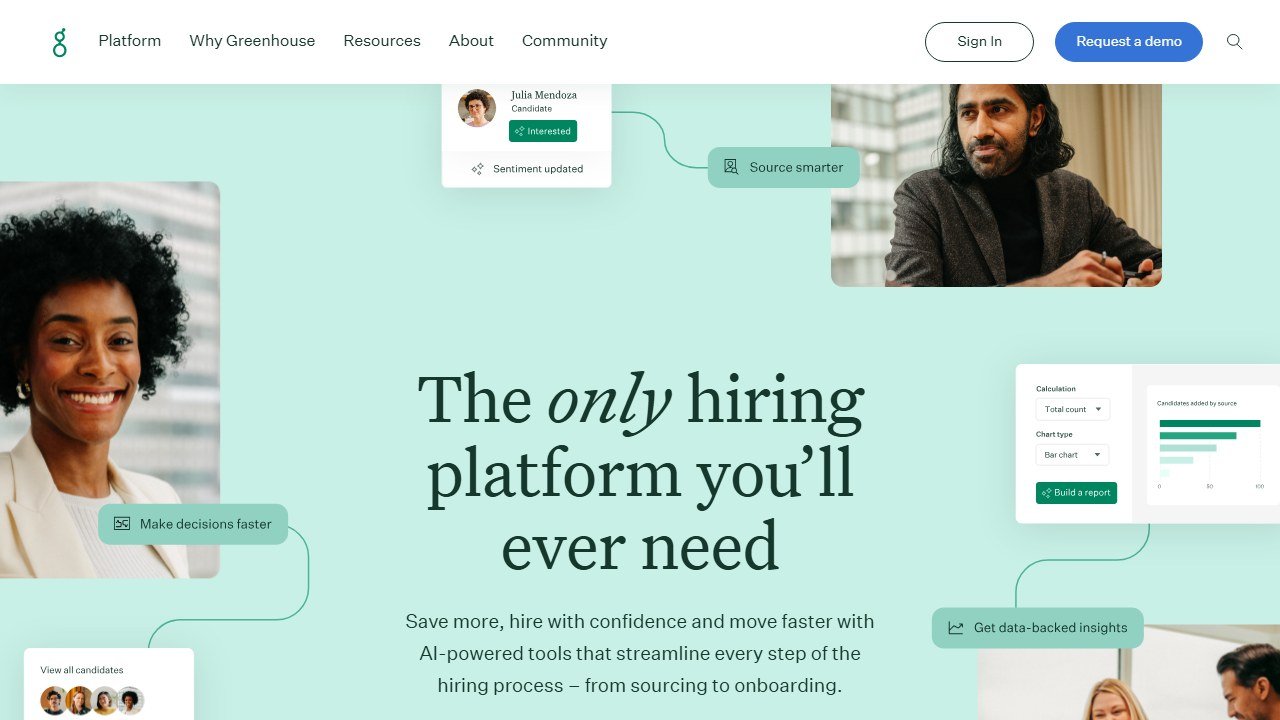
Greenhouse is what happens when an applicant tracking system is designed around a hiring philosophy rather than a feature list. Its entire model is structured hiring: you define what a great hire looks like before you post the role, then every interviewer measures candidates against the same plan. That discipline is why Greenhouse sits at the top of our applicant tracking system roundup, and why so many high-growth and enterprise teams standardize on it. After testing it against the field, here is the honest breakdown of what it does well, where it costs you, and who it actually fits.
Greenhouse is not the cheapest or the lightest ATS, and it does not pretend to be. It asks for setup effort and ongoing admin discipline, and in return it gives you a hiring process that is consistent, auditable, and hard to game. For the right team that trade is a bargain. For a five-person startup filling one role a quarter, it is likely overkill. This review sorts out which camp you are in.
Greenhouse is a structured-hiring applicant tracking system built around interview plans, scorecards, and focus areas that keep every interviewer measuring the same things. It offers 500-plus integrations, strong EEO, OFCCP, and compliance tooling, and AI that now assists sourcing, matching, and automation. Pricing is quote-based and per employee. Best for mid-market and enterprise teams that want auditable hiring at scale.
Faz says: The reason Greenhouse earns its price is that it forces good hiring habits instead of just tracking bad ones. You build an interview plan with defined focus areas, each interviewer owns a scorecard for their piece, and hiring decisions come from evidence rather than the loudest voice in the debrief. That structure is what reduces bias, speeds up decisions, and gives you a real audit trail. Most ATS tools store your process. Greenhouse actually improves it, which is why it is the one I recommend to teams that hire seriously and at volume.
Saru says: This review draws on Greenhouse’s official documentation, published feature set, stated integration counts, and aggregated customer feedback, current to 2026. Greenhouse pricing is quote-based and priced per employee, so it is not published as a fixed number. Always request a current quote and confirm what your headcount and module choices actually cost before you commit, since pricing and tiers change.
Quick Facts
| Tool | Greenhouse |
|---|---|
| Category | Applicant tracking system (structured hiring) |
| Best for | Mid-market and enterprise teams |
| Standout | Structured hiring with interview plans and scorecards |
| Integrations | 500-plus in the partner ecosystem |
| Compliance | Strong EEO, OFCCP, and audit tooling |
| AI | Assists sourcing, matching, and automation |
| Pricing | Quote-based, priced per employee (as of 2026) |
| Our score | 4.5 / 5 |
What Greenhouse Does Well
Structured hiring is the whole point. This is the headline feature and the reason to choose Greenhouse over a lighter tool. You define an interview plan for each role, break it into focus areas so no two interviewers cover the same ground twice, and give every interviewer a scorecard tied to the attributes that matter. Candidates get evaluated on the same criteria, feedback is submitted before people compare notes, and decisions come from evidence instead of gut feel. It is the closest thing the ATS market has to a built-in hiring methodology, and it measurably reduces the ad hoc bias that creeps into unstructured interviews.
A genuinely deep integration ecosystem. Greenhouse connects to more than 500 tools across sourcing, assessments, background checks, HRIS, scheduling, and analytics. That matters because an ATS sits at the center of your hiring stack, and the value comes from how cleanly it passes data to everything around it. Whether you run assessments, a sourcing platform, or a downstream HRIS, the odds are high that Greenhouse already talks to it, which keeps your process from turning into manual copy-paste between systems.
Compliance that holds up under scrutiny. Greenhouse takes EEO, OFCCP, and general hiring compliance seriously, with tooling for consistent data capture, reporting, and audit trails. For regulated employers, federal contractors, and any company that needs to defend its hiring decisions, that structured record is not a nice-to-have, it is the reason the platform is on the shortlist. The same discipline that improves hiring quality also produces the documentation compliance teams want.
AI that assists rather than replaces. Greenhouse has layered AI into the workflow to help with sourcing, candidate matching, and automating repetitive coordination work. The framing is the right one: the AI accelerates the busywork and surfaces candidates, while the structured-hiring bones keep humans making the actual evaluation. It speeds up the top of the funnel without handing judgment to a black box.
Pricing
Greenhouse pricing is quote-based and priced per employee, so there is no single published sticker figure to quote, and any specific number you see floating around should be treated as a rough starting point rather than a promise. As of 2026, expect the model to scale with your company headcount and the modules you turn on, which means cost rises as you grow and as you add capability. Larger organizations and teams that want the more advanced hiring, reporting, and enterprise features will land at the higher end.
Because it is a sales-led quote, the only reliable way to know your number is to request one for your specific headcount and module needs. Budget for it as an investment in hiring infrastructure rather than a cheap monthly SaaS line item, and confirm exactly which features are included at your tier before you sign.
Where It Fits
Greenhouse fits mid-market and enterprise teams that hire with enough volume and seriousness to benefit from structure. A scaling company running dozens of roles across multiple teams gets consistency, faster decisions, and a defensible process. A regulated or federal-contractor employer gets the compliance and audit trail it needs. A talent team that lives inside a larger stack gets the integrations to keep everything connected.
Where it fits less well is the small end. A tiny team filling the occasional role will feel the setup weight and the per-employee pricing without using enough of the platform to justify either. If that is you, a lighter, cheaper ATS will serve you better until your hiring volume grows into what Greenhouse is built for.
Pros and Cons
Pros
- Structured hiring with interview plans, scorecards, and focus areas that reduce bias
- 500-plus integrations across the hiring stack
- Strong EEO, OFCCP, and compliance tooling with real audit trails
- AI that assists sourcing, matching, and automation without replacing judgment
- Scales cleanly from mid-market to enterprise
- The de facto standard for teams that hire seriously at volume
Cons
- Heavier setup than lightweight ATS tools
- Ongoing admin time to maintain scorecards and interview plans
- Per-employee pricing escalates as headcount grows
- Quote-based pricing means no transparent published rate
- Overkill for very small teams with low hiring volume
How It Compares
Greenhouse leads our best applicant tracking systems roundup because its structured-hiring model does something most ATS tools do not: it improves the process rather than just recording it. Its closest rival is Lever, which combines an ATS with a built-in CRM for a more sourcing-and-relationship-driven flavor of the same job. We break the two down side by side in our Greenhouse vs Lever comparison and cover Lever on its own in our Lever review. If you want the wider recruiting picture, including the AI sourcing and screening layers that plug into an ATS like this one, see our best AI recruiting software guide.
Verdict
Greenhouse is the best applicant tracking system for structured hiring in 2026 and earns a 4.5 out of 5. It does the one thing most ATS tools cannot: it improves how you hire, not just how you track applicants. Interview plans, focus areas, and scorecards keep every interviewer measuring the same things, which cuts bias, speeds decisions, and leaves a compliance-grade audit trail. Add 500-plus integrations and AI that assists sourcing and matching, and you get hiring infrastructure that scales from mid-market to enterprise.
The honest caveats are real: setup is heavier than a lightweight tool, it takes ongoing admin discipline to keep scorecards and plans sharp, and per-employee pricing escalates as you grow. It is genuinely overkill for a tiny team. Because pricing is quote-based, request a current number for your headcount before you commit. For teams that hire at volume and want to do it well, Greenhouse is the standard for a reason. See how it stacks up against the field in our best applicant tracking systems guide, and against its closest rival in our Greenhouse vs Lever comparison.

Written by
FazFaz is the founder of AIToolsBakery. Some tools here are tested hands on. Others are assessed from vendor documentation and pricing verified on the live page, and every review says which one it is. Sponsors can buy a position in a guide. They cannot buy the score, the criticism, or silence about a better option.
How we test and how we make money →