Most applicant tracking systems assume the candidate comes to you. Lever was built on the opposite bet: that the people you most want to hire are already employed, not applying, and have to be found and courted long before a job opens. LeverTRM, the company’s flagship, fuses a traditional ATS with a candidate-relationship-management (CRM) layer so recruiters can build pipelines of passive talent and nurture them over time. After testing it against the field, it is one of our top picks for teams whose hiring lives or dies on outbound sourcing. Here is the honest breakdown of what it does well, where it costs, and who it fits.
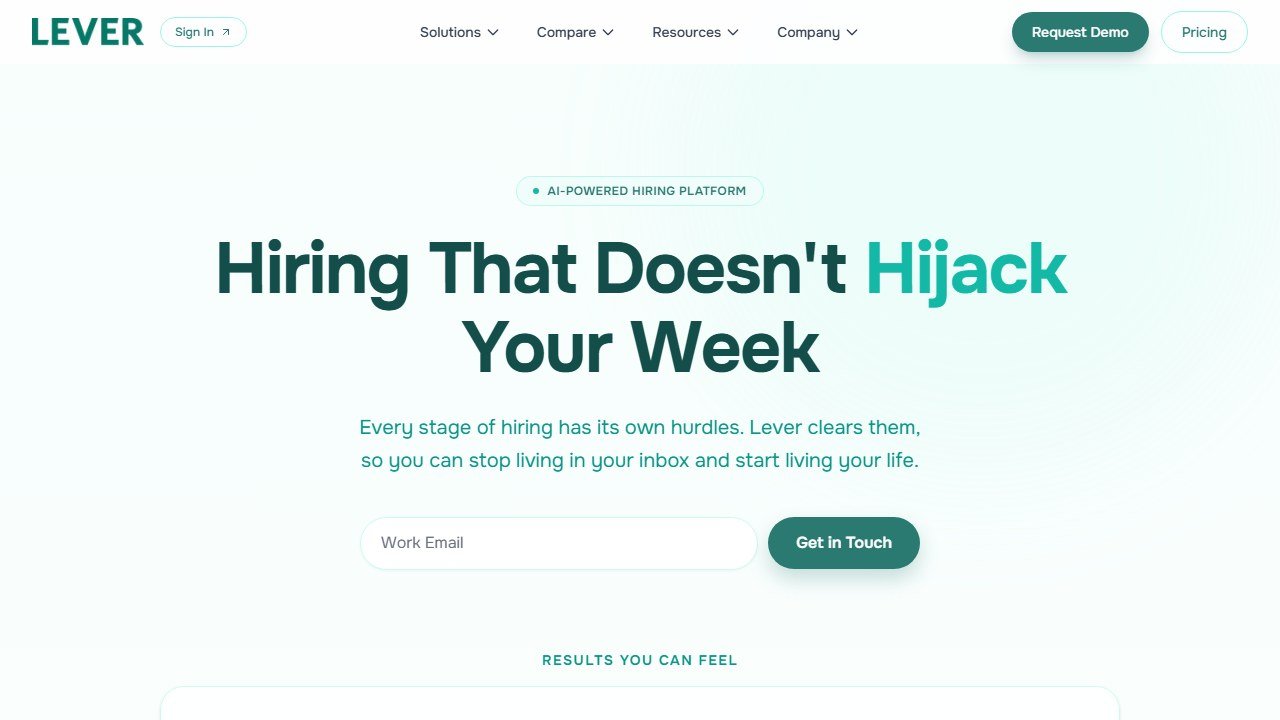
Lever is a talent-acquisition suite whose LeverTRM product merges an applicant tracking system with a candidate CRM, so teams can source and nurture passive candidates before a role exists. It scores highly on usability, has a modern visual pipeline, and integrates email well. Pricing is quote-based and per employee. Best for growth-stage teams that hire through proactive sourcing.
Faz says: The reason to pick Lever over a pure ATS is the CRM half of LeverTRM. If your best hires are passive candidates you have to chase for months, you need a place to build those relationships, tag them, and nurture them before a requisition is even open. Lever treats sourcing as a first-class workflow instead of an afterthought bolted onto an applicant tracker, and the visual pipeline makes it easy for a whole team to see where every candidate stands. For sourcing-led teams, that is the whole ballgame.
Saru says: This review draws on Lever’s official documentation, its stated positioning, and aggregated customer feedback, current to 2026. Lever does not publish list pricing. It is quote-based and generally scales per employee, so costs rise as you grow. Get a written quote and confirm what is included before you commit, since plans and add-ons change.
Quick Facts
| Tool | Lever (LeverTRM) |
|---|---|
| Category | Applicant tracking + candidate CRM |
| Best for | Growth-stage, sourcing-led teams |
| Standout | ATS and CRM merged in one product |
| Usability | Consistently strong scores, modern UI |
| Solid two-way email integration | |
| Pricing | Quote-based, per employee (as of 2026) |
| Our score | 4.3 / 5 |
What Lever Does Well
ATS and CRM in one product. This is the headline. Most tools make you choose between an applicant tracker (for people who apply) and a sourcing CRM (for people you go find). LeverTRM combines both, so a candidate you sourced cold two quarters ago and an applicant who came through your careers page live in the same system, on the same pipeline. You stop stitching together a spreadsheet of “people to reach out to” alongside your real ATS.
Nurture before a role exists. Because the CRM layer is native, you can build talent pools and nurture passive candidates before there is a requisition to attach them to. When a role does open, you are not starting cold. You are reaching into a warm pipeline you have been cultivating. For teams where the best hires never respond to a job post, this changes the math on time-to-fill.
Modern, visual pipeline. Lever is genuinely pleasant to use, and it scores well on third-party usability rankings for a reason. The candidate pipeline is visual and drag-friendly, so a hiring manager can glance at a role and understand exactly where every candidate sits. That clarity drives adoption, and an ATS the team actually keeps updated is worth far more than a powerful one nobody maintains.
Good email integration. Two-way email sync means outreach, replies, and follow-ups stay logged against the candidate record instead of getting lost in individual inboxes. For a sourcing motion built on personalized, sustained outreach, having that history in one place is not a nice-to-have. It is the difference between a coordinated team effort and a pile of forgotten threads.
Pricing
Lever does not publish list pricing. It is quote-based and generally priced per employee, so your cost scales with the size of your organization rather than a flat per-seat or per-recruiter fee. As of 2026, expect a custom quote based on headcount, the modules you need, and any add-ons.
That per-employee model has two consequences worth planning for. First, budgeting requires a sales conversation. You cannot self-serve a price off the website. Second, as your company grows, the bill grows with it, sometimes faster than you expect, so factor in escalation when you compare total cost of ownership against flat-rate competitors. Heavier compliance or analytics needs may also require add-ons that lift the quote.
Where It Fits
Lever fits growth-stage companies whose hiring depends on proactive sourcing. If you are a scaling startup or a mid-market team competing for talent that is already employed, the CRM half of LeverTRM is exactly the tool you are missing, and the strong usability means your recruiters and hiring managers will actually adopt it.
It is a weaker fit if your hiring is mostly inbound and high-volume, where a pure ATS may cost less and do the job, or if you are a large enterprise with heavy structured-interviewing and compliance demands, where a more process-rigid competitor like Greenhouse may serve you better. It can also be more than a very small team needs if you are not running a real outbound sourcing motion yet.
Pros and Cons
Pros
- ATS and CRM merged in one product (LeverTRM)
- Nurture passive candidates before a role opens
- Strong, consistent usability scores
- Modern, visual, drag-friendly pipeline
- Solid two-way email integration
- Built for sourcing-led hiring, not retrofitted for it
Cons
- Structured-interviewing, scorecard, and OFCCP tooling less mature than Greenhouse
- Quote-based pricing means no transparent list price
- Per-employee model escalates as headcount grows
- Heavy compliance or analytics needs may require add-ons
- More tool than a small, purely inbound team needs
How It Compares
Lever’s closest rival is Greenhouse, and the two split along a clear line. Greenhouse is the more process-rigid, structured-hiring platform, with deeper scorecards, interview-kit discipline, and compliance tooling such as OFCCP support. Lever leans into relationships and sourcing, with its native CRM and friendlier interface. If your priority is a repeatable, auditable, structured-interview process, Greenhouse tends to win. If your priority is building and nurturing pipelines of passive candidates, Lever tends to win. We break down that decision in detail in our Greenhouse vs Lever comparison, and cover Greenhouse on its own in our Greenhouse review. To see where both sit against the broader field, start with our best applicant tracking systems guide, and if sourcing is your bottleneck, our best AI sourcing tools roundup pairs well with Lever’s CRM.
Verdict
Lever earns a 4.3 out of 5. LeverTRM does something most applicant trackers do not: it treats sourcing and relationship-building as first-class workflows by merging an ATS with a native candidate CRM, so you can nurture passive candidates before a role even opens. Add strong usability, a modern visual pipeline, and solid email integration, and you get a tool that recruiters and hiring managers actually adopt.
The honest caveats are that its structured-interviewing, scorecard, and OFCCP compliance tooling is less mature than Greenhouse’s, and that quote-based, per-employee pricing means both an opaque list price and a bill that climbs as you scale. For growth-stage teams whose hiring depends on proactive sourcing, though, Lever is one of the strongest choices available, and you can start your outreach directly at Lever. Compare it head-to-head in our Greenhouse vs Lever breakdown, and see the full field in our best applicant tracking systems guide.

Written by
FazFaz is the founder of AIToolsBakery. Some tools here are tested hands on. Others are assessed from vendor documentation and pricing verified on the live page, and every review says which one it is. Sponsors can buy a position in a guide. They cannot buy the score, the criticism, or silence about a better option.
How we test and how we make money →