Harvey is the most talked-about generative AI in the legal industry, and for good reason: it is genuinely capable, deeply funded, and built for the demands of large law firms and in-house legal teams. If you have read about legal AI at all, you have read about Harvey. The honest caveat to lead with is this: Harvey is enterprise-only. There is no self-serve plan, no public price list, and no way for a solo attorney to sign up with a credit card. This review covers what it actually does, why the pricing is invisible, and whether smaller firms can realistically use it.
Harvey is an enterprise generative-AI platform for legal and professional-services work, covering research, drafting, document analysis, and agentic workflows. It is sold through enterprise sales with custom pricing and no self-serve option. It fits large law firms, in-house legal teams, and professional-services firms that can commit to a full deployment. Solos and small firms are effectively priced out.
Faz says: Harvey is genuinely one of the strongest legal AI platforms out there, so this is not a knock on the product. But for 99% of solos and small firms, the real answer is simple: you cannot buy it yet, and cheaper tools do the same core jobs. Harvey is sold firm-wide through a sales team, not by the seat to individuals, and the contracts are built for hundreds of lawyers. If you are a two-person practice, do not spend a week trying to get a demo. Use an accessible tool now, and revisit Harvey if you ever grow into a firm that a sales rep will actually call back.
Saru says: This review draws on Harvey’s official platform documentation, its public funding announcements, and reported customer and capability figures, current to 2026. Harvey’s capabilities, models, and access model change fast, and it does not publish pricing, so treat any dollar figure you see elsewhere as unverified. Confirm current features, deployment terms, and availability directly with Harvey before making any decision.
Quick Facts
| Tool | Harvey |
|---|---|
| Category | Enterprise generative AI for legal and professional services |
| Best for | Large law firms, in-house legal teams, professional-services firms |
| Core jobs | Research, drafting, summarization, document review and analysis, agentic workflows |
| Underlying models | Frontier LLMs via an OpenAI partnership, plus other models routed by task |
| Pricing | Enterprise, custom only. No public self-serve, as of 2026 |
| Our score | 4.3 / 5 |
What Harvey Actually Does
Harvey is a horizontal AI platform built for legal and professional-services work, not a single-purpose tool. At its core it handles the tasks that eat associate and in-house hours: legal research, first-draft generation, summarization, and document review. You can ask it a research question and get a reasoned answer, hand it a contract and get an analysis, or point it at a matter and have it draft. The pitch is a single assistant that spans the workflow rather than a bolt-on for one narrow job.
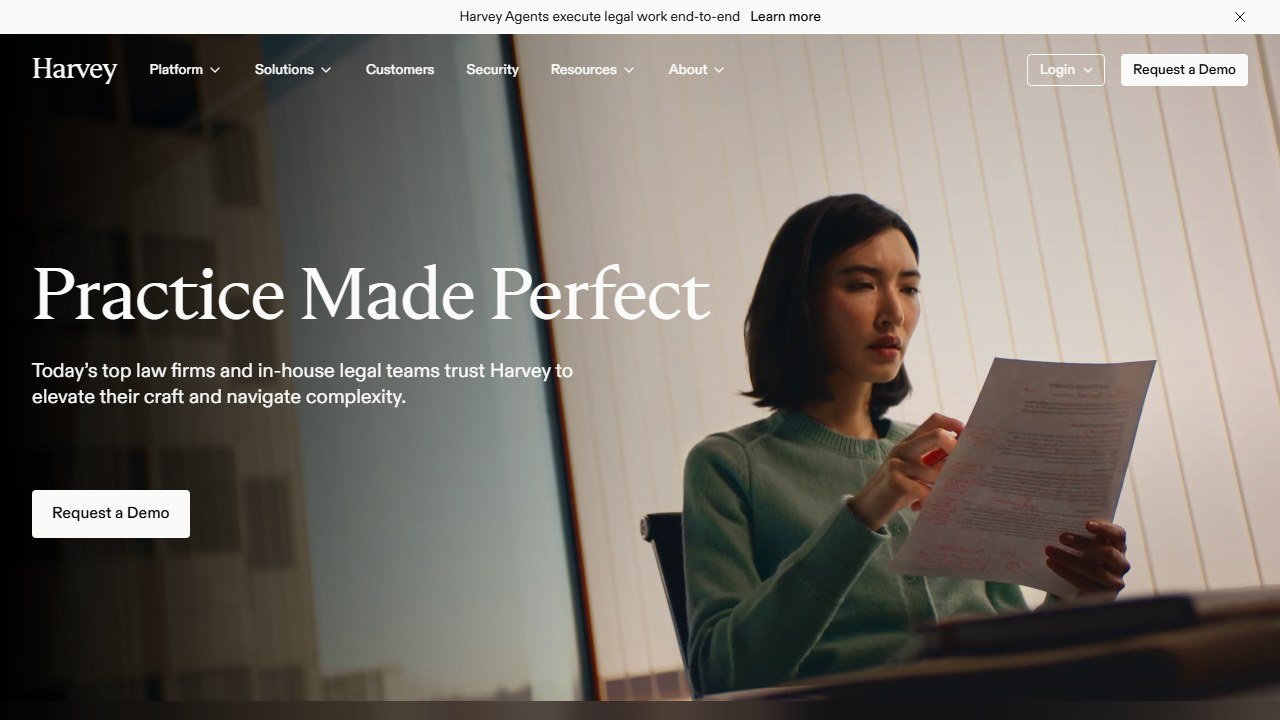
The most distinctive piece is Vault, Harvey’s engine for large document sets. Vault lets you run a query across thousands of documents at once and get structured, cross-document answers. A single project can hold up to around 10,000 documents, and Vault can return per-file tabular answers, consolidated answers to one question across the whole set, or deeper cited reports. This is aimed squarely at due diligence, discovery, and any situation where a team would otherwise read a data room by hand. Vault is the feature that most clearly separates Harvey from a general chatbot.
On top of research, drafting, and Vault, Harvey has pushed into workflows and agents: one-click and multi-step processes, built by its team of former practitioners, that carry out common document tasks with less manual prompting. The direction is clear, moving from an assistant you prompt toward agents that execute defined legal work end to end.
Under the hood, Harvey is model-agnostic. It was an early OpenAI partner and built custom, legally tuned models with OpenAI, and it also routes to other frontier models depending on the task. You are not locked to one model provider, which matters for a platform betting on staying at the capability frontier.
Why There Is No Public Pricing
Search for “Harvey pricing” and you will not find a plan page, and that is by design. Harvey runs an enterprise sales motion. Deployments are sold firm-wide through a sales team, scoped to your organization, and priced per contract rather than off a public rate card. Reporting suggests accounts commonly start with a few hundred seats, which tells you the shape of the buyer: this is a firm-level purchase, not a personal subscription.
For a buyer, the enterprise model cuts both ways. On the plus side, an enterprise deployment brings the things large firms require: security review, defined data-handling and confidentiality terms, integration into document-management systems, onboarding, and support. Client-confidential legal data cannot go into a consumer tool, and Harvey’s model is built to clear procurement and security teams. On the downside, there is no way to try it cheaply, no transparent price to compare, and a real sales-and-procurement cycle before you can use it. If you want a number today, you will not get one, and anyone quoting you a firm public price for Harvey is guessing.
We pieced together what firms actually pay in our Harvey AI pricing guide, built from reported contract figures and deployment sizes, so you have a ballpark before the sales conversation.
Who Actually Uses Harvey
Harvey’s customer base is large law firms, in-house legal departments, and professional-services organizations. It rose to prominence through early adoption at major international law firms, and it has since expanded across a large share of the biggest firms and into corporate legal teams and adjacent professional-services work. Reported figures put its reach at a large portion of the top US firms and tens of thousands of lawyers across many countries, though exact counts move quickly, so treat specifics as directional.
The through-line is scale. Harvey is designed for organizations with many lawyers, real security and procurement requirements, and the budget to deploy a platform firm-wide. That is the profile it fits, and it fits it well.
Can Solo and Small Firms Use It?
Honestly: mostly no, at least not today. Harvey is not sold to individuals or tiny practices. There is no self-serve signup, the contracts are built for firm-wide deployments, and the sales motion is oriented toward organizations that will license hundreds of seats. A solo or small firm can request a demo, but should not expect an accessible plan on the other side.
The good news is that you do not need Harvey to get real value from legal AI. Accessible tools cover research, drafting, and document analysis at prices a small firm can actually pay, and several sign up online today. Start with our roundup of the best AI legal research tools, and look at CoCounsel, which is available to a much wider range of firms and grounded in a major legal database. For most solos and small firms, one of those is the right answer now, and Harvey is a “someday, if we scale” option, not a today one.
For most small firms the realistic comparison is not Harvey versus nothing, it is Harvey versus Spellbook. Our Spellbook vs Harvey comparison runs that matchup in full.
Pros and Cons
Pros
- Genuinely strong, broad capability across research, drafting, and document review
- Vault handles large document sets (up to around 10,000 per project) with structured cross-document answers
- Moving fast into agentic, multi-step legal workflows
- Model-agnostic, built to stay at the frontier via an OpenAI partnership and other models
- Enterprise-grade security, data handling, and integrations for firm-wide deployment
- Deep adoption across large firms signals real-world reliability at scale
Cons
- Enterprise-only: no self-serve, no way to buy online
- No public pricing, so no easy comparison or low-cost trial
- Effectively inaccessible to solos and small firms
- Requires a real sales and procurement cycle before use
- Overkill for anyone whose need is a single narrow task
- As a frontier AI tool, outputs still require lawyer verification
How It Compares
The clearest way to place Harvey is against the two research-grounded assistants small and midsize firms actually compare it to. CoCounsel, from Thomson Reuters, and Lexis+ AI, from LexisNexis, are legal AI assistants tied directly to established legal research databases. Their strength is that answers are grounded in a specific, authoritative legal corpus, and, just as importantly, they are available to a far wider range of firms.
Harvey is a different kind of product: a horizontal, frontier-AI platform that spans research, drafting, document analysis, and workflows across professional-services work, rather than an assistant bolted onto one legal database. That breadth and its Vault document engine are its edge. The trade-off is access and price: CoCounsel and Lexis+ AI you can realistically buy as a smaller firm, while Harvey you generally cannot. We put the accessible options side by side in our best AI legal research tools guide, which is the better starting point for most buyers.
The other name in every Harvey evaluation is CoCounsel. Our Harvey vs CoCounsel comparison puts the two enterprise heavyweights side by side on research, drafting, and cost.
Verdict
Harvey earns a 4.3 out of 5. Judged on capability for the market it is built for, it is one of the best legal AI platforms available: broad, fast-improving, strong on large-document work through Vault, and backed by the security and integrations a large firm needs. That score reflects what it delivers for large firms and in-house teams that can actually deploy it.
The points off are for accessibility, not quality. Harvey is enterprise-only, publishes no pricing, and is effectively out of reach for the solos and small firms who make up most of the legal profession. If that is you, do not spend energy trying to buy Harvey. Start with the accessible options in our best AI tools for lawyers pillar, and revisit Harvey only if your firm grows into its target market.

Written by
FazFaz is the founder of AIToolsBakery. Some tools here are tested hands on. Others are assessed from vendor documentation and pricing verified on the live page, and every review says which one it is. Sponsors can buy a position in a guide. They cannot buy the score, the criticism, or silence about a better option.
How we test and how we make money →