Harvey AI is the most talked about legal AI platform on the market and the least transparent about what it costs. There is no price page, no rate card, and no self-serve checkout. If you are budgeting for a sales call, everything you can find online is a reported number from third parties, and the sources disagree with each other.
This page is the budgeting math, nothing else. We collect the reported figures, label every single one, show where the sources conflict, and run three total-cost scenarios so you can walk into the demo with a realistic range. For what Harvey actually does and whether it is any good, read our full Harvey AI review first. This page assumes you already want it and need to know if you can afford it.
Every reported Harvey AI price, in one table
One thing before the table: none of these numbers come from Harvey. We verified harvey.ai on July 15, 2026 and the site offers a Request a Demo button and ROI calculators, nothing more. Every dollar figure below is third-party reported, and we name the source and its confidence level so you can weigh it yourself.
| Line item | Reported figure | Official or reported | Source type |
|---|---|---|---|
| Base seat price | ~$1,200/seat/month | Reported, unofficial | Third-party blogs (eesel.ai, bindlegal.com), Reddit threads |
| Seat price with LexisNexis bundle | ~$2,400/seat/month | Reported, unofficial | Third-party blogs |
| Smaller-firm tier | ~$399/seat/month | Reported, unofficial | Third-party blogs |
| Mid-market range (50 to 200 attorneys) | ~$1,000 to $2,000/seat/month | Reported, unofficial | aivortex.io, costbench.com |
| AmLaw 100 at 200+ seats | ~$100 to $300/seat/month | Reported, unofficial | aivortex.io, costbench.com |
| Seat minimum | 20 to 25+ seats (sources conflict) | Reported, unofficial | Multiple third-party sources |
| Contract term | 12 months minimum | Reported, unofficial | Third-party blogs |
| Median contract value | ~$175,000/year | Reported, unofficial | Third-party estimate |
| Typical contract band | $50,000 to $200,000/year | Reported, unofficial | costbench.com |
| Official published price | None exists | Official (verified 2026-07-15) | harvey.ai |
Notice the only official row is the one that says there is no official price. That is the honest state of Harvey pricing in 2026.
Does Harvey publish pricing? No, and here is what the site actually offers
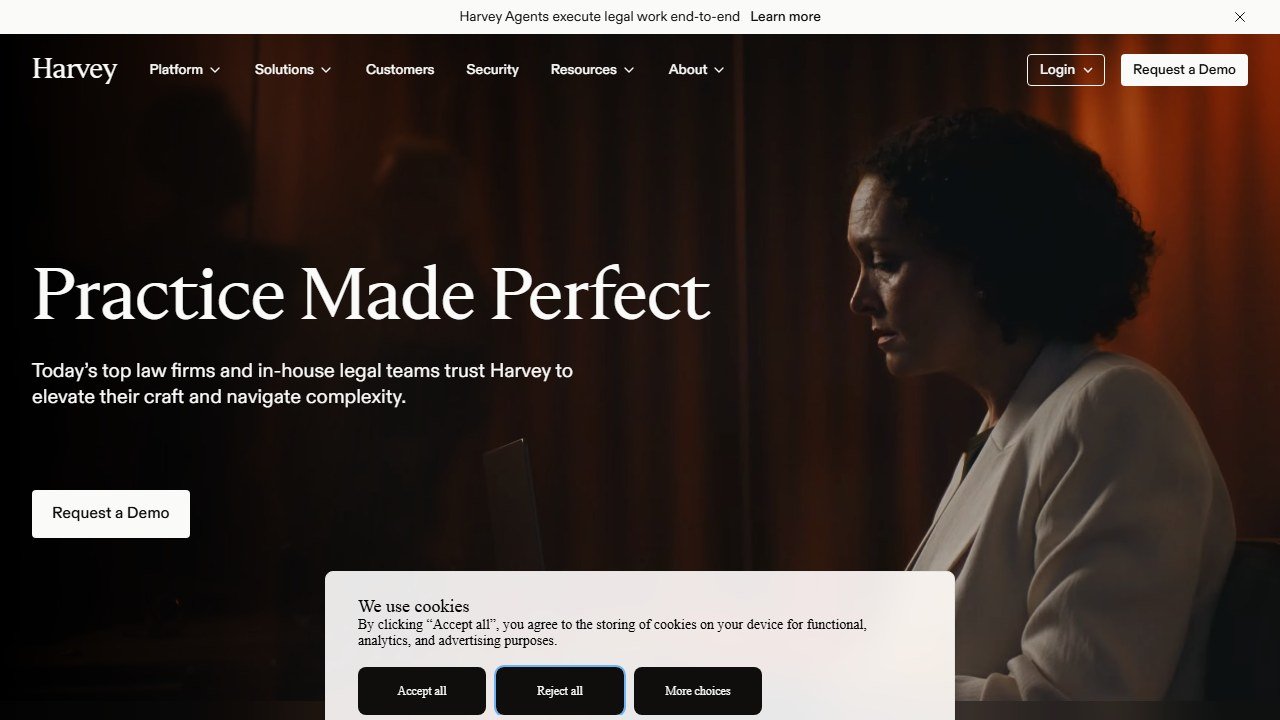
Harvey sells a suite of enterprise legal AI modules: Assistant, Vault, Knowledge, Agents, Contract Intelligence, Command Center, Shared Spaces, Harvey Mobile, and Ecosystem integrations. You may see older articles referencing a “Workflows” module; that is no longer a current module name, so do not budget against a tier list built around it.
What you will not find on harvey.ai is a number. The pricing journey is: fill out the demo form, talk to sales, receive a custom quote based on your seat count, module selection, and term. The site does offer ROI calculators, which tell you something about how Harvey wants the conversation framed: value delivered, not sticker price.
The company can afford to negotiate from strength. Harvey raised a $200 million growth round at an $11 billion valuation co-led by GIC and Sequoia, announced March 25, 2026, up from an $8 billion valuation in December 2025, with roughly $1.2 billion raised in total. Harvey also claims its users run 700,000+ tasks daily. That is a vendor-claimed figure, but the funding numbers are public and verified, and they explain why Harvey feels no pressure to publish a rate card.
The seat minimum is the real price
The reported per-seat number gets the headlines, but the minimum commitment is what actually prices firms out. Third-party sources report a 20 seat minimum on a 12 month contract; others say 25 or more. The sources conflict, so we state the range rather than picking a side: expect a floor of 20 to 25+ seats, and confirm it on your own quote.
Run the math on the low end of that range. Twenty seats at the reported ~$1,200 per seat per month is $24,000 a month, or roughly $288,000 a year before onboarding, training, or any LexisNexis content bundle. That reported figure is the entry floor for the standard product. The reported ~$399 smaller-firm tier would change this math dramatically, but it is the least corroborated number in the whole table, so do not build a budget on it without getting it in writing.
For context on how differently the main rival handles this, Thomson Reuters runs a self-serve CoCounsel configurator for firms up to 10 attorneys. Harvey has no equivalent. If you cannot clear the seat minimum, the conversation ends before it starts, and that single fact routes most small and mid-size firms toward other tools.
Three TCO scenarios: boutique, mid-market, AmLaw
Here is what the reported numbers produce as annual total cost of ownership at three firm sizes. Every input is a reported figure, so treat the outputs as planning ranges, not quotes. We use first-year license cost only; implementation time, prompt training, and any research-content bundles come on top.
| Scenario | Seats | Reported per-seat/month | Estimated annual license cost | What drives the number |
|---|---|---|---|---|
| Boutique at the minimum | 20 | ~$1,200 (reported base) | ~$288,000/year | The reported 20 seat minimum on a 12 month term. This is the entry floor; a 25 seat minimum pushes it to ~$360,000. |
| Mid-market firm | 100 | ~$1,000 to $2,000 (reported range) | ~$1.2M to $2.4M/year | Reported mid-market band for 50 to 200 attorney firms. Module mix and LexisNexis bundling (reported ~$2,400/seat) set where you land in the band. |
| AmLaw discount curve | 250 | ~$100 to $300 (reported at 200+ seats) | ~$300,000 to $900,000/year | Reported volume discounting. A 250 seat AmLaw deal can reportedly cost about the same as a 20 seat boutique deal, per seat prices collapse at scale. |
The striking thing in this table is the shape, not any single number. Harvey pricing reportedly behaves like a steep discount curve, not a tier list. A boutique pays a reported ~$1,200 per seat while an AmLaw firm reportedly pays a tenth of that. If those reports are even directionally right, small buyers subsidize the logos on Harvey’s customer page, which is worth knowing before you negotiate.
Reported total contract values back up the wide spread: one source puts the median contract around $175,000 a year, while costbench frames $50,000 to $200,000 a year as typical. Those two claims do not fully agree with each other, or with the mid-market math above. That is the nature of unofficial data; we print the conflict rather than smoothing it over.
Hidden costs the reported numbers do not include
The reported seat price is the license line, not the budget. Based on how enterprise legal AI deployments typically run, plan for these on top of whatever number lands on your quote:
- Onboarding and workflow setup. Harvey’s value case rests on firm-specific agents and Vault projects built around your matters. Someone senior has to spend real hours configuring that, and on a 20 seat deal those internal hours are a meaningful percentage of the contract.
- Training and adoption time. A platform this broad has a learning curve. Budget partner and associate time for training sessions, and expect utilization to ramp over a quarter rather than a week. Empty seats at a reported ~$1,200 a month are the most expensive line item nobody forecasts.
- Research content. The reported ~$2,400 per seat LexisNexis-bundled figure is double the reported base. If your research contracts live elsewhere, that is money you may be paying twice.
- Security and procurement review. Enterprise AI deals routinely spend weeks in infosec and outside-counsel-guideline review. Not a Harvey-specific cost, but it delays time to value on a contract that reportedly starts billing from signature.
None of these appear in any reported figure we found, which is one more reason the third-party numbers floating around understate what year one actually costs.
Negotiation levers that reportedly move the number
Since everything is negotiated, the levers matter more than the list price. Based on the reported deal structures, these are the ones to pull:
- Seat count staging. Ask to start at the contractual minimum with pre-agreed pricing for expansion seats, rather than buying for headcount you hope to onboard. The reported discount curve means expansion seats should cost less, not the same.
- Term length. The reported baseline is a 12 month commitment. Multi-year terms are the classic enterprise discount trigger; if you are confident after a pilot, trading term for rate is the cleanest lever.
- Module scope. Assistant, Vault, Knowledge, Agents, and Contract Intelligence are separately scoped modules. Quoting fewer modules is a real lever; you can add later once usage proves out.
- The content bundle. The reported jump from ~$1,200 to ~$2,400 per seat with LexisNexis content is the single biggest swing in the table. If your firm already pays for research content elsewhere, keep it out of the Harvey deal.
- Benchmark quotes. Walking in with a CoCounsel configurator quote (visible down to ~$104 to $639 per user per month depending on configuration, per third-party checks) gives you a written comparison point Harvey’s team has to price against.
When a cheaper path makes more sense
Harvey is built for large firms and large in-house teams running research, diligence, and multi-document analysis at scale. If the reported ~$288,000 floor made you flinch, that is a signal the product is not aimed at you, and there are credible routes at every budget below it.
- CoCounsel. The closest like-for-like alternative, with a self-serve configurator for firms up to 10 attorneys and configuration-dependent pricing you can actually see before a sales call. Our CoCounsel pricing breakdown covers the tiers and the Westlaw dependency math, and our Harvey vs CoCounsel comparison covers which platform fits which firm.
- Spellbook. If the job is contract drafting and review in Word rather than a full research platform, Spellbook has a 7 day self-serve trial and reported per-seat pricing far below Harvey’s. See our Spellbook pricing analysis and the Spellbook vs Harvey head-to-head for the ICP split.
- Paxton. For solo and small-firm research and drafting, Paxton publishes a real price, $499 per user per month, no sales call required. Our small law firm AI roundup ranks it alongside other tools with published pricing.
The pattern across all three: the further you get from BigLaw, the more likely a tool exists that publishes its price and sells to you directly. Harvey’s quote-only model is a feature for enterprise procurement and a wall for everyone else.
Verdict: budget the range, verify everything
Harvey AI pricing in 2026 comes down to four reported facts and one official one. Reported: roughly $1,200 per seat per month at the base, a 20 to 25+ seat minimum on 12 month terms, a mid-market band of $1,000 to $2,000 per seat, and an AmLaw discount curve that reportedly falls to $100 to $300 per seat at 200+ seats. Official: Harvey publishes none of this, so every figure needs verification on your own quote.
Practical guidance: if you are under 20 attorneys, start with the alternatives above rather than the demo form. If you are mid-market, budget the wide band and negotiate module scope hard. If you are AmLaw scale, the reported discount curve is your leverage; make the sales team earn the volume. And whatever size you are, read our Harvey AI review before the call, because the pricing conversation goes better when you already know exactly which modules you would actually use.

Written by
FazFaz is the founder of AIToolsBakery. Some tools here are tested hands on. Others are assessed from vendor documentation and pricing verified on the live page, and every review says which one it is. Sponsors can buy a position in a guide. They cannot buy the score, the criticism, or silence about a better option.
How we test and how we make money →